日本語版

6-n-propylthiouracil

compound / compound-prop

プロピルチオウラシル(PROP)

6-n-propylthiouracil is a thiourea-class antithyroid drug used as a standard probe in psychophysical studies of PTC/PROP taster status. An agonist of the TAS2R38 bitter taste receptor.

Photographs (captions in Japanese)
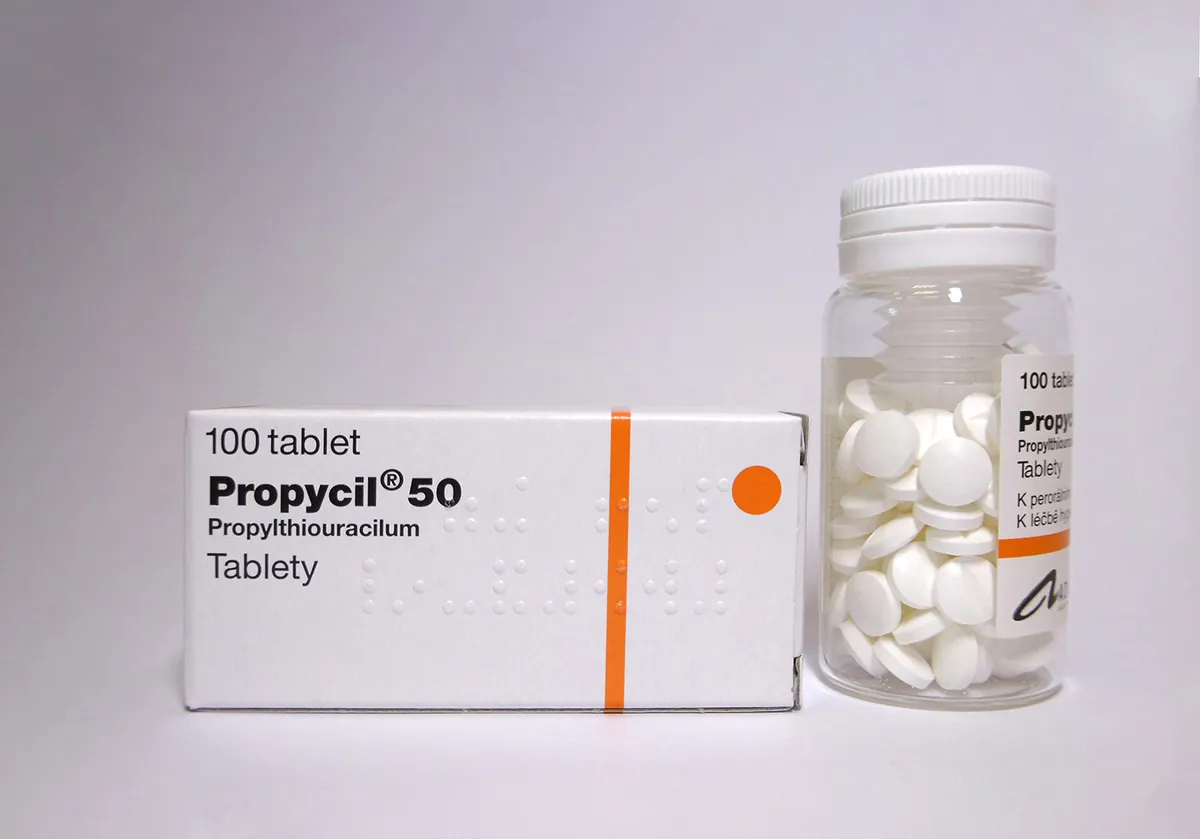
白い錠剤がシート・容器とともに写っている写真

プロピルチオウラシル製剤 Propycil(50mg錠)の写真。6-n-プロピルチオウラシル(PROP)は精神物理学で味覚テイスター状態の標準プローブとして用いられる。

写っているもの: 該当なし(生物ではなく医薬品)部位・状態: 錠剤(製剤名 Propycil、50mg)

写真: Tomino de WS/ CC BY-SA 4.0/ 原画像/ 台帳の原画像

写真の範囲と来歴

被写体の確認: 原典の記載による同定。製剤名がファイルページで特定されている実在の医薬品写真。

掲載画像: Wikimedia Commons の原寸ファイル。苦味研究所では切り抜き・色調変更なし。 表示用には幅1200px上限のWebPを配信し、台帳の原画像は上のリンクから確認できます。

On this page (6 sections)
  1. Overview
  2. Sources for this overview (5)
  3. Topic hubs
  4. Follow the connections
  5. Related entries (10)
  6. Sensory (4)
↑

Reading the bitterness

PROP (6-n-propylthiouracil) is a thiourea-class compound that has been used as an antithyroid drug and, in psychophysical experiments investigating individual differences in taste perception, has been used as a standard reference substance alongside PTC (phenylthiocarbamide). Both are compounds that activate a bitter taste receptor called TAS2R38, but their responses differ. In a study of 32 subjects with known TAS2R38 haplotypes, when comparing detection thresholds, the fold difference between PAV and AVI homozygotes exceeded 400-fold for PTC, whereas for PROP it remained at 40-fold. There are also observations of 2 AVI homozygotes responding strongly to PROP and 2 PAV homozygotes showing little response, suggesting that genetic and environmental factors beyond TAS2R38 haplotype are involved in PROP taste sensitivity.

Regarding PROP bitterness perception, there is a well-known concept of a 「スーパーテイスター」 (in translation: "supertaster") that associates this sensitivity with the density of fungiform papillae and taste buds on the front of the tongue. A 1994 report that became the basis for this concept stated that papilla density correlated significantly with perceived PROP bitterness. However, a 2014 replication study in 394 subjects found no association between papilla density and PROP response (R-squared = 0.003). Even when stratified by TAS2R38 haplotype, papilla density lacked predictive power. The authors of this study caution against using papilla density as an indicator of taste sensitivity and against casual use of the term 「スーパーテイスター」 (in translation: "supertaster").

In an experiment where L-arginine was added to a PROP (3.2 mM) solution at stepwise concentrations of 0.8-5.2 mM, bitterness intensity increased and latency decreased significantly in AVI/AVI homozygous (non-responder) subjects in a dose-dependent manner. Of 8 non-responders who did not detect PROP at all, 6 first detected PROP bitterness at the lowest concentration of 0.8 mM, and all detected bitterness at the highest concentration of 5.2 mM.

Electrogustometry (ETG) recordings showed that the depolarization amplitude during PROP stimulation correlated significantly with perceived bitterness intensity (r = 0.741, P < 0.00001, n = 43). This amplitude also correlated with fungiform papilla density (r = 0.504, P = 0.00057). The maximum depolarization rate also correlated with both bitterness intensity (r = 0.511, P = 0.00053) and papilla density (r = 0.518, P = 0.00037).

Sources for this overview

  1. The molecular basis of individual differences in phenylthiocarbamide and propylthiouracil bitterness perception

    Bufe B; Breslin PA; Kuhn C; Reed DR; Tharp CD; Slack JP; Kim UK; Drayna D; Meyerhof W / 2005 / journal article / full text checked

    Checked for this overview: Confirmed the finding that threshold separation ratios between PTC and PROP differed across haplotypes.

  2. PTC/PROP tasting: anatomy, psychophysics, and sex effects

    Bartoshuk LM; Duffy VB; Miller IJ / 1994 / journal article / abstract checked

    Checked for this overview: Confirmed the initial report linking papilla density to PROP bitterness.

  3. Crowdsourcing taste research: genetic and phenotypic predictors of bitter taste perception as a model

    Garneau NL; Nuessle TM; Sloan MM; Santorico SA; Coughlin BC; Hayes JE / 2014 / journal article / full text checked

    Checked for this overview: Confirmed the finding in a 394-subject replication study that papilla density and PROP response lacked association.

  4. Dose-Dependent Effects of L-Arginine on PROP Bitterness Intensity and Latency and Characteristics of the Chemical Interaction between PROP and L-Arginine

    Melis M; Arca M; Aragoni MC; Cabras T; Caltagirone C; Castagnola M; Crnjar R; Messana I; Tepper BJ; Tomassini Barbarossa I / 2015 / journal article / full text checked

    Checked for this overview: Arginine addition enabled PROP bitterness detection in non-responders.

  5. First objective evaluation of taste sensitivity to 6-n-propylthiouracil (PROP), a paradigm gustatory stimulus in humans

    Sollai G; Melis M; Pani D; Cosseddu P; Usai I; Crnjar R; Bonfiglio A; Tomassini Barbarossa I / 2017 / journal article / full text checked

    Checked for this overview: Correlation coefficient between electrophysiological amplitude and perceived bitterness intensity.

Follow the connections

6-n-propylthiouracil →is not perceptually interch…→ phenylthiocarbamide

6-n-propylthiouracil →— perceived bitterness is a…→ L-arginine

Structured claims — open a section to read each claim's confidence, evidence and limits

Sensory (4)

6-n-propylthiouracil is not perceptually interchangeable with phenylthiocarbamidesupported

Scope: 32 subjects with known TAS2R38 diplotypes were tested with concentration series of both compounds. Threshold was defined as the 75% point on the psychometric function

Note: A mechanistic caveat about the practice of using PROP as a substitute for PTC. The direct basis is that 2 AVI/AVI subjects responded strongly to PROP while 2 PAV/PAV subjects showed almost no response.

The threshold, defined as the 75% correct point (inflection point) on the psychometric function, differed by more than 400-fold between PAV/PAV and AVI/AVI for PTC, but by only 40-fold for PROP. The concentration-intensity function for PROP did not separate by haplotype as clearly as the PTC ratings did. The observation that 2 AVI/AVI subjects responded strongly to PROP while 2 PAV/PAV subjects showed almost no response strongly suggests that suprathreshold PROP sensitivity is under additional genetic and environmental control.
Limitations: The paper avoids quantifying the total variance explained. The authors suggest that variation among heterozygotes may reflect variation in the mRNA ratio of PAV and AVI transcripts, but this remains a proposed mechanism.
Source: The molecular basis of individual differences in phenylthiocarbamide and propylthiouracil bitterness perception (Bufe B; Breslin PA; Kuhn C; Reed DR; Tharp CD; Slack JP; Kim UK; Drayna D; Meyerhof W, 2005) · full text checked
Show datacompound-prop —is_not_perceptually_interchangeable_with→ compound-ptc
claim: clm-prop-ptc-not-interchangeable / type: sensory / updated: 2026-08-30
6-n-propylthiouracil — perceived bitterness is associated with: The density of fungiform papillae and taste buds on the front of the tonguecontested

Scope: Human psychophysics with papilla counts on the tongue surface. Originally reported as a significant correlation supporting the supertaster concept

Note: The correlation that had been the anatomical pillar of the supertaster concept was not reproduced in a direct n=394 verification (Garneau 2014) (R-sq = 0.003). Not significant within diplotype groups either.

The density of taste receptors on the front of the tongue (fungiform papillae, taste buds) correlates significantly with the perceived bitterness of PROP, supporting the supertaster concept. Women have more fungiform papillae and taste buds.
Limitations: At the abstract level; the correlation coefficient and n are not given. This is the founding report of the association that Garneau 2014 later failed to reproduce.
Source: PTC/PROP tasting: anatomy, psychophysics, and sex effects (Bartoshuk LM; Duffy VB; Miller IJ, 1994) · abstract checked
Contradicts: "We failed to find any evidence that FP associates with PROP response [R-sq = 0.003, F(1,392) = 1.23, p = 0.267]" (verbatim); FP was not predictive within diplotype groups either (AVI/AVI p = 0.311, PAV/AVI p = 0.418, PAV/PAV p = 0.447), and FP was not significant in the full model either (p = 0.306), whereas diplotype, age, and sex predicted PROP bitterness (model R-sq = 0.514); "these data argue against the use of papillae density in predicting taste sensitivity and caution against imprecise use of the term supertaster" (verbatim).
Limitations: Only PROP was tested, so this null result does not directly address the relationship between papillae and other bitter substances. The papilla-counting method differs from the Bartoshuk-era studies (no flattening of the tongue), and while the authors position this as an improvement, it remains a methodological difference between the two conflicting reports.
Source: Crowdsourcing taste research: genetic and phenotypic predictors of bitter taste perception as a model (Garneau NL; Nuessle TM; Sloan MM; Santorico SA; Coughlin BC; Hayes JE, 2014) · full text checked
Show datacompound-prop —has_perceived_bitterness_associated_with→ "The density of fungiform papillae and taste buds on the front of the tongue"
claim: clm-fp-density-predicts-prop / type: sensory / updated: 2026-08-30
6-n-propylthiouracil — perceived bitterness is affected by: L-argininesupported

Scope: Layer: solution. Bitterness intensity and latency were measured repeatedly using the Labeled Magnitude Scale (LMS) in 51 healthy adults (already TAS2R38-genotyped and PROP taster-status classified).

"The effects of L-Arg on PROP bitterness intensity (upper graph) was restricted to heterozygous and homozygous AVI/AVI subjects. Supplementation with 3.2 mM and 5.2 mM L-Arg significantly increased bitterness intensity in these subjects (p<0.0035...). ...six of them perceived PROP bitterness when supplemented with L-Arg at the lowest concentration tested (0.8 mM), whereas all of these subjects perceived PROP bitterness at the highest concentration (5.2 mM)"
Limitations: The effect is limited to subjects with the AVI/AVI (non-sensitive) genotype; there was no change in PAV/PAV subjects.
Source: Dose-Dependent Effects of L-Arginine on PROP Bitterness Intensity and Latency and Characteristics of the Chemical Interaction between PROP and L-Arginine (Melis M; Arca M; Aragoni MC; Cabras T; Caltagirone C; Castagnola M; Crnjar R; Messana I; Tepper BJ; Tomassini Barbarossa I, 2015) · full text checked
Show datacompound-prop —has_perceived_bitterness_affected_by→ compound-arginine
claim: clm-w71a2-prop-arginine-dose-response / type: sensory / updated: 2026-09-07
6-n-propylthiouracil — perceived bitterness is associated with: The depolarization amplitude during PROP stimulation, recorded from the tongue by electrogustometry (ETG), correlated significantly with perceived bitterness intensity (r=0.741, P<0.00001, n=43). The same amplitude also correlated with fungiform papillae density (r=0.504, P=0.00057). The maximum rate of depolarization also correlated with bitterness intensity (r=0.511, P=0.00053) and papillae density (r=0.518, P=0.00037).supported

Scope: Layer: solution. Electrophysiological recording (electrogustometry) from 43 healthy adults during application of PROP (3.2 mM) solution to the tongue, with linear regression analysis against TAS2R38 genotype, PROP taster classification, and LMS bitterness intensity ratings.

"The amplitude of signals was linearly correlated with density of fungiform papillae (r = 0.504; P = 0.00057)...and with intensity of perceived bitterness (r = 0.741; P<0.00001)...Also the maximum value of the first derivative was linearly correlated with the same parameters...(maximum value of the first derivative vs. papilla density: r = 0.518; P = 0.00037 or vs. intensity of perceived bitterness: r = 0.511; P = 0.00053)"
Limitations: Some of the correlation coefficients are moderate (around r=0.5), so the variance explained is limited.
Source: First objective evaluation of taste sensitivity to 6-n-propylthiouracil (PROP), a paradigm gustatory stimulus in humans (Sollai G; Melis M; Pani D; Cosseddu P; Usai I; Crnjar R; Bonfiglio A; Tomassini Barbarossa I, 2017) · full text checked
Show datacompound-prop —has_perceived_bitterness_associated_with→ "The depolarization amplitude during PROP stimulation, recorded from the tongue by electrogustometry (ETG), correlated significantly with perceived bitterness intensity (r=0.741, P<0.00001, n=43). The same amplitude also correlated with fungiform papillae density (r=0.504, P=0.00057). The maximum rate of depolarization also correlated with bitterness intensity (r=0.511, P=0.00053) and papillae density (r=0.518, P=0.00037)."
claim: clm-w71a2-prop-etg-amplitude-correlates-bitterness / type: sensory / updated: 2026-09-07

↑ Top of page · ← Encyclopedia (English entries)