Socarrat
dish / dish-socarrat
ソカラット
Socarrat is the rice layer that adheres to the bottom of the pan near the end of Valencian paella cooking. In Valencian it is described as meaning "lightly scorched".
Photographs (captions in Japanese)
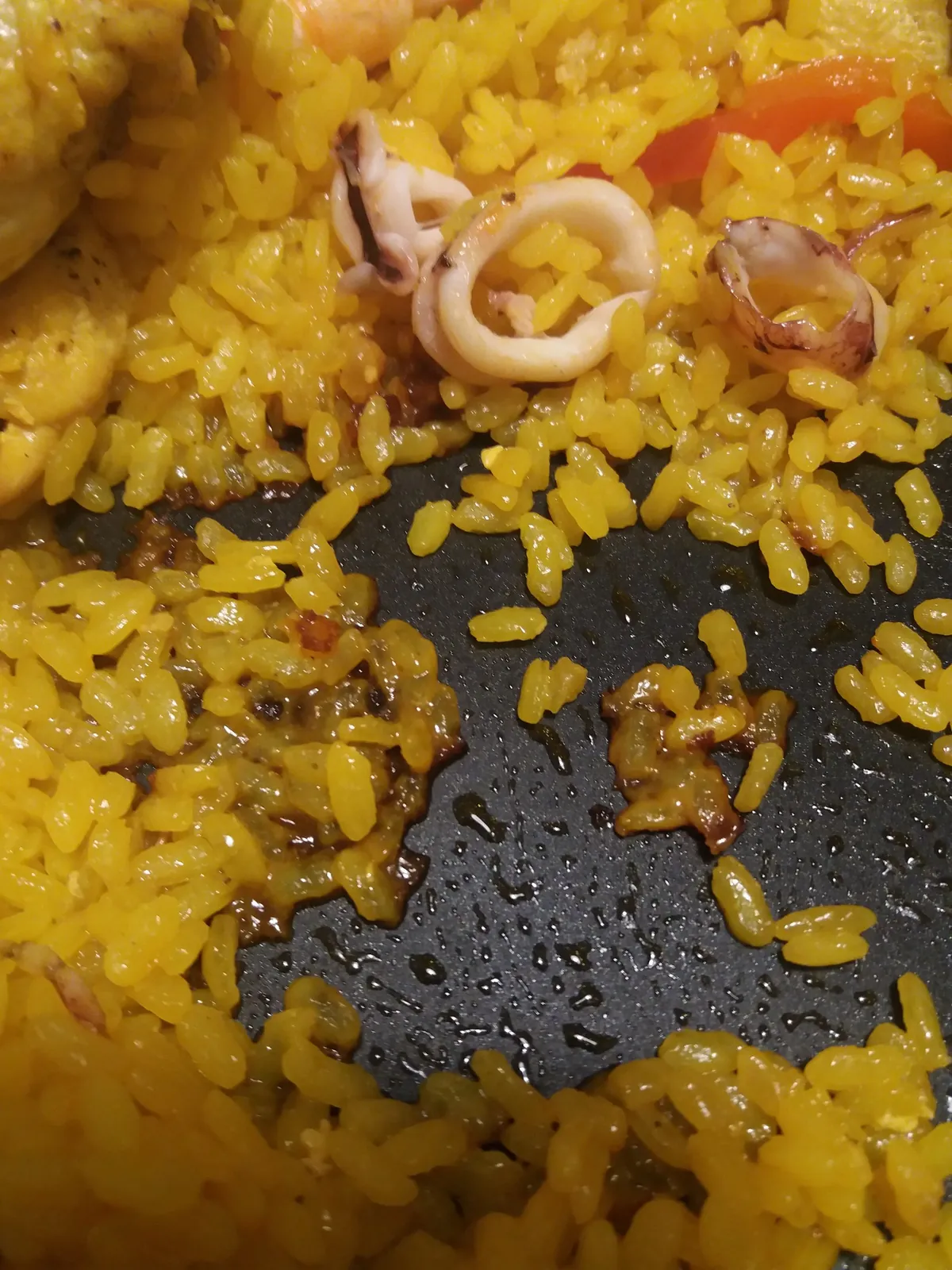
シーフードパエリアの鍋底に見える、茶色く焦げ付いたソカラットの層。
料理写っているもの: 該当分類群なし(料理: シーフードパエリアの鍋底のソカラット)部位・状態: 鍋底に密着した米の焦げ層(シーフードパエリアの一部)
写真: MiguelAlanCS/ CC BY-SA 4.0/ 原画像/ 台帳の原画像
写真の範囲と来歴
被写体の確認: 原典の記載による同定。説明文「fondo de paella(パエリアの底)」。ファイル名にも socarrat と明記。 画像を開き、黄色い米の間から鍋底に密着した焦げ茶色の米の層がクローズアップで写っているのを確認した。
掲載画像: Wikimedia Commons の原本を長辺2400pxへ縮小。切り抜き・色調変更なし。 表示用には幅1200px上限のWebPを配信し、台帳の原画像は上のリンクから確認できます。
On this page (8 sections)
Reading the bitterness
Near the end of Valencian paella cooking, the rice layer adhering to the bottom of the pan is called socarrat. The Acadèmia Valenciana de la Llengua (AVL), Valencia's official language institution, defines it as 「調理する鍋にこびりついたパエリアの米の層」 (in translation: "the paella rice layer adhering to the cooking pan"), and describes the diminutive socarraet as concentrating 「パエリアの本質の味」 (in translation: "the essence of paella's flavor"). This definition uses no specific taste or odor terms such as bitterness or roasted aroma; it is limited to a lexical explanation of how it forms.
The dictionary of the Acadèmia de Cultura Valenciana, another normative dictionary, describes socarrat rice as 「部分的に焦げているが、時にたいへん美味な(molt gustós)」 (in translation: "partly scorched but sometimes very delicious"). Although it uses 「焦げた(cremat)」 (in translation: "scorched"), its evaluative word is 「たいへん美味」 (in translation: "very delicious"), rather than 「苦い」 (in translation: "bitter") or 「香ばしい」 (in translation: "roasted"). This too is a general dictionary description, not one based on a food-science sensory definition.
In food science, a study evaluated paella's heating process with an electronic nose and a trained sensory panel of 9 people. As cooking progressed toward formation of socarrat, 「roasted(焙煎香)」 (in translation: "roasted") attribute intensity increased significantly, while 「burnt(焦げ臭)」 (in translation: "burnt") odor remained lower than for the white-rice control. The paper considers this to suggest that socarrat forms a crust in the pan that prevents the rice itself from burning. However, the panel's rating scale did not include 「bitter(苦味)」 (in translation: "bitter"); this study did not measure bitterness as a taste of socarrat.
The same study detected volatile furan, furanone, and ketone compounds late in heating. Earlier studies report these compound groups as having 「bitter-caramel aroma(苦味を伴うカラメル香)」 (in translation: "bitter-caramel aroma") along with roasted and caramel aromas. However, this 「苦味」 (in translation: "bitterness") is an aroma description based on citations to earlier literature, not data in which people tasted socarrat itself and rated it bitter. The connection between compound identification and bitterness actually perceived by people remains unconfirmed.
Sources for this overview
Checked for this overview: Used the AVL definition and lexical explanation as evidence for paragraph 1.
socarrat(Diccionari General de la Llengua Valenciana)
Checked for this overview: Used the dictionary description that evaluates it as delicious rather than calling it bitter as evidence for paragraph 2.
Checked for this overview: Used the sensory-panel roasted/burnt results as evidence for paragraph 3. / Used the compound identification and the unconfirmed connection to bitterness as evidence for paragraph 4.
Other names: socarrat (ca), socarraet (ca, identification medium)
Structured claims — open a section to read each claim's confidence, evidence and limits
Composition and content (1)
Scope: GC-MS/electronic-nose analysis of white-rice and paella samples, for samples late in heating.
Show data
dish-socarrat —has_candidate_bitterness_contributors→ "Volatile furan, furanone, and ketone compounds detected late in heating are reported in earlier studies as compound groups having roasted and caramel aromas together with 「bitter-caramel aroma(苦味を伴うカラメル香)」 (in translation: "bitter-caramel aroma")."Sensory (2)
Show data
dish-socarrat —has_sensory_attribute→ "The normative dictionary of the Valencian Academy of Culture defines the rice of socarrat as "partially charred but at times very tasty (molt gustós)," evaluating it as tasty rather than bitter."Scope: A comparison across the paella cooking process (white rice and multiple heating stages of paella) using Spanish rice. Trained sensory panel, n=9.
Note: Acrylamide quantification is also one focus of the same paper, but NIGAMI LAB adopts only its sensory and aroma-compound descriptions here and does not touch on health effects.
Show data
dish-socarrat —has_sensory_response→ "In an unstructured 10 cm scale evaluation by a trained sensory panel of 9, the intensity of the "roasted" attribute rose significantly as paella cooking progressed and socarrat formed, while "burnt" was kept lower than in the white-rice control. The paper discusses this as suggesting that the socarrat forms a crust in the pan that keeps the rice from burning."How processing and cooking change it (1)
Note: A glossary of the Valencian official language academy, a regional-government-related institution.
Show data
dish-socarrat —is_defined_as→ "The Valencian Academy of Language (AVL) defines socarrat as 「調理する鍋にこびりついたパエリアの米の層」 (in translation: "the paella rice layer adhering to the cooking pan") and describes the diminutive socarraet as concentrating 「パエリアの本質の味」 (in translation: "the essence of paella's flavor")."