chocolate milk
ingredient / ingredient-chocolate-milk
チョコレートミルク
Chocolate milk is a drink that combines cocoa with milk. Sugar sweetness and the richness of milk fat overlap with cocoa-derived bitterness, each affecting palatability and bitterness perception differently.
Photographs (captions in Japanese)
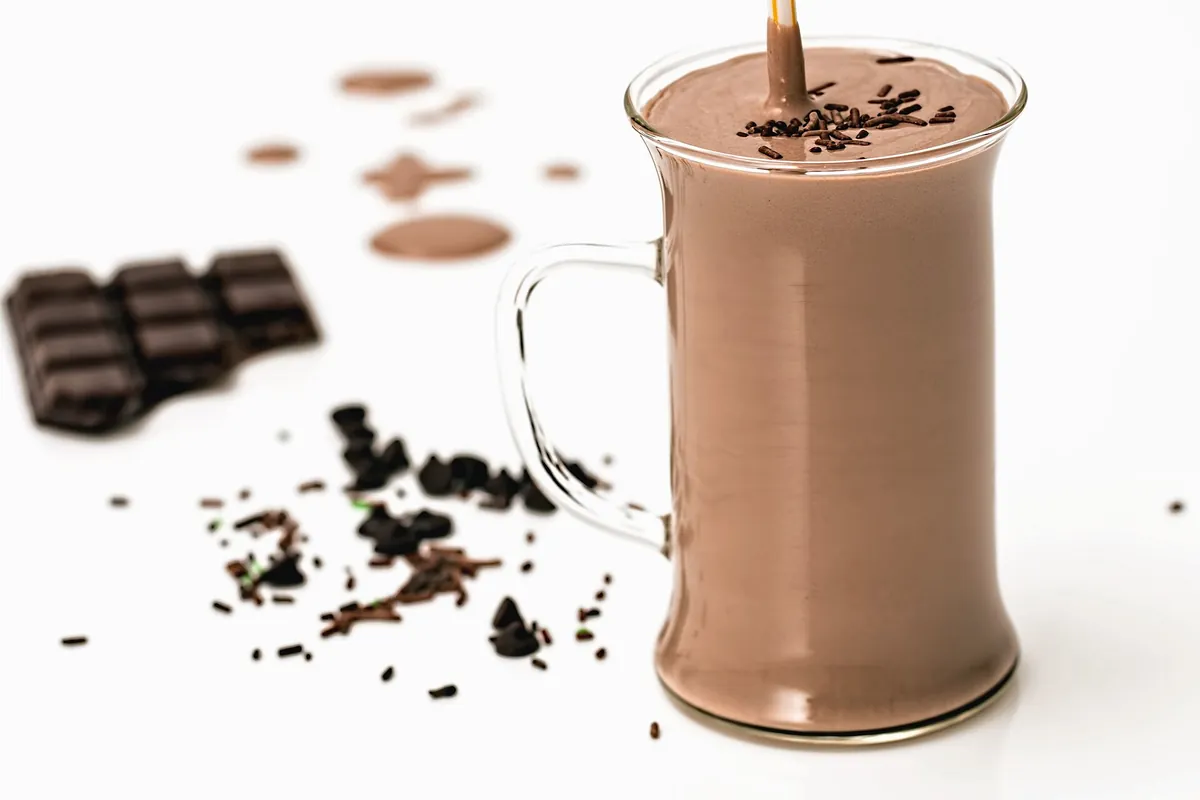
チョコレートミルク(ココア風味の牛乳飲料)をガラス製マグに注いだ状態。表面にチョコレートスプリンクルが散らされ、脇に板チョコレートの欠片が添えられている。
写っているもの: 該当分類群なし(チョコレートミルク飲料)部位・状態: グラスに注がれたチョコレートミルク(飲料)。チョコレートの塊とチョコチップが脇に添えられている
写真: stevepb/ CC0 1.0/ 原画像/ 台帳の原画像
写真の範囲と来歴
被写体の確認: 原典の記載による同定。市販品の銘柄・原料乳の種類は写真からは判定できない一般的な飲料写真。
掲載画像: Wikimedia Commons の1920px版。苦味研究所では切り抜き・色調変更なし。 表示用には幅1200px上限のWebPを配信し、台帳の原画像は上のリンクから確認できます。
On this page (5 sections)
Reading the bitterness
Chocolate milk is a drink in which sugar sweetness and the richness of milk fat overlap with cocoa-derived bitterness. A study evaluated taste with a trained panel for 8 chocolate-milk samples made with 3% cocoa, combining 2 fat-concentration levels with sweetener conditions. In this study, as sucrose concentration increased from 0% to 2.5% to 5%, both bitterness intensity and lingering bitter aftertaste decreased significantly.
Fat concentration did not work in the same way. In an analysis comparing 0.1% and 4.5% fat, no statistically significant main effect on bitterness intensity was found. However, because sugar also interacts with tastes other than bitterness, and viscosity, aroma, and mouthfeel change at the same time, it is difficult to fully separate these effects. The result that fat did not affect bitterness also concerns this one beverage and cannot be extended directly to other foods.
In a study where 8 trained panelists evaluated prototypes made with the same formulation—30% buffalo milk, 1% cocoa powder, 7.5% sugar, and so on—on a 15 cm unstructured line scale, the bitter-aftertaste intensity score was 2.9 for the alkalized cocoa product and 2.4 for the natural cocoa product, and these were statistically different groups. Meanwhile, among 120 consumers who drank 4 products that added commercial ones, there was no significant difference in 「苦味の好ましさ」 (in translation: "liking of bitterness"). Intensity and liking are separate questions, and because the powders were also different brands, the difference cannot be concluded to be an effect of alkali treatment alone.
In a 2024 test using a 1.5% cocoa beverage with 6% sucrose as the reference, the 2 products with 58% of the sucrose replaced showed no significant difference from the reference product in a 2-sip evaluation by 9 trained panelists. With 100% replacement, bitterness was higher for the acesulfame K product in the in-mouth phase of the first sip and at 20 seconds after swallowing for both the first and second sips, and for the products using rebaudioside M and erythritol at 20 seconds after swallowing for each sip. Even when sweetness was designed to be equivalent, how bitterness appeared was not the same across sweetener systems and evaluation time points.
Among 104 university students aged 19–35 who evaluated the same 5 products, the liking of the 2 products with 58% partial replacement showed no significant difference from the sucrose reference product. The 100% replacement products were 0.6 or 0.8 points lower than the reference product on a 9-point scale. However, with full replacement, attributes other than bitterness—such as licorice-like notes, pungency, mouth-drying, and off-flavors—also varied by sweetener, so the difference in liking cannot be explained by bitterness alone.
Sources for this overview
Sensory Interactions between Sweetness and Fat in a Chocolate Milk Beverage
Checked for this overview: The portion confirming significant decreases in bitterness intensity and lingering bitter aftertaste as sucrose concentration increased. / The portion confirming the result that the main effect of fat concentration was not significant for bitterness intensity, and its limitations.
Checked for this overview: Used for 30% buffalo milk, 1% cocoa, 7.5% sugar, 8 trained panelists, the bitter-aftertaste intensity scores of 2.9 versus 2.4 on the 15 cm unstructured line scale, the different letter groups, and the limitation that this is not a sole causal effect of treatment because the powders are different brands. / Used for the 4 commercial and prototype products, 120 consumers, the lack of a significant difference in liking of bitterness, and the separation between intensity and liking.
Checked for this overview: Used for the 2024 study, 1.5% cocoa, the 6% sucrose control, the 58% partial and 100% full replacements, the 9 trained panelists, and the bitterness differences separated between the in-mouth phase of the first sip and 20 seconds after each swallow. / Used for the 5 products, 104 university students aged 19–35, the lack of difference for partial replacement, the 9-point scale differences of 0.6/0.8 for full replacement, and the limitation that attributes other than bitterness also change.
Structured claims — open a section to read each claim's confidence, evidence and limits
Sensory (6)
Scope: A trained-panel test that factorialized 2 fat levels and sweetener
Note: Bitterness and bitter aftertaste decreased significantly as sucrose increased. This does not mean that the sugar removed the bitter compounds.
Show data
ingredient-chocolate-milk —has_perceived_bitterness_affected_by→ "Sucrose concentration (0%, 2.5%, 5%)"Scope: The same factorial chocolate-milk test
Note: There was no significant main effect of fat concentration on bitterness. This is not proof that fat in general has no effect on bitterness.
Show data
ingredient-chocolate-milk —has_perceived_bitterness_unchanged_by→ "The main effect of fat at 0.1% versus 4.5%"Scope: Juvinal et al. 2023; 2 prototypes containing 1% cocoa powder, 7.5% sugar, and so on; 8 trained panelists; 15 cm line scale; 4 replicates.
Note: Because the cocoa powders differ not only in treatment but also in brand, the difference is not treated as a sole causal effect of alkali treatment. This is not extended to solid milk chocolate or milk in general.
Show data
ingredient-chocolate-milk —has_sensory_attribute→ "Buffalo-milk chocolate milk made with alkalized cocoa powder in the same prototype formulation had a higher trained-panel bitter-aftertaste intensity than the product with natural cocoa powder (2.9 versus 2.4, different letter groups, p<0.05)."Scope: Juvinal et al. 2023; ages 21–68 in Nueva Ecija, Philippines; about 4°C; 9-point hedonic scale.
Note: This is liking, not bitterness intensity. The commercial and prototype products also do not have identical formulation and processing, and the null result is not attributed to cocoa treatment alone.
Show data
ingredient-chocolate-milk —has_sensory_response→ "For the 4 commercial and prototype products using natural and alkalized cocoa, there was no significant difference in the 120 consumers' liking-of-bitterness scores."Scope: Andersen et al. 2024; 5 1.5% cocoa beverages; 9 trained panelists; scale relative to the control; evaluated at 15 seconds in-mouth and 20 seconds after swallowing for each of 2 sips.
Note: A specific formulation designed to have equivalent sweetness. The partial replacement leaves 2.5% sucrose, and the 2 full-replacement products differ in sweetener system. This is not generalized to all sweeteners or to commercial products.
Show data
ingredient-chocolate-milk —has_perceived_bitterness_affected_by→ "The 2 products with 58% partial sucrose replacement showed no significant difference from the control across all sensory attributes; with 100% replacement, bitterness was higher than the control for the acesulfame K product in the in-mouth phase of the first sip and at 20 seconds after swallowing for the first and second sips, and for the rebaudioside M/erythritol product at 20 seconds after swallowing for each sip."Scope: Andersen et al. 2024; Danish university students aged 19–35; 5 beverages; about 10°C; 30 g per 1 product.
Note: The differences for full replacement were p<0.01 and p<0.001, respectively. This is limited to a specific young university-student sample and formulation, and bitterness alone is not concluded to be the cause of the difference in liking.
Show data
ingredient-chocolate-milk —has_sensory_response→ "In the 9-point hedonic evaluation by 104 consumers, the 2 products with 58% partial replacement showed no significant difference from the sucrose control; the 100% replacement acesulfame K product was 0.6 points lower than the control, and the rebaudioside M/erythritol product was 0.8 points lower."