roasted cocoa nibs
ingredient / ingredient-roasted-cocoa-nibs
焙炒カカオニブ
Roasted Theobroma cacao seed fragments.
Photographs (captions in Japanese)
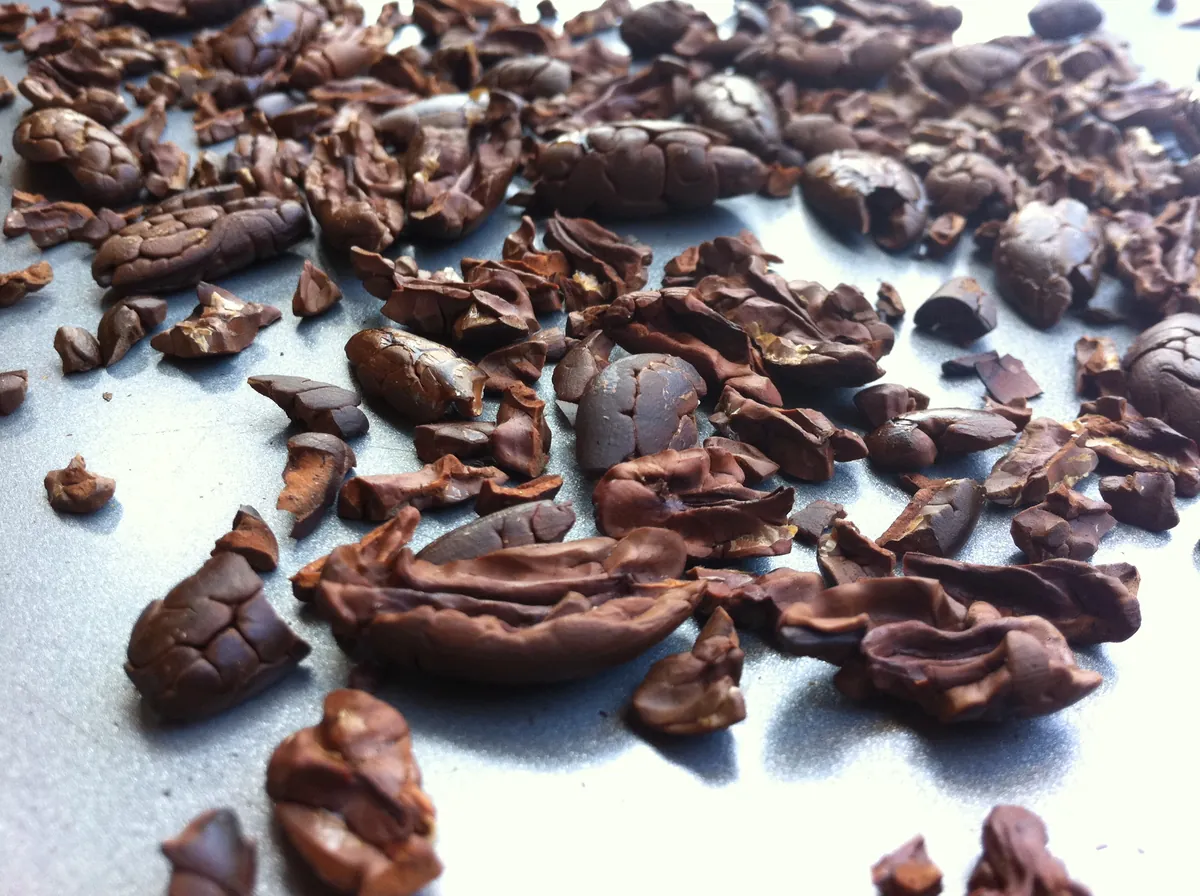
焙煎した Theobroma cacao 種子の破砕片(ロースト・カカオニブ)。
写っているもの: Theobroma cacao部位・状態: 焙煎・破砕された種子(ニブ)
写真: Michael/ CC BY 2.0/ 原画像/ 台帳の原画像
写真の範囲と来歴
被写体の確認: 原典の記載による同定。
掲載画像: Wikimedia Commons の原寸ファイル。苦味研究所では切り抜き・色調変更なし。 表示用には幅1200px上限のWebPを配信し、台帳の原画像は上のリンクから確認できます。
On this page (7 sections)
Reading the bitterness
For roasted cacao nibs (roasted Theobroma cacao seed fragments), the compounds involved in bitterness are, within the scope of abstracts reviewed, the methylxanthines theobromine and caffeine. A 2006 study reproduced the bitterness profile of roasted nibs suspended in water by means of water-based reconstitution, and then conducted comparative trials with specific compounds removed and dose-response trials, but reported that theobromine and caffeine remained major sensory-contributing compounds. Another 2005 study identified, in addition to theobromine and caffeine, flavan-3-ols such as epicatechin and catechin, and procyanidins B-2, B-5, C-1 and others as compounds contributing to both bitterness and astringency (a drying, mouth-tightening sensation), but within the scope of abstracts reviewed, the relative magnitude of each compound's contribution was not distinguished.
Astringency has been separately identified as arising from a distinct compound group. A 2005 study identified a previously unreported family of amino acid amides (such as clovamide and deoxyclovamide) as key astringent compounds in roasted cacao, and also identified quercetin and related flavonol glycosides. However, within the scope of abstracts reviewed, numerical threshold values, panel size, and nib concentration were not provided, and it is not possible to rank the relative contribution of these compounds to each other.
A 2022 study addressing origin-related bitterness differences reported, on the basis of sensory evaluation by 145 consumers using unsweetened 100% chocolate, that Peru-origin chocolate showed a mean bitterness of 28.1 on the gLMS intensity scale, significantly higher than Ghana-origin (26.0, p = 0.0001) and Madagascar-origin (26.8, p = 0.016). However, these 3 origins differed simultaneously in variety and post-harvest processing as well, so bitterness differences cannot be attributed to origin alone. A 2024 systematic review of literature published through May 2023 also noted that characteristic flavor descriptors recorded at the cacao liquor stage were not consistently maintained in the final chocolate product, and caution is warranted when extrapolating findings from roasted nibs directly to chocolate products.
A 2013 etymological study argued, on the basis of analysis of dictionary headwords, that a preparation method can be discerned: crushing cacao beans and combining them with water or atole (corn gruel), then whipping the mixture into foam, a beverage called xocoatl (xocoatl). Quantitative information such as proportions or temperature is not provided. In one measured recipe example recorded in a 2008 thesis on mole poblano, 2 chocolate tablets were listed as ingredients alongside 400 g of chile ancho, 100 g of chile pasilla, almonds, peanuts, raisins, bread, tortillas, and spices.
Sources for this overview
Checked for this overview: Confirmed that theobromine and caffeine remained major contributing compounds even after quantitative reconstitution and omission trials. / Confirmed that water-based reconstitution reproduced the bitterness profile of roasted nibs.
Checked for this overview: Confirmed that flavan-3-ols, in addition to theobromine and caffeine, contribute to both bitterness and astringency. / Confirmed the identification of amino acid amides and flavonol glycosides as astringent compounds.
Checked for this overview: Confirmed significant differences in mean gLMS bitterness values across origins (p = 0.0001 and p = 0.016).
Sensory attributes of fine flavor cocoa beans and chocolate: A systematic literature review
Checked for this overview: Confirmed that characteristic flavor recorded at the cacao liquor stage is not consistently maintained in the final chocolate product.
Chocolate: historia de un nahuatlismo
Checked for this overview: Confirmed a discussion reading the preparation method for xocoatl from dictionary headwords.
Implantación de un sistema de calidad a un platillo típico mexicano: El mole poblano
Checked for this overview: Confirmed an example of a measured recipe for mole poblano that includes chocolate.
Follow the connections
roasted cocoa nibs →— sensory attribute→ bitterness →can be measured separately …→ astringency
xocóatl (cacáhuatl) →is prepared through→ roasted cocoa nibs
mole poblano →includes→ roasted cocoa nibs
Hypotheses and recipe candidates for this entry are on the Japanese page.
Structured claims — open a section to read each claim's confidence, evidence and limits
Sensory (5)
Scope: Water-based reconstruction of roasted cacao nibs and human omission testing
Note: Specific to the roasted-nib material studied and the water-based model.
Show data
ingredient-roasted-cocoa-nibs —has_key_bitter_organoleptics→ "Theobromine and caffeine"Scope: Roasted cacao nibs and taste reconstruction in a water-based system
Note: The finished chocolate requires a separate matrix and process record. / 2026-08-31: Calibrated down from established to supported because the supporting evidence does not derive from a full-text check. May be re-upgraded once the full text is checked.
Show data
ingredient-roasted-cocoa-nibs —has_sensory_attribute→ sensation-bitterScope: 3 origins of unsweetened 100% chocolate, 145 consumers
Note: The origin effect coexists with roasting effects in the same experimental design. In the text read, both were not separated into an interaction term.
Show data
ingredient-roasted-cocoa-nibs —has_perceived_bitterness_affected_by→ "Cacao origin: mean bitterness on the gLMS scale was Peru 28.1 versus Ghana 26.0 (p = 0.0001) and Madagascar 26.8 (p = 0.016)"Scope: Roasted cacao nibs, taste dilution analysis and half-tongue threshold testing
Note: These compounds are reported as contributing to astringency, not bitterness. Cacao's astringency cannot be reduced to flavan-3-ols alone.
Show data
ingredient-roasted-cocoa-nibs —has_key_astringent_compounds→ "N-phenylpropenoyl amino acid amides, including clovamide, deoxyclovamide, and (-)-N-[3',4'-dihydroxy-(E)-cinnamoyl]-L-tyrosine, along with glycopyranosides of quercetin, naringenin, luteolin, and apigenin"Scope: Roasted cacao nibs, sensory-guided fractionation
Show data
ingredient-roasted-cocoa-nibs —has_bitter_and_astringent_contributors→ "In addition to theobromine and caffeine: epicatechin, catechin, procyanidin B-2, procyanidin B-5, procyanidin C-1, [epicatechin-(4beta->8)]3-epicatechin, and [epicatechin-(4beta->8)]4-epicatechin"How processing and cooking change it (3)
Scope: Fine-flavor cacao literature reviewed through May 2023
Note: The fermentation, roasting, liquor, and chocolate stages should be modeled separately.
Show data
ingredient-roasted-cocoa-nibs —does_not_guarantee_retention_of→ "The same characteristic sensory attributes in the final chocolate"Scope: A method of preparation combining ground cacao beans with water or atole (corn gruel) and finishing by whipping it into foam
Note: Connects the existing cacao line (ingredient-roasted-cocoa-nibs, etc.) to the Mesoamerican beverage context.
Show data
dish-xocoatl —is_prepared_with→ ingredient-roasted-cocoa-nibsScope: Example measured recipe: uses 400g chile ancho, 100g chile pasilla, along with almonds, peanuts, raisins, bread, tortillas, spices, and more, plus 2 tablets of chocolate (tablillas)
Show data
dish-mole-poblano —includes→ ingredient-roasted-cocoa-nibs