Siamese neem tree
organism / organism-azadirachta-indica-siamensis
サダオ / Siamese neem / Azadirachta indica var. siamensis
Thai neem (sadao). Young leaves and inflorescences are eaten as bitter vegetables.
Photographs (captions in Japanese)
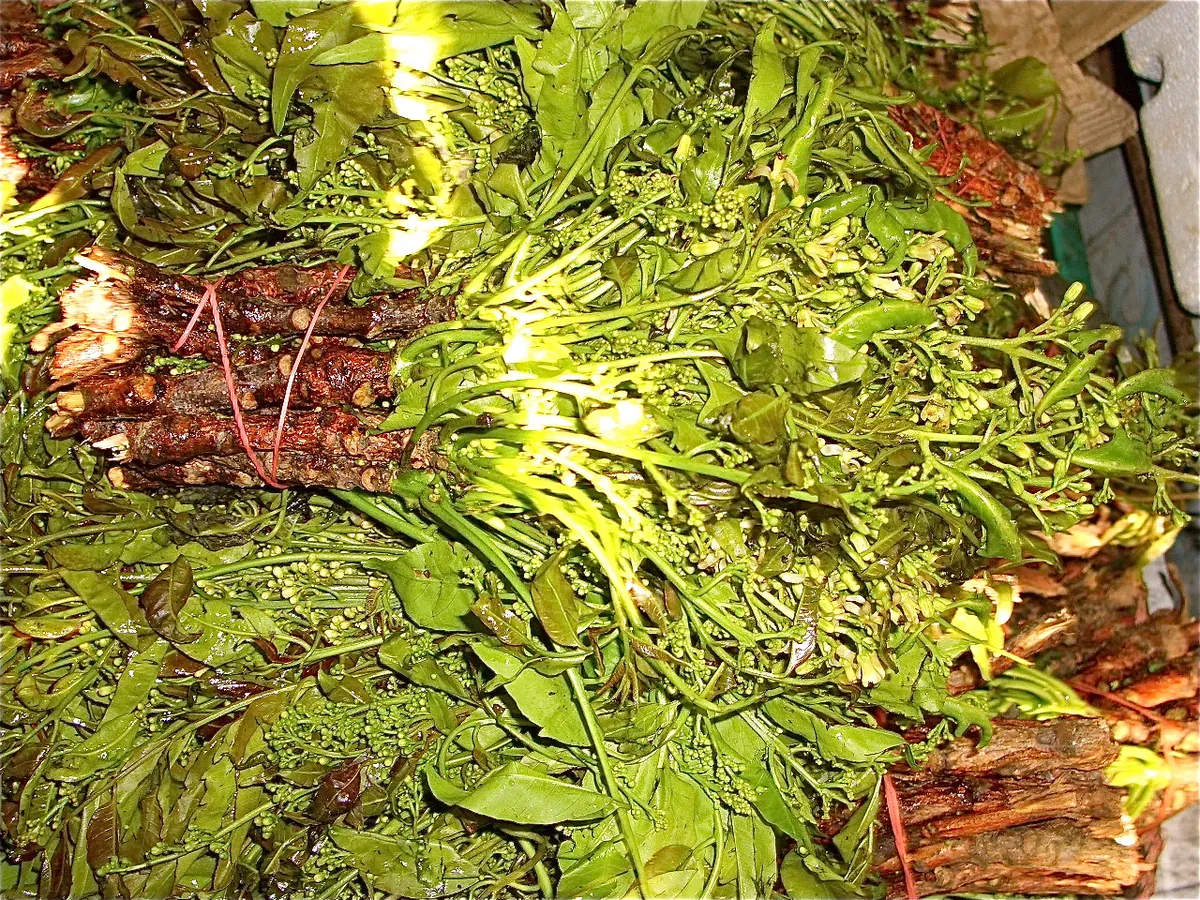
サダオ(Azadirachta indica、タイのシャムニーム)の若い枝葉。細かい緑色の花芽の房と若葉が、木質の茎の根元で束ねられた状態で写っている。原典ページは『neem tree shoots, margosa shoots (Azadirachta indica)』と記載し、『Leaf vegetables in Thailand』に分類している。
写っているもの: Azadirachta indica部位・状態: 収穫直後の若い枝葉。小さな緑の花芽の房と若葉が木質の茎にまとまって束ねられている
写真: Susan Slater/ CC BY-SA 4.0/ 原画像/ 台帳の原画像
写真の範囲と来歴
被写体の確認: 原典の記載による同定。原典ページは学術種名を Azadirachta indica と記載し、変種名 siamensis の明記はないが、カテゴリ『Leaf vegetables in Thailand』からタイのサダオとして扱われている個体であることがうかがえる。専門家による再同定は行っていない。
掲載画像: Wikimedia Commons の原寸版。苦味研究所では切り抜き・色調変更なし。 表示用には幅1200px上限のWebPを配信し、台帳の原画像は上のリンクから確認できます。
On this page (9 sections)
Reading the bitterness
Thai neem (Azadirachta indica var. siamensis) is a tree called sadao in Thailand. Young shoots, young inflorescences, and young leaves are eaten. An article on a government-affiliated site lists young shoots and inflorescences together as edible parts. Separately, it records young leaves and flowers as having been used ethnomedically as a vegetable bitter tonic, or a bitter tonic vegetable.
A Thai research paper introduces neem flowers as one of the vegetables commonly consumed in Thailand, alongside fruits of Thai and Chinese bitter gourd and sweet basil leaves. This is background to a paper on an enzyme assay, however, not a study of food culture itself. The ethnomedical use as a bitter tonic vegetable likewise records a traditional use; the action described as health-promoting itself has not been confirmed in a human trial.
Sources for this overview
10 สมุนไพร ที่ปลูกทานเองที่สวนหลังบ้าน
Checked for this overview: Confirmed the description of young shoots and young inflorescences as edible parts.
Antioxidant activity of Siamese neem tree (VP1209)
Checked for this overview: Confirmed the ethnomedical description of young leaves and flowers used as a bitter tonic.
Checked for this overview: Confirmed the background description of neem flowers as a commonly eaten vegetable in Thailand.
Other names: sadao (th-Latn), สะเดา (th), SADAO (th-Latn)
Follow the connections
neem young shoots →is prepared from→ Siamese neem tree
neem flowers →is prepared from→ Siamese neem tree
neem leaves →is prepared from→ Siamese neem tree
Structured claims — open a section to read each claim's confidence, evidence and limits
Composition and content (3)
Scope: Edible young shoots of Thai sadao
Show data
ingredient-neem-young-shoots —is_prepared_from→ organism-azadirachta-indica-siamensisScope: Young inflorescences of Thai sadao.
Note: The inflorescences are not treated as the same plant part as the leaves or young shoots.
Show data
ingredient-neem-flowers —is_prepared_from→ organism-azadirachta-indica-siamensisScope: Young leaves of Thai neem
Note: The plant part is linked through existing ethnomedical contextual material.
Show data
ingredient-neem-leaves —is_prepared_from→ organism-azadirachta-indica-siamensisHow processing and cooking change it (1)
Scope: Thailand.
Show data
organism-azadirachta-indica-siamensis —is_eaten_as→ "One of the vegetables commonly consumed in Thailand (neem inflorescences)."Culture (2)
Scope: Thailand.
Note: Does not assert clinical evidence for any health-promoting effect itself.
Show data
organism-azadirachta-indica-siamensis —is_used_as→ "An ethnomedical use of eating young leaves and flowers as a vegetable bitter tonic (a bitter tonic vegetable)."Scope: A general-audience article from the Highland Research and Development Institute (HRDI).
Note: The list does not identify chemical bitter compounds; it includes folk accounts of effects (บำรุงโลหิต เจริญอาหาร ช่วยระบาย; in translation: "nourishing the blood, stimulating appetite, and helping bowel movements").
Show data
organism-azadirachta-indica-siamensis —is_documented_as_part_of→ "One of the vegetables on the Thai folk taste category 「รสขม(苦味)」 (in translation: "bitter taste (bitterness)") list in an HRDI article."