Brassica vegetables
ingredient / ingredient-brassica
アブラナ科野菜
Cruciferous vegetables such as cabbage and broccoli.
Photographs (captions in Japanese)
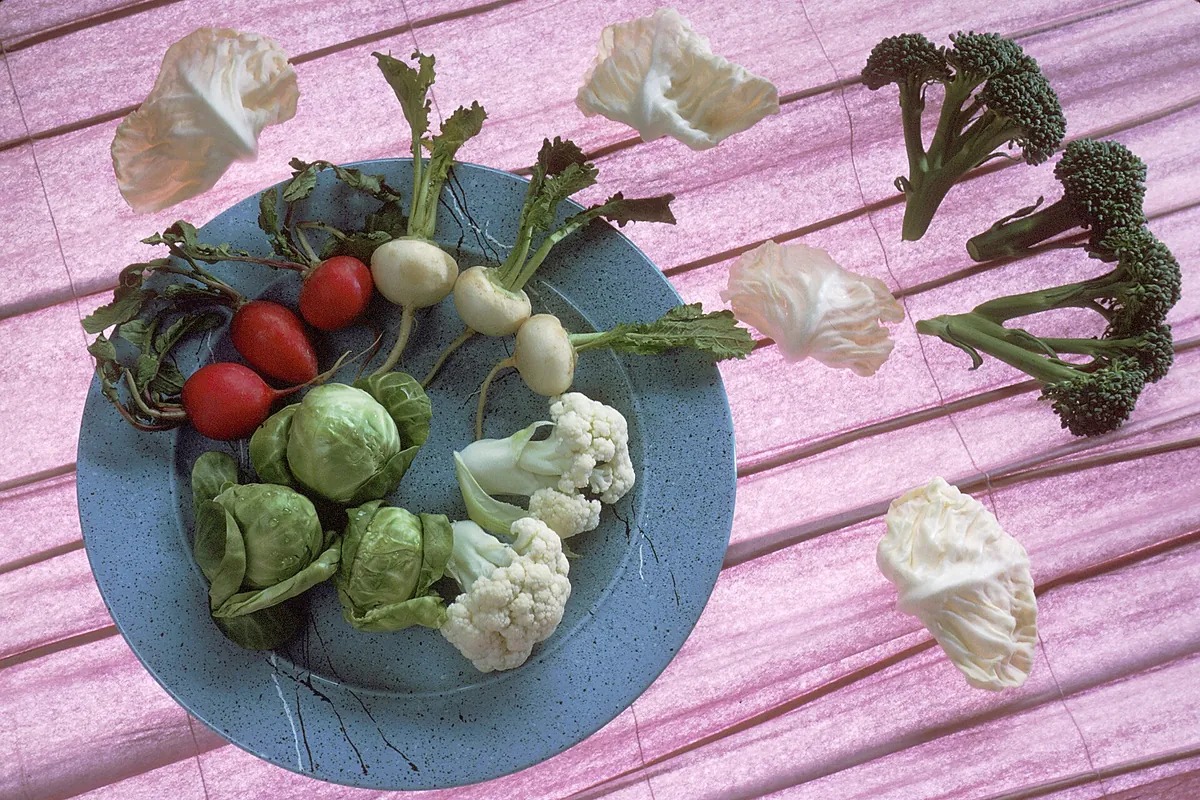
アブラナ科野菜(Brassicaceae)の一例。灰色の皿にラディッシュ・二十日大根・芽キャベツ・カリフラワーを茎付きで円形に盛り、周囲にブロッコリーの花蕾とカリフラワー・キャベツの葉を配置している。個々の学名は写真からは特定できない。
写っているもの: Brassicaceae(複数種の混在。ラディッシュは Raphanus 属)部位・状態: ラディッシュ、二十日大根、芽キャベツ、カリフラワーを茎付きのまま皿に円形に並べ、周囲にブロッコリーの花蕾とカリフラワー・キャベツの葉片を散らした状態
写真: Unknown photographer (National Cancer Institute, U.S. government)/ Public domain/ 原画像/ 台帳の原画像
写真の範囲と来歴
被写体の確認: 原典の記載による同定。原典(米国国立がん研究所提供)のキャプションは「ラディッシュ、芽キャベツ、カリフラワーを茎付きで円形に並べた灰色の皿。テーブルの上にカリフラワーの葉とブロッコリーの穂先」と記す。写っているラディッシュ(Raphanus属)はアブラナ科だがBrassica属ではないため、アブラナ科全体を代表する集合写真として掲載し、Brassica属単独の標準形とはみなさない。
掲載画像: Wikimedia Commons の1920px版。苦味研究所では切り抜き・色調変更なし。 表示用には幅1200px上限のWebPを配信し、台帳の原画像は上のリンクから確認できます。
On this page (8 sections)
Reading the bitterness
Cruciferous vegetables include familiar leafy and flower-bud vegetables such as cabbage and broccoli. These vegetables are described as having sulfur-bearing compounds called glucosinolates as a characteristic component. When tissue is damaged, glucosinolates are broken down by enzymatic action, yielding products such as isothiocyanates. Review articles position glucosinolates and isothiocyanates as the causative substances of the characteristic pungent and bitter taste of cruciferous vegetables.
How much glucosinolate remains appears to depend more on the cooking method than on heat treatment itself. In research on broccoli, Brussels sprouts, cauliflower, and green cabbage, steaming, microwaving, and stir-frying showed no significant loss, whereas boiling caused a clear decrease; approximately 90% of the lost amount was detected in the boiling water. When finely chopped and left for 6 hours, as much as 75% loss has been reported. If the amount retained varies this much depending on cooking method, the flavor of raw and cooked forms cannot be described using the same measure.
Two glucosinolates, sinigrin and progoitrin, always correlate with the bitterness of Brussels sprouts themselves, while their relationship with preference is not uniform. Across 4 taste tests conducted between 1989 and 1995, a relationship in which higher combined content was associated with lower preference was observed only when the combined content of these two components exceeded 2.2 g/kg. In tests where content remained below this threshold, no relationship with preference was observed, though the correlation with bitterness continued across the full range of content. High content alone cannot be used as a straightforward measure of preference.
The view that genetic variation in TAS2R38, which influences bitter taste sensitivity, determines preference for cruciferous vegetables has often been discussed in review articles. However, research that has directly tested this view appears to show divided results. In a UK consumer study using rocket, the TAS2R38 genotype was related to bitter perception, but it was reported that it was the pungency of the leaves rather than bitterness that determined acceptance or rejection. In another study using cooked turnip, the TAS2R38 genotype had no significant effect on preference. A systematic review of bitter taste sensitivity and vegetable and legume consumption overall also found the association to be reported as very weak and not statistically significant. The simple scheme that people with stronger bitter perception avoid cruciferous vegetables is not supported, at least by these tests.
Sources for this overview
Checked for this overview: Confirmed the framework in review articles that positions glucosinolates and isothiocyanates as the cause of bitterness.
Effect of storage, processing and cooking on glucosinolate content of Brassica vegetables
Checked for this overview: Confirmed numerical values of glucosinolate retention and loss by cooking method.
Checked for this overview: Confirmed the relationship between content and preference/bitterness at the 2.2 g/kg threshold.
Checked for this overview: Confirmed that TAS2R38 genotype was not the primary factor in acceptance or rejection in rocket.
Checked for this overview: Confirmed that TAS2R38 genotype did not produce a significant effect on preference in cooked turnip.
Checked for this overview: Confirmed a meta-analysis result showing weak association between bitter taste sensitivity and vegetable consumption.
Follow the connections
Brassica vegetables →contains→ glucosinolates →are not uniformly→ bitterness
Brassica vegetables →can generate→ isothiocyanates →can elicit→ pungency
sinigrin →reduces taste preference for→ Brassica vegetables
Structured claims — open a section to read each claim's confidence, evidence and limits
Composition and content (1)
Scope: Brassicaceae vegetables
Note: Individual glucosinolate profiles vary by crop and processing. / 2026-08-31: Calibrated down from established to supported because the supporting evidence has not been confirmed via full text. Can be re-upgraded once the full text is confirmed.
Show data
ingredient-brassica —contains→ compound-glucosinolatesSensory (3)
Scope: Brussels sprout cultivars across 4 taste tests conducted from 1989 to 1995. 2 consumer panels and 1 analytical panel
Note: Not a monotonic relationship, but a threshold-dependent, conditional one. Below 2.2 g/kg, bitterness and preference diverge, which is a caution against treating glucosinolate content as a proxy for preference in the low-concentration range.
Show data
compound-sinigrin —reduces_taste_preference_for→ ingredient-brassicaScope: Consumer liking and acceptance of Brassica vegetables as a function of TAS2R38 diplotype
Note: This review-level framing was directly tested in 2 UK consumer studies and was not supported: the genotype effect on perceived bitterness does not carry through to liking. For rocket, the main basis for acceptance was not bitterness but perceived hotness (pungency).
Show data
receptor-tas2r38 —determines_acceptance_of→ ingredient-brassicaScope: A narrative review of consumer research (bitterness acceptance in EVOO and Brassicaceae)
Note: The review states that “although bitter taste is a general driver of dislike,” and for Brassica vegetables specifically, that “consumers generally prefer such vegetables cooked as they are less bitter and pungent.” As an industry response, it cites “the elimination of bitter substances from vegetables ... and the use of sweet masking substances.” This is a minimal addition to the 『産業は苦味を抜く』 (in translation: "industry removes bitterness") side, connecting to existing assets on Brassica breeding and acquired liking.
Show data
sensation-bitter —determines_acceptance_of→ ingredient-brassicaHow processing and cooking change it (2)
Scope: Brassicaceae foods
Note: Raw and cooked forms must not be merged into a single sensory record.
Show data
ingredient-brassica —has_flavor_affected_by→ "Cooking conditions, enzyme stability, and glucosinolate hydrolysis products"Scope: Glucosinolate hydrolysis in raw or processed Brassicaceae
Note: Enzyme stability and cooking change the product profile. / 2026-08-31: Calibrated down from established to supported because the supporting evidence has not been confirmed via full text. Can be re-upgraded once the full text is confirmed.
Show data
ingredient-brassica —can_generate→ compound-isothiocyanates