glucosinolates
compound class / compound-glucosinolates
グルコシノレート類
Glucosinolates: a sulfur-containing plant metabolite characteristic of the order Brassicales.
Photographs (captions in Japanese)
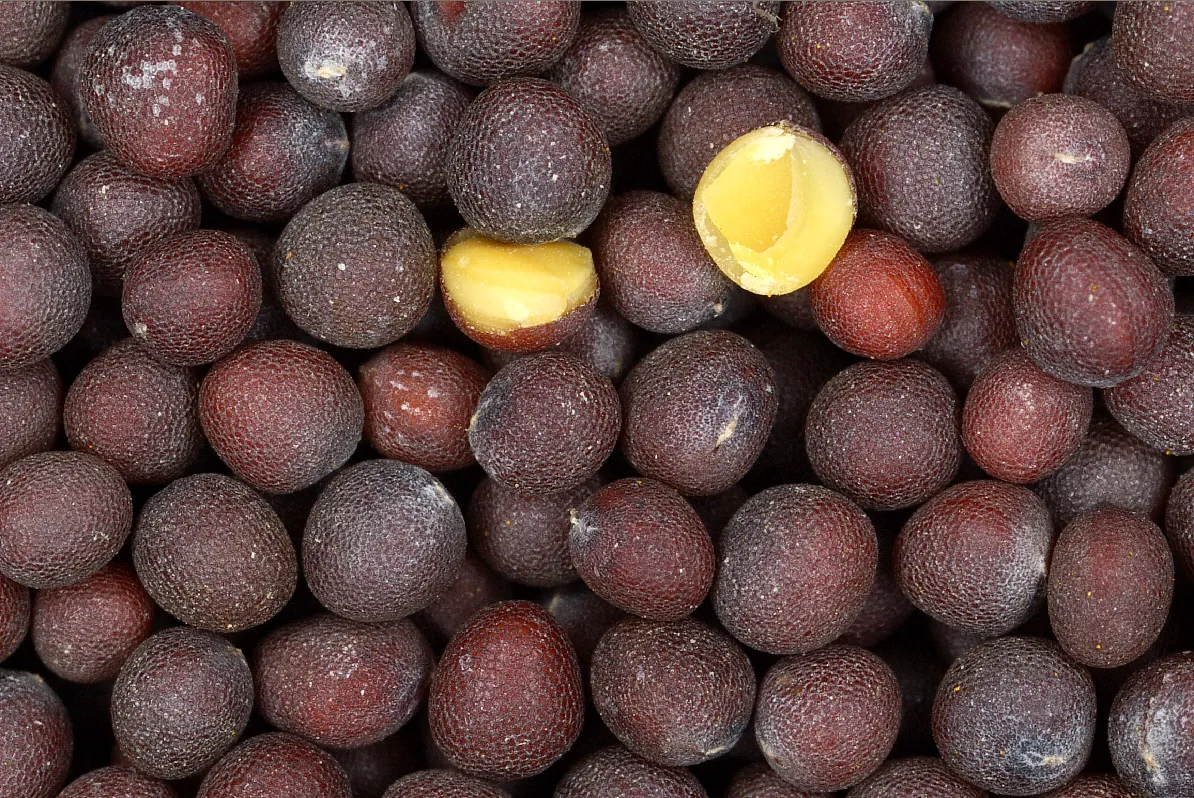
クロガラシ(Brassica nigra)の種子。グルコシノレート類はアブラナ目に特徴的な含硫代謝産物で、代表的な給源作物であるマスタード種子の写真を採用した。
原料写っているもの: Brassica nigra(クロガラシ)の種子部位・状態: 種子
写真: Sanjay Acharya/ CC BY-SA 3.0/ 原画像/ 台帳の原画像
写真の範囲と来歴
被写体の確認: 原典の記載による同定。化合物そのものの写真ではなく給源となる種子。
掲載画像: Wikimedia Commons の原寸ファイル。苦味研究所では切り抜き・色調変更なし。 表示用には幅1200px上限のWebPを配信し、台帳の原画像は上のリンクから確認できます。
On this page (8 sections)
Reading the bitterness
Glucosinolates are a group of sulfur-containing compounds commonly present in Brassicaceae plants (broccoli, Brussels sprouts, cauliflower, cabbage, and others). Not all glucosinolates are equally bitter. For example, sinigrin contained in Brussels sprouts is bitter in itself, whereas progoitrin, also present, is not itself bitter but its breakdown product (goitrin) is treated as the cause of bitterness. This is an example of how individual compounds differ in their role in bitterness.
For this reason, whether the total glucosinolate content alone can predict bitterness strength is a matter of disagreement between studies. In studies of Brussels sprouts and cauliflower, it was reported that the combined sinigrin and progoitrin content, or the content of sinigrin and neoglucobrassicin, correlates with bitterness as rated by a panel. In contrast, in a study of steamed turnip, the correlation between the total of 12 glucosinolates present and bitterness was not significant (r = 0.47), and only 4-methoxyglucobrassicin showed significant correlation (glucobrassicin fell just short of the significance threshold), pointing rather to low-concentration individual compounds. This discrepancy appears to depend on differences in the vegetables studied and sample size.
Residual content varies greatly depending on cooking method. In studies of multiple Brassicaceae vegetables including broccoli and Brussels sprouts, boiling caused significant loss through leaching into the cooking water, with approximately 90% of the lost amount recovered from the cooking water; by contrast, steaming, microwaving, and stir-frying showed no significant loss. Cutting method and storage also have an effect: shredded vegetables show a decline in content with standing time, with a maximum 75% decrease reported at 6 hours, whereas intact vegetables stored for 7 days at room temperature or under refrigeration showed a loss of only 9–26%.
Differences by vegetable type are also substantial. In a survey comparing 15 varieties of Brassicaceae vegetables distributed domestically in Japan, 「なばな(菜花)」 (nabana, rapeseed greens) had the highest content of both gluconapin and glucobrassicanapin among the surveyed items, and ranked second only to broccoli sprouts in total glucosinolate content. However, this was a compositional survey; no sensory evaluation of bitterness was performed.
Sources for this overview
Taste and Flavor Perceptions of Glucosinolates, Isothiocyanates, and Related Compounds
Checked for this overview: Confirmed that specific glucosinolates impart bitterness while the effect is not uniform / Confirmed positioning as a characteristic component of Brassicaceae vegetables
Checked for this overview: Confirmed the difference in how sinigrin and progoitrin relate to bitterness
Effect of storage, processing and cooking on glucosinolate content of Brassica vegetables
Checked for this overview: Confirmed empirical composition of constituent compounds by quantification across multiple Brassicaceae vegetables / Confirmed the description of leaching into cooking water and approximately 90% detection by boiling / Confirmed the description of maximum 75% decrease at 6 hours after shredding
Checked for this overview: Confirmed correlation between content and bitterness rating in Brussels sprouts
Flavor-active compounds potentially implicated in cooked cauliflower acceptance
Checked for this overview: Confirmed identification of bitter-causing compounds in cauliflower
Checked for this overview: Confirmed non-significant correlation (r=0.47) between total content and bitterness in steamed turnip
Checked for this overview: Confirmed the description that steaming, moisture-heated cooking shows no significant loss
秋から冬に市販される日本産アブラナ科野菜のグルコシノレート組成および含有量
Checked for this overview: Confirmed that nabana has the highest content among the 15 surveyed items
Follow the connections
glucosinolates →are not uniformly→ bitterness →can be measured separately …→ astringency
Brassica vegetables →contains→ glucosinolates
boiling of vegetables →reduces→ glucosinolates
Structured claims — open a section to read each claim's confidence, evidence and limits
Composition and content (2)
Scope: Brassicaceae vegetables
Note: Individual glucosinolate profiles vary by crop and processing. / 2026-08-31: Calibrated down from established to supported because the supporting evidence has not been confirmed via full text. Can be re-upgraded once the full text is confirmed.
Show data
ingredient-brassica —contains→ compound-glucosinolatesScope: Nabana from the Japanese market (Fukushima, December 2008 and December 2010; Kagawa, February 2011). LC-MS method for desulfoglucosinolates
Note: The content of both GSLs was the highest among the 15 Japanese Brassica items surveyed, and the total GSL amount was second only to broccoli sprouts. This is compositional data; this paper does not address the sensory correspondence with bitterness.
Show data
ingredient-nanohana —contains→ compound-glucosinolatesSensory (5)
Scope: Specific glucosinolates within Brassicaceae
Note: Some individual glucosinolates impart bitterness, but total content is an insufficient proxy for sensory outcome. / 2026-08-31: Calibrated down from established to supported because the supporting evidence has not been confirmed via full text. Can be re-upgraded once the full text is confirmed.
Show data
compound-glucosinolates —are_not_uniformly→ sensation-bitterScope: Cooked Brassica vegetables (Brussels sprouts, cauliflower, turnip) evaluated by trained analytical panels
Note: Studies that sum specific glucosinolates (sinigrin, progoitrin, neoglucobrassicin) report a strong correlation, while a study correlating total glucosinolate content across batches of steamed turnip found the relationship not significant. The sampling unit (cultivar or batch), which glucosinolates are summed, and n differ across studies.
Show data
compound-glucosinolates —predicts_perceived_intensity_of→ sensation-bitterScope: Layer: Food. Analysis matching data from a single sensory panel of 9 persons with LC-MS quantification of glucosinolates. 7 independent batches of steamed-pureed turnip.
Note: The only significant correlation was 4-methoxyglucobrassicin (r=0.82, p=0.02) (the significance of the negative correlation between bitterness and sweetness has not been confirmed from the materials).
Show data
ingredient-turnip-root —has_perceived_bitterness_affected_by→ compound-glucosinolatesScope: Layer: food. Young leaves of rapeseed grown in Denmark (27–29 days after sowing), 5 white-flowered and 2 yellow-flowered cultivars, evaluated raw by a trained panel (11 people in 2016, 7 in 2017). These are young leaves of Brassica napus, the same species as yōshu nabana (Western-type nanohana), not nanohana itself, so the findings do not apply to the flower buds' bitterness or to bitterness after cooking.
Note: The association is described on a principal component analysis plot, and the text gives no correlation coefficients or test values. In 2016, neither the cultivar difference nor the life-cycle difference in bitterness was significant (life-cycle means 7.5 vs 6.6); only 2017 was significant. The authors say the glucosinolate contributing most was glucobrassicin rather than the sinigrin or progoitrin types given in the literature, and that glucobrassicanapin also showed a strong relationship with bitterness in 2017. There was no difference in bitterness by flower color (white or yellow).
Show data
ingredient-nanohana —has_perceived_bitterness_associated_with→ compound-glucosinolatesScope: Layer: food. Flowering stalks (at harvest) of 5 cultivars of caixin grown in a greenhouse in Shenyang, China, raw. Electronic tongue (TS-5000Z) and a trained panel of 15 (0–10 scale). A related flowering-stalk vegetable, not nanohana itself. Cooking and water soaking are not covered.
Note: The sensory evaluation numbers are in a figure (Fig. 2D), not in the text, so this relies on the text's description. Glucosinolates were quantified only as a total by the palladium chloride method, and the relationship between individual compounds and bitterness is not shown. The explanation of bitterness is the authors' speculation (the wording is "may partially explain"). Electronic tongue results are not equated with human sensory evaluation.
Show data
ingredient-nanohana —has_perceived_bitterness_associated_with→ compound-glucosinolatesHow processing and cooking change it (2)
Scope: Broccoli, Brussels sprouts, cauliflower, and green cabbage. 7 major glucosinolates quantified by LC-MS/MS
Show data
process-vegetable-boiling —reduces→ compound-glucosinolatesScope: Broccoli, Brussels sprouts, cauliflower, and green cabbage quantified by LC-MS/MS
Note: Tissue disruption that releases myrosinase is a far larger determinant of glucosinolate loss than storage duration or temperature.
Show data
compound-glucosinolates —is_reduced_by→ "Standing time after shredding in shredded vegetables: content fell by up to 75% at 6 hours, with some detected as isothiocyanates. By contrast, 7 days of room-temperature or refrigerated storage of intact vegetables produced only a 9-26% loss"