miso
ingredient / ingredient-miso
味噌
Miso is a traditional Japanese fermented seasoning made by fermenting and aging soybeans with koji mold (including Aspergillus oryzae): soybean miso uses soybeans alone, while rice and barley miso add rice or barley koji. It is classified as sweet miso, mild miso, salty miso, soybean miso, and other types according to ingredient composition and aging period.
Photographs (captions in Japanese)
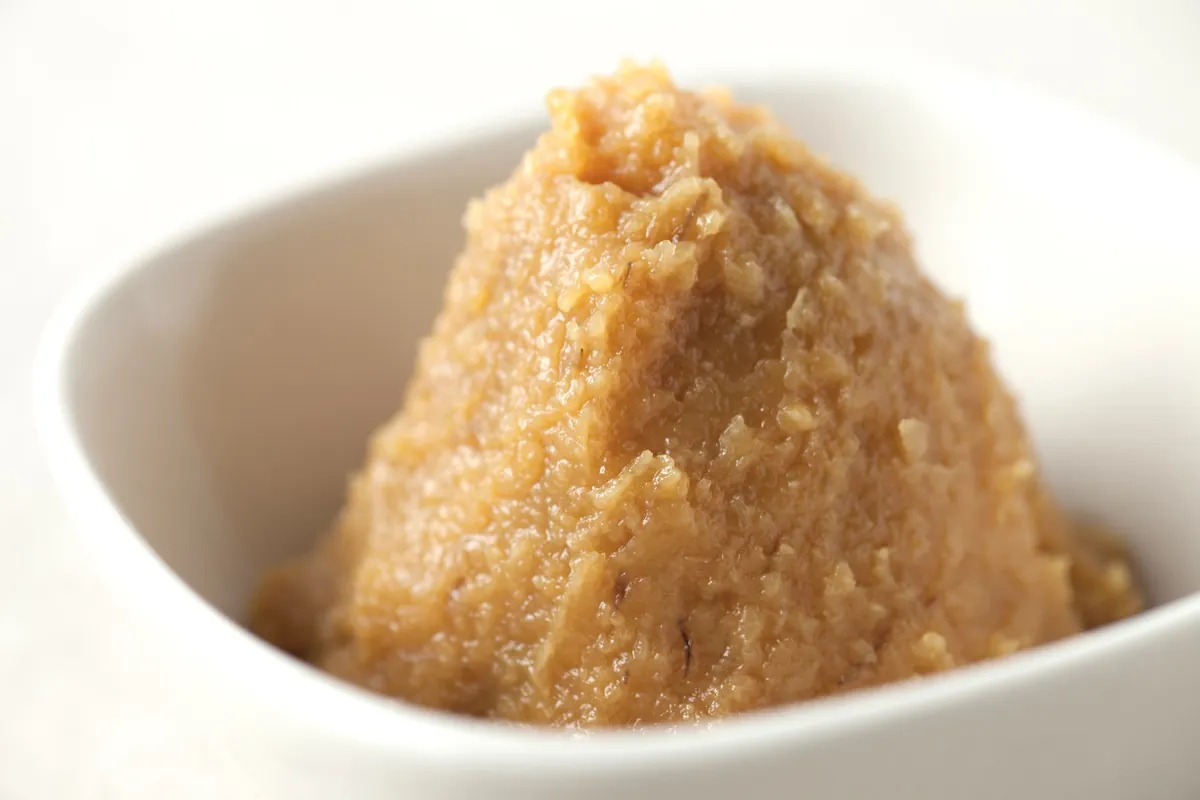
味噌(原料配合や熟成期間により甘味噌・辛口味噌・豆味噌などに区分される日本の発酵調味料)のペーストを椀に盛ったクローズアップ写真。特定の銘柄・産地を代表する写真ではない。
写っているもの: 該当分類群なし(味噌ペースト)部位・状態: 味噌ペースト、椀に盛った状態のクローズアップ
写真: publicdomainq.net/ CC0 1.0/ 原画像/ 台帳の原画像
写真の範囲と来歴
被写体の確認: 原典の記載による同定。原典(publicdomainq.net経由のCC0提供元)には品種名・産地の記載なし。「味噌」という広い名称全体の標準形として扱わない。
掲載画像: Wikimedia Commons の原寸ファイルを取得後、苦味研究所にて sips で長辺2400px程度に縮小。切り抜き・色調変更なし。 表示用には幅1200px上限のWebPを配信し、台帳の原画像は上のリンクから確認できます。
On this page (8 sections)
Reading the bitterness
Miso is a traditional Japanese fermented seasoning made by fermenting soybeans with koji mold (Aspergillus oryzae). Its types include soybean miso made with soybeans alone and rice or barley miso made by adding rice or barley koji to soybeans. A 1966 study of Hatcho miso, a soybean miso from the Okazaki area of Aichi, confirmed strong bitterness accompanied by astringency in fractions extracted with ether and butanol in a two-point preference test. The author himself explicitly cautioned 「八丁味噌の苦味は従来からペプチド,アミンのような窒素化合物によるといわれているが,まだ確証はない」 (in translation: "Hatcho miso's bitterness has traditionally been attributed to nitrogen compounds such as peptides and amines, but this remains unconfirmed"); the bitter substance itself had not been chemically isolated and identified at that time.
In its conclusion, the same study inferred from component analysis that 「八丁味噌の苦味はその成分上の特長から考えれば,大豆成分の分解により生成されるものであり,大豆蛋白に由来すると考えられるであろう」 (in translation: "Judging from its composition, the bitterness of Hatcho miso may arise through breakdown of soybean constituents and may derive from soybean protein"). Nitrogen fractionation found 41.2% of total nitrogen in the amino-acid fraction and 10.4% in the proteose-peptone fraction (relatively large intermediate fragments of protein breakdown). This is an inference without isolation or identification, however. The author also stated 「他の味噌に比べ脂質が多いので,あるいはこのものの微量成分が影響しているかも知れない」 (in translation: "Because it contains more lipids than other miso, perhaps trace lipid components may also have an effect"), leaving a lipid-derived possibility open.
The 1966 paper cites a prior 1957 study for a general rule that miso develops bitterness when the ratio of soluble to total nitrogen reaches at least 65%. Yet its measured ratio for Hatcho miso was only about 55%, and the authors recorded bitterness despite this value falling below the 65% threshold. The mismatch between the cited general rule and the bitter Hatcho miso at a lower measured ratio illustrates that soluble-nitrogen quantity alone does not fully explain whether bitterness is present.
Protein-breakdown products are not the only possible cause of miso bitterness. A 1992 study extracted and analyzed saponins (soybean glycosides) from 239 miso samples, including soybean, rice, and barley miso, submitted to the National Miso Tasting Competition. The major saponin Bb ranged from 16–173 mg% per dry weight (mean 57 mg% in salty rice miso). Content was highest in soybean miso, then lower in salty rice miso, mild rice miso, and sweet miso, in that order. However, content did not necessarily increase in proportion to the amount of soybean used; soybean processing, koji making, fermentation and aging, and other factors were considered to influence it.
Sources for this overview
大豆不快味成分と発酵食品―大豆サポニン・イソフラボン成分を中心に―
Checked for this overview: Checked the definition of miso as a soybean food fermented with koji mold. / Checked saponin Bb levels in 239 miso samples and the trend across types.
Checked for this overview: Checked the bitterness of ether- and butanol-extracted fractions and the explicit lack of confirmation. / Checked the authors' inference about soybean protein and the measured nitrogen fractions. / Checked the cited general rule associating bitterness with a soluble-nitrogen ratio of at least 65%. / Checked the exceptional measured ratio of 55% in bitter Hatcho miso.
Follow the connections
miso →— bitterness is attributed …→ bitter peptides
miso →— bitterness derives in par…→ soybean
soyasaponin group B →has a measured content in→ miso
Hypotheses and recipe candidates for this entry are on the Japanese page.
Structured claims — open a section to read each claim's confidence, evidence and limits
Composition and content (2)
Scope: Hatcho miso (soybean miso made using soybean alone)
Note: Ishii (1966) confirmed, through solvent fractionation and sensory testing, that the ether and butanol extracts of Hatcho miso show a strong bitterness (accompanied by an astringent taste), and states 「八丁味噌の苦味は従来からペプチド,アミンのような窒素化合物によるといわれているが,まだ確証はない」 (in translation: "the source states that Hatcho miso's bitterness has traditionally been attributed to nitrogen compounds such as peptides and amines, but there is not yet definitive confirmation"). The chemical isolation and identification of the bitter substance itself had not been completed as of this paper.
Show data
ingredient-miso —has_bitterness_attributed_to→ compound-class-bitter-peptidesScope: 239 miso samples entered in the National Miso Tasting Competition (soybean miso, rice miso, barley miso, and specialty miso; per dry weight)
Note: Kudo et al. (1992) analyzed the glycoside components of 239 miso samples entered in the National Miso Tasting Competition by TLC and HPLC. The content of the main saponin component Bb was highest in the order soybean miso > salty rice miso > sweet rice miso > sweet miso, and tended to be higher the higher the blending ratio of raw soybean (though not in direct proportion). Group A saponins, meanwhile, were not detected in any of the 239 miso samples analyzed, and partial deacetylation or partial degradation of the sugar chain is inferred.
Show data
compound-class-soyasaponin-group-b —has_measured_content_in→ ingredient-misoSensory (3)
Scope: The ripening process of Hatcho miso (soybean miso made using soybean alone)
Note: From the conclusion of Ishii (1966): 「八丁味噌の苦味はその成分上の特長から考えれば,大豆成分の分解により生成されるものであり,大豆蛋白に由来すると考えられるであろう」 (in translation: "judging from the compositional characteristics of Hatcho miso, its bitterness would be considered to be generated by the breakdown of soybean components, and to derive from soybean protein"). This is an inferential summary drawn by the author himself from general-component and amino-acid composition analysis, and it does not involve isolation and identification of the bitter substance. The author also notes, alongside this, the possibility that trace lipid components are involved, since Hatcho miso contains more lipid than other misos.
Show data
ingredient-miso —derives_bitterness_in_part_from→ organism-glycine-maxScope: Miso in general (the original source is a secondary citation of Yoshikawa 1957). The point of comparison is the measured value for Hatcho miso
Note: Ishii (1966) introduces the statement 「一般に味噌は可溶性窒素/全窒素の比が65%以上になると苦味を生ずるといわれている(吉川,醗工55,501(1957))」 (in translation: "the source states that, in general, miso develops bitterness when the soluble-nitrogen/total-nitrogen ratio reaches 65% or above (Yoshikawa, Hakko Kogaku 55,501 (1957))"), while also pointing out, within the same source, a mismatch between the general rule and the measured value, stating 「八丁味噌ではこの比は大体55%であるがすでに苦味がある」 (in translation: "in Hatcho miso this ratio is about 55%, yet it is already bitter"). Yoshikawa (1957) is a secondary citation; the original was not checked.
Show data
ingredient-miso —has_perceived_bitterness_associated_with→ "The soluble-nitrogen/total-nitrogen ratio reaching 65% or above (a report described as a general tendency for miso)"Scope: Water-soluble fractions (W-S, extracted with water) and butanol-soluble fractions (Bu-S) of salt-free soybean miso, soybean miso and Hatcho miso, and aqueous solutions of bitter amino acids. The panel ranged from 3 to 32 people depending on the test (8 for paired comparison, 30 for ranking, 32 for pairwise comparison, and 3 for comparison with a bitterness reference substance)
Note: These are tests on an extract of the water-soluble components of miso and on solutions of bitter amino acids, not on miso soup itself. Numerical values for the strength of bitterness are in Tables 1 to 5, but some tables can be read only as images, so the judgments in the text were used. Some tests had small panels (3 and 8 people). The text states that in an earlier report from the same research group, a sensory test of miso soup with salt and nitrogen concentrations adjusted found no difference in bitterness between salt-free soybean miso and ordinary soybean miso, so differences may not appear at the concentration of miso soup. Glutamic acid (100 mg/100 mL) also weakened the bitterness of the bitter amino acids, and worked better than aspartic acid.
Show data
ingredient-miso —has_perceived_bitterness_suppressed_by→ compound-sodium-chlorideHow processing and cooking change it (1)
Note: Kudo et al. (1992): 「味噌と醤油はAsp. oryzae(麹菌)による大豆の代表的醗酵食品である」 (in translation: "Miso and soy sauce are representative fermented soybean foods made with Asp. oryzae (koji mold)").
Show data
ingredient-miso —is_prepared_from→ organism-glycine-max