soybean
organism / organism-glycine-max
大豆 / Glycine max
Soybean, a legume seed that is a principal ingredient of traditional East Asian fermented foods such as miso, soy sauce, tofu, and natto. Seeds contain several glycoside classes (saponins and isoflavones), with composition reported to differ substantially among the seed coat, hypocotyl, and cotyledons.
Photographs (captions in Japanese)
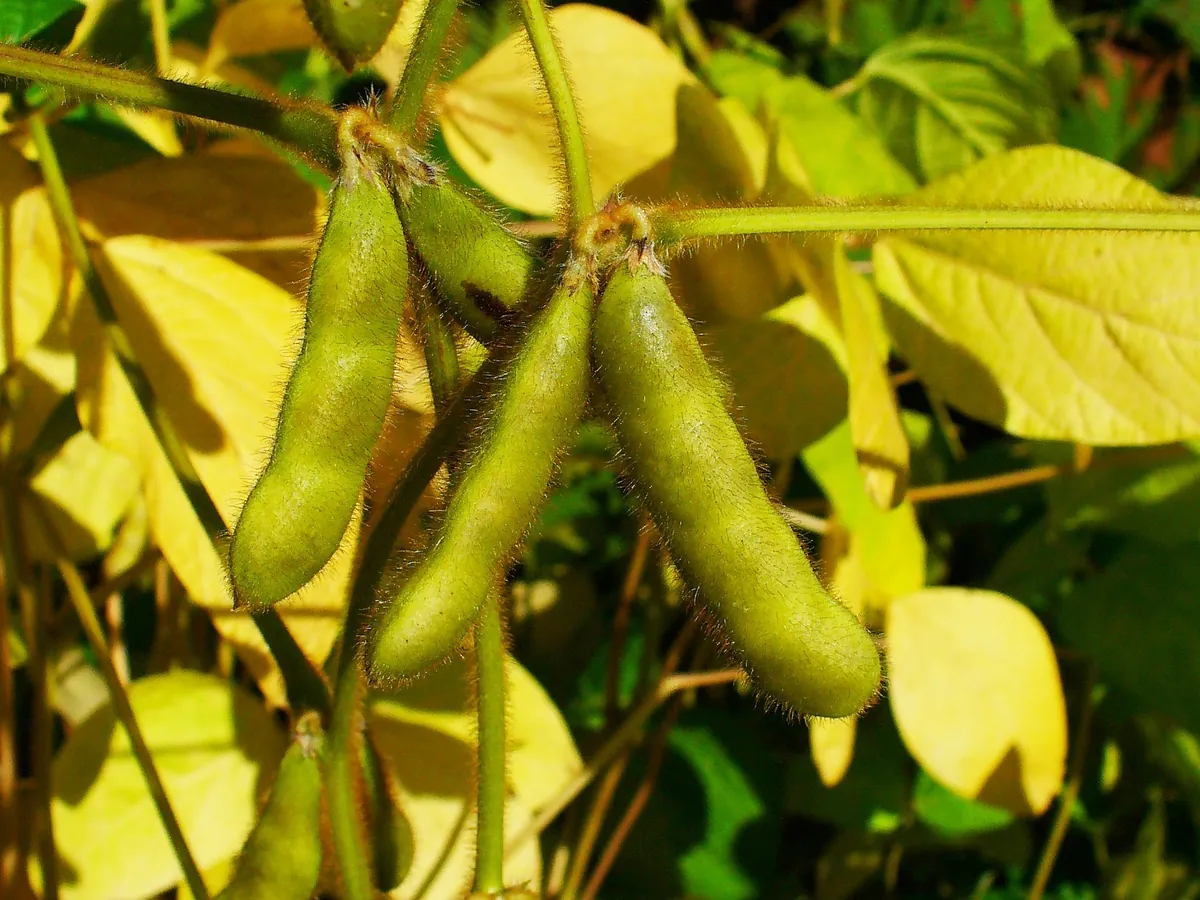
大豆(Glycine max)の莢。カールスルーエ植物園(ドイツ)にて撮影された栽培個体で、東アジア原産地での撮影ではない。
写っているもの: Glycine max部位・状態: 莢(枝付き)
写真: H. Zell/ CC BY-SA 3.0/ 原画像/ 台帳の原画像
写真の範囲と来歴
被写体の確認: 原典の記載による同定。撮影地はドイツの植物園。種としては大豆そのものであり、栽培環境が原産地と異なる点のみ留意。
掲載画像: リサイズ・トリミング・色調変更なし。Wikimedia Commons のオリジナル画像をそのまま使用。 表示用には幅1200px上限のWebPを配信し、台帳の原画像は上のリンクから確認できます。
On this page (8 sections)
Reading the bitterness
Soybean (Glycine max) is a principal ingredient of traditional East Asian fermented foods, including miso and soy sauce made through fermentation involving koji mold (Aspergillus oryzae). Miso and soy sauce are regarded as representative soybean-fermented foods involving koji. Soy sauce is described as a seasoning made chiefly from soybeans, wheat, and salt through fermentation by koji mold, lactic acid bacteria, and yeast. Soybean seeds contain several glycoside classes (saponins and isoflavones), with composition reported to differ substantially among seed coat, hypocotyl, and cotyledons.
A 1988 report states that, when enzymes cleave the sugar chains of soybean glycosides to form aglycones, taste strength shifts in opposite directions depending on the compound class. Aglycone formation in group A soybean saponins raises the taste threshold, tending to weaken unpleasant taste. By contrast, aglycone formation from isoflavone glycosides such as daidzin and genistin into daidzein and genistein lowers the threshold, tending to strengthen unpleasant taste. This is recorded as an example of the same sugar-chain cleavage shifting taste in opposite directions.
Regarding bitterness arising as Hatcho miso (a soybean-only miso) matures, a 1966 study inferred from general-component and amino-acid-composition analyses that it is generated by breakdown of soybean components and likely derives from soybean protein. Its supporting nitrogen-fraction analysis found 41.2% of total nitrogen in the amino-acid fraction and 10.4% in the proteose-peptone fraction. The bitter substance itself was not isolated or identified; the authors also noted possible involvement of trace lipid components because this miso has more lipid than other miso varieties.
Sources for this overview
大豆不快味成分と発酵食品―大豆サポニン・イソフラボン成分を中心に―
Checked for this overview: Confirmed the description of miso as a soybean food fermented with koji mold.
定量的記述分析法による市販の生しょうゆと火入れしょうゆの評価および日本のしょうゆの特徴の体系化
Checked for this overview: Confirmed the principal ingredients and fermentation microorganisms of soy sauce.
大豆のDMF(Dry Mouth Feel,あく,不快味)成分と豆腐等の食品加工におけるその挙動
Checked for this overview: Confirmed the opposing shifts in taste thresholds for saponins and isoflavones.
Checked for this overview: Confirmed the inferential conclusion concerning bitterness in Hatcho miso.
Other names: ダイズ (ja), Glycine max (la)
Follow the connections
miso →— bitterness derives in par…→ soybean
soy sauce (shoyu) →is prepared from→ soybean
Hypotheses and recipe candidates for this entry are on the Japanese page.
Structured claims — open a section to read each claim's confidence, evidence and limits
Sensory (2)
Scope: The ripening process of Hatcho miso (soybean miso made using soybean alone)
Note: From the conclusion of Ishii (1966): 「八丁味噌の苦味はその成分上の特長から考えれば,大豆成分の分解により生成されるものであり,大豆蛋白に由来すると考えられるであろう」 (in translation: "judging from the compositional characteristics of Hatcho miso, its bitterness would be considered to be generated by the breakdown of soybean components, and to derive from soybean protein"). This is an inferential summary drawn by the author himself from general-component and amino-acid composition analysis, and it does not involve isolation and identification of the bitter substance. The author also notes, alongside this, the possibility that trace lipid components are involved, since Hatcho miso contains more lipid than other misos.
Show data
ingredient-miso —derives_bitterness_in_part_from→ organism-glycine-maxScope: Sensory tests measuring taste thresholds for glycosides isolated from soybeans and their aglycones.
Show data
organism-glycine-max —has_perceived_bitterness_affected_by→ "A report describes opposing changes when enzymatic sugar-chain cleavage converts glycosides (saponins and isoflavones) to aglycones: the taste threshold for saponins rises (tending toward weaker unpleasant taste), whereas that for isoflavones falls (tending toward stronger unpleasant taste)."How processing and cooking change it (2)
Note: Kudo et al. (1992): 「味噌と醤油はAsp. oryzae(麹菌)による大豆の代表的醗酵食品である」 (in translation: "Miso and soy sauce are representative fermented soybean foods made with Asp. oryzae (koji mold)").
Show data
ingredient-miso —is_prepared_from→ organism-glycine-maxNote: Imamura and Katayama (2017): 「しょうゆは大豆,小麦,食塩を主な原材料とし,麹菌,乳酸菌,酵母による発酵を経て作られる日本の伝統的な調味料である」 (in translation: "Soy sauce is a traditional Japanese seasoning made mainly from soybeans, wheat, and salt and fermented with koji mold, lactic acid bacteria, and yeast").
Show data
ingredient-shoyu —is_prepared_from→ organism-glycine-max