Persimmon (kaki)
ingredient / ingredient-persimmon
柿 / Diospyros kaki Thunb.
Persimmon (kaki) is a deciduous fruit tree in the genus Diospyros, native to East Asia. Depending on the cultivar, astringent persimmons retain strong pulp astringency even when ripe, while non-astringent persimmons lose astringency through ripening or processing. The astringent component is soluble tannin called persimmon tannin, and its concentration accounts for astringency intensity.
Photographs (captions in Japanese)
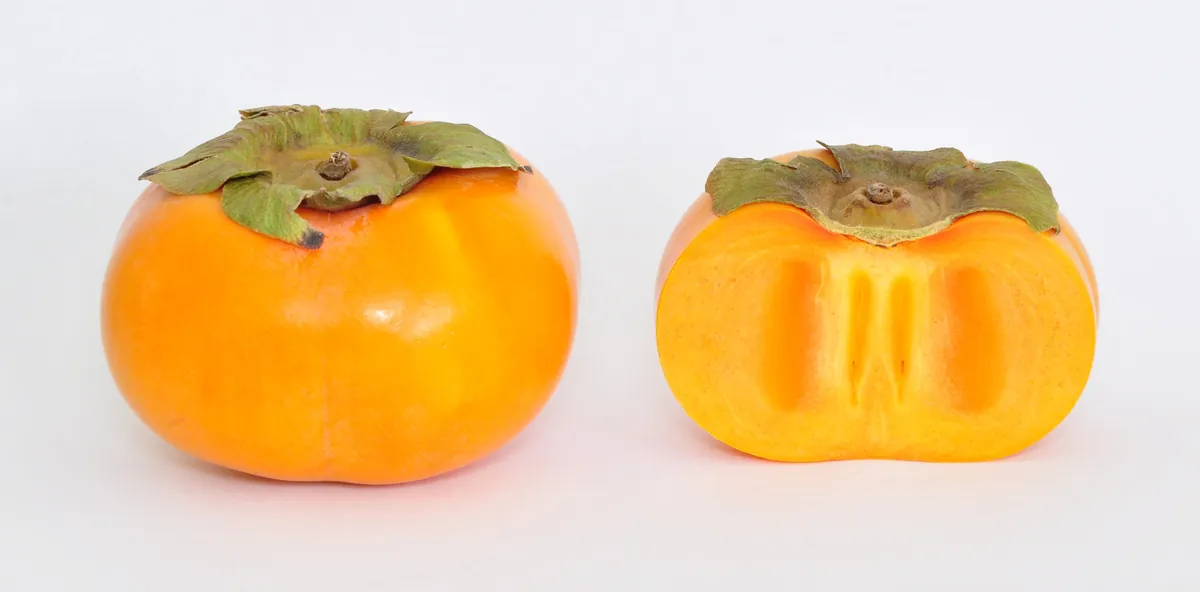
丸ごとの果実と、横半分に切って果肉を見せた甘柿の断面。
写っているもの: Diospyros kaki(甘柿系品種)部位・状態: 果実全体と横断面(種子・果肉を含む)
写真: Joe Ravi/ CC BY-SA 3.0/ 原画像/ 台帳の原画像
写真の範囲と来歴
被写体の確認: 原典の記載による同定。ファイル名は「Fuyu Persimmon」だが説明文本文は「Jiro Persimmon」と記載しており、両者の間に表記の食い違いがある。ふ有・次郎はいずれも甘柿系(不完全甘柿)の代表品種で、渋抜き不要のなめらかな果肉という点は一致している。 画像を開き、丸ごとの果実と断面の両方で、渋みを感じさせる筋や斑点のない滑らかで均質なオレンジ色の果肉を確認した。
掲載画像: Wikimedia Commons の原本を長辺2400pxへ縮小。切り抜き・色調変更なし。 表示用には幅1200px上限のWebPを配信し、台帳の原画像は上のリンクから確認できます。
On this page (10 sections)
Reading the bitterness
Persimmon is a deciduous fruit tree in the genus Diospyros, native to East Asia. Cultivars are divided into astringent persimmons, whose pulp remains strongly astringent when ripe, and non-astringent persimmons, whose astringency disappears with ripening or processing. The astringent component is a soluble tannin called persimmon tannin, whose concentration accounts for the intensity of astringency. This basic description is given similarly across astringent and non-astringent persimmons.
Persimmon cultivars are divided into 4 types by how they lose astringency: pollination-constant non-astringent (PCNA), pollination-variant non-astringent (PVNA), pollination-constant astringent (PCA), and pollination-variant astringent (PVA). Several sources use this same 4-type framework, and 'Taiten' is classified as a new PVA-type astringent cultivar.
Acetaldehyde, which triggers astringency removal, is thought to be generated by the action of pyruvate decarboxylase (PDC) or alcohol dehydrogenase (ADH). Activity of both enzymes was consistently detected during fruit growth and ripening in both astringent and non-astringent cultivars. Enzyme-activity measurements showed PDC activity to be about 100 times higher than ADH activity.
Changes in soluble tannin concentration as fruit ripens differ greatly by cultivar. The non-astringent persimmon Fuyu is extremely astringent when immature in months 6–7 (June–July), with soluble tannin at 0.7% or higher, but after month 9 (September) it falls until astringency is barely perceptible. In the astringent cultivar Hiratanenashi, soluble tannin is far more abundant than in the non-astringent cultivar in months 7–8 (July–August), then gradually declines; by month 11 (November), little difference from the non-astringent cultivar remains.
Limits have also been reported for artificial astringency-removal treatments. In an experiment treating commercial astringent persimmons with ethanol at 37°C for 24 hours, fruit with pretreatment soluble tannin of 1% or less lost astringency within 24 hours, but fruit with 3% or more did not and needed longer treatment. Among the cultivars tested, overripe Hachiya persimmon A did not lose astringency; this was inferred to be related to the absence of detectable ADH activity. A separate study reported that dry-ice treatment tended to cause peel damage and softening, with no effective method identified; ethyl-alcohol treatment could remove astringency, but a suitable method for commercial production had not yet been made sufficiently clear.
Sources for this overview
柿の脱渋に関する一考察(第2報) タンニンの不溶化及びそれに関与する酵素活性の変動
Checked for this overview: Used to support the basic description of persimmon tannin as the astringent component. / Used to support the measured result that PDC activity is about 100 times ADH activity. / Used to support the numerical seasonal-change data for Fuyu and Hiratanenashi. / Used to support the tannin-concentration-specific results on whether ethanol treatment removed astringency.
Checked for this overview: Used to support the account of high-concentration accumulation in tannin cells. / Used to support the definitions of the 4 types based on astringency loss.
Checked for this overview: Used to support the classification of 'Taiten' as a PVA-type astringent persimmon. / Used to support the description of the limits of dry-ice astringency removal.
Other names: かき (ja)
Follow the connections
persimmon tannin (kaki-tannin) →are key astringent compound…→ Persimmon (kaki)
Persimmon (kaki) →is processed by→ alcohol-based kaki de-astringing
Structured claims — open a section to read each claim's confidence, evidence and limits
Composition and content (2)
Scope: 'Fuyu' (a PCNA-type non-astringent persimmon) and 'Hiratanenashi' (an astringent persimmon), grown in Gifu Prefecture; measurements over time from June to November.
Note: Inari & Tomoeda (1992).
Show data
ingredient-persimmon —has_content_change_with_fruit_maturation→ "Even the non-astringent persimmon ('Fuyu') is extremely astringent during its immature stage in June–July, with soluble tannin concentration at 0.7% or above, but from September onward it falls to about 0.1% or below, the level at which astringency is no longer felt. The astringent persimmon's ('Hiratanenashi') soluble tannin concentration is extremely high compared to the non-astringent persimmon in July–August, but gradually decreases, and by November shows little difference from 'Fuyu'."Note: Organized as an explanatory summary by Kanzaki (2016) (the original classification is Kikuchi Akio, 1948); the same 4-type framework is also used in the original NARO paper by Yamada et al. (2012), which classifies 'Taiten' as a PVA type.
Show data
ingredient-persimmon —is_divided_into→ "4 types based on de-astringing character (the manner in which astringency is lost): PCNA (Pollination Constant Non-Astringent), PVNA (Pollination Variant Non-Astringent), PCA (Pollination Constant Astringent), and PVA (Pollination Variant Astringent)."Sensory (1)
Note: The basic framing that the astringent compound in persimmon is called kaki-tannin, and that astringency is caused by the concentration of soluble tannin. Inari & Tomoeda (1992) and Kanzaki (2016) both state this in the same way.
Show data
compound-kaki-tannin —are_key_astringents_of→ ingredient-persimmonMechanism and receptors (1)
Note: From the enzyme-activity measurement experiment of Inari & Tomoeda (1992). Samples were 'Hiratanenashi', 'Hachiya', 'Fuji', and 'Tsurunoko' as astringent persimmons, and 'Fuyu' as the non-astringent persimmon (all grown in Gifu Prefecture).
Show data
ingredient-persimmon —has_currently_proposed_mechanisms→ "Acetaldehyde is thought to be generated through the action of pyruvate decarboxylase (PDC) or alcohol dehydrogenase (ADH). In both astringent persimmons ('Hiratanenashi' and others) and non-astringent persimmons ('Fuyu'), the activity of both enzymes was present throughout growth and ripening, and PDC activity was measured to be about 100 times higher than ADH activity."How processing and cooking change it (2)
Scope: Several commercially available astringent persimmon cultivars ('Fuji', 'Tsurunoko', 'Hachiya' A/B/C), ethanol treatment at 37°C for 24 hours.
Note: When soluble tannin concentration before treatment was 3% or above, 24 hours of ethanol treatment could not de-astringe the fruit, and a longer treatment was needed. When it was 1% or below, de-astringing was achieved in 24 hours. One cultivar tested (overripe 'Hachiya' A) could not be de-astringed by ethanol treatment, which was inferred to be related to the fact that no ADH activity was detected. Inari & Tomoeda (1992).
Show data
ingredient-persimmon —is_processed_by→ process-kaki-alcohol-deastringingScope: 'Taiten' (a PVA-type astringent persimmon), a breeding trial at the NARO Institute of Fruit Tree Science.
Note: Yamada et al. (2012).
Show data
ingredient-persimmon —has_methodological_limitation→ "De-astringing with dry ice tends to cause skin injury and softening, and no effective method was found. De-astringing with ethyl alcohol is possible, but a suitable method for commercial production had not yet been fully clarified (as of 2012)."