日本語版

EVOO

ingredient / ingredient-extra-virgin-olive-oil

エキストラバージンオリーブオイル / extra virgin olive oil / Olea europaea

Virgin olive oil meeting the criteria for extra virgin classification.

Photographs (captions in Japanese)
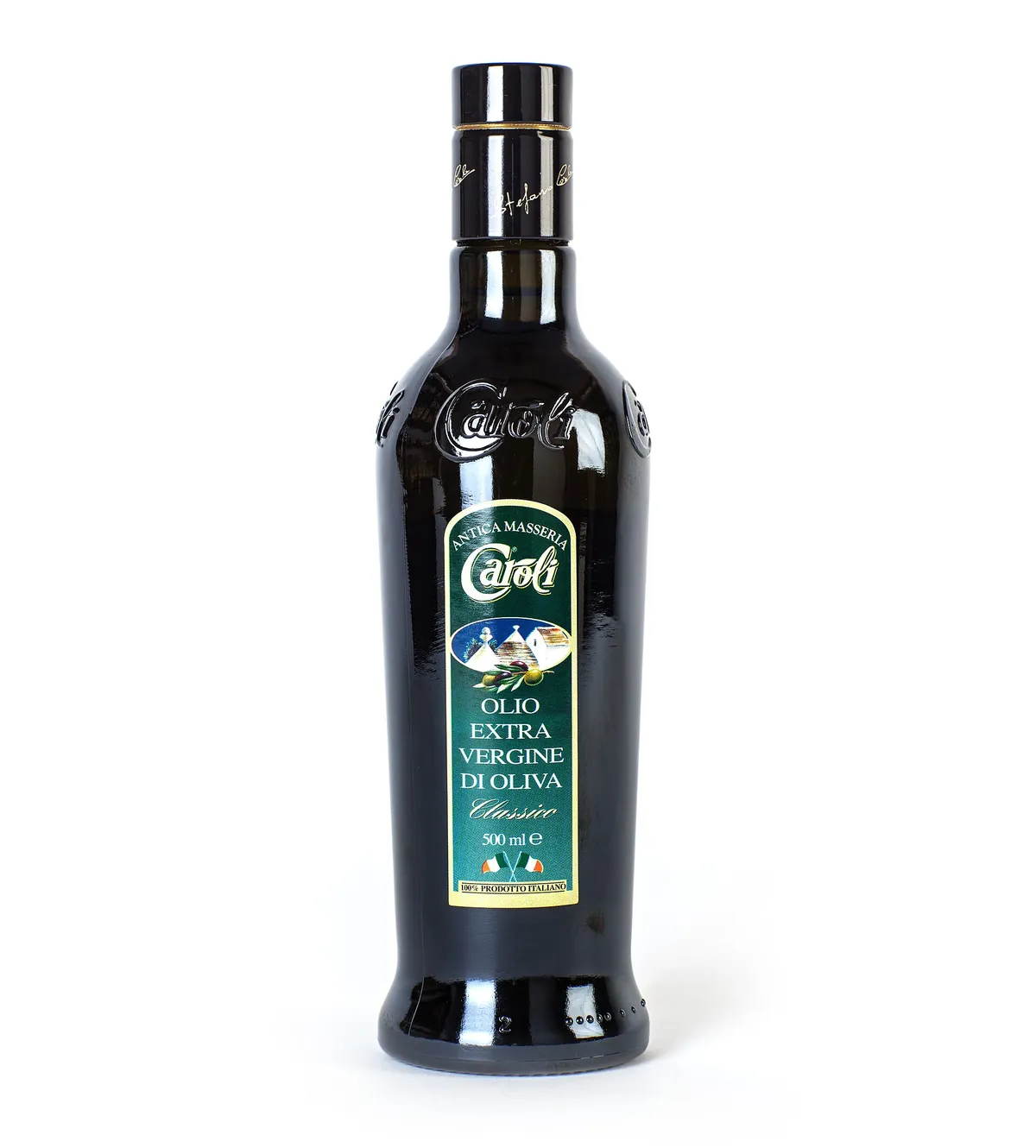
白背景の中央に、濃い緑褐色のガラス瓶が直立している。瓶の中ほどに緑を基調としたラベルがあり、金文字とオリーブの図柄とともにイタリア国旗が描かれている。

エキストラバージンオリーブオイル(Olea europaea由来)の市販ボトル。イタリア・プーリア州のブランド「Caroli」による500ml入りで、ラベルに「OLIO EXTRA VERGINE DI OLIVA」の表示がある。

写っているもの: Olea europaea部位・状態: 「Olio Extra Vergine di Oliva」と表示された市販ボトル入りエキストラバージンオリーブオイル(500ml、イタリア・プーリア産)

写真: Caroliusa/ CC BY-SA 4.0/ 原画像/ 台帳の原画像

写真の範囲と来歴

被写体の確認: 原典の記載による同定。特定商品ブランドのボトル写真であり、エキストラバージンオリーブオイル全般の外観を代表するものではない。液色・風味は容器越しに判別できない。

掲載画像: Wikimedia Commons の1920px版。苦味研究所では切り抜き・色調変更なし。 表示用には幅1200px上限のWebPを配信し、台帳の原画像は上のリンクから確認できます。

On this page (8 sections)
  1. Overview
  2. Sources for this overview (6)
  3. Topic hubs
  4. Follow the connections
  5. Related entries (10)
  6. Composition and content (1)
  7. Sensory (4)
  8. Safety and regulation (2)
↑

Reading the bitterness

Extra virgin olive oil refers to the most stringently-graded among virgin olive oils. In the international organoleptic evaluation method (IOC method, Rev. 11 as of 2024 revision), fruity, bitter, and pungent (a pricking sensation) are positioned as three positive attributes of the oil; bitterness is described as a primary taste perceived at the circumvallate papillae, characteristic of oils pressed from green or greenish olives. Pungency is characteristic of oils produced early in the harvest year and is recorded as a pricking tactile sensation felt especially in the throat.

However, bitterness and pungency are optional labelling terms (robust if the trained-panel median exceeds 6.0, medium if above 3.0 and at most 6.0, delicate if 3.0 or below) and are not mandatory requirements for the extra virgin grade itself. The IOC method grades oils by defect median = 0.0 and fruity-attribute median > 0.0, which aligns with EU sales standards (defect median Md = 0.0, fruitiness median Mf > 0.0). Mild oils with bitterness and pungency medians of 2.0 or less can equally be certified as extra virgin.

In a study analysing 100 extra virgin olive oils from 8 countries, 19 phenolic compounds were quantified; total phenol content ranged approximately from 52 to 315 mg GAE/kg, with oleocanthal and oleacein the most abundant at mean 77.9 mg/kg and 41.8 mg/kg respectively. In the same study, bitterness intensity showed the strongest correlation with total phenol content (r = 0.72) and also correlated with 3,4-DHPEA-EA (oleuropein aglycone, a secoiridoid) (r = 0.57); however, the paper attributes the coefficient to 3,4-DHPEA-EA in the abstract while the discussion section refers to it as 「オレウロペイン」 (in translation: "oleuropein"), leaving ambiguity—whether the correlation was to glycoside or aglycone remains unresolved within the paper itself.

Which phenolic compound is the primary driver of bitterness remains disputed across studies. A study examining 20 extra virgin oils of varying bitterness intensity reported that both oleuropein aglycone and ligstroside aglycone (in both dialdehyde and aldehyde forms) jointly contribute to bitterness, while a separate study found results strongly supporting dependence on oleuropein aglycone (3,4-DHPEA-EA). Attempts have been made to predict bitterness from chemical indicators alone; one study found that bitterness intensity could be adequately predicted from the spectrophotometric absorbance at 225 nm (K225) and total phenol content, but the functional forms of reported models differ across studies, and no single calibration equation has yet been established.

Sources for this overview

  1. Sensory analysis of olive oil - Method for the organoleptic assessment of virgin olive oil (COI/T.20/Doc. No 15/Rev. 11)

    International Olive Council / 2024 / standard / full text checked

    Checked for this overview: Verified the IOC method's definition of bitterness and pungency as positive attributes / Verified the statement that bitterness is not a grading criterion / Verified the IOC method grading criteria based on defect and fruitiness medians

  2. Commission Delegated Regulation (EU) 2022/2104 supplementing Regulation (EU) No 1308/2013 as regards marketing standards for olive oil

    European Commission / 2022 / government document / full text checked

    Checked for this overview: Verified the EU sales standards for Md and Mf threshold values

  3. Characterization of Phenolic Compounds and Their Contribution to Sensory Properties of Olive Oil

    Pedan V; Popp M; Rohn S; Nyfeler M; Bongartz A / 2019 / journal article / full text checked

    Checked for this overview: Verified phenol quantification and oleocanthal content from the analysis of 100 samples / Verified the correlation coefficients between bitterness intensity and total phenol and 3,4-DHPEA-EA

  4. Main polyphenols in the bitter taste of virgin olive oil. Structural confirmation by on-line high-performance liquid chromatography electrospray ionization mass spectrometry

    Gutierrez-Rosales F; Rios JJ; Gomez-Rey ML / 2003 / journal article / abstract checked

    Checked for this overview: Verified the reported joint involvement of 2 aglycone types in 20-sample study

  5. Bitter taste and phenolic compounds in extra virgin olive oil: an empirical relationship

    Siliani S; Mattei A; Benevieri Innocenti L; Zanoni B / 2006 / journal article / abstract checked

    Checked for this overview: Verified the competing claim of oleuropein aglycone dependence / Verified the exponential model prediction approach

  6. Extra virgin olive oil bitterness evaluation by sensory and chemical analyses

    Favati F; Condelli N; Galgano F; Caruso MC / 2013 / journal article / abstract checked

    Checked for this overview: Verified the K225 and total phenol bitterness prediction model

Follow the connections

EVOO →contains→ olive oil phenolic compounds →is correlated with→ bitterness

Structured claims — open a section to read each claim's confidence, evidence and limits

Composition and content (1)

EVOO contains olive oil phenolic compoundsestablished

Scope: 100 oils in the cited composition study

Note: The specific compounds and their concentrations vary by cultivar, ripeness, and processing method.

100 extra virgin olive oil samples (single cultivars and blends) from 8 countries (Italy 28, Spain 27, Greece 15, Portugal 11, Croatia 3, France 1, United States 3, China 2) were quantified for 19 phenolic compounds; total phenol content in the range of approximately 52 to 315 mg GAE/kg. Verbatim: "oleocanthal and oleacein were the most abundant phenolic compounds, with average amounts of 77.9 mg/kg and 41.8 mg/kg, respectively."
Limitations: Sampling does not cover all oils; the number of panelists is not stated in the text.
Source: Characterization of Phenolic Compounds and Their Contribution to Sensory Properties of Olive Oil (Pedan V; Popp M; Rohn S; Nyfeler M; Bongartz A, 2019) · full text checked
Show dataingredient-extra-virgin-olive-oil —contains→ compound-olive-phenolics
claim: clm-evoo-phenolics / type: composition / updated: 2026-08-30

Sensory (4)

EVOO — bitterness is attributed to: secoiridoid aglycones: the dialdehyde and aldehyde forms of oleuropein aglycone and ligstroside aglyconecontested

Scope: Panel-assessed bitterness versus HPLC-ESI-MS-confirmed phenols in extra-quality virgin olive oil

Note: Studies disagree on which aglycone is dominant: Gutierrez-Rosales 2003 shows joint involvement of oleuropein- and ligstroside-type aglycone forms, while Siliani 2006 finds the correlation depends mainly on the oleuropein aglycone (3,4-DHPEA-EA).

The bitterness intensity perceived by assessors was analyzed by linear regression against the concentration (mmol/kg) of the dialdehyde and aldehyde forms of oleuropein aglycone and ligstroside aglycone (structures confirmed by on-line HPLC-ESI-CID-MS); the authors conclude that these compounds play an essential role in virgin olive oil's bitterness.
Limitations: The abstract's wording on the regression variables is garbled; the regression coefficients are not given in the abstract.
Contradicts: While confirming a positive correlation between total phenol content and bitterness intensity, the study finds that this correlation significantly depends on the relationship between the oleuropein aglycone (3,4-DHPEA-EA) and bitterness intensity, and states that the contribution of individual phenols to bitterness is not clearly defined.
Limitations: The abstract was obtained only via OpenAlex. The degree of conflict with the 4-aglycone attribution cannot be quantified from the abstract alone.
Source: Bitter taste and phenolic compounds in extra virgin olive oil: an empirical relationship (Siliani S; Mattei A; Benevieri Innocenti L; Zanoni B, 2006) · abstract checked
Across 100 extra virgin olive oil samples, bitterness intensity correlated most strongly with total phenolic content (verbatim: "r = 0.72 and in particular, for 3,4-DHPEA-EA, with r = 0.57"). p-HPEA-EA showed a correlation of 0.46 with bitterness and 0.37 with pungency, and the discussion lists p-HPEA-EA and oleuropein as the phenolic compounds contributing most to bitterness and pungency sensations.
Limitations: This is correlational rather than a reconstitution or omission trial. The abstract attributes r = 0.57 to 3,4-DHPEA-EA, but the discussion cites "oleuropein" for the same coefficient, leaving it ambiguous whether the analyzed compound is named as the glycoside or the aglycone. The panel size is not stated in the body text. This leans toward the oleuropein-aglycone-centered attribution (Siliani 2006), but it does not conflict with the joint 4-aglycone attribution (Gutierrez-Rosales 2003).
Source: Characterization of Phenolic Compounds and Their Contribution to Sensory Properties of Olive Oil (Pedan V; Popp M; Rohn S; Nyfeler M; Bongartz A, 2019) · full text checked
Show dataingredient-extra-virgin-olive-oil —has_bitterness_attributed_to→ "secoiridoid aglycones: the dialdehyde and aldehyde forms of oleuropein aglycone and ligstroside aglycone"
claim: clm-evoo-bitterness-aglycones / type: sensory / updated: 2026-08-30
EVOO bitterness_predictable_from Phenol-related chemical indicators (K225 spectrophotometric value, total phenol content, individual secoiridoid aglycones)supported

Scope: Blended and single-cultivar extra virgin olive oil from studies in Italy and Spain

Note: Reported functional forms differ across studies (linear regression, validated exponential model, K225-based prediction). A single calibration has not been established.

A bitterness prediction model was constructed and validated on the basis of the relationship between perceived bitterness and chemical indicators (total phenol content and K225 absorbance value measured spectrophotometrically at 225 nm), and bitterness intensity was adequately predicted using the K225 value.
Limitations: The abstract reports neither the model functional form nor error statistics.
Source: Extra virgin olive oil bitterness evaluation by sensory and chemical analyses (Favati F; Condelli N; Galgano F; Caruso MC, 2013) · abstract checked
An empirical exponential model relating phenol concentration to bitterness intensity was constructed and validated.
Limitations: Model parameters are not available from the abstract; the exponential form differs from the linear approach reported elsewhere.
Source: Bitter taste and phenolic compounds in extra virgin olive oil: an empirical relationship (Siliani S; Mattei A; Benevieri Innocenti L; Zanoni B, 2006) · abstract checked
Show dataingredient-extra-virgin-olive-oil —bitterness_predictable_from→ "Phenol-related chemical indicators (K225 spectrophotometric value, total phenol content, individual secoiridoid aglycones)"
claim: clm-evoo-bitterness-prediction / type: sensory / updated: 2026-08-30
EVOO — perceived bitterness is affected by: Irrigation treatment (cv. Coratina, improved karst soil in Croatia, 2 harvest years): oil from the rainfed plot (C, 0 L/tree of irrigation water) showed robust bitterness and pungency intensity (both above 6 on the 10 cm scale). In the irrigated plots (T1: 448 L/tree in 2019, 1,393 L/tree in 2020; T2: 560 L/tree in 2019, 1,261 L/tree in 2020; T3 = 100% ETc: 800 L/tree in 2019, 1,800 L/tree in 2020), bitterness and pungency intensity fell slightly compared with the rainfed plot (a significant difference in 2019, no significant difference in 2020). No significant difference in bitterness was detected among the irrigated plots themselves.supported

Scope: Cv. Coratina olives, a field trial on improved coastal karst soil in Croatia, 2 harvest years (2019-2020)

Note: Sensory evaluation was by an IOC (International Olive Council)-recognized descriptive sensory panel of 8 assessors (5 women, 3 men, average age 33), trained to comply with the IOC method, using a 0-10 cm unstructured intensity scale. Total phenol and secoiridoid concentrations showed no significant difference between irrigated and non-irrigated (chemical composition is covered in a separate claim).

Bitterness and pungency in the rainfed plot were robust (above 6 on the 0-10 cm scale). Irrigation treatment slightly lowered bitterness and pungency, but significance differed by year, and differences among the irrigated plots themselves were not significant.
Limitations: Data from 2 harvest years at a single field, 1 site in Croatia, and a single cultivar. Whether the bitterness difference among irrigation treatments is significant does not agree from year to year.
Source: Effect of Different Watering Regimes on Olive Oil Quality and Composition of Coratina Cultivar Olives Grown on Karst Soil in Croatia (Brkić Bubola K; Kolega Š; Marcelić Š; Šikić Z; Gašparović Pinto A; Zorica M; Klisović D; Novoselić A; Jukić Špika M; Kos T, 2022) · full text checked
Show dataingredient-extra-virgin-olive-oil —has_perceived_bitterness_affected_by→ "Irrigation treatment (cv. Coratina, improved karst soil in Croatia, 2 harvest years): oil from the rainfed plot (C, 0 L/tree of irrigation water) showed robust bitterness and pungency intensity (both above 6 on the 10 cm scale). In the irrigated plots (T1: 448 L/tree in 2019, 1,393 L/tree in 2020; T2: 560 L/tree in 2019, 1,261 L/tree in 2020; T3 = 100% ETc: 800 L/tree in 2019, 1,800 L/tree in 2020), bitterness and pungency intensity fell slightly compared with the rainfed plot (a significant difference in 2019, no significant difference in 2020). No significant difference in bitterness was detected among the irrigated plots themselves."
claim: clm-coratina-evoo-irrigation-bitterness / type: sensory / updated: 2026-09-02
EVOO — perceived bitterness is affected by: Regulated deficit irrigation (RDI) on 'Arbequina' olive: relative to control T0 (100% ETc), in Optimal RDI (T1, 58% reduction in total irrigation during growth stage II), multiple sensory attributes including fruity-olive, fruity-green, floral, green-grass, and bitterness all declined. In Confederation RDI (T2, 66% reduction in the same stage), fruity-olive, fruity-green, and green-herb attributes increased, with no mention of bitterness. Across all deficit-irrigation plots compared with control, green-herb aroma and acidity were weaker, while almond and walnut aromas and sweetness increased.supported

Scope: 'Arbequina' olive cultivar, Spain, field trial in a single harvest year

Note: Sensory evaluation was performed by an ENAC-accredited official panel (for commercial quality grading) and by a university-affiliated descriptive panel of 8 assessors (4 women, 4 men, ages 25-55, trained to 600+ hours). Statistics: 3-way ANOVA (irrigation treatment × session × assessor).

In the Optimal RDI (T1) plot, multiple attributes including bitterness declined relative to the control. In the Confederation RDI (T2) plot, fruity components increased with no mention of bitterness.
Limitations: Results from a single cultivar, single year, and single location. Attributes other than bitterness may increase with treatment, and the direction of change differs by attribute.
Source: Quality Attributes and Fatty Acid, Volatile and Sensory Profiles of "Arbequina" hydroSOStainable Olive Oil (Sánchez-Rodríguez L; Kranjac M; Marijanović Z; Jerković I; Corell M; Moriana A; Carbonell-Barrachina ÁA; Sendra E; Hernández F, 2019) · full text checked
Show dataingredient-extra-virgin-olive-oil —has_perceived_bitterness_affected_by→ "Regulated deficit irrigation (RDI) on 'Arbequina' olive: relative to control T0 (100% ETc), in Optimal RDI (T1, 58% reduction in total irrigation during growth stage II), multiple sensory attributes including fruity-olive, fruity-green, floral, green-grass, and bitterness all declined. In Confederation RDI (T2, 66% reduction in the same stage), fruity-olive, fruity-green, and green-herb attributes increased, with no mention of bitterness. Across all deficit-irrigation plots compared with control, green-herb aroma and acidity were weaker, while almond and walnut aromas and sweetness increased."
claim: clm-arbequina-hydrosostainable-rdi-bitterness / type: sensory / updated: 2026-09-02

Safety and regulation (2)

EVOO — positive sensory attributes: Bitterness and pungency, together with fruitiness, are positive attributes in the IOC sensory assessment method (COI/T.20/Doc. No 15/Rev. 11)established

Scope: The IOC method for the sensory assessment of virgin olive oil, Rev. 11 (June 2024)

Note: The optional labelling terms robust (median > 6.0), medium (3.0 < Me <= 6.0), and delicate (<= 3.0) apply to bitterness and pungency. This is the structural mirror image of table-olive debittering, which removes the same phenolic compounds.

Section 4.3 lists fruity, bitter, and pungent as positive attributes: bitter is the primary taste characteristic of oil obtained from green or turning olives, perceived by the circumvallate papillae; pungent is the stinging tactile sensation characteristic of oil produced early in the harvest year, perceived especially in the throat. Section 4.4 defines the labelling terms robust (median > 6.0), medium (3.0-6.0), and delicate (< 3.0).
Limitations: Read directly from the official PDF (pages 1-10); the annex pages have not been read.
Limits: Bitterness and pungency are included in this method as positive attributes and as optional labelling terms, but the category classification itself uses only the medians of defects and fruitiness, so a mild oil (with a bitterness/pungency median of 2.0 or below) can be certified in the same category.
Limitations: Being a positive attribute therefore does not mean bitterness is required for the extra virgin grade.
"Amaro: Sapore elementare caratteristico dell'olio ottenuto da olive verdi o invaiate, percepito dalle papille caliciformi che formano la V linguale" (a primary taste characteristic of oil obtained from green or turning olives, perceived by the circumvallate papillae that form the tongue's V). The same section lists Fruttato, Amaro, and Piccante as positive attributes (attributi positivi). Section 4.4 sets the labelling-term thresholds Amaro leggero (median <= 3.0), medio (3.0 < Me <= 6.0), and intenso (> 6.0).
Limitations: The original-language (Italian) wording of the same document referenced in the related evidence entry (English version). Only pages 1-10 have been read; the annex has not been read.
Show dataingredient-extra-virgin-olive-oil —has_positive_sensory_attributes→ "Bitterness and pungency, together with fruitiness, are positive attributes in the IOC sensory assessment method (COI/T.20/Doc. No 15/Rev. 11)"
claim: clm-evoo-bitter-pungent-positive / type: regulatory / updated: 2026-08-30
EVOO is graded by: Median defect = 0.0 and median fruitiness attribute > 0.0 (IOC method, section 10.4). The medians of bitterness and pungency are not category criteriaestablished

Scope: The IOC sensory classification of virgin olive oil

Note: Bitterness is a positive attribute that may be labelled, but it is not a requirement for the extra virgin grade.

Extra virgin olive oil is graded when the median of defects is 0.0 and the median of the fruitiness attribute is above 0.0; virgin olive oil is graded when the median of defects is above 0.0 and at most 3.5, with fruitiness above 0.0.
Limitations: The EU regulatory counterpart (Reg. 2568/91 and its successors) was not checked in this survey.
The EU marketing standard grades extra virgin olive oil at Md = 0,0 and Mf > 0,0, and virgin olive oil at Md <= 3,5 and Mf > 0,0. Md is the median of defects and Mf the median of fruitiness, determined in accordance with Implementing Regulation (EU) 2022/2105. The medians of bitterness and pungency do not appear in the grading criteria.
Limitations: The row for the virgin category can be read as Md <= 3,5 with no explicit lower bound (the boundary with extra virgin follows from category 1). Physicochemical criteria are also applied jointly. The EU framework is harmonized with the IOC method; it is convergence of regulation rather than a fully independent measurement system.
Show dataingredient-extra-virgin-olive-oil —is_classified_by→ "Median defect = 0.0 and median fruitiness attribute > 0.0 (IOC method, section 10.4). The medians of bitterness and pungency are not category criteria"
claim: clm-evoo-classification-defects-fruity / type: regulatory / updated: 2026-08-30

↑ Top of page · ← Encyclopedia (English entries)