日本語版

spilanthol

compound / compound-spilanthol

スピラントール

Spilanthol is an unsaturated alkylamide abundant in Acmella oleracea.

Photographs (captions in Japanese)
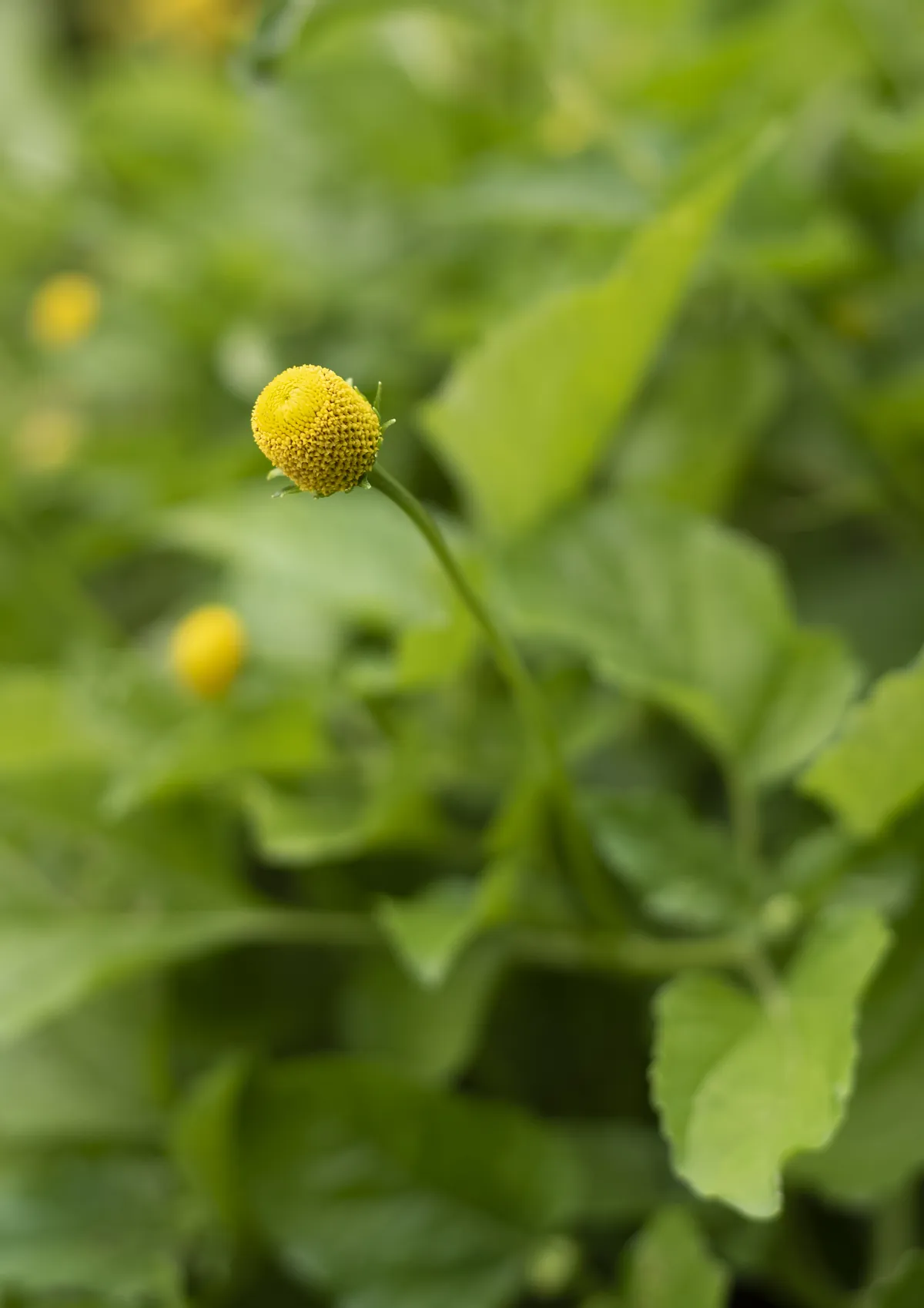
黄色く先端が赤みを帯びた円錐形の花が接写されている写真

Acmella oleracea(トゥースエイクプラント、buzz buttons)の花。spilanthol はこの植物に多く含まれる不飽和アルキルアミドであり、化合物そのものではなく給源植物の写真である。

原料写っているもの: Acmella oleracea(トゥースエイクプラント)部位・状態: 花

写真: Sixflashphoto/ CC BY-SA 4.0/ 原画像/ 台帳の原画像

写真の範囲と来歴

被写体の確認: 原典の記載による同定。organism-acmella で使用した写真とは別ファイル(重複回避)。

掲載画像: Wikimedia Commons の原寸ファイル。苦味研究所では切り抜き・色調変更なし。 表示用には幅1200px上限のWebPを配信し、台帳の原画像は上のリンクから確認できます。

On this page (8 sections)
  1. Overview
  2. Sources for this overview (3)
  3. Topic hubs
  4. Follow the connections
  5. Related entries (10)
  6. Composition and content (1)
  7. Sensory (4)
  8. Mechanism and receptors (1)
↑

Reading the bitterness

Spilanthol is an unsaturated alkylamide (a class of compounds derived from fatty acids) abundant in Acmella oleracea, a member of the Asteraceae family. There is no record in this database of this compound itself being a bitter taste component; rather, what is tracked is a distinct oral sensation separate from bitterness: a tingling, pungent, or numbing sensation in the mouth. When whole flower buds are placed in the mouth, an initial grassy flavor is recorded, followed by an intense numbing sensation, excessive salivation, and a cooling effect in the throat.

In an experiment using isolated taste receptor cells (TBCs) from mice, spilanthol was shown to enhance responses to sodium chloride (NaCl). When 1222 isolated taste cells were presented with NaCl and KCl and their responses measured by calcium imaging, 72.8% (134 of 184 cells) of the NaCl-responsive cells showed greater magnitude responses to a mixture of NaCl and spilanthol than to NaCl alone. Responses to 140 millimolar NaCl were significantly enhanced by 3 micromolar spilanthol, and the enhancement was concentrated in Type III cells. Enhancement in trigeminal neurons was minimal, and was significant only when 200 millimolar NaCl and 6 micromolar spilanthol were combined.

Tingling, pungency, and numbing are recorded as distinct sensations attributed by review articles to spilanthol and structurally related alkylamides. However, these descriptions appear only in the literature review section at the introduction of the studies, not in the experimental results. The experiments themselves, using taste receptor cells or trigeminal neurons, did not measure the tingling or numbing sensations felt in the human mouth. For saltiness enhancement as well, evidence in humans is limited to preliminary, unpublished observations using split-tongue methods, and the records caution against inferring human effects from these experimental results.

In reviews of Acmella oleracea research, spilanthol is positioned alongside other alkylamides as a central component in the botanical literature, and Thailand's medicinal plant database lists it among the active constituents of the same species. However, content varies greatly by plant part, geographic source, and extraction method, and a value of 16.50 milligrams per gram of dry weight has been reported for flower extracts. This content measurement is limited to summary-level confirmation, and the full text of a primary quantitative study supporting differences in content between plant parts has not yet been appended.

Sources for this overview

  1. Botany, Ethnopharmacology, Phytochemistry, and Biological Activities of Acmella oleracea: A Comprehensive Review

    Lee BW / 2026 / review / full text checked

    Checked for this overview: Confirmed the description from bud flavor to numbing sensation upon ingestion / Confirmed the description of review positioning spilanthol as a central component / Confirmed the example of 16.50 milligrams per gram content in flower extract

  2. Spilanthol Enhances Sensitivity to Sodium in Mouse Taste Bud Cells

    Xu J; Lewandowski BC; Miyazawa T; Shoji Y; Yee K; Bryant BP / 2019 / journal article / full text checked

    Checked for this overview: Confirmed the numerical values of response magnitude and significance levels in mouse taste cells / Confirmed the description of tingling as one of the sensations attributed / Confirmed the description of pungency as one of the sensations attributed / Confirmed the description of numbing as one of the sensations attributed / Confirmed the limitation that human split-tongue data is preliminary and unpublished

  3. การสกัดผักคราดหัวแหวน

    Mahidol University Medicinal Plant Information Center / 2019 / academic database / full text checked

    Checked for this overview: Confirmed the description from Thailand's medicinal plant page listing it as an active constituent

Follow the connections

spilanthol →is associated with→ tingling

spilanthol →is associated with→ pungency

spilanthol →is associated with→ numbing

Structured claims — open a section to read each claim's confidence, evidence and limits

Composition and content (1)

toothache plant contains spilantholsupported

Scope: Acmella oleracea plant material as reviewed in the cited source

Note: Content varies with plant part, geographic source, and extraction method. These factors require measurement records. / 2026-08-31: calibration downgrade from established to supported because the supporting evidence does not derive from full-text confirmation. Eligible for re-upgrade after full-text verification.

This review identifies alkylamides as a major constituent group of Acmella and positions spilanthol at the center of the botanical literature on the species.
Limitations: Primary quantitative research should be appended for organ-specific content.
Context: Mahidol University's medicinal plant page explicitly lists spilanthol as the corresponding active constituent of Acmella oleracea.
Limitations: Secondary source.
Source: การสกัดผักคราดหัวแหวน (Mahidol University Medicinal Plant Information Center, 2019) · full text checked
Show dataorganism-acmella —contains→ compound-spilanthol
claim: clm-acmella-spilanthol / type: composition / updated: 2026-08-31

Sensory (4)

spilanthol is associated with Tingling, pungency, and numbing in the oral cavitysupported

Scope: Acmella and spilanthol literature as summarized by cited sources

Note: Intensity, time course, and human dose-response have not yet been recorded here.

Verbatim: 'Ingesting a whole bud results in an initial grassy flavor, followed by an intense numbing sensation, excessive salivation, and a cooling effect in the throat.' Verbatim: 'As NAAs containing plants generally exhibit a pungent taste, numbness, and tingling sensation'. The review identifies spilanthol as a major alkylamide. Verbatim: 'For the quantitative analysis of major NAAs, spilanthol (6) has the highest proportion in flower' (for example, the table data shows 16.50 mg/g dry weight in flower extract).
Limitations: Flavor descriptions rely on ethnobotanical and culinary records, not controlled human sensory trials; the only cited clinical study (SA3X capsule in 240 males) did not evaluate oral sensations. Quantitative spilanthol content values vary greatly with extraction method.
Context: Verbatim: 'Spilanthol and several structurally related unsaturated fatty acid amides induce a variety of somatosensory sensations, including pungency, tingling, buzzing, numbing, mouthwatering, and/or cooling sensations'. The Discussion adds preliminary, unpublished human split-tongue observations showing that subthreshold spilanthol may enhance NaCl saltiness perception, connecting this compound's oral sensory profile to a role in taste modification.
Limitations: Attribution of oral sensations relies on the literature. The experiments used mouse taste receptor cells and trigeminal neurons; human split-tongue data are described as preliminary and unpublished.
Source: Spilanthol Enhances Sensitivity to Sodium in Mouse Taste Bud Cells (Xu J; Lewandowski BC; Miyazawa T; Shoji Y; Yee K; Bryant BP, 2019) · full text checked
Show datacompound-spilanthol —is_associated_with→ "Tingling, pungency, and numbing in the oral cavity"
claim: clm-spilanthol-oral / type: sensory / updated: 2026-08-30
spilanthol is associated with tinglingsupported

Scope: Oral spilanthol exposure as described in background sections of the literature

Note: Human time-intensity studies are still needed in this database.

Verbatim: "Spilanthol and several structurally related unsaturated fatty acid amides induce a variety of somatosensory sensations, including pungency, tingling, buzzing, numbing, mouthwatering, and/or cooling sensations"(in translation: 'Spilanthol and several structurally related unsaturated fatty acid amides induce a variety of somatosensory sensations, including pungency, tingling, buzzing, numbing, mouthwatering, and/or cooling sensations'). The full text confirms that tingling is among the literature-supported sensations attributed to spilanthol and related alkylamides.
Limitations: The statement appears in the literature review of the introduction and is not from the study's own experiments. The research itself, using mouse taste cells and trigeminal neurons, did not measure human tingling. Human dose-response for tingling sensations is beyond the scope of this source.
Source: Spilanthol Enhances Sensitivity to Sodium in Mouse Taste Bud Cells (Xu J; Lewandowski BC; Miyazawa T; Shoji Y; Yee K; Bryant BP, 2019) · full text checked
Show datacompound-spilanthol —is_associated_with→ sensation-tingling
claim: clm-spilanthol-tingling / type: sensory / updated: 2026-08-30
spilanthol is associated with pungencysupported

Scope: Oral spilanthol exposure as described in background sections of the literature

Note: Human time-intensity studies are still needed in this database.

Verbatim: 'Spilanthol and several structurally related unsaturated fatty acid amides induce a variety of somatosensory sensations, including pungency, tingling, buzzing, numbing, mouthwatering, and/or cooling sensations'. Pungency is listed first among the sensations the paper attributes to spilanthol and related alkylamides.
Limitations: This is a literature statement at the introduction level, not a finding from the study's own mouse cell experiments, which did not quantify human pungency.
Source: Spilanthol Enhances Sensitivity to Sodium in Mouse Taste Bud Cells (Xu J; Lewandowski BC; Miyazawa T; Shoji Y; Yee K; Bryant BP, 2019) · full text checked
Show datacompound-spilanthol —is_associated_with→ sensation-pungent
claim: clm-spilanthol-pungent / type: sensory / updated: 2026-08-30
spilanthol is associated with numbingsupported

Scope: Oral spilanthol exposure as described in background sections of the literature

Note: Human time-intensity studies are still needed in this database.

Verbatim: 'Spilanthol and several structurally related unsaturated fatty acid amides induce a variety of somatosensory sensations, including pungency, tingling, buzzing, numbing, mouthwatering, and/or cooling sensations'. Numbing is one of the sensations the paper attributes to spilanthol and related alkylamides.
Limitations: This is a literature statement at the introduction level. The study's own mouse cell experiments did not quantify human numbing.
Source: Spilanthol Enhances Sensitivity to Sodium in Mouse Taste Bud Cells (Xu J; Lewandowski BC; Miyazawa T; Shoji Y; Yee K; Bryant BP, 2019) · full text checked
Show datacompound-spilanthol —is_associated_with→ sensation-numbing
claim: clm-spilanthol-numbing / type: sensory / updated: 2026-08-30

Mechanism and receptors (1)

spilantholResponse to NaCl in isolated mouse taste receptor cells enhanced preliminary

Scope: Mouse cells and trigeminal neurons at the micromolar concentrations tested

Note: Do not infer human saltiness enhancement effects from this experiment.

Verbatim: 'We presented 1222 isolated taste cells with NaCl and KCl and measured their responses using calcium imaging.' Verbatim: 'Of the 184 NaCl-responsive TBCs, 72.8% (n = 134/184) had greater magnitude responses to the mixture of NaCl + spilanthol compared with NaCl alone.' Verbatim: 'Responses to 140 mM NaCl were significantly enhanced by both 3 uM (t(14) = -2.84, P = 0.0066, paired 1-tailed t-test)'. Enhancement was concentrated in Type III cells. Originally 58 NaCl-unresponsive cells became responsive upon spilanthol addition, while trigeminal neuron enhancement was minimal (significant only with the combination of 200 mM NaCl and 6 uM spilanthol).
Limitations: Spilanthol at near-threshold concentrations (3-6 micromolar) in mouse cells. Human relevance depends on preliminary, unpublished split-tongue data. Verbatim: 'Preliminary data from split-tongue experiments in humans suggest that subthreshold concentrations of spilanthol can increase the perceived saltiness of NaCl'. The percentages of enhancement by cell type (Type III 81.7%, Type II 51.1%) were obtained in the first extraction pass, but were not re-confirmed verbatim in a second narrowed pass, so only the aggregate values can be cited as verified.
Source: Spilanthol Enhances Sensitivity to Sodium in Mouse Taste Bud Cells (Xu J; Lewandowski BC; Miyazawa T; Shoji Y; Yee K; Bryant BP, 2019) · full text checked
Show datacompound-spilanthol —enhanced→ "Response to NaCl in isolated mouse taste receptor cells"
claim: clm-spilanthol-sodium / type: mechanism / updated: 2026-08-30

↑ Top of page · ← Encyclopedia (English entries)