toothache plant
organism / organism-acmella
キバナオランダセンニチ / Acmella oleracea / Acmella oleracea
Toothache plant is an edible and medicinal plant in the daisy family, also called jambu or toothache plant.
Photographs (captions in Japanese)
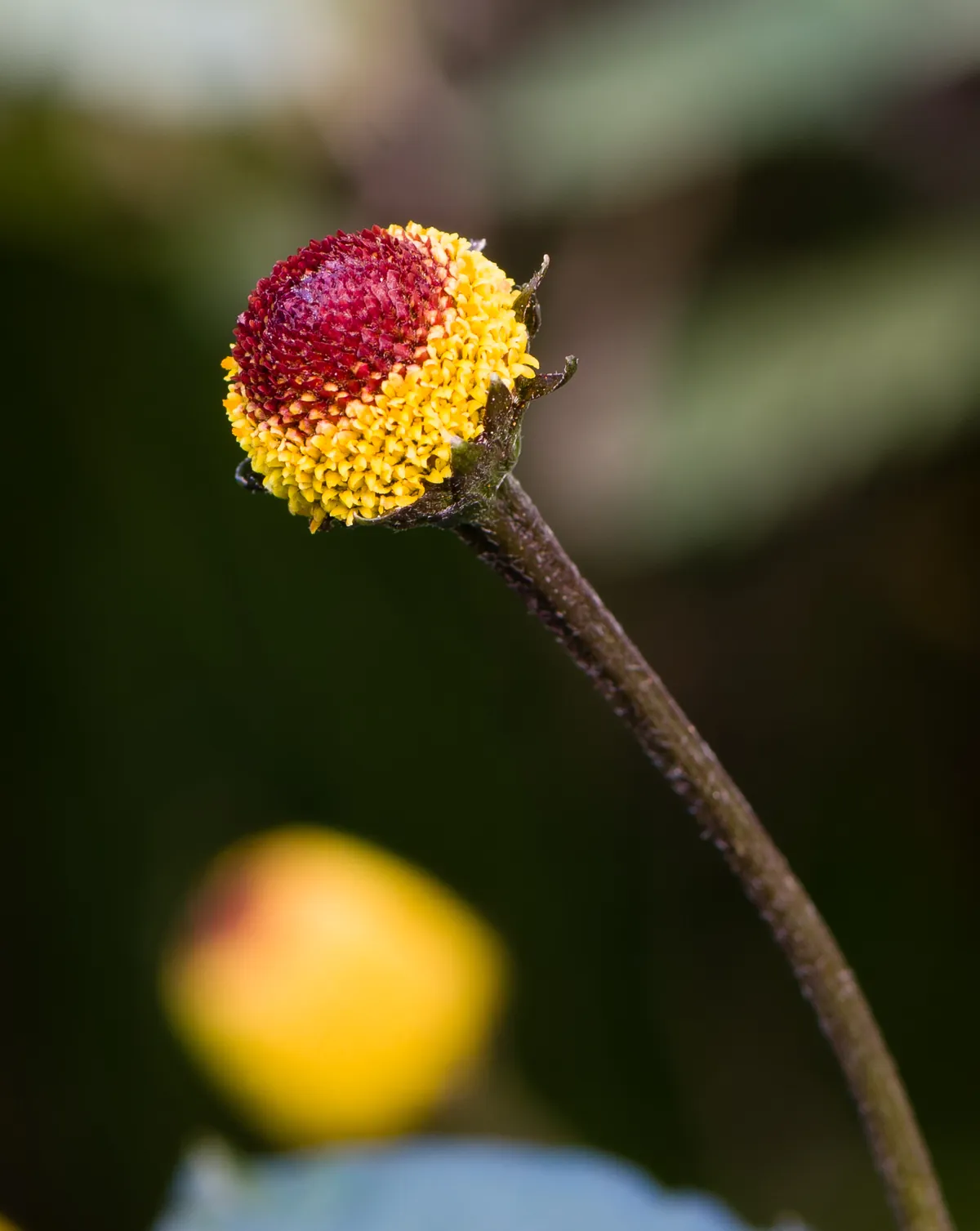
アクメラ(Acmella oleracea、ジャンブー)の頭花が1個、茎の先に写っている。円錐状に盛り上がった小花の集合で、先端は赤褐色、周囲は黄色に色分かれしている。原典ページは『Jambú (Acmella oleracea)』と記載している。
写っているもの: Acmella oleracea部位・状態: 花期の頭花(花序)。円錐形に盛り上がった小花の集合体で、先端が赤褐色、周囲が黄色に色分かれしている
写真: Tuxyso/ CC BY-SA 3.0/ 原画像/ 台帳の原画像
写真の範囲と来歴
被写体の確認: 原典の記載による同定。原典ページは学術種名 Acmella oleracea と通称 Jambú を記載している。専門家による再同定は行っていない。
掲載画像: Wikimedia Commons の原寸版。苦味研究所では切り抜き・色調変更なし。 表示用には幅1200px上限のWebPを配信し、台帳の原画像は上のリンクから確認できます。
On this page (8 sections)
Reading the bitterness
Acmella oleracea is a plant in the daisy family, also called jambu in Portuguese and toothache plant in English. According to a review, its raw leaves have been used as a salad flavoring in the United States, as a cooked vegetable added to soups and meat dishes in India, and as a major leafy vegetable in Indigenous Brazilian cuisine. In Java, Indonesia, young shoots and leaves are served as raw (a raw-vegetable preparation) with sambal, while in Thailand both leaves and flower heads are used in various curries. In Japan, the flowers are prized as an edible spice; the flower buds are commercially known as Buzz Buttons, Szechuan Buttons, or Electric Buttons and are used in gastronomy to counter the heat of chili peppers.
The plant's main group of constituents is described as alkylamides (a group of nitrogen-containing, lipid-like compounds), with spilanthol occupying a central place in the literature. A page introducing Thai medicinal plants also names spilanthol as an active constituent for the Thai name assigned to this plant. Content is described as varying by plant organ, place of origin, and extraction method; individual measurement records are needed to demonstrate those differences.
However, it has been pointed out that more than a few Thai ethnobotanical and phytochemical records labeled Acmella oleracea or Spilanthes acmella may actually refer to Acmella paniculata, the most widely distributed native species. A study that reclassified 6 Thai Acmella species states that those two names account for about 80% of all Thai use records and that many of them could refer to A. paniculata. The correspondence between a local name and the scientific name Acmella oleracea must also be read as a folk species name that could encompass several closely related species.
Sources for this overview
Checked for this overview: Checked the review's description of edible uses by region and commercial names for the flower buds. / Checked the review's description of alkylamides and spilanthol as central constituents.
Checked for this overview: Checked the mention of spilanthol on the Thai medicinal-plant page.
Taxonomy and ethnobotany of Acmella (Asteraceae) in Thailand
Checked for this overview: Checked the observation that nearly 80% of Thai use records could refer to A. paniculata.
Other names: Acmella oleracea (la), jambu (pt), ผักคราดหัวแหวน (th), ผักเผ็ด (th, identification low), phak phet (th-Latn, identification low)
Follow the connections
toothache plant →contains→ spilanthol →is associated with→ tingling
toothache plant →Records of are often confl…→ Acmella paniculata
Structured claims — open a section to read each claim's confidence, evidence and limits
Composition and content (3)
Scope: Acmella oleracea plant material as reviewed in the cited source
Note: Content varies with plant part, geographic source, and extraction method. These factors require measurement records. / 2026-08-31: calibration downgrade from established to supported because the supporting evidence does not derive from full-text confirmation. Eligible for re-upgrade after full-text verification.
Show data
organism-acmella —contains→ compound-spilantholScope: Thai ethnobotanical and phytochemical literature; a taxonomic reassessment of Acmella in Thailand (6 species: 2 native and 4 introduced).
Show data
organism-acmella —is_often_conflated_in_records_with→ organism-acmella-paniculataScope: Throughout Thailand (including a recorded northern name).
Note: Regional names recorded in the CMU Lanna ingredient encyclopedia. The species identification is not settled between A. oleracea and A. paniculata (as Panyadee points out, many Thai records labeled "Acmella oleracea" may actually refer to A. paniculata, a possibility already noted in another claim). The spelling matches the name ผักเผ็ด already recorded for ingredient-chiangmai-green-candidate, but this is only a name-level match and should not be treated as evidence identifying that candidate ingredient.
Show data
organism-acmella —is_listed_as→ "ผักเผ็ด (northern name) / ผักตุ้มหู (southern name) / ผักคราด and ผักคราดหัวแหวน (general names)."How processing and cooking change it (1)
Scope: A review-level cultural and botanical summary.
Note: Primary local sources are needed for specific regional dishes and preparation methods.
Show data
organism-acmella —is_used_as→ "A culinary spice in tropical and subtropical regions."