Basque burnt cheesecake
dish / dish-basque-burnt-cheesecake
バスクチーズケーキ / Basque burnt cheesecake (tarta de queso)
Basque burnt cheesecake is a cheesecake without a wheat-flour crust, baked briefly at high heat until the top is deeply blackened. English-language media widely describe it as created at the San Sebastián bar "La Viña" around the late 1980s to early 1990s.
Photographs (captions in Japanese)
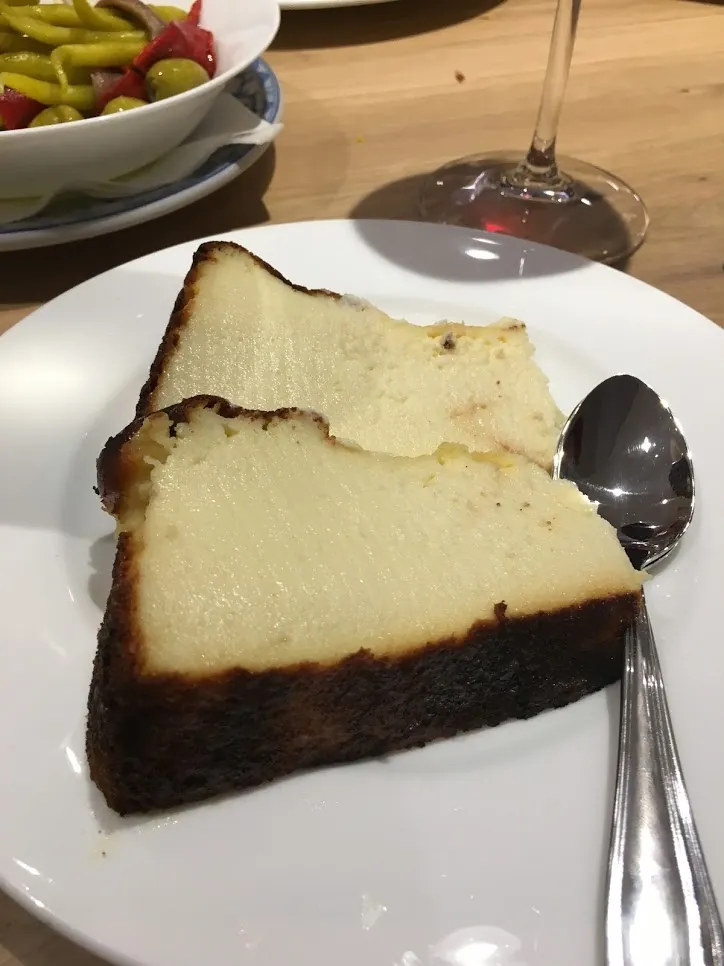
表面が黒く焦がされたバスク風チーズケーキの一切れ。切り口はクリーム色でとろみを帯びる
料理写っているもの: N/A(チーズケーキ、料理)部位・状態: 完成形。切り分けられた一切れ。表面と側面が黒く焦げ、断面はクリーム色でとろみのある質感
写真: Yukio 12/ CC BY-SA 4.0/ 原画像/ 台帳の原画像
写真の範囲と来歴
被写体の確認: 原典の記載による同定。説明文に「Cheesecake in restaurant "La Viña" in San Sebastián」と明記。entities.csvの説明文が言及するLa Viñaで撮影された写真で一致度が高い。解像度は724x966とやや小さいが原寸のまま採用 画像を開いて確認。焦げた表面と側面、クリーム色の断面を持つ三角形の一切れが白皿に盛られている
掲載画像: Wikimedia Commons の原本と同寸。切り抜き・色調変更なし。 表示用には幅1200px上限のWebPを配信し、台帳の原画像は上のリンクから確認できます。
On this page (6 sections)
Reading the bitterness
Basque burnt cheesecake (tarta de queso) is a cheesecake with no wheat-flour crust, baked briefly at high heat so the surface blackens, and English-language media interview articles report that it was created at the bar "La Viña" in the old town of San Sebastián, Spain. It is described as having been created by Santiago (Santi) Rivera, the proprietor who succeeded La Viña, founded in 1959, but the sources do not agree on the details of the year of creation — a 2019 article states 1990 explicitly, while a 2021 article gives the early 1990s; these are not contradictory within a range of around 1990, but a single confirmed year cannot be identified.
In English the cheesecake is called 「burnt(焦がした)」 (in translation: "burnt") and is known for its blackened surface. Within the sources checked for this entry, however, neither the shop's official product page nor the English-language media interviews use the word 「苦い(bitter)」 (in translation: "bitter"). The official site calls it only 「tarta de queso(チーズケーキ)」 (in translation: "cheesecake") and confines itself to price and pickup details. In a 2019 interview article, the journalist describes the flavor of the burnt part as 「塩キャラメルやブラウンバターに近い、複雑で人を引きつける風味」 (in translation: "a complex, compelling flavor akin to salted caramel and brown butter"). This description uses sweet and toasty terms rather than bitterness, illustrating why burnt cooking should not be assumed to imply bitter taste.
A 2021 Resy article traces examples of shops in various places recreating the La Viña-style cheesecake. It cites Alex Raij in New York as a 2008 example, Lurra in London as a 2015 example, and Brat as a 2018 example. This is not a record showing La Viña's branch expansion or the inheritance of an identical recipe; because it is a set of shop examples selected by a single article, it does not establish the full worldwide path of the dish's spread.
Sources for this overview
How Basque Burnt Cheesecake Took Over The World
Checked for this overview: Used the 2021 article's statement of 1990 as evidence for this paragraph. / Used to describe the 2008, 2015, and 2018 shop examples, and the limitation that these are derivative versions from a single article
Spain's Burnt Cheesecake Breaks All the Rules. And Lord, It's Good.
Checked for this overview: Used the 2019 article's phrasing of about 30 years as evidence for this paragraph. / Used the journalist's flavor description as evidence for this paragraph.
La auténtica tarta de queso de La Viña (product page)
Checked for this overview: Used the absence of bitterness language on the official site as evidence for this paragraph.
Other names: tarta de queso (es), tarta de queso quemada (es, identification medium)
Hypotheses and recipe candidates for this entry are on the Japanese page.
Structured claims — open a section to read each claim's confidence, evidence and limits
Culture (3)
Scope: English-language media interviews with Santi Rivera (2019 and 2021).
Note: The sources do not agree on the details of the year of creation. TASTE (published 2019) states 『1990年』 (in translation: "1990") explicitly, while Resy (published 2021) gives 『1990年代初め』 (in translation: "the early 1990s"). The two are not contradictory within a range of around 1990, but this research lab does not assert a single confirmed year. All the sources agree that La Viña itself was founded in 1959 (by the preceding generation, including Eladio Rivera and his wife) and that the cheesecake was a later creation by his successor Santi. The sources do not agree in detail on the year of creation and the origin of the idea, and this research lab does not determine them.
Show data
dish-basque-burnt-cheesecake —has_historical_origin→ "English-language media interviews report that the cheesecake was created at "La Viña" in San Sebastián's old town, but their accounts of its creator differ. A 2021 article says the current operator Santiago (Santi) Rivera inherited the bar of his predecessors, brothers Eladio and Antonio Rivera and their wives; a 2019 article presents Santi himself as the creator. Both describe a method without a crust, baked at a higher temperature than usual for a short time so that the surface blackens while the center remains meltingly soft."Scope: La Viña's official product-description page and a 2019 English-language media interview article.
Note: The term 『苦い(bitter)』 (in translation: "bitter") does not appear on La Viña's official product page or in the English-language media articles checked by NIGAMI LAB. The press uses terms such as 『キャラメル』 (in translation: "caramel"), 『ブラウンバター』 (in translation: "brown butter"), and 『焦げ』 (in translation: "char") instead; the absence of bitterness is recorded as a negative finding. Several English-language outlets report the owner calling the term 『burnt』 (burnt) 「マーケティングだ」 (in translation: "marketing"), but the original article carrying that statement was not reached in this review, so it is not recorded as an established finding.
Show data
dish-basque-burnt-cheesecake —is_defined_in_context_as→ "On the shop's official product page it is called only 『tarta de queso(チーズケーキ)』 (in translation: "cheesecake"); neither the English descriptor 『burnt(焦げた)』 (in translation: "burnt") nor any word for bitterness is used. A journalist in a 2019 English-language interview article describes the burnt portion in their own words as 『塩キャラメルやブラウンバターに近い、複雑で人を引きつける風味』 (in translation: "a complex, compelling flavor akin to salted caramel and brown butter")."Scope: Restaurant examples in New York and London cited in a 2021 Resy retrospective article
Note: These are shop examples looked back on by a single media outlet, not a source that independently establishes the full path of worldwide spread or each year. Nor does it claim that each shop's version is the same recipe as La Viña's.
Show data
dish-basque-burnt-cheesecake —is_documented_as_part_of→ "A 2021 Resy article cites Alex Raij in New York in 2008, Lurra in London in 2015, and Brat in 2018 as examples of shops in various places recreating the La Viña-style cheesecake"