olive debittering and fermentation
process / process-olive-debittering
オリーブの脱苦味・発酵
Processing to reduce olive bitterness and stabilize table olives.
Photographs (captions in Japanese)
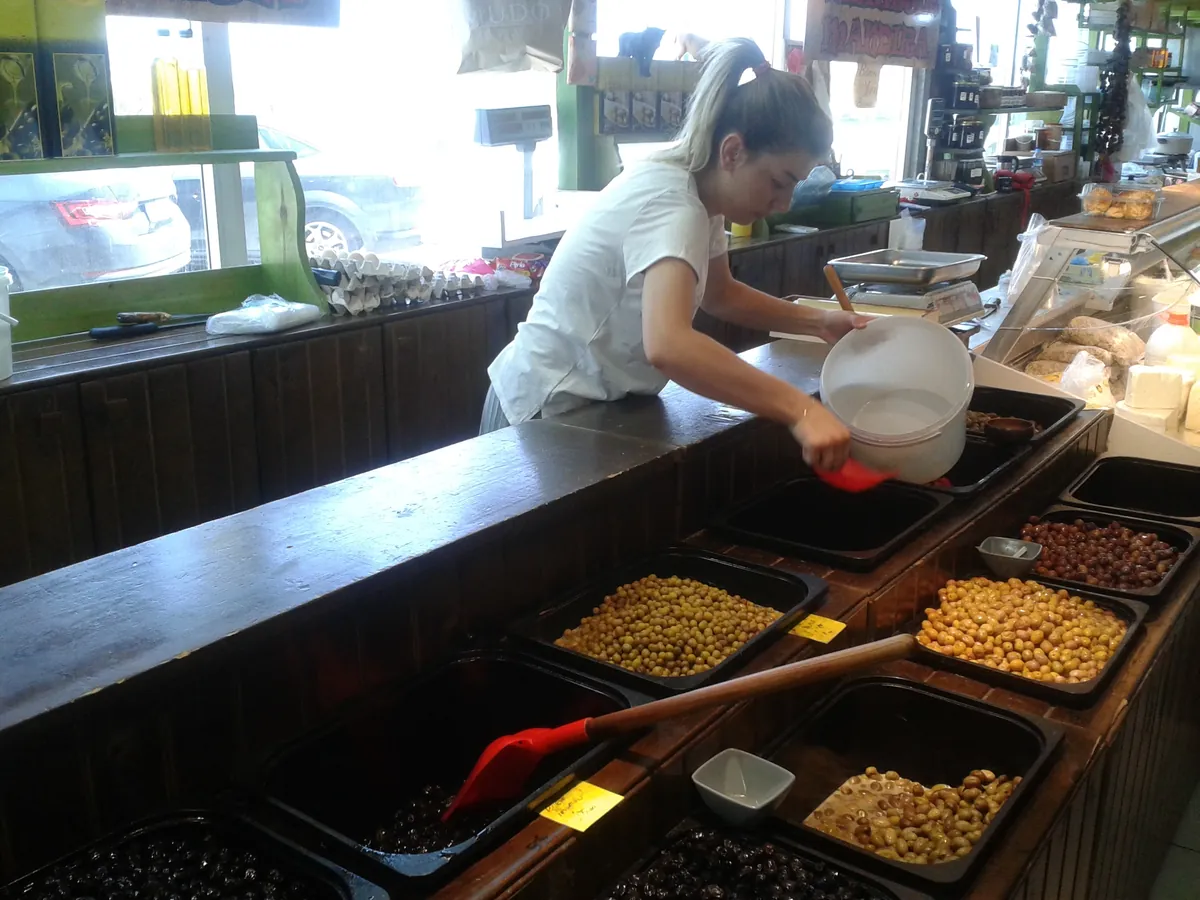
トルコ・アンカラの市場でオリーブにブライン(塩水)を加えている場面。オリーブの苦味低減とテーブルオリーブの安定化を目的とする加工工程のうち、ブライン添加という実施場面を示す。
写っているもの: Olea europaea(オリーブ)の脱苦味加工部位・状態: ブライン(塩水)添加の場面
写真: E4024/ CC BY-SA 4.0/ 原画像/ 台帳の原画像
写真の範囲と来歴
被写体の確認: 原典の記載による同定。
掲載画像: Wikimedia Commons の原寸ファイル。苦味研究所では切り抜き・色調変更なし。 表示用には幅1200px上限のWebPを配信し、台帳の原画像は上のリンクから確認できます。
On this page (6 sections)
Reading the bitterness
Raw olives remain strongly bitter even though bitterness weakens as they ripen. Table olives, eaten as a preserved food, are produced through partial or complete debittering followed by fermentation. A principal source of bitterness is oleuropein, a bitter secoiridoid, so debittering is a process that reduces this compound. Methods vary: the Spanish style soaks fruit in a 1.5–4.5% sodium hydroxide solution to break down oleuropein chemically, then uses lactic fermentation in brine; the Greek style ferments whole fruit directly in brine; and the alcaparras style repeatedly soaks halved fruit in water over one week to remove oleuropein by diffusion.
During debittering, oleuropein breaks down into the less bitter compounds hydroxytyrosol and tyrosol. In a storage experiment with natural green olives, one study found enzymatic hydrolysis early in storage followed by slower chemical hydrolysis. This is a different pathway from an external chemical treatment such as the rapid breakdown with caustic soda in the Spanish style. In a Spanish-style PDO product, it was also reported that alkali treatment completely removed oleuropein, leaving only hydroxytyrosol, tyrosol, and oleoside 11-methyl ester.
A study following Nyons-style black olives fermented naturally in brine alone without additives for about 15 months considered diffusion, chemical breakdown, and enzymatic hydrolysis as possible pathways of debittering. It concluded that diffusion from flesh into brine and the activity of enzymes naturally present in the olive were most involved in this fermentation. However, no strong association with a particular microorganism was found. This study did not establish the share of bitterness reduction attributable to each mechanism or a causal role for a particular microbe.
Sources for this overview
Table Olives: An Overview on Effects of Processing on Nutritional and Sensory Quality
Checked for this overview: Checked the definition of table-olive production through debittering and fermentation. / Checked the characterization of debittering as partial or complete. / Checked the measured complete removal in a Spanish-style PDO product.
Oleuropein hydrolysis in natural green olives: Importance of the endogenous enzymes
Checked for this overview: Checked the progression from enzymatic to chemical hydrolysis.
Factors influencing phenolic compounds in table olives (Olea europaea)
Checked for this overview: Checked the decrease in oleuropein and increase in hydrolysis products.
Checked for this overview: Checked the involvement of diffusion and endogenous enzymes in Nyons-style fermentation.
Follow the connections
table olives →is produced through→ olive debittering and fermentation
olive debittering and fermentation →reduces→ bitterness →can be measured separately …→ astringency
Structured claims — open a section to read each claim's confidence, evidence and limits
How processing and cooking change it (5)
Scope: Principal processing method categories for table olives
Note: The degree and method of debittering vary.
Show data
ingredient-table-olives —is_produced_through→ process-olive-debitteringScope: Natural green olives under the cited storage conditions
Note: The rate and pathway depend on pH, temperature, and pre-heating.
Show data
process-olive-debittering —includes→ "Enzymatic hydrolysis of oleuropein early in storage, followed by a slower chemical hydrolysis"Scope: Processing of table olives
Note: Method and final residual bitterness vary by product style. / 2026-08-31: Recalibrated from established to supported, because the supporting evidence does not derive from a full-text check. May be re-upgraded after a full-text check.
Show data
process-olive-debittering —reduces→ sensation-bitterScope: Table-olive curing and processing methods, reviewed across cultivars and ripeness stages
Note: A review-level synthesis. The magnitude of change depends on cultivar, ripeness, and curing method.
Show data
process-olive-debittering —converts→ "from oleuropein to its hydrolysis products hydroxytyrosol and tyrosol (oleuropein decreases and the hydrolysis products increase during table-olive processing)"Scope: Natural fermentation of Nyons black olives in 10% brine for 15 months
Note: Chemical breakdown and microbial enzymes are candidates from prior research, but in this system, neither their contribution ratio nor causation by a single microbe was identified.
Show data
process-olive-debittering —has_debittering_most_likely_due_to→ "In this Nyons system, diffusion from the flesh into the brine and endogenous enzymes"