oleuropein
compound / compound-oleuropein
オレウロペイン
Phenolic secoiridoid abundant in olive, associated with bitterness.
Photographs (captions in Japanese)
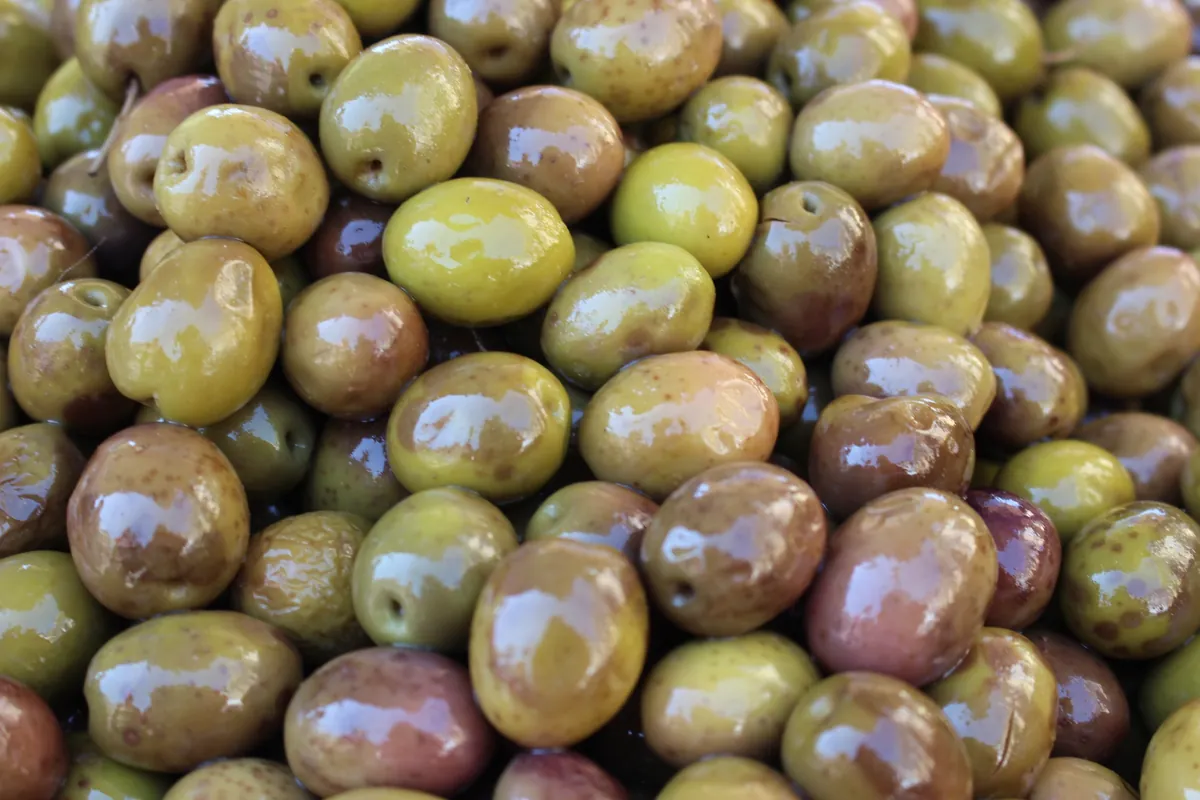
オリーブ(Olea europaea)の果実の付いた枝。oleuropein はオリーブに豊富なフェノール性セコイリドイドであり、化合物そのものではなく給源となる果実の写真である。
原料写っているもの: Olea europaea(オリーブ)部位・状態: 果実の付いた枝
写真: Emőke Dénes/ CC BY-SA 4.0/ 原画像/ 台帳の原画像
写真の範囲と来歴
被写体の確認: 原典の記載による同定。ingredient-table-olives で使用した写真とは別ファイル(重複回避)。
掲載画像: Wikimedia Commons の原寸ファイルを sips で長辺2400pxに縮小。苦味研究所では切り抜き・色調変更なし(リサイズのみ)。 表示用には幅1200px上限のWebPを配信し、台帳の原画像は上のリンクから確認できます。
On this page (7 sections)
Reading the bitterness
Oleuropein is a phenolic secoiridoid abundant in olives. In research on naturally processed green olives, the bitterness of olives is described as arising primarily from this oleuropein, and a review also describes the drupe as 「果実が熟すにつれて弱まる、苦いオレウロペインを特徴とする」 (in translation: "bitter oleuropein that diminishes as the fruit matures"). However, this characterization pertains to naturally processed green olives and should not be generalized wholesale to all olive oils or all processing methods.
In table-olive processing, the breakdown of oleuropein through enzymatic and chemical reactions has been tracked across the process. The final product's oleuropein content varies considerably with processing method: for example, dry-salt-cured Thassos-style olives show high oleuropein levels even in the finished product, whereas Spanish alkaline treatment is described as able to remove oleuropein completely. In short, whether oleuropein remains in the final product depends strongly on which processing method is chosen.
Conversely, a high phenolic content including oleuropein does not necessarily translate into strong bitterness as perceived. A study comparing 5 varieties of naturally fermented olives found that although the final product's phenolic composition differed by variety, an 8-member panel showed no significant difference in perceived bitterness ratings. This is a small-scale panel comparison at a single harvest point and does not rule out relationships between individual phenolics and individual scores.
Sources for this overview
Oleuropein hydrolysis in natural green olives: Importance of the endogenous enzymes
Checked for this overview: Statement that the bitterness of naturally processed green olives arises primarily from oleuropein / Statement on tracking enzymatic and chemical breakdown across processing
Table Olives: An Overview on Effects of Processing on Nutritional and Sensory Quality
Checked for this overview: Verbatim expression from a review: bitter oleuropein that weakens with maturation / Verification of processing differences: high content in dry-salt-cured products and complete removal in Spanish alkaline treatment
Checked for this overview: Result from 5 varieties: phenolic differences across varieties but no significant difference in 8-member panel bitterness ratings
Follow the connections
oleuropein →is a major cause of→ bitterness →can be measured separately …→ astringency
table olives →contains, before and during…→ oleuropein
olive leaf →contains→ oleuropein
Structured claims — open a section to read each claim's confidence, evidence and limits
Composition and content (6)
Scope: Natural green olives, in the cited processing studies
Note: The content changes through enzymatic and chemical hydrolysis.
Show data
ingredient-table-olives —contains_before_and_during_processing→ compound-oleuropeinScope: Review integrating multiple primary studies (Olea europaea fruit, multiple varieties)
Note: A ripening-dependent pattern distinct from bitter orange (Castillo 1992): in olive, 「生育初期に高濃度→成熟に向け一貫して減少」 (in translation: "early growth shows high concentration → consistent decline toward maturity"), contrasting with bitter orange's nonmonotonic fluctuation within flower buds. In olive, young fruit and growth phase peak, then decline monotonically—differing from bitter orange's pattern. The "14%" and "3-4.5 g/kg" are representative values from separate primary studies cited in the review, not time-series data from a single study.
Show data
compound-oleuropein —has_content_change_with_fruit_maturation→ "Fruit development divides into 3 stages: growth phase (oleuropein accumulation) → green maturation phase (chlorophyll and oleuropein both decline) → black maturation phase (anthocyanins and flavonoids appear; oleuropein continues to decline). Young fruit can reach 14% oleuropein on dry matter basis (= 140 mg/g), while typical reported values for mature pulp are around 3–4.5 g/kg (= 0.3–0.45%) dry matter basis."Scope: A review's generalization about olive fruit and leaves
Note: This passage of the review does not present quantitative comparison data by tissue (skin/around the seed versus the flesh as a whole). It remains a qualitative description of localization.
Show data
compound-oleuropein —occurs_in→ "In olive leaves and fruit, the review states that the bitter phenols (oleuropein and ligstroside) are localized mainly in the skin and the tissue around the seed. This accumulation is explained as a defense mechanism against pathogens and herbivory."Scope: 2 primary studies cited in a review (variety and region within each primary study)
Show data
compound-oleuropein —shows_developmental_concentration_decline_due_to→ "Olive leaf age effect. In the Ortega-García et al. report cited by a review, leaves collected at early fruit maturation showed significantly higher oleuropein concentration than leaves collected 40 days later, and concentration remained stable until day 120. Laguerre et al. reported significant phenolic profile differences between 1-year-old and 3-year-old Picholine leaves: younger leaves contain more oleuropein, ligstroside, and flavonoid aglycones; mature leaves contain more verbascoside, oleuroside, and glycosylated luteolin."Scope: Layer: food. A comparison of salt and fermentation conditions in the same Gaeta PDO olives, with oleuropein quantified by chemical analysis.
Note: A counterexample showing that increasing salt does not chemically remove the principal bitter compound.
Show data
ingredient-table-olives —does_not_significantly_influence→ compound-oleuropeinScope: Layer: food. A discussion passage that links measurement of total polyphenol content in olive-leaf herbal tea (infusion) with sensory analysis.
Note: With microwave drying, total polyphenol content (TPC) increased to about 3 times that of hot-air drying (MWD approx. 3.0 mg/L GAE vs. AD approx. 1.0 mg/L GAE), corresponding to a sensory increase in bitterness. Beyond the existing compound-oleuropein claim (declining content with plant age), this adds oleuropein's positioning as the bitter principle itself.
Show data
ingredient-olive-leaf —contains→ compound-oleuropeinSensory (2)
Scope: Naturally processed green olives investigated during processing
Note: Other phenolic compounds and processing conditions also contribute to final sensory quality.
Show data
compound-oleuropein —is_a_major_cause_of→ sensation-bitterScope: The final product of naturally fermented olives across 5 cultivars
Note: The amount of bitterness-related phenolics differed among cultivars, but there was no significant difference in the final perceived bitterness rated by an 8-member panel. This does not mean chemical quantity in general is irrelevant.
Show data
compound-oleuropein —does_not_reliably_track→ sensation-bitter