canh khổ qua
dish / dish-canh-kho-qua
カイン・コー・クア
Canh khổ qua is a bitter-gourd soup served at Tết tables and as an offering in southern Vietnam. The VOV article concerns the meat-stuffed version.
Photographs (captions in Japanese)
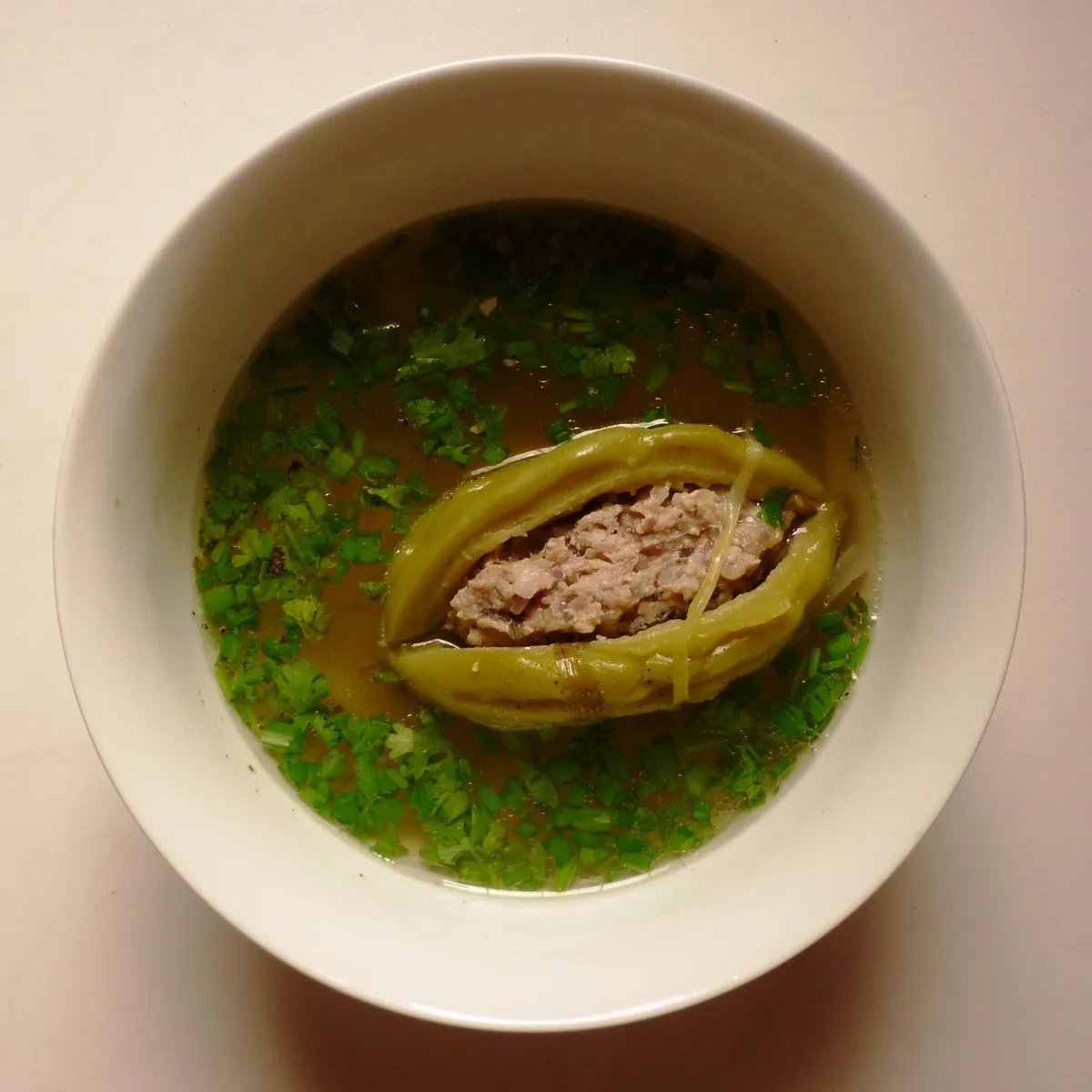
canh khổ qua(苦瓜の肉詰めスープ)。苦瓜の輪切りに豚ひき肉を詰めて澄んだスープで煮込み、刻んだ香草を散らした一例。ベトナムの家庭料理の一皿であり、地域全体の標準形ではない。
料理写っているもの: Momordica charantia(料理: canh khổ qua)部位・状態: 苦瓜(khổ qua)を輪切りにし、種を抜いた中に豚ひき肉を詰めて煮込み、澄んだスープに仕立てた状態。刻んだパクチー・ネギを散らしている
写真: Ngô Trung/ CC BY-SA 3.0/ 原画像/ 台帳の原画像
写真の範囲と来歴
被写体の確認: 原典の記載による同定。原典キャプションは Bitter melon soup(Canh khổ qua)とのみ記載。学名の再同定は行っていない。家庭調理の一例であり地域の標準形ではない。
掲載画像: Wikimedia Commons の原寸版。苦味研究所では切り抜き・色調変更なし。 表示用には幅1200px上限のWebPを配信し、台帳の原画像は上のリンクから確認できます。
On this page (8 sections)
Reading the bitterness
Canh khổ qua is covered in an article by the public broadcaster VOV as a dish placed on Tết, the Lunar New Year, tables and in offerings to ancestors in the Mekong Delta of southern Vietnam. The article identifies meat-stuffed canh khổ qua nhồi thịt as one of the dishes that appears 「永続的」 (in translation: "perennially") on regional tables, and introduces slowly simmered canh khổ qua hầm as a dish whose name begins with an interpretation that 「苦しみ・困難(khổ)が過ぎ去る(qua)」 (in translation: "suffering and hardship [khổ] pass [qua]"). This is a regional record from one public-broadcast article; it is not presented as a custom uniformly shared throughout Vietnam.
As a dish, the article describes removing the seeds from green bitter gourd (khổ qua), stuffing it with meat, and simmering it. This is a regional record showing that bitter gourd is the main ingredient in this meat-stuffed soup, but the article is only one cooking example and does not represent all household formulations or names.
A 2024 analysis of bitter-gourd extracts concludes, from dose-over-threshold (DoT) calculations, that two bitter compounds isolated by sensory-guided fractionation and HPLC purification, including charantoside B, should be regarded as the bitter principle of bitter gourd. The dry-weight content of charantoside B was 214.8±14.0 mg/kg. This analysis concerns fruit extracts of bitter gourd, not the dish canh khổ qua itself.
Sources for this overview
Checked for this overview: The extent checked for descriptions of its place on Mekong Delta Tết tables and the interpretation of its name. / The extent checked for the description of removing bitter-gourd seeds, stuffing with meat, and simmering.
Checked for this overview: Identification of charantoside B from bitter-gourd extracts and a content of 214.8±14.0 mg/kg.
Follow the connections
canh khổ qua →uses→ bitter melon
canh khổ qua →contains→ charantoside B →elicits→ bitterness
Hypotheses and recipe candidates for this entry are on the Japanese page.
Structured claims — open a section to read each claim's confidence, evidence and limits
Composition and content (1)
Scope: Layer: Food (isolated compound from fruit extract). Isolated from the dichloromethane fraction of 75% methanol extract by sensory-guided fractionation and HPLC purification, quantified by UPLC-MS/MS, sensory threshold test in 3% ethanol solution.
Show data
dish-canh-kho-qua —contains→ compound-charantoside-bHow processing and cooking change it (1)
Scope: Canh khổ qua hầm / nhồi thịt, as recorded by VOV
Note: Based on the cooking description in the same article. Not generalized into a recipe. Confidence calibration (2026-08-31 review): downgraded from supported to contextual, since the grounds are only public and press cultural records.
Show data
dish-canh-kho-qua —uses→ ingredient-bitter-gourdCulture (1)
Scope: Southern Vietnam, the Mekong Delta (the food culture covered by VOV)
Note: A regional record based on a public-broadcast article; it does not claim a uniform custom throughout Vietnam.
Show data
dish-canh-kho-qua —is_documented_as_part_of→ "A dish served at Tết tables and in ancestor veneration in the Mekong Delta. The article gives an interpretation of the name as wishing for 「苦・困難が過ぎ去る」 (in translation: "bitterness and hardship to pass")."