cucumber
ingredient / ingredient-cucumber
キュウリ / Cucumis sativus
Cucumber is the edible fruit of cucumber. Wild ancestral lines and immature fruits have strong bitterness, but during domestication only fruit bitterness was selectively lost.
Photographs (captions in Japanese)
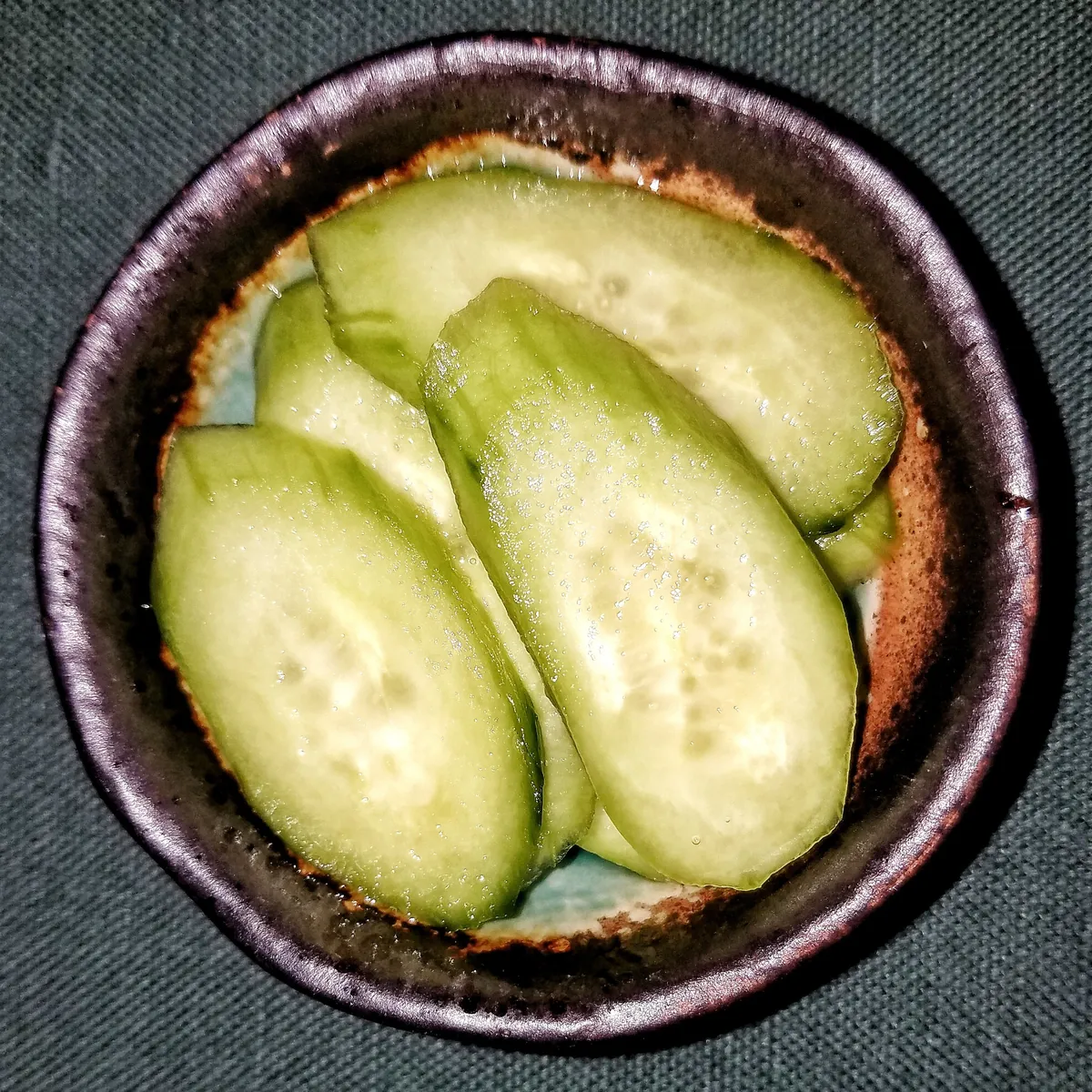
皮付きのまま輪切りにしたキュウリ果実の断面。
加工後写っているもの: Cucumis sativus部位・状態: 果実の輪切り(皮つき、種子部を含む断面)
写真: Daderot/ CC0 1.0/ 原画像/ 台帳の原画像
写真の範囲と来歴
被写体の確認: 原典の記載による同定。説明文は"Cucumbers - Massachusetts, USA"のみ。切片は和え物のように見え軟白栽培写真ではないが果実の断面が明瞭。 画像を開き、皿の上に緑の皮と白緑色の果肉のキュウリ切片が複数枚重なっているのを確認した。調味・和え物風の見た目。
掲載画像: Wikimedia Commons の原本を長辺2400pxへ縮小。切り抜き・色調変更なし。 表示用には幅1200px上限のWebPを配信し、台帳の原画像は上のリンクから確認できます。
On this page (8 sections)
Reading the bitterness
Cucumber has strong bitterness in wild-like lines and immature fruits, but in most domesticated cultivars only the fruit is not bitter. Central to this difference are the Bt (Bitter Fruit) and Bl (Bitter Leaf) genes, which control the biosynthetic pathway for the bitter compound cucurbitacin C. One study identified 9 genes in this pathway and 4 stages of catalytic reactions, and reported that mutations arising in the promoter region of Bt, which governs fruit bitterness, were selected and fixed during domestication. This finding has only been confirmed at the abstract level. An explanatory article states that, because Bl controlling the same pathway retains expression in leaves, domestication selectively removed only fruit bitterness while retaining leaf bitterness as deterrence against herbivory in the plant as a whole. The perspective of domestication (breeding) is involved here.
Even if fruit bitterness was lost through domestication, this does not appear to be constant in all cases. According to an explanatory article, domesticated cultivars in which a particular single-nucleotide polymorphism (SNP) in the Bt promoter remains the G type may develop bitter fruit when exposed to cultivation stress such as low temperature. Conversely, lines in which this SNP has mutated to the A type have been reported not to develop bitterness even at low temperature. This is an example in which the cultivation environment may restore bitterness that had once been suppressed, and it suggests that genetic debittering is not necessarily an irreversible one-way property.
Sources for this overview
Biosynthesis, regulation, and domestication of bitterness in cucumber
Checked for this overview: Used while explicitly stating that confirmation is at the abstract level.
Checked for this overview: Used in full as an explanation of the difference in Bt/Bl expression. / Introduces recurrence of bitterness under low-temperature stress.
Other names: Cucumis sativus (la)
Follow the connections
cucumber →has debittering most likely…→ cucurbitacin C →— sensory attribute→ bitterness
Structured claims — open a section to read each claim's confidence, evidence and limits
Composition and content (1)
Scope: Layer: food. HPLC analysis of fruit, leaves, and shoot tips from bitter and non-bitter cultivars (2004-2005, at an agricultural experiment station field in Mie Prefecture).
Show data
ingredient-cucumber —has_composition→ "In fruit of the bitter cultivar 'Shinsyo Hakuhi', juice pressed from the stem end contained cucurbitacin C at 2.0±3.5 mg/L (n=4), a higher concentration than in other parts of the fruit. In fruit of the non-bitter common cultivars 'Sharp 1', 'Zenkoku Sekko Kyuri', and 'Marianna RZ', cucurbitacin C was not detected (ND)."Mechanism and receptors (2)
Scope: Cucumber, Cucumis sativus
Note: The evidence is Shang et al. 2014, Science (abstract), and its accompanying commentary Chen 2015 (full text). The identification of the 9 genes and 4 catalytic steps of the cucurbitacin C biosynthesis pathway, and tissue-specific control by Bt/Bl, are the central findings of the original paper.
Show data
ingredient-cucumber —has_debittering_most_likely_due_to→ compound-cucurbitacin-cScope: Cultivated cucumber varieties
Note: From Chen 2015 (a commentary article summarizing the findings of Shang et al. 2014). A summary of primary research showing that the drop in Bt expression from domestication is not an irreversible loss, but a conditional suppression whose expression can shift with environmental conditions.
Show data
ingredient-cucumber —has_perceived_bitterness_affected_by→ "Cultivation stress such as cold or drought. Non-bitter cultivated varieties in which a specific single-nucleotide polymorphism within the Bt promoter remains the G allele are reported to have fruit that can turn bitter again under cold stress. Lines in which this polymorphism has mutated to the A allele do not turn bitter even under cold."