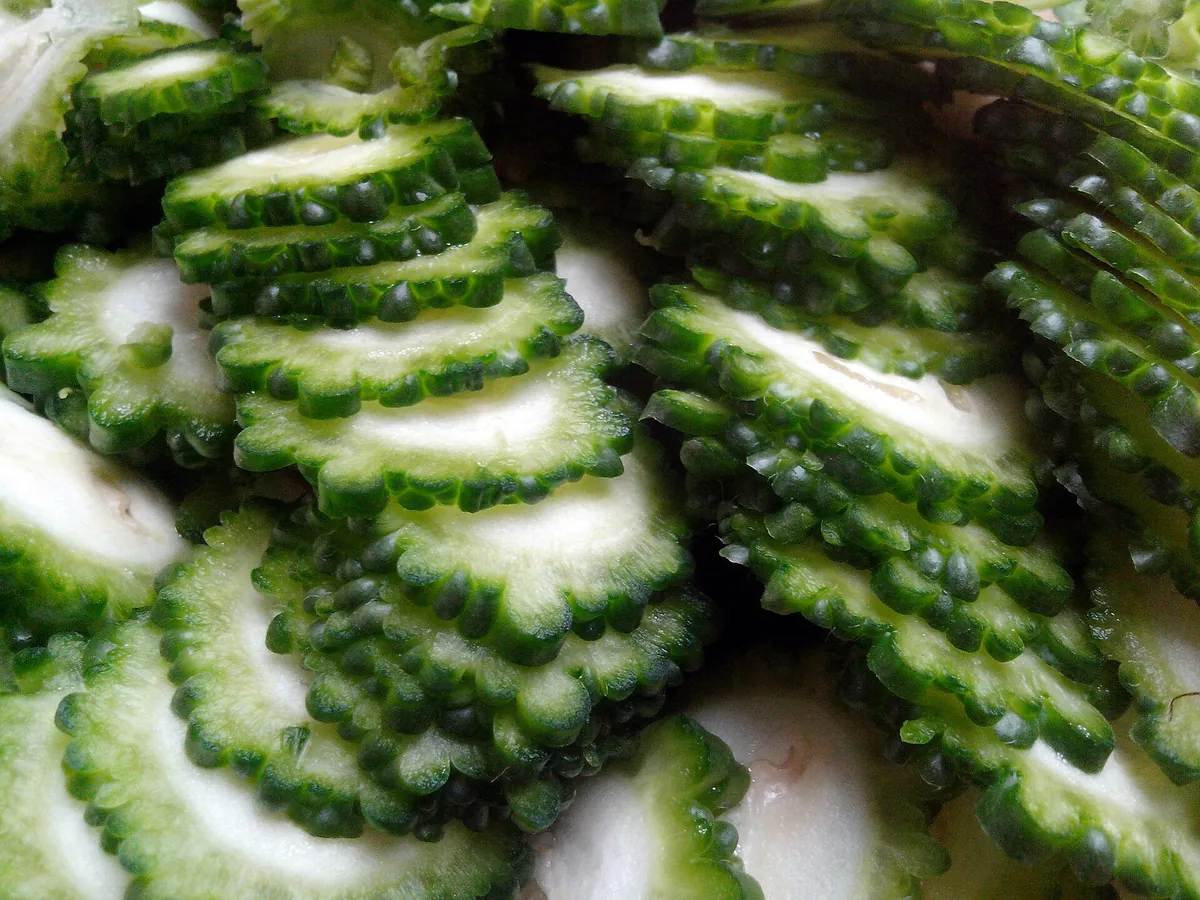
Bitter gourd, also known as goya and bitter melon, is an edible fruit. The immature green fruit is used in stir-fries and soups, and there are cultures in various regions that utilize its bitterness as a distinctive element of the dish.
Structured claims — open a section to read each claim's confidence, evidence and limits
Composition and content (4)
Scope: Immature fruit and extracts investigated by sensory-guided fractionation
Note: This class contains both bitter and non-bitter structures, and isomerization can also occur during analysis.
The isolated bitter compounds and their precursors belonged to the cucurbitane-type triterpenoids quantified in bitter gourd.
Limitations: Extraction and isomerization affect the recovered profile.
Limits: Demonstration that 5,19-(hemi)acetal and (me)thyl ether derivatives arise in solution during methanol extraction, and their absence in non-methanol fruit extracts, limits how the reported diversity of cucurbitane-type triterpenoids in bitter gourd should be read. A large proportion of the reported members may not be present in the fruit itself.
Limitations: Before adjusting individual compound rows, the class attribution of the specifically named compounds must be confirmed in the full text.
The bitter compounds identified by sensory-guided fractionation were quantified at concentrations ranging from approximately 16.5 +/- 1.3 mg/kg to 214.8 +/- 14.0 mg/kg in fruit material on a dry-weight basis. This concentration range had not previously been listed in evidence.csv.
Limitations: These are abstract-level figures; which compounds correspond to the upper and lower ends of the range has not been confirmed in the full text. Cultivar and maturity-stage dependence also needs to be confirmed in the full text.
Show data
ingredient-bitter-gourd —contains→ compound-cucurbitane-triterpenoidsclaim: clm-bitter-gourd-cucurbitanes / type: composition / updated: 2026-08-30
Scope: A list of scientific and local names recorded in a publicly released Thai local-government source
Note: The source gives the same scientific name, Momordica charantia L. The side-by-side listing of the 2 types, including mara jeen (the Chinese-derived type), is based on a separate source (a home-cooking explanation from Suan Dusit). This is not a claim of a formal varietal name.
Context: ชื่อวิทยาศาสตร์: Momordica charantia L.... ชื่ออื่น:... มะระเล็ก มะระขี้นก (ทั่วไป) (in translation: "Scientific name: Momordica charantia L. ... Other names: ... mara lek [small mara], mara khi nok, [general]")
Limitations: No formal botanical varietal distinction is given; this remains a side-by-side listing of local names.
Source:
มะระขี้นก (เทศบาลตำบลแม่ยม (เอกสารเผยแพร่)) ·
full text checkedContext: Verbatim: 「มะระที่คนไทยส่วนใหญ่กินก็จะเป็นมะระจีนและมะระขี้นก」 (in translation: "the mara that most Thai people eat is mara jeen and mara khi nok"). It lists side by side, as the mara commonly eaten in Thailand, 2 types: mara jeen (Chinese-derived) and mara khi nok.
Limitations: This is only a side-by-side listing of the 2 types; this source has no comparative description of form or bitterness intensity.
Show data
ingredient-mara-khinok —is_a_type_of→ ingredient-bitter-gourdclaim: clm-mara-khinok-same-species-as-bitter-gourd / type: taxonomy / updated: 2026-09-01
bitter melon — concentration declines during development because of: Fruit maturation from the color-break stage (BR, 28 days after flowering) to the ripening stage (RS, 35 days after flowering).supported
Scope: A metabolome analysis of pulp tissue in the same genome paper. A group of cucurbitane-type compounds specific to the Cucurbitaceae, including cucurbitacin E, cucurbitacin D-O-glucoside, cucurbitacin E-O-glucoside, momordicoside F2, kuguaglycoside I, momordicine IV, and momordicoside L.
Note: This group of compounds is reported to have 'changed by 0.78-fold' from the BR stage to the RS stage (an overall fold-change; the absolute value for each individual compound cannot be confirmed from this summary, and the paper states that the details appear in Supplementary Data Table S12-S14, which has not been confirmed). For charantin and charantoside B (existing compound entries in this database), a quantified value in this paper could not be confirmed.
States: "the abundance of substances unique to Cucurbitaceae, such as cucurbitacin E, cucurbitacin D-O-glucoside, cucurbitacin E-O-glucoside, momordicoside F2, kuguaglycoside I, momordicine IV and momordicoside L, changed by 0.78-fold".
Limitations: The 0.78-fold figure is a statement combining multiple compounds; the absolute concentration and variance for each individual compound require the Supplementary Data (not yet obtained).
Show data
ingredient-bitter-gourd —shows_developmental_concentration_decline_due_to→ "Fruit maturation from the color-break stage (BR, 28 days after flowering) to the ripening stage (RS, 35 days after flowering)."claim: clm-bittergourd-ripening-cucurbitanoid-decline / type: composition / updated: 2026-09-02
bitter melon is consumed in Okinawacontextual Scope: Layer: food (a description concerning Okinawan native vegetables).
"Momordica charantia (G) is called 'goya' on the island. The peculiar bitterness of goya is due to momordicin, which is contained in the skin."
Limitations: This sentence carries no citation number, and whether it is primary data or a summary of general knowledge cannot be determined from the text. There is no quantitative value or analytical method for momordicin at that point.
Show data
ingredient-bitter-gourd —is_consumed_in→ region-okinawaclaim: clm-w72e1-okinawa-goya-momordicin-bitter / type: composition / updated: 2026-09-08
Sensory (10)
Scope: The dichloromethane fraction of a 75% methanol extract, and quantified dried fruit material
Note: Precursors in fresh fruit and other cultivars require separate characterization.
A dose-over-threshold analysis identified momordicine IV as one of 2 principal bitterness-contributing compounds in the analyzed fraction and fruit material.
Limitations: Isomerization of acid-labile precursors complicates extrapolation to fresh fruit.
Limits: A 1982 structural study (Okabe et al.) identified momordicoside K and momordicoside L as the bitter principles of immature bitter gourd fruit. Verbatim from the abstract: "momordicosides K and L, bitter principles in the fruits of Momordica charantia L." This does not agree with the identification in the 2024 attribution, which names a different compound as the principal bitterness contributor from the same immature fruit.
Limitations: This 'limits' connection is indirect, based on the disagreement between studies over the attribution of the principal bitter compound in immature fruit; it does not experimentally refute the bitterness of momordicine IV itself. The compounds may still not be mutually exclusive at the level of individual compounds.
Context: Verbatim: analysis of the polar fraction of a methanol extract of M. charantia leaves 'resulted in the isolation of a novel cucurbitane glucoside, 7-O-beta-D-glucopyranosyl-3,23-dihydroxycucurbita-5,24-dien-19-al, named momordicine IV', and at 20.3 microg/cm2 on the leaf surface this compound 'deterred oviposition by L. trifolii significantly'. The compound name momordicine IV therefore predates the 2024 sensory characterization by 18 years, and was originally described not as a human bitterness compound but as an insect oviposition deterrent.
Limitations: There is no human taste data. The plant part is leaf, not fruit. Whether the structure Cai 2024 assayed under the name momordicine IV is identical to this 3,23-dihydroxy-5,24-dien-19-al should be confirmed once the full text of Cai is available.
Context: In the same oviposition-deterrence bioassay, momordicine II significantly deterred L. trifolii oviposition at 75.6 microg/cm2 on the leaf surface. The abstract states that combining the two compounds showed no synergistic effect. Momordicine II is not yet listed as an independent entity in this database.
Limitations: This is insect-deterrence data, not human taste data. Because momordicine II itself is not listed in entities.csv, this row is positioned only as contextual information for the claim about momordicine IV's bitterness above.
Show data
compound-momordicine-iv —is_a_bitter_principle_of→ ingredient-bitter-gourdclaim: clm-momordicine-bitter / type: sensory / updated: 2026-08-30
Scope: The dichloromethane fraction of a 75% methanol extract, and quantified dried fruit material
Note: Precursors in fresh fruit and other cultivars require separate characterization.
A dose-over-threshold analysis identified charantoside B as one of 2 principal bitterness-contributing compounds in the analyzed fraction and fruit material.
Limitations: Specific to cultivar, maturity stage, and extraction method.
Limits: A 1982 structural study (Okabe et al.) identified momordicoside K and momordicoside L as the bitter principles of immature bitter gourd fruit. Verbatim from the abstract: "momordicosides K and L, bitter principles in the fruits of Momordica charantia L." This does not agree with the identification in the 2024 attribution, which names a different compound as the principal bitterness contributor from the same immature fruit.
Limitations: This 'limits' connection is indirect, based on the disagreement between studies over the attribution of the principal bitter compound in immature fruit; it does not experimentally refute the bitterness of charantoside B itself. The compounds may still not be mutually exclusive at the level of individual compounds.
Show data
compound-charantoside-b —is_a_bitter_principle_of→ ingredient-bitter-gourdclaim: clm-charantoside-bitter / type: sensory / updated: 2026-08-30
bitter melon — the identity of the principal bitter compounds is contested between studies: Momordicoside K and L (1982 structural study, restated in later debittering studies) versus momordicine IV and charantoside B (2024 dose-over-threshold analysis) versus 5 principal cucurbitane-type triterpenoids (2025 review)contested
Scope: Immature bitter gourd fruit studied across independent groups from 1982 to 2025
Note: At the compound level the attributions are not mutually exclusive, but no single set of compounds is consistently named across studies, and isolation artifacts complicate every attribution.
Verbatim from the abstract: "The structures of momordicosides K and L, bitter principles in the fruits of Momordica charantia L. (Cucurbitaceae), were elucidated as 7-O-beta-D-glucopyranosides of 3beta,7beta-dihydroxy-25-methoxy-cucurbita-5,23-dien-19-al and 3beta,7beta,25-trihydroxy-cucurbita-5,23-dien-19-al, respectively, from spectral and chemical evidence." The introduction restates that K and L were "isolated as bitter principles from the immature fruits of Momordica charantia L."; the experimental section defers the isolation itself to an earlier Part III paper (Chem. Pharm. Bull. 30:3977 (1982)), and this paper itself is purely a structural study (1H/13C-NMR, CD, acetylation, hydrogenation, methanolysis).
Limitations: Nowhere in the full text is there sensory-panel, threshold, or bitterness-intensity data; the term 'bitter principle' is carried over from the Part III isolation paper. Momordicoside K has a 25-methoxy group and was crystallized from MeOH, and the paper itself demonstrates an easy acid-methanol conversion of this skeleton (0.01 N HCl-MeOH, room temperature) -- the very type of chemistry invoked by the 2024-2025 artifact reassessment.
A 2018 abstract restates this attribution verbatim: 'triterpene glycosides namely momordicoside K and momordicoside L causes bitterness in bitter-gourd, thereby reducing consumer acceptance'.
Limitations: This restates the 1982 attribution; it is not an independent sensory identification.
A 2024 dose-over-threshold analysis concluded that momordicine IV (5) and charantoside B (6) should be regarded as the principal bitter compounds of bitter gourd. Momordicoside L (1) was one of five known compounds isolated, and for compounds 3-8, a strong bitterness with recognition thresholds of 3.6-13.6 ppm in 3% ethanol was reported.
Limitations: The abstract also states that many of the isolated compounds are isomerization products of natural precursors, and that the primary bitterness contributors in fresh fruit should be those precursors, so this attribution applies to the analyzed extract rather than to fresh fruit.
A 2025 review states verbatim that bitter gourd's bitterness is attributed to 5 key cucurbitane-type triterpenoids, but the abstract does not name the compounds.
Limitations: The 5 compounds cannot be identified from the abstract; the full text could not be obtained, and overlap with the 1982 and 2024 attributions could not be confirmed.
A 2007 processing study puts the 1982 attribution into practice: its stated purpose was 'to determine the effect of the processing methods on momordicosides K and L contents' of a vegetable that 'has an unpleasant bitter taste', treating K and L as the analytical targets tied to bitterness. This records that the attribution of momordicoside K/L as the principal bitter compounds served as a working hypothesis in applied food chemistry through the period from Okabe 1982 to the 2024 re-attribution.
Limitations: It assumes the link between K/L and bitterness rather than testing it (no sensory verification of these compounds); the methanol extraction is precisely the condition later argued to generate cucurbitane-type artifacts.
Verbatim: "Bitter gourd's bitter taste is linked to a presence of high concentration of triterpene glycosides known as saponins (Deng et al. 2022), especially momordicosides K and L" -- showing that the 1982 K/L attribution was still being restated as the prevailing view as late as 2023, immediately before Cai 2024's dose-over-threshold re-attribution to momordicine IV and charantoside B.
Limitations: A secondary citation rather than primary sensory data. Included to record the transmission lineage of the contested attribution.
Show data
ingredient-bitter-gourd —has_contested_identity_of_principal_bitter_compounds→ "Momordicoside K and L (1982 structural study, restated in later debittering studies) versus momordicine IV and charantoside B (2024 dose-over-threshold analysis) versus 5 principal cucurbitane-type triterpenoids (2025 review)"claim: clm-gourd-bitter-principal-contested / type: sensory / updated: 2026-08-30
Scope: Immature bitter gourd fruit in 1982 structural analysis
Note: Status contested at the level of natural occurrence: Momordicoside K carries a 25-methoxy (methyl ether) side chain, and a 2025 study judges reported methyl ether forms of bitter gourd cucurbitanes to be extraction artifacts generated in methanol rather than natural constituents. Whether momordicoside K itself is included in the scope of this finding remains unresolved in the abstract read.
Momordicoside K was elucidated structurally as 7-O-β-D-glucopyranoside of 3β,7β-dihydroxy-25-methoxy-cucurbita-5,23-dien-19-al. Full text: colorless needles from MeOH, mp 236–237 °C, C37H60O9.1/2H2O (found C 67.45, H 9.56), 1H-NMR showing 3.21 (3H, s, –OCH3) and 10.43 (H, s, –CHO). The abstract describes K verbatim as one of the "bitter principles in the fruits of Momordica charantia L." (in translation: "bitter principles in the fruits of Momordica charantia L.")
Limitations: No taste data in the full text. The description as the bitter principle relies on Part III isolation paper (Chem. Pharm. Bull. 30:3977 (1982)). The 25-methoxy side chain and crystallization from MeOH are later (Cai 2025) discussed as markers of methanol extraction artifacts, and the paper itself demonstrates that K undergoes methanolysis to methyl acetals under mild acidic methanol conditions.
Limits: A 2025 study demonstrates that when methanol is present during extraction, 5,19-acetals and methyl ethers can be generated from cucurbitane-type triterpenoids, and the authors state the view that all 40 of the 5,19-acetals, 46 methyl ethers, 6 5,19-ethyl acetals, and 7 ethyl ethers reported are extraction/isolation artifacts and should not be regarded as natural constituents of bitter gourd.
Limitations: The abstract does not name momordicoside K specifically. Momordicoside K carries a 25-methoxy side chain per its 1982 structure, and whether it falls within the 46 artifact methyl ethers is an unresolved question requiring the complete compound list.
Show data
compound-momordicoside-k —is_a_bitter_principle_of→ ingredient-bitter-gourdclaim: clm-momordicoside-k-bitter-principle / type: sensory / updated: 2026-08-30
Scope: Immature bitter gourd fruit in 1982 structural analysis
Note: Status contested at the level of bitter-principle designation: A 2024 dose-over-threshold study isolated momordicoside L but designated momordicine IV and charantoside B, rather than L, as the principal bitter contributors of that material.
Momordicoside L was determined as 7-O-β-D-glucopyranoside of 3β,7β,25-trihydroxy-cucurbita-5,23-dien-19-al; full text gives colorless needles from CHCl3-MeOH, mp 227–232 °C, C36H58O9.2H2O. The 1H-NMR spectrum of L was "were quite similar to those of K" (in translation: "were quite similar to those of K") but "showed no methoxyl signal" (in translation: "showed no methoxyl signal"), making L a hydroxyl derivative of K. The abstract describes L verbatim as one of the "bitter principles in the fruits of Momordica charantia L." (in translation: "bitter principles in the fruits of Momordica charantia L.")
Limitations: No taste data in full text; the designation as the bitter principle relies on Part III isolation paper. Unlike K, L carries a free 25-OH (no methoxy), so the methanol-artifact argument does not apply to L through the methoxy marker, but only through the shared biogenic lineage.
Limits: In a 2024 study, momordicoside L was isolated as compound 1, but the strong bitterness with recognition thresholds was reported for compounds 3–8, and the dose-over-threshold calculation designated momordicine IV (5) and charantoside B (6), not momordicoside L, as the principal bitter compounds of the material.
Limitations: The abstract does not explicitly state that momordicoside L is not bitter or has low dose-over-threshold; its absence from the strong-bitterness list is inferred indirectly.
Show data
compound-momordicoside-l —is_a_bitter_principle_of→ ingredient-bitter-gourdclaim: clm-momordicoside-l-bitter-principle / type: sensory / updated: 2026-08-30
bitter melon — bitterness varies among cultivars: Of three Guangdong cultivars grown under equivalent conditions, D was sweeter, Q was intermediate, and B was more strongly bitter. Geranyl 3-O-xylopyranosyl-glucopyranoside, which the authors identify as the substance responsible for bitterness, was strongly upregulated in B and Q but not in Dpreliminary
Scope: 3 bitter gourd cultivars (D, B, Q) in 1 multi-omics study
Note: Bitterness levels are based on the authors' experimental research and customer feedback; there is no description of a formal sensory panel. The study is limited to 3 cultivars.
Verbatim: "where D was sweeter, Q was average, and B was high in bitterness comparative to others"; "glycosylated terpenoids (e.g. goyaglycoside, kuguaglycoside) were markedly higher in cv. D compared to other cultivars"; and "the substance geranyl 3-O-xylopyranosyl-glucopyranoside, responsible for bitterness, was found highly upregulated in B and Q but not in D".
Limitations: The bitterness ranking relies, verbatim, on the authors' "experimental research and customer feedback", with no description of a formal sensory-panel method; the authors state that this study is limited to 3 specific cultivars. Note the apparent tension in which bitter-type glycosides (goyaglycoside, kuguaglycoside) are higher in the sweeter cultivar D, while a different geranyl glycoside tracks with the bitter cultivars.
Show data
ingredient-bitter-gourd —has_bitterness_varying_among_cultivars→ "Of three Guangdong cultivars grown under equivalent conditions, D was sweeter, Q was intermediate, and B was more strongly bitter. Geranyl 3-O-xylopyranosyl-glucopyranoside, which the authors identify as the substance responsible for bitterness, was strongly upregulated in B and Q but not in D"claim: clm-gourd-cultivar-bitterness-differs / type: sensory / updated: 2026-08-30
bitter melon — sensory attribute: During ripening, the peel changes from green to yellow/orange at maturity, and the pulp changes from bitter white to sweet red.supported
Scope: A description of fruit developmental stages in the cultivar (Momordica charantia var. abbreviata) used for telomere-to-telomere genome sequencing. 3 stages were set: IM (14 days after anthesis), BR (28 days after anthesis), and RS (35 days after anthesis).
Note: The original text reads 『the pulp turns from bitter white to sweet red』. Pulp refers to the fruit-flesh tissue, and the paper treats peel and pulp as the 2 tissues analyzed for metabolites; the word for the aril enclosing the seeds does not appear in the body text. Correspondence with the commonly stated tissue name in 『仮種皮が甘くなる』 (in translation: "the aril becomes sweet") cannot be confirmed from this paper, and is recorded here as a limitation.
States: "During the process of fruit ripening, the fruit peel turns from green to yellow/orange at maturity, the pulp turns from bitter white to sweet red."
Limitations: The term 『aril(仮種皮)』 (in translation: aril) does not appear in the body text; pulp is used as a tissue category alongside peel. Correspondence with the specific tissue called the aril has not been confirmed.
Show data
ingredient-bitter-gourd —has_sensory_attribute→ "During ripening, the peel changes from green to yellow/orange at maturity, and the pulp changes from bitter white to sweet red."claim: clm-bittergourd-ripening-peel-pulp-color / type: sensory / updated: 2026-09-02
bitter melon is documented as having The liking score for the bitterness attribute (9-point hedonic scale, 1 = dislike extremely to 9 = like extremely) differed by recipe: chili 5.0±2.2, tomato sauce 5.9±2.0, curry 3.3±2.2, minestrone soup 5.1±2.3 (rated by 49 non-diabetic adults, mean±SD). The authors state that the 3 dishes other than curry masked bitterness with ingredients such as tomato, garlic, and basil, and among them tomato sauce had the highest score.preliminary
Scope: Layer: food. 50 g of bitter gourd mixed into a 1-cup (250 mL) serving of each dish (chili, tomato sauce, curry, minestrone soup). Frozen within 7 days of cooking, reheated to 70-73°C and held at 60°C on the day of evaluation, and served with white rice or pasta. Texture, bitterness, aroma, and overall liking were evaluated.
Note: The bitterness score is a hedonic (liking) evaluation, not a rating of bitterness intensity itself. Curry had the lowest bitterness liking of the 4 dishes, and the authors interpreted this as showing that spice does not necessarily mask bitterness.
Hedonic scores for the bitterness attribute of the 4 dishes (mean±SD, 9-point scale, 1 = dislike extremely to 9 = like extremely): chili 5.0±2.2, tomato sauce 5.9±2.0, curry 3.3±2.2, minestrone soup 5.1±2.3. The authors state "tomato, garlic and basil that masked their bitterness," and identify tomato sauce as masking bitterness the most.
Limitations: Because the bitterness score is a liking evaluation rather than an intensity measurement, whether bitterness intensity itself changed cannot be determined from this evaluation alone. The specific spice composition of the curry recipe has not been confirmed within the scope of the text summary.
Show data
ingredient-bitter-gourd —is_documented_as_having→ "The liking score for the bitterness attribute (9-point hedonic scale, 1 = dislike extremely to 9 = like extremely) differed by recipe: chili 5.0±2.2, tomato sauce 5.9±2.0, curry 3.3±2.2, minestrone soup 5.1±2.3 (rated by 49 non-diabetic adults, mean±SD). The authors state that the 3 dishes other than curry masked bitterness with ingredients such as tomato, garlic, and basil, and among them tomato sauce had the highest score."claim: clm-w67c-goya-dish-bitterness-liking-by-recipe / type: sensory / updated: 2026-09-06
bitter melon — perceived bitterness is suppressed by: Addition of beta-cyclodextrin (bitter gourd extract; a 0.25% addition reduced bitterness by about 33%)supported
Scope: Layer: food. Beta-cyclodextrin added to bitter gourd extract. Separate from the acceptability claim (same source group), this line records the reduction in bitterness intensity itself.
Note: Split out from an existing claim that recorded the rise in acceptability, isolating only the reduction in bitterness intensity.
An independent group found, verbatim, in bitter gourd extract, that 'With the addition of only 0.25% beta-CD, the bitterness was reduced by about 33%', and that with 0.75% or 1% beta-CD 'the bitterness was reduced by more than 90%', contrasting with a 19% reduction using 0.6% carboxymethyl cellulose. A trained panel (n = 10, ISO 8586-2014, 10 cm unstructured scale) rated bitterness intensity, and FTIR/1H-NMR/TGA supported formation of an inclusion complex with beta-CD. Total saponin content was not significantly affected.
Limitations: This measures the bitterness intensity of an extract rather than the hedonic acceptability of a juice, as in Deshaware 2018, and the effective concentrations also differ (0.75% vs. 1.5%). Because of the difference in matrix, a direct numerical comparison is not possible, but the debittering mechanism via beta-CD inclusion complexation is independently reproduced.
Show data
ingredient-bitter-gourd —has_perceived_bitterness_suppressed_by→ "Addition of beta-cyclodextrin (bitter gourd extract; a 0.25% addition reduced bitterness by about 33%)"claim: clm-w68l-gourd-bcd-bitterness-reduced / type: sensory / updated: 2026-09-06
bitter melon can be debittered by: Eating raw bitter gourd and gōya chanpurū with katsuobushi added significantly lowered the rated bitterness intensity compared with not adding it (chanpurū p<0.01, raw bitter gourd p<0.001). Adding katsuobushi stock (a hot-water extract) to bitter gourd extract also significantly lowered bitterness (p<0.05). Treating bitter gourd extract with spent katsuobushi (the solid residue left after stock extraction) ground in a mortar markedly lowered bitterness (p<0.001), and when bitter gourd extract was passed through a column packed with spent katsuobushi, the bitter component was adsorbed onto the column: it did not elute with distilled water but eluted with 60% ethanol.supported
Scope: Layer: food. Human sensory evaluation using raw bitter gourd, gōya chanpurū, and bitter gourd extract, together with a fractionation experiment using a column of spent katsuobushi.
In gōya chanpurū, bitterness markedly decreased with the addition of katsuobushi (p<0.01); in raw bitter gourd it likewise markedly decreased (p<0.001, Figure 1). Bitterness also markedly decreased (p<0.001, Figure 4) in the supernatant obtained by grinding spent katsuobushi in a mortar, adding it to bitter gourd extract, and centrifuging. When bitter gourd extract was passed through a column packed with spent katsuobushi, the component eluted in the pass-through fraction of the column; the bitter component that did not elute with distilled water eluted with 60% ethanol (Figure 5). It is stated that not only bitterness but also astringency and a grassy odor decreased in the same way (no figures given).
Limitations: Chanpurū is a composite dish containing multiple ingredients, so this is not a comparison that strictly isolates the effect of katsuobushi alone. The column fractionation experiment is indirect evidence (UV absorbance and elution pattern) for adsorption of the bitter component; sensory evaluation of the bitterness of the eluted fraction itself was performed in a separate experiment (Figure 4).
Show data
ingredient-bitter-gourd —can_be_debittered_by→ "Eating raw bitter gourd and gōya chanpurū with katsuobushi added significantly lowered the rated bitterness intensity compared with not adding it (chanpurū p<0.01, raw bitter gourd p<0.001). Adding katsuobushi stock (a hot-water extract) to bitter gourd extract also significantly lowered bitterness (p<0.05). Treating bitter gourd extract with spent katsuobushi (the solid residue left after stock extraction) ground in a mortar markedly lowered bitterness (p<0.001), and when bitter gourd extract was passed through a column packed with spent katsuobushi, the bitter component was adsorbed onto the column: it did not elute with distilled water but eluted with 60% ethanol."claim: clm-katsuobushi-goya-bitterness-adsorption / type: sensory / updated: 2026-09-26
How processing and cooking change it (20)
bitter melon — perceived bitterness is unchanged by: Fruit pieces soaked in 3.5% (w/v) NaCl solution at 25 C for 60 minutes before juicing (bitterness 10.6 +/- 1.1 on a 15 cm line scale versus 10.7 +/- 1.7 untreated, p > 0.05)supported
Scope: Bitter gourd juice evaluated by a trained panel of 10 in 1 Malaysian study
Note: A null result contrary to the folk expectation that salt-rubbing reduces bitterness. The same soak significantly reduced sourness rather than bitterness. Single study, single fruit lot.
For juice from fruit soaked in 3.5% (w/v) NaCl solution at 25 C for 60 minutes, bitterness was 10.6 +/- 1.1 on an unstructured 15 cm line scale, versus 10.7 +/- 1.7 for untreated fruit; the paper states verbatim that no significant (p > 0.05) difference in juice bitterness was observed between untreated bitter gourd and fruit treated with NaCl solution, while the same soak significantly (p < 0.05) reduced sourness.
Limitations: A single study with a small, young panel. Whether the untreated control also underwent a blanching step is not included in our extraction, so the effects of NaCl alone and NaCl plus blanching cannot be fully separated here.
Context: Verbatim: 'Only extracted ion chromatographs for blanched bitter melon and bitter melon with MY 68 agent showed the absence of momordicosides K and L.' Heat blanching and the commercial masking agent MY 68 rendered the bitterness-related glycosides (momordicoside K and L) undetectable by LC/ESI/MS, whereas oil cooking (frying) and drying (sun, oven, freeze) did not. This paper contains no description of NaCl soaking.
Limitations: The endpoint is compound detectability, not sensory bitterness. NaCl soaking itself is not among the conditions tested. Abstract-level. The link between K/L and bitterness assumed here has itself been contested since 2024.
Show data
ingredient-bitter-gourd —has_perceived_bitterness_unchanged_by→ "Fruit pieces soaked in 3.5% (w/v) NaCl solution at 25 C for 60 minutes before juicing (bitterness 10.6 +/- 1.1 on a 15 cm line scale versus 10.7 +/- 1.7 untreated, p > 0.05)"claim: clm-gourd-nacl-soak-bitterness-unchanged / type: processing / updated: 2026-08-30
bitter melon — perceived bitterness is suppressed by: Addition of 5% gum arabic to juice (8.6 +/- 0.6 versus control 10.7 +/- 1.7 on a 15 cm line scale, p < 0.05; 7.3 +/- 1.4 at 15%)supported
Scope: Bitter gourd juice evaluated by a trained panel of 10 in 1 Malaysian study
Note: In the same study, bitterness showed a negative correlation with viscosity, so part of the effect may be masking by matrix/mouthfeel rather than removal of the bitter compounds.
The paper states verbatim that adding 5% gum arabic significantly (p < 0.05) reduced the bitterness of bitter gourd juice. The table values, on a 15 cm line scale, are 10.7 +/- 1.7 for the control versus 8.6 +/- 0.6 with 5% gum arabic and 7.3 +/- 1.4 with 15% gum arabic.
Limitations: In the same study, viscosity was negatively correlated with bitterness, and masking from increased viscosity is not separated from binding of the bitter compounds.
Context: Verbatim from the abstract: "Juice with 1.5% beta-cyclodextrin demonstrated highest score (7.7 +/- 0.3) for sensory acceptability compared to the control (3.8 +/- 0.7)", and the NMR/ROESY/FTIR results "indicated formation of an inclusion complex by interaction of hydrophobic triterpenoidal region of momordicosides with beta-cyclodextrin". That is, an independent group reproduced the sensory improvement of bitter gourd juice by a carbohydrate-type additive.
Limitations: The additive is beta-cyclodextrin (inclusion-complex formation), not gum arabic; the endpoint is overall acceptability, not bitterness intensity; an abstract-level reading.
Context: Verbatim: 'adding 0.6% CMC resulted in lowering the bitterness significantly by 19%' (a trained-panel rating on a 10 cm unstructured bitterness scale). The proposed mechanism is that CMC acts as 'a physical barrier that restricts the interaction between bitterants and taste buds by increasing viscosity'. This independently reproduces, with a different viscous polysaccharide (carboxymethylcellulose), the same class of effect that Rashima 2017 reported with 5% gum arabic.
Limitations: CMC is not gum arabic. There was no significant reduction at 0.2% or 0.4% CMC, and even at 0.6% the reduction was only 19%, far smaller than beta-CD (>90% at 0.75%). The matrix is an extract, not juice. The paper notes that CMC 'cannot be applied to low-viscosity products'.
Show data
ingredient-bitter-gourd —has_perceived_bitterness_suppressed_by→ "Addition of 5% gum arabic to juice (8.6 +/- 0.6 versus control 10.7 +/- 1.7 on a 15 cm line scale, p < 0.05; 7.3 +/- 1.4 at 15%)"claim: clm-gourd-gum-arabic-debittering / type: processing / updated: 2026-08-30
bitter melon — sensory acceptability was increased by: cyclodextrinssupported Scope: Bitter gourd juice with 0.25-2% beta-cyclodextrin added, in 1 Indian study
Note: The reported value is hedonic acceptability, not a bitterness-intensity rating. The abstract has no bitterness-intensity value.
Juice with 1.5% beta-cyclodextrin showed the highest sensory acceptability score (7.7 +/- 0.3) compared with the control (3.8 +/- 0.7). NMR, ROESY, and FTIR showed formation of an inclusion complex through interaction between the hydrophobic triterpenoid region of momordicosides and beta-cyclodextrin.
Limitations: An abstract-level extraction. The score is acceptability, not bitterness intensity, and panel size and scale are not given in the abstract. A slight (10%) decrease in alpha-glucosidase inhibition is also reported.
An independent group found, in bitter gourd extract, verbatim that 'With the addition of only 0.25% beta-CD, the bitterness was reduced by about 33%', and that with 0.75% or 1% beta-CD 'the bitterness was reduced by more than 90%', a contrast with the 19% reduction seen with 0.6% carboxymethylcellulose. A trained panel (n = 10, ISO 8586-2014, 10 cm unstructured scale) rated bitterness intensity, and FTIR/1H-NMR/TGA supported inclusion-complex formation by beta-CD. Total saponin content was not significantly affected.
Limitations: This measures the bitterness intensity of an extract rather than the hedonic acceptability of juice as in Deshaware 2018, and the effective concentration also differs (0.75% versus 1.5%). Because of the different matrix, direct numerical comparison is not possible, but the bitterness-removal mechanism via beta-CD inclusion complexation is independently reproduced.
Show data
ingredient-bitter-gourd —has_sensory_acceptability_increased_by→ compound-class-cyclodextrinsclaim: clm-gourd-bcd-acceptability / type: processing / updated: 2026-08-30
bitter melon is prepared by: Stir-fried with Okinawan tofu and eggcontextual
Scope: MAFF's record of goya chanpuru
Note: The same page states that stir-frying reduces bitterness, but since it gives no reduction rate or mechanism, only the cooking record is kept here.
The English-language MAFF version shows a procedure of stir-frying bitter gourd and combining it with egg, pork, and tofu.
Limitations: This is one recipe on the same page, and no inference is drawn to Okinawan cuisine in general.
Source:
Goya Chanpuru (Ministry of Agriculture Forestry and Fisheries of Japan) ·
full text checkedShow data
ingredient-bitter-gourd —is_prepared_by→ "Stir-fried with Okinawan tofu and egg"claim: clm-jp-bitter-gourd-stir-fry / type: culinary / updated: 2026-08-31
bitter melon is consumed in Thailand (fruits of both Thai and Chinese cultivars are listed as commonly consumed vegetables)supported
Scope: Thailand.
Note: An addition of Asian food-culture context to the existing entry for bitter gourd (ingredient-bitter-gourd).
Lists "fruits of Thai and the Chinese bitter gourd (Momordica charantia Linn.)" as vegetables commonly consumed in Thailand. Also shows that the two cultivar groups are distributed while being distinguished as the same species.
Show data
ingredient-bitter-gourd —is_consumed_in→ "Thailand (fruits of both Thai and Chinese cultivars are listed as commonly consumed vegetables)"claim: clm-bitter-gourd-thai / type: culinary / updated: 2026-08-31
Scope: Canh khổ qua hầm / nhồi thịt, as recorded by VOV
Note: Based on the cooking description in the same article. Not generalized into a recipe. Confidence calibration (2026-08-31 review): downgraded from supported to contextual, since the grounds are only public and press cultural records.
The article records the process of removing the seeds from the green khổ qua, stuffing it with meat, and simmering it. A regional record that bitter gourd is the main ingredient of this stuffed soup.
Limitations: The article gives one example of the cooking method and does not represent every household's proportions or naming.
Show data
dish-canh-kho-qua —uses→ ingredient-bitter-gourdclaim: clm-canh-kho-qua-ingredient / type: culinary / updated: 2026-08-31
Scope: A candidate structural component of a dish. Regional variation in ingredients is unconfirmed
Note: Source not connected. Does not indicate quantities or cooking conditions.
No source connected — this claim has not been verified yet. It is a general-knowledge placeholder, not a confirmed statement.
Show data
dish-goya-tsukudani —includes→ ingredient-bitter-gourdclaim: clm-dish-goya-tsukudani-candidate-ingredient / type: culinary / updated: 2026-08-31
shukto includes bitter melonunverified Scope: A candidate structural component of a dish. Regional variation in ingredients is unconfirmed
Note: Source not connected. Does not indicate quantities or cooking conditions.
No source connected — this claim has not been verified yet. It is a general-knowledge placeholder, not a confirmed statement.
Show data
dish-shukto —includes→ ingredient-bitter-gourdclaim: clm-dish-shukto-candidate-ingredient / type: culinary / updated: 2026-08-31
Scope: A candidate structural component of a dish. Regional variation in ingredients is unconfirmed
Note: Source not connected. Does not indicate quantities or cooking conditions.
No source connected — this claim has not been verified yet. It is a general-knowledge placeholder, not a confirmed statement.
Show data
dish-uchhe-bhaja —includes→ ingredient-bitter-gourdclaim: clm-dish-uchhe-bhaja-candidate-ingredient / type: culinary / updated: 2026-08-31
Scope: A candidate structural component of a dish. Regional variation in ingredients is unconfirmed
Note: Source not connected. Does not indicate quantities or cooking conditions.
No source connected — this claim has not been verified yet. It is a general-knowledge placeholder, not a confirmed statement.
Show data
dish-karela-sabzi —includes→ ingredient-bitter-gourdclaim: clm-dish-karela-sabzi-candidate-ingredient / type: culinary / updated: 2026-08-31
Scope: A candidate structural component of a dish. Regional variation in ingredients is unconfirmed
Note: Source not connected. Does not indicate quantities or cooking conditions.
No source connected — this claim has not been verified yet. It is a general-knowledge placeholder, not a confirmed statement.
Show data
dish-bharwa-karela —includes→ ingredient-bitter-gourdclaim: clm-dish-bharwa-karela-candidate-ingredient / type: culinary / updated: 2026-08-31
Scope: A candidate structural component of a dish. Regional variation in ingredients is unconfirmed
Note: Source not connected. Does not indicate quantities or cooking conditions.
No source connected — this claim has not been verified yet. It is a general-knowledge placeholder, not a confirmed statement.
Show data
dish-pavakka-theeyal —includes→ ingredient-bitter-gourdclaim: clm-dish-pavakka-theeyal-candidate-ingredient / type: culinary / updated: 2026-08-31
Scope: A candidate structural component of a dish. Regional variation in ingredients is unconfirmed
Note: Source not connected. Does not indicate quantities or cooking conditions.
No source connected — this claim has not been verified yet. It is a general-knowledge placeholder, not a confirmed statement.
Show data
dish-kugua-chaodan —includes→ ingredient-bitter-gourdclaim: clm-dish-kugua-chaodan-candidate-ingredient / type: culinary / updated: 2026-08-31
Scope: A candidate structural component of a dish. Regional variation in ingredients is unconfirmed
Note: Source not connected. Does not indicate quantities or cooking conditions.
No source connected — this claim has not been verified yet. It is a general-knowledge placeholder, not a confirmed statement.
Show data
dish-kugua-paigu-tang —includes→ ingredient-bitter-gourdclaim: clm-dish-kugua-paigu-tang-candidate-ingredient / type: culinary / updated: 2026-08-31
Scope: A candidate structural component of a dish. Regional variation in ingredients is unconfirmed
Note: Source not connected. Does not indicate quantities or cooking conditions.
No source connected — this claim has not been verified yet. It is a general-knowledge placeholder, not a confirmed statement.
Show data
dish-kho-qua-xao-trung —includes→ ingredient-bitter-gourdclaim: clm-dish-kho-qua-xao-trung-candidate-ingredient / type: culinary / updated: 2026-08-31
Scope: A candidate structural component of a dish. Regional variation in ingredients is unconfirmed
Note: Source not connected. Does not indicate quantities or cooking conditions.
No source connected — this claim has not been verified yet. It is a general-knowledge placeholder, not a confirmed statement.
Show data
dish-ginisang-ampalaya —includes→ ingredient-bitter-gourdclaim: clm-dish-ginisang-ampalaya-candidate-ingredient / type: culinary / updated: 2026-08-31
bitter melon is prepared through: Cut off the head and tail, split lengthwise, remove the seeds and white pith, then wash in salt water and leave it to soak for about 10-20 minutescontextual
Scope: A cooking column from the Faculty of Home Economics at Suan Dusit University (a Thai home-cooking method)
ตัดหัวตัดท้าย หั่นมะระในแนวยาว คว้านเมล็ดและเยื่อสีขาวด้านในออก นำไปล้างด้วยน้ำเกลือ แช่ทิ้งไว้ประมาณ 10-20 นาที (cut off the head and tail, slice lengthwise, remove the seeds and white pith inside, wash with salt water, and leave to soak for about 10-20 minutes)
Limitations: No quantitative measurement of bitterness reduction accompanies this. The subject and conditions differ from the existing Malaysian study's null result (bitterness unchanged with brine soaking).
Show data
ingredient-bitter-gourd —is_prepared_with→ "Cut off the head and tail, split lengthwise, remove the seeds and white pith, then wash in salt water and leave it to soak for about 10-20 minutes"claim: clm-bitter-gourd-thai-salt-soak / type: processing / updated: 2026-09-01
bitter melon — content changes with fruit maturation: Once past the optimal harvest window, the fruit turns yellow to orange, the skin splits and exposes the seeds, and it is no longer suitable for eating as an immature fruit (overripe / missed harvest).contextual
Scope: A statement on the optimal harvest window from a practical cultivation guide.
Note: A statement from a guide for practicing growers, recorded as general cultivation knowledge without accompanying academic sensory or compositional measurement.
States: "once the harvest is missed, the fruit turns yellow to orange, the skin splits, the seeds emerge, and it becomes inedible".
Limitations: A practical cultivation guide with no named individual author, without academic verification or measured data.
Show data
ingredient-bitter-gourd —has_content_change_with_fruit_maturation→ "Once past the optimal harvest window, the fruit turns yellow to orange, the skin splits and exposes the seeds, and it is no longer suitable for eating as an immature fruit (overripe / missed harvest)."claim: clm-bittergourd-overripe-inedible / type: culinary / updated: 2026-09-02
Scope: Layer: food. Katsuobushi added to raw bitter gourd and to cooked bitter gourd.
Note: Based on the abstract's description (the Japanese portion of the body text was garbled due to a font-embedding problem in the PDF, so specific figures such as sensory scores could not be confirmed). The authors conclude that katsuobushi has a debittering effect by adsorbing (binding) the bitter substances.
English abstract: 'Addition of Katsuobushi reduced the bitterness of both raw and cooked bitter gourd.' States explicitly that adding katsuobushi reduced the bitterness of both raw and cooked bitter gourd.
Limitations: The Japanese portion of the PDF body text was garbled due to a font-embedding problem, so the sensory-score figures and panel details could not be confirmed.
Show data
ingredient-bitter-gourd —has_perceived_bitterness_suppressed_by→ ingredient-katsuobushiclaim: clm-w68a-goya-katsuobushi-reduces-bitterness / type: processing / updated: 2026-09-06