Lophius litulon
ingredient / ingredient-ankimo
あんきも
Anglerfish liver (including Lophius litulon) prepared by boiling in salted water, steaming, or similar methods. Fish whose livers enlarge in winter are prized. The dictionaries and local-food materials consulted go no further than descriptions such as "prized"; no explicit description of bitterness was found.
Photographs (captions in Japanese)
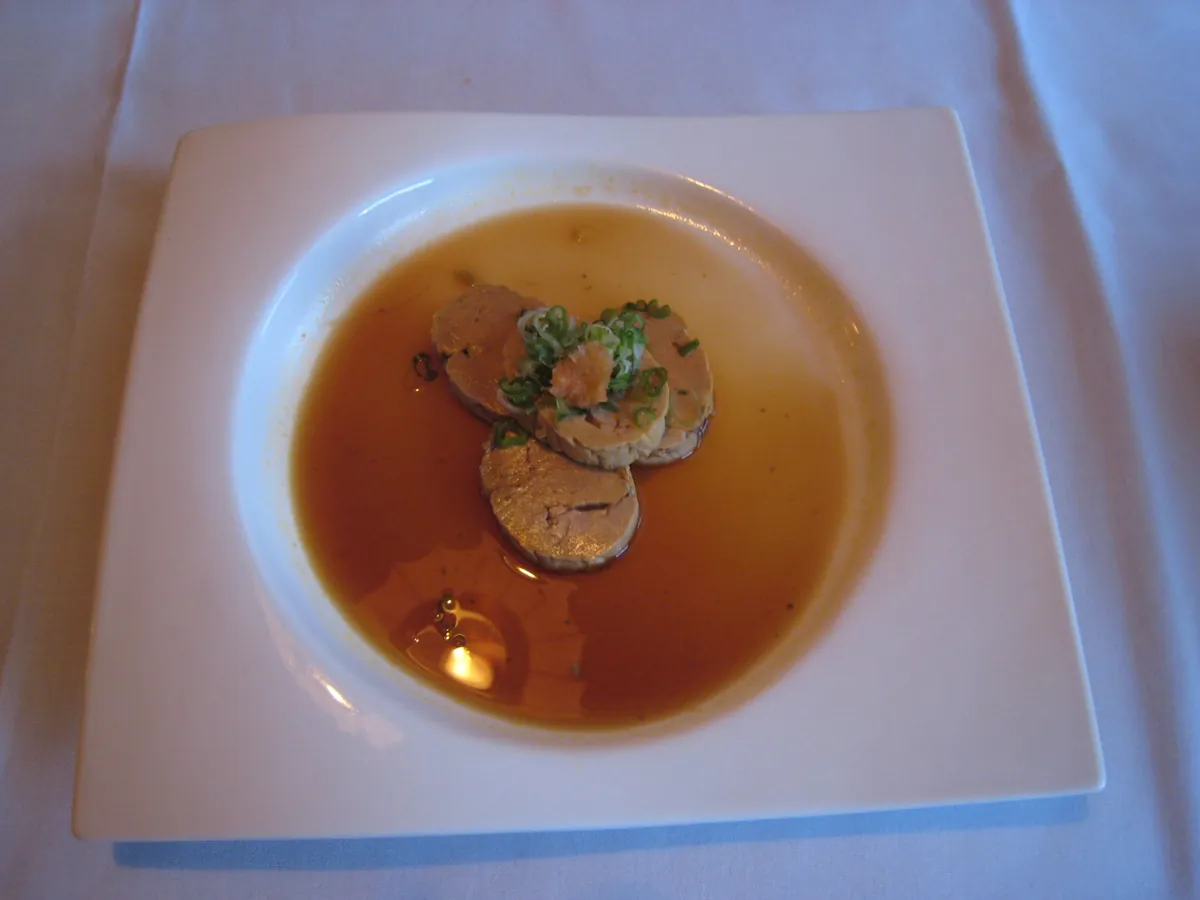
輪切りにされたあん肝が出汁の中に盛られ、小口ねぎと薬味が添えられている
加工後写っているもの: アンコウ(原典表記 Ankimo or monkfish liver)部位・状態: 塩ゆで・成形されたあん肝を輪切りにした状態。3切れが小鉢に盛られ、出汁に浸り小口ねぎと薬味が乗る
写真: Anyarei/ CC BY 3.0/ 原画像/ 台帳の原画像
写真の範囲と来歴
被写体の確認: 原典の記載による同定。説明文に明示的に「Ankimo or monkfish liver」と記載。原寸2592x1944 画像を開いて確認。輪切りのあん肝3切れが出汁の入った角皿に盛られている
掲載画像: Wikimedia Commons の原本を長辺2400pxへ縮小。切り抜き・色調変更なし。 表示用には幅1200px上限のWebPを配信し、台帳の原画像は上のリンクから確認できます。
On this page (8 sections)
Reading the bitterness
「あん肝」 (ankimo, also written 「鮟肝」) is anglerfish liver, including liver from Lophius litulon, prepared by boiling in salted water or steaming; fish with enlarged livers in winter are prized. 「デジタル大辞泉」 (Digital Daijisen) defines it as 「アンコウの肝臓。塩ゆでして水にさらし、薄切りにして、わさび醤油で食べたり、味噌あえにしたりする」 (in translation: "Anglerfish liver. Boiled in salted water, soaked in water, and sliced thinly; eaten with wasabi soy sauce or mixed with miso"). 「精選版日本国語大辞典」 (Seisenban Nihon Kokugo Daijiten) describes it as 「鮟鱇の肝臓。酒の肴などに珍重される」 (in translation: "Anglerfish liver. Prized as an accompaniment to alcohol, among other uses"). 『世界の料理がわかる辞典』 (in translation: "Dictionary of World Cuisine") also states 「酒の肴として好まれる」 (in translation: "favored as an accompaniment to alcohol"), but none of the 3 dictionaries consulted explicitly defines its taste as bitter or slightly bitter.
One local dish is 「あんこうの共酢」 (ankō no tomozu; in translation: "anglerfish with tomozu sauce") from Ibaraki Prefecture. The liver is fried to release its fat, ground, and combined with miso, sugar, and vinegar in a sauce served with boiled anglerfish flesh and other ingredients. It is described as an offering from the Mito Domain in the Edo period, and anglerfish liver is described as one of the five great delicacies under the name 「三鳥二魚」 (in translation: "three birds and two fish"). In Soma City, Fukushima Prefecture, 「あんこうのとも和え」 (ankō no tomoae; in translation: "anglerfish dressed with its liver") is made by frying and breaking up ankimo, seasoning it with miso and sugar, and mixing it with the flesh, dried daikon, and wakame. It is traditionally described as a treat for people who helped with rice planting. Neither Ministry of Agriculture, Forestry and Fisheries description mentions bitterness.
The 3 Japanese-language dictionaries consulted and the 2 entries on anglerfish dishes from Ibaraki and Fukushima Prefectures in the Ministry of Agriculture, Forestry and Fisheries’ 「うちの郷土料理」 (in translation: "Our Local Cuisine") give descriptions such as 「珍重」 (in translation: "prized") and 「酒の肴として好まれる」 (in translation: "favored as an accompaniment to alcohol"), but no explicit description of bitterness or slight bitterness was found. These materials provide no basis for a bitterness claim, so none is made here. More specialized sources may contain different descriptions.
There is also an example that measured the rupture stress related to hardness after heating. One study froze commercial Chinese-produced ankimo at -40°C, thawed it, and heated 30 g pieces in distilled water at 95-100°C for 7 minutes. Measuring 5 samples each of raw and heated ankimo, 3 times each, the rupture stress increased 1.6-fold, from 2.39×10^5 Pa to 3.80×10^5 Pa. This is a result for a single commercial-product condition and needs to be read separately from the physical properties of a steamed dish.
In the same study, 15 g each of ankimo and tiger pufferfish liver, both heated for 7 minutes, were presented to 8 female teaching staff in their 20s to 50s. Appearance, odor, oiliness, and taste, along with preference for appearance, aroma, taste, texture, and overall impression, were compared on a 5-point scale, and there was no significant difference for any item. However, 「味」 (in translation: "taste") is a broad item, and this was not a test that measured bitterness alone.
Even for the same liver, how it is handled changes with the dish. Ibaraki Prefecture's winter-fish feature introduces a fisherman's-meal dish, in which the liver is dry-roasted and then simmered, as 「どぶ汁」 (dobu-jiru). Tomozu, on the other hand, as introduced by the Ministry of Agriculture, Forestry and Fisheries, is made by frying the liver to release its fat, then grinding it and combining it with miso, sugar, and vinegar. The 2 dishes diverge in process: simmering it into a hot pot, or grinding it into a vinegar-miso sauce.
Sources for this overview
鮟肝(アンキモ)とは — デジタル大辞泉・精選版日本国語大辞典・世界の料理がわかる辞典
Checked for this overview: Used the definitions from 3 Japanese-language dictionaries verbatim. / Explicitly noted that the dictionary definitions contain no bitterness terms.
Checked for this overview: Used the preparation and history of Ibaraki’s tomozu dish. / Explicitly noted that the Ibaraki material contains no bitterness terms. / Used to describe how this differs from the existing tomozu process of the liver with miso, sugar, and vinegar.
Checked for this overview: Used the preparation and history of Fukushima’s tomoae dish. / Explicitly noted that the Fukushima material contains no bitterness terms.
Checked for this overview: Used for the commercial Chinese-produced sample, the freezing and thawing, the heating conditions, the number of samples, the rupture stress, and the limits on applicability. / Used for the amount presented, the panel conditions, the evaluation items, the absence of a significant difference between samples, and the qualification that bitterness was not separated out.
Checked for this overview: Used for the dry-roasting and simmering process of the liver in Ibaraki Prefecture's dobu-jiru.
Other names: 鮟肝 (ja)
Structured claims — open a section to read each claim's confidence, evidence and limits
Sensory (2)
Scope: The 3 dictionaries consulted this time and 2 Ministry of Agriculture, Forestry and Fisheries local-dish resources
Note: An honest record of a negative finding, based on NIGAMI LAB's collection discipline of not bending a source that only says "koku" (rich depth of flavor) into a claim of bitterness. A wider set of sources (academic journals, specialist cookbooks, and the like) might turn up a different description.
Show data
ingredient-ankimo —has_insufficient_evidence_for→ "A statement explicitly naming bitterness or mild bitterness. The 3 Japanese-language dictionaries consulted this time (Digital Daijisen, Selected Edition of the Nihon Kokugo Daijiten, and the Dictionary of World Cuisine), as well as 2 ankimo dish entries in the Ministry of Agriculture, Forestry and Fisheries' "Uchi no Kyodo Ryori" for Ibaraki and Fukushima Prefectures, all stop at descriptions such as 「珍重」 (in translation: "prized") and do not explicitly state bitterness."Scope: The comparison of commercial Chinese-produced ankimo and land-farmed tiger pufferfish liver in Mineki et al. 2009, with 8 female teaching staff
Note: 「味」 (in translation: "taste") is a broad evaluation item, and bitterness intensity was not measured independently. This is limited to an 8-person single-institution panel and a single commercial ankimo sample, and the absence of a significant difference is not proof of equivalence.
Show data
ingredient-ankimo —has_sensory_response→ "In a 5-point sensory test in which 15 g each of ankimo and tiger pufferfish liver, heated for 7 minutes, were presented, 8 female teaching staff in their 20s to 50s evaluated appearance, odor, oiliness, and taste, along with preference for appearance, aroma, taste, texture, and overall impression, and there was no significant difference between the two samples for any item"How processing and cooking change it (4)
Scope: Ministry of Agriculture, Forestry and Fisheries, 「うちの郷土料理」 (in translation: "Our Local Cuisine"), Ibaraki Prefecture.
Note: The body of this page does not mention bitterness or slight bitterness.
Show data
ingredient-ankimo —is_prepared_by→ "The Ibaraki Prefecture local dish 「あんこうの共酢」 (in translation: "anglerfish with tomozu sauce") is made by frying anglerfish liver to release its fat, grinding it well in a mortar, then making a sauce (tomozu) with miso, sugar, and vinegar to serve with boiled anglerfish flesh and other ingredients. It is described as an offering from the Mito Domain in the Edo period, and anglerfish liver is described as one of the five great delicacies under 「三鳥二魚」 (in translation: "three birds and two fish")."Scope: Ministry of Agriculture, Forestry and Fisheries, 「うちの郷土料理」 (in translation: "Our Local Cuisine"), Fukushima Prefecture.
Note: The body of this page does not mention bitterness or slight bitterness. The origin as a dish served to rice-planting helpers is presented as tradition; its date has not been verified in primary historical records.
Show data
ingredient-ankimo —is_prepared_by→ "The local dish 「あんこうのとも和え」 (in translation: "anglerfish dressed with its liver") from Soma City, Fukushima Prefecture, is made by frying and breaking up ankimo in a pan, kneading it with miso and sugar, and mixing in boiled anglerfish flesh, rehydrated dried daikon, and salted wakame. It is described as having once been served as a treat to people who helped with rice planting in the 5th month."Scope: The comparison sample of ankimo in Mineki et al. 2009. The rupture test measured 5 raw and 5 heated samples, each 3 times
Note: The main object of the study was tiger pufferfish liver; ankimo was a comparison sample under a single commercial-Chinese-product condition. The fish species and the product's processing history are unknown. This is not generalized to home steaming or to all ankimo.
Show data
ingredient-ankimo —was_observed_with→ "In a test in which Chinese-produced ankimo, purchased at a mass retailer in January 2007, was frozen at -40°C, thawed, and 30 g pieces were heated in distilled water at 95-100°C for 7 minutes, the rupture stress increased 1.6-fold, from 2.39×10^5 Pa raw to 3.80×10^5 Pa after heating"Scope: The dish introduction on Ibaraki Prefecture's official website, 「いばらき“冬のお魚”特集2025」 (in translation: "Ibaraki 'Winter Fish' Feature 2025")
Note: A dish process from prefectural public-relations material. No quantity, heating time, or scientific name is given, and this is not a measurement of bitterness or physical properties.
Show data
ingredient-ankimo —is_prepared_by→ "Ibaraki Prefecture's winter-fish introduction presents a dish in which anglerfish liver is dry-roasted and then simmered as 「どぶ汁」 (dobu-jiru)"Culture (1)
Scope: The 3 dictionaries included in Kotobank: Digital Daijisen, Seisenban Nihon Kokugo Daijiten, and Sekai no Ryori ga Wakaru Jiten.
Note: All 3 dictionaries stop at descriptions such as 「珍重」 (in translation: "prized"); no definition explicitly mentioning bitterness or slight bitterness was found in the material checked.
Show data
ingredient-ankimo —is_defined_in_dictionary_as→ "Digital Daijisen defines it as 「アンコウの肝臓。塩ゆでして水にさらし、薄切りにして、わさび醤油で食べたり、味噌あえにしたりする」 (in translation: "Anglerfish liver. Boiled in salted water, soaked in water, then sliced thinly and eaten with wasabi soy sauce or mixed with miso"). Seisenban Nihon Kokugo Daijiten defines it as 「鮟鱇(あんこう)の肝臓。酒の肴などに珍重される」 (in translation: "Anglerfish liver. Prized as an accompaniment to alcohol, among other uses"). 『和・洋・中・エスニック 世界の料理がわかる辞典』 (in translation: "Dictionary of Japanese, Western, Chinese, and Ethnic World Cuisine") states 「あんこうの肝臓。またこれを蒸した料理。もみじおろしやあさつきを添え、ポン酢しょうゆをかけることが多い。酒の肴として好まれる」 (in translation: "Anglerfish liver, or a dish made by steaming it. Often served with grated daikon and chili, asatsuki scallions, and ponzu soy sauce. Favored as an accompaniment to alcohol")."