Awa bancha
ingredient / ingredient-awa-bancha
阿波晩茶
Awa bancha is a post-fermented tea traditional to Kamikatsu in Katsuura District, Naka in Naka District, and Minami in Kaifu District, Tokushima Prefecture. Tough tea leaves picked late in summer are heated, for example by boiling in a large cauldron, to stop oxidative fermentation, then placed in tubs or barrels for lactic-acid fermentation.
Photographs (captions in Japanese)
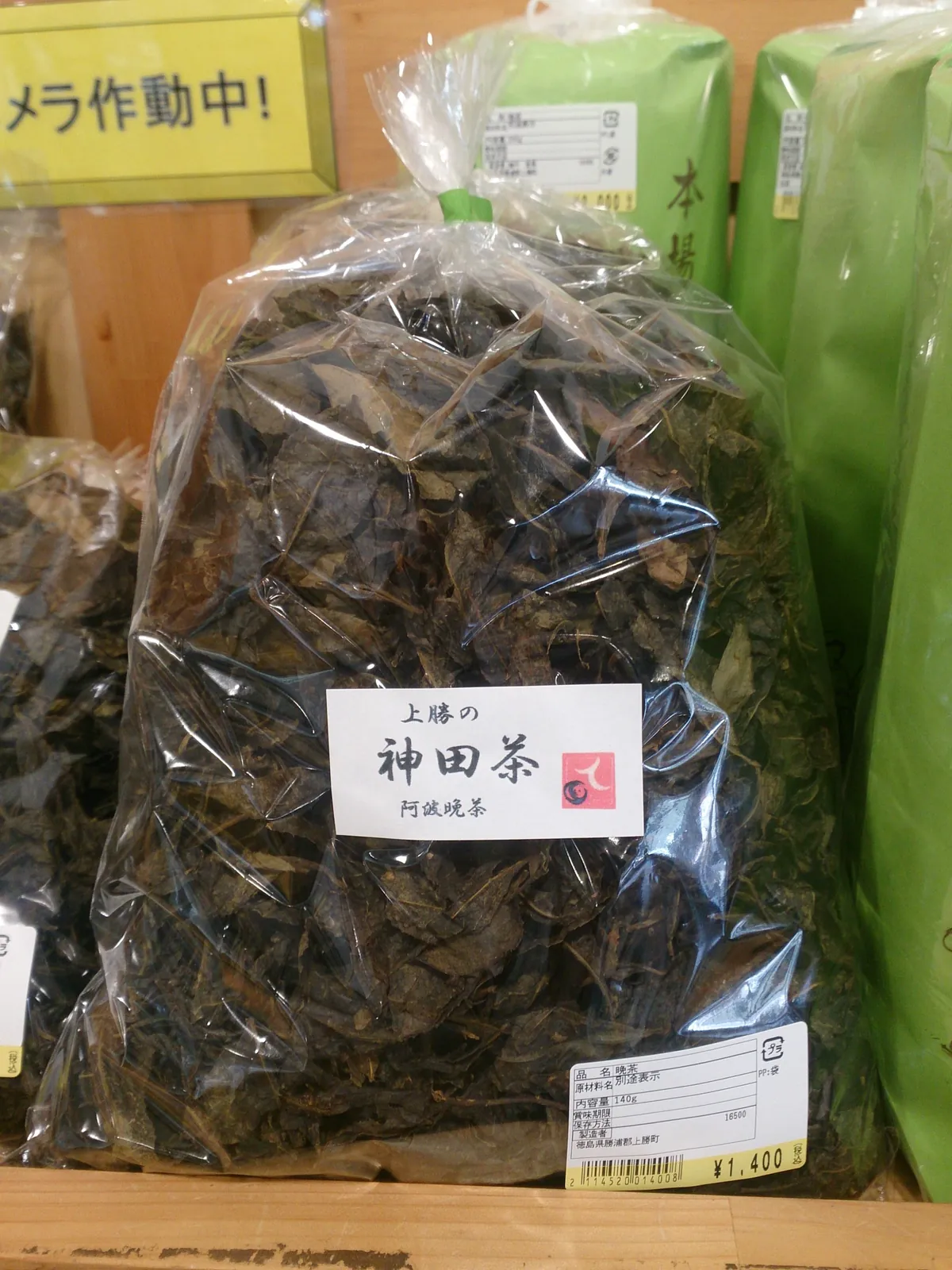
神田茶(阿波晩茶の一種として説明されている)の茶葉。ファイル名は地域内の一種類「神田茶」だが、ファイルページの英語説明は「Awabancha, Fermented tea in Tokushima Prefecture, Japan」と、阿波晩茶そのものとして記載している。
写っているもの: 該当分類群なし(神田茶、阿波晩茶の一種として説明されている)部位・状態: 神田茶(阿波晩茶の一種として説明されている)の茶葉
写真: Shugyoso/ CC BY-SA 4.0/ 原画像/ 台帳の原画像
写真の範囲と来歴
被写体の確認: 原典の記載による同定。Wikimedia Commons上で阿波晩茶を明示的に主題とする写真はこの1点のみ確認(Category:Fermented tea・「阿波晩茶」「Awabancha」の全文検索で他に該当なし)。神田茶は上勝町周辺の地域名であり、ファイルページの英語説明が阿波晩茶との対応を明記している点に基づき採用。
掲載画像: Wikimedia Commons の原寸ファイルを取得後、苦味研究所にて sips で長辺2400px程度に縮小。切り抜き・色調変更なし。 表示用には幅1200px上限のWebPを配信し、台帳の原画像は上のリンクから確認できます。
On this page (6 sections)
Reading the bitterness
Awa-bancha is a post-fermented tea traditional to Kamikatsu in Katsuura District, Naka in Naka District, and Minami in Kaifu District, Tokushima Prefecture. Tough leaves picked late in summer are heated, such as by boiling in a large cauldron, to stop oxidative fermentation, then immersed in a tub or barrel for lactic-acid fermentation. In a composition analysis conducted by the Tokushima Prefectural Industrial Technology Center in accordance with the Food Labeling Standards (Cabinet Office Ordinance No. 10 of Heisei 27), reported tannin contents were 8.1 g/100 g for Awa-bancha, 7.5 g/100 g for Ishizuchi-kurocha, 11.4 g/100 g for sencha, and 6.5 g/100 g for black tea.
The same analysis also compared caffeine contents: 1.5 g/100 g for Awa-bancha, 1.4 g/100 g for Ishizuchi-kurocha, 2.1 g/100 g for sencha, and 3.0 g/100 g for black tea. Awa-bancha was reported to have less protein, caffeine, and tannin than sencha and less protein and caffeine than black tea. The sample number and production-lot details were not given.
The Tokushima Prefectural Industrial Technology Center also measured infusions with a taste sensor (SA402B, Intelligent Sensor Technology). It reported lower astringency-stimulus and umami output values for Awa-bancha than for sencha or black tea, while its acidity output was second highest after Ishizuchi-kurocha. On this basis, Awa-bancha was described as having a refreshing taste with acidity. The acidity and saltiness sensor outputs, however, were judged below the tasteless point, and no sample count, repetitions, or statistical tests were reported; the outputs should be treated as reference values.
A separate Tokushima Prefectural Industrial Technology Center report compared a total of 7 tea types, including 15 Awa-bancha samples, with Ishizuchi-kurocha, Goishicha, Batabatacha, sencha, black tea, and oolong tea. It analyzed flavor-related organic acids (acidity), catechins (astringency and bitterness), caffeine (bitterness), and free amino acids (flavor complexity). Awa-bancha was reported to have more organic acids and fewer catechins, caffeine, and free amino acids. This report was a results poster; individual contents were not stated numerically in the body text and appeared only in bar charts and a PCA biplot.
Sources for this overview
Checked for this overview: Checked the tannin-content comparison in a composition analysis complying with the Food Labeling Standards. / Checked the same analysis's caffeine-content and protein comparisons. / Checked the infusion measurements with the SA402B taste sensor and their limitations.
後発酵茶「阿波晩茶」の特性が明らかに――阿波晩茶の成分特性に関する研究
Checked for this overview: Relative amounts of catechins, caffeine, and organic acids in the comparison of 7 tea types.
Structured claims — open a section to read each claim's confidence, evidence and limits
Composition and content (2)
Scope: Leaf analysis of awa-bancha and Ishizuchi-kurocha (both post-fermented teas), sencha (an unfermented tea), and black tea (a fermented tea)
Note: Included after checking the full text (Table 2) from the Tokushima Prefectural Industrial Technology Center. Details of sample size and origin/lot are not given.
Show data
ingredient-awa-bancha —has_composition→ "In an analysis conducted under the Food Labeling Standards (Cabinet Office Ordinance No. 10 of Heisei 27), tannin content was 8.1 g/100g for awa-bancha, 7.5 g/100g for Ishizuchi-kurocha, 11.4 g/100g for sencha, and 6.5 g/100g for black tea; caffeine content was 1.5 g/100g for awa-bancha, 1.4 g/100g for Ishizuchi-kurocha, 2.1 g/100g for sencha, and 3.0 g/100g for black tea. Awa-bancha had less protein, caffeine, and tannin than sencha, and less protein and caffeine than black tea."Scope: Layer: food. A Tokushima Prefectural Industrial Technology Center study (15 Awa-bancha samples compared with 7 other tea types; full text read). Individual values appear only in graphs, not in the body text.
Show data
ingredient-awa-bancha —has_composition→ "The contents of catechins, associated with astringency and bitterness, and caffeine, associated with bitterness, were lower than in the comparison teas (Ishizuchi-kurocha, Goishicha, Batabatacha, sencha, black tea, and oolong tea)."Sensory (1)
Scope: A comparison of infusions of awa-bancha, Ishizuchi-kurocha, sencha, and black tea (Tokushima Prefectural Industrial Technology Center, taste sensor SA402B)
Note: A comparison between single samples; the number of replicates and statistical testing are not stated.
Show data
ingredient-awa-bancha —has_sensory_attribute→ "Measuring infusions with a taste sensor (SA402B), awa-bancha showed lower output values for astringency stimulus and umami than sencha and black tea. Its sourness output value was the second highest, after Ishizuchi-kurocha. These results are reported to show that awa-bancha has a sour, clean-tasting profile."