caffeine
compound / compound-caffeine
カフェイン
Caffeine is a bitter methylxanthine with diverse biological actions.
Photographs (captions in Japanese)
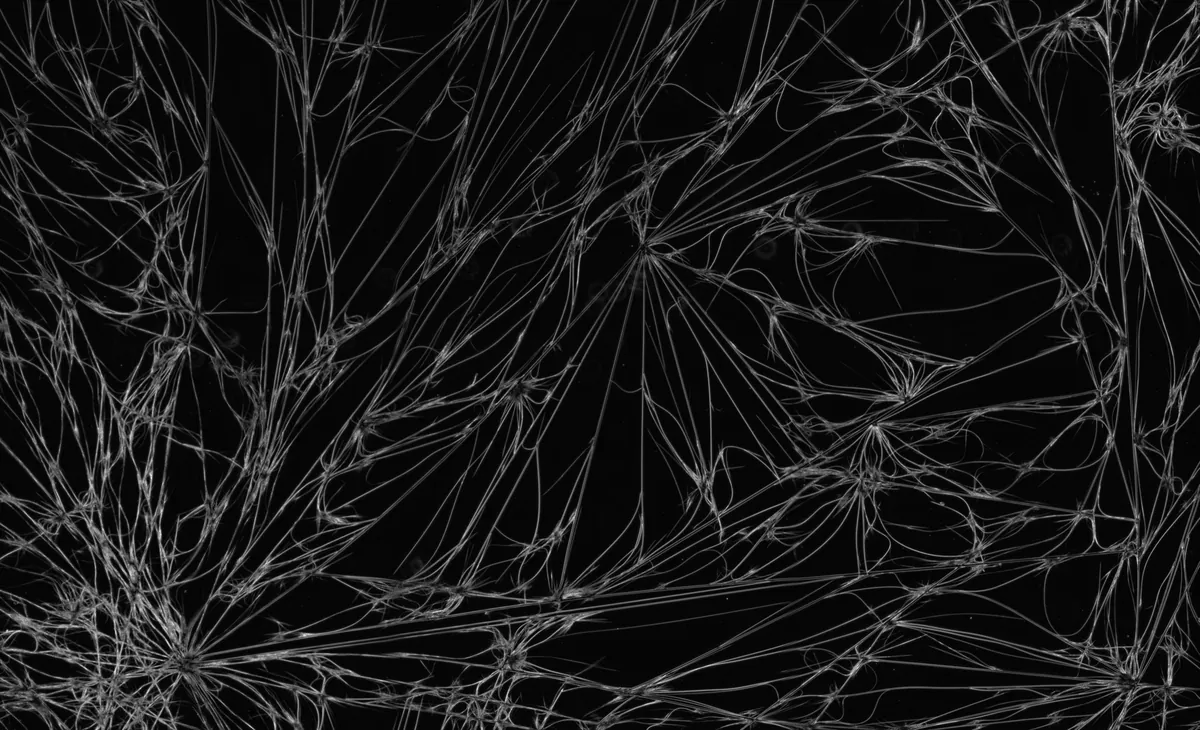
暗視野顕微鏡で撮影した繊維状のカフェイン結晶。核形成点から放射状に伸びる結晶が観察できる。
写っているもの: 該当なし(生物ではなく化合物の結晶)部位・状態: 結晶(暗視野顕微鏡像)
写真: Zephyris/ CC BY-SA 3.0/ 原画像/ 台帳の原画像
写真の範囲と来歴
被写体の確認: 原典の記載による同定。分子構造図ではなく実物の結晶を暗視野顕微鏡で撮影した写真。
掲載画像: 苦味研究所側で sips により長辺2400pxにリサイズ(オリジナルは7362x4476px)。トリミング・色調変更なし。 表示用には幅1200px上限のWebPを配信し、台帳の原画像は上のリンクから確認できます。
On this page (9 sections)
Reading the bitterness
Caffeine is not suitable as a universal representative for use in bitter research. According to reviews, caffeine acts through multiple pathways independent of TAS2R receptors. These include micromolar affinity for adenosine receptors A1, A2A, and A2B; elevation of intracellular calcium via ryanodine receptors; elevation of cGMP through phosphodiesterase inhibition; and TRPA1 channel activity that reverses by species. In mice, TRPA1 is activated by 0.1-10 mM caffeine, and wild-type mice avoided 5 mM caffeine water while TRPA1-deficient mice did not. Conversely, human TRPA1 does not respond to 5 mM caffeine and has been shown to instead suppress its activity.
On the receptor side of caffeine bitterness on the tongue, no simple one-to-one correspondence exists. In cultured-cell receptor assays, caffeine is reported to activate 5 receptors: hTAS2R7, 10, 14, 43, and 46. However, individuals who completely lack the TAS2R43 gene are common in many populations; in a study of 946 individuals from 52 populations worldwide, the deletion allele frequency for this gene was 0.33, and over 20% of subjects in Europe lacked it. Despite this, caffeine bitterness is still perceived. The loss of a single receptor does not erase the bitter sensation itself.
There is individual variation in how bitter caffeine tastes, and this difference is linked to daily intake quantity. In a 20-person study, bitterness ratings for 8 mM caffeine correlated with both the combined mRNA of TAS2R10, 43, and 46 genes in taste buds and daily caffeine intake; these 2 factors explained 47% of the variance in bitterness ratings. In a larger UK population study, individuals genetically predicted to have 1 standard deviation higher caffeine bitterness sensitivity consumed approximately 0.146 cups/day more coffee—a relationship opposite to intuition has been reported. In the same study, bitterness sensitivity to quinine showed the opposite, a negative relationship with coffee intake; only caffeine points in the opposite direction.
This opposite relationship is explained by connecting it to the hypothesis that caffeine bitterness may be 「学習によって好きになる」 (in translation: "acquired through learning"). In a series of experiments with moderate caffeine consumers, after 1 night of caffeine abstinence, a new-flavor beverage was repeatedly paired with caffeine; preference for that flavor increased over successive days. However, this preference did not appear when tested in the non-abstinent state, declined as consumption continued without caffeine, and actually decreased in individuals who had completely abstained for weeks. The researchers explain this phenomenon not as preference for bitterness itself, but as negative reinforcement through relief of caffeine withdrawal discomfort.
Sources for this overview
Checked for this overview: Confirmed that caffeine acts through multiple receptor-independent pathways / Confirmed the number of 5 receptors activated by caffeine
Caffeine activates mouse TRPA1 channels but suppresses human TRPA1 channels
Checked for this overview: Confirmed experimental results showing species-dependent reversal of TRPA1 activation and suppression
Checked for this overview: Confirmed TAS2R43 deletion frequency of 0.33 and over 20% in Europe
Checked for this overview: Confirmed result that the correlation between bitterness rating and intake quantity and mRNA amount explains 47%
Checked for this overview: Confirmed the 0.146 association where higher bitterness sensitivity correlates with increased intake
Acquisition and extinction of flavour preferences conditioned by caffeine in humans
Checked for this overview: Confirmed experiment where flavor conditioning after caffeine abstinence raised preference / Confirmed result showing conditioning preference disappears in the non-deprived state
Checked for this overview: Confirmed result showing long-term complete abstainers have decreased liking for caffeinated beverages
Follow the connections
caffeine →is a poor universal prototy…→ bitterness →can be measured separately …→ astringency
caffeine →activates→ human TAS2R receptor family
caffeine →remains bitter even for peo…→ TAS2R43
caffeine →can decrease→ astringency →is not synonymous with→ bitterness
Measured values (1)
| Kind | Compound | Target | Value | Conditions | Source |
|---|---|---|---|---|---|
| receptor EC50 | caffeine | Mouse TRPA1 | 1–2.5 mM | Heterologous expression system (mouse receptors) (Human TRPA1 shows no activation but suppression (species difference)) | Nagatomo K, 2008 |
Values are the reported values of each source (with units and conditions). Thresholds and EC50 depend on the panel and method; they are not single true values.
Structured claims — open a section to read each claim's confidence, evidence and limits
Composition and content (8)
Scope: Multiple lines of evidence: human sensory testing, receptor assays, and quantitative chemistry
Note: A group of counterexamples to the common belief that 「コーヒーの苦味=カフェイン」 (in translation: "coffee's bitterness equals caffeine"). The quantitative contribution ratio is not recorded, since the full text was not confirmed.
Show data
ingredient-coffee-brew —has_bitter_contributors_other_than→ compound-caffeineScope: The source lists 「コーラナッツの2つの重要成分」 (in translation: "two important constituents of kola nuts") as caffeine and theobromine
Note: Content values are not reported in the abstract.
Show data
ingredient-kola-nut —contains→ compound-caffeineScope: Hot- and cold-brewed mate tea infusions
Note: The object_entity is caffeine. Theobromine and theophylline are recorded in object_text.
Show data
ingredient-yerba-mate-infusion —contains→ compound-caffeineScope: Product definition description in the GI registry
Note: This is a description from the GI standard, not based on standardized analytical testing.
Show data
ingredient-doi-chang-coffee —has_composition→ compound-caffeineScope: Kochi Prefectural Agricultural Technology Center Tea Experiment Station, 2014; light-roast and deep-roast hojicha made from crude first-flush and cut-leaf tea (roasted 2 times with an automatic continuous hojicha roaster).
Note: Direct quantification by HPLC (Shimadzu).
Show data
process-hojicha-roasting —reduces→ compound-caffeineScope: New shoots of tea plants -- such as for gyokuro and tencha -- grown under high-shading-rate materials for roughly 20-30 days
Note: A re-investigation of an item deferred in W44 (shading cultivation, "astringency only"). The existing claim covered only the change in catechins (astringent, bitter-astringent compounds) and did not state bitterness explicitly. This claim records that, within the same table of the same manual, the increase in caffeine is classified in the remarks column as "bitterness / functional," while the decrease in catechins is classified as "bitter-astringent compounds" -- a separate item -- showing that the source explicitly distinguishes bitterness from bitter-astringency (astringency).
Show data
process-tea-shading-cultivation —increases→ compound-caffeineScope: Layer: food (roasted beans, dry-matter-basis values). HPLC analysis. The other 5 samples were a mix of arabica and robusta with some origins undisclosed; this is not an exhaustive species-by-species comparison.
Show data
ingredient-robusta-coffee —has_composition→ compound-caffeineScope: Layer: Literature (review summary). Includes variation by extraction conditions, origin, and processing method.
Show data
organism-ilex-paraguariensis —has_composition→ compound-caffeineSensory (13)
Scope: A small-scale human study reported in the cited paper
Note: The association does not establish the direction of causation, nor can it be generalized to every population.
Show data
compound-caffeine —has_perceived_bitterness_associated_with→ "Habitual caffeine intake and bitter-receptor mRNA abundance in taste papillae"Scope: Reconstituted black tea infusion system. First empirical demonstration reported
Note: The direction is amplification of caffeine bitterness by flavonol-3-glycosides. This differs in both compound pair and attribute from the finding that caffeine weakens EGCG astringency.
Show data
compound-flavonol-glycosides —amplify_bitterness_of→ compound-caffeineScope: Mendelian randomization, UK Biobank white British ancestry, n = 438,870. The instrumental variable was estimated in an adolescent twin sample, n = 1757
Show data
compound-caffeine —has_perceived_bitterness_positively_associated_with→ "Coffee intake: +0.146 [0.103, 0.189] cups/day per 1 SD of genetically predicted caffeine bitterness. OR 1.207 [1.126, 1.294] for becoming a consumer of more than 4 cups/day. Tea intake moves in the opposite direction (-0.045 [-0.061, -0.030])"Scope: Layer: literature (secondhand citation). A figure stated in the Introduction of Gigl et al. 2026 (JAFC, full text read), citing Chen W.C. (1979, a doctoral dissertation at the University of Munich, primary source not read — a secondhand citation).
Show data
compound-caffeine —contributes_to→ sensation-bitterScope: Layer: food. Sensory evaluation on a 5-point scale, 0 (not detectable) to 5 (strongly detected), by 18 panelists (8 women, 10 men, ages 23-31). Caffeine was added to a decaffeinated roasted coffee beverage (a commercial capsule, equivalent to 54 g/L).
Show data
ingredient-coffee-brew —has_perceived_bitterness_unchanged_by→ compound-caffeineScope: Layer: food. A 3-AFC method in which panelists identified 1 added-caffeine cup among 3 cups, 2 of which were decaffeinated coffee (control).
Show data
compound-caffeine —can_increase→ sensation-bitterScope: Layer: food (reconstitution of a high-molecular-weight fraction isolated from coffee). A 5-point scale, 0 (not detectable) to 5 (strongly detected), 18 panelists, t-test (α=0.05).
Show data
compound-class-melanoidins —reduces_perceived_bitterness_of→ compound-caffeineScope: Layer: solution. 18 panelists, 0-5 point scale, t-test (α=0.05).
Show data
compound-caffeine —has_perceived_bitterness_unchanged_by→ compound-chlorogenic-acidScope: Layer: Literature (cited value). The value cited in the text of Gigl et al. 2026 (JAFC) (original source not specified)
Note: An indirect citation whose original source is not specified in the text
Show data
compound-caffeine —has_bitter_recognition_threshold→ "The human caffeine bitter detection threshold is cited as 0.67 mmol/L"Scope: Layer: Food. QDA by a trained panel of 18 and consumer preference survey of 120. Traditional and decaffeinated espresso sweetened with sucrose, sucralose, or stevia (multiple rebaudioside A concentrations) were compared.
Show data
ingredient-coffee-brew —has_perceived_bitterness_affected_by→ compound-caffeineScope: Layer: food. A raw coffee beverage prepared at 54 g/L unroasted coffee powder from green beans (Colombian origin, ground under liquid nitrogen). 18 panelists, 0-5 point scale.
Show data
ingredient-green-coffee-bean —has_perceived_bitterness_unchanged_by→ compound-caffeineScope: Layer: Solution. Labeled Magnitude Scale (LMS) bitterness intensity rating by 45 healthy adults (separate from the PROP experiment mentioned above).
Show data
compound-arginine —increases→ compound-caffeineScope: Ranking method sensory test (20 female students, Hamajima 1981) in a model system where caffeine (0.03/0.05%, etc.) was stepwise added to acetic acid aqueous solution (0.01/0.1/0.3/0.5%)
Note: This is basic knowledge of taste interactions in an aqueous model system, not an experiment targeting specific foods like ornamental chrysanthemum. In the actual preparation of edible chrysanthemum, the materials we checked (FoodsLink, note.com) explain the purpose of adding vinegar as color development, not as bitterness suppression. Do not casually conflate the two.
Show data
compound-caffeine —has_perceived_bitterness_suppressed_by→ "Addition of 0.03% or higher acetic acid aqueous solution"Mechanism and receptors (8)
Scope: Caffeine's experimental use as a bitter stimulus
Note: The review in question also discusses receptor-independent pathways in addition to the canonical pathway.
Show data
compound-caffeine —is_a_poor_universal_prototype_for→ sensation-bitterScope: A receptor assay in a cultured-cell system (Meyerhof et al.'s results as cited by a review)
Note: EC50 is not given in the review.
Show data
compound-caffeine —activates→ receptor-tas2r-familyScope: The correspondence between the frequency of the gene deletion in human populations and perception
Note: An example that a single receptor cannot explain bitterness perception. "About 18-30%" is a review-level figure. Note that the primary data (946 people / 52 populations) give a deletion-allele frequency of 0.33, a different kind of quantity from "the proportion of individuals lacking the gene".
Show data
compound-caffeine —remains_bitter_despite_absence_of→ receptor-tas2r43Scope: In an EGCG/caffeine/saliva model, the astringency of EGCG when caffeine partially occupied EGCG binding sites on salivary proteins
Note: Assessed by molecular docking, ITC, and salivary rheology. Perceived astringency was inferred from salivary film structure; the abstract reports no human panel data.
Show data
compound-caffeine —can_decrease→ sensation-astringentScope: Double-blind human flavor-conditioning studies (University of Sussex group)
Note: The experimental basis for the 『連合学習』 (in translation: "associative learning") theory of coffee and beer preference. Note that replication remains within the same research group.
Show data
compound-caffeine —conditions_liking_for_paired_flavors→ "In moderate caffeine consumers who abstained overnight, an increase in liking for a novel beverage flavor repeatedly paired with caffeine"Scope: The same conditioning paradigm. The 4-week maintenance/withdrawal manipulation in Tinley 2003
Note: Supports the negative reinforcement theory. A strong limitation on the naive interpretation of 『苦味自体を安定的に好きになる』 (in translation: "coming to stably like bitterness itself").
Show data
compound-caffeine —produces_conditioned_liking_dependent_on→ "Caffeine deprivation state: the conditioned preference is not expressed when tested in a non-deprived state, is extinguished without caffeine, and reverses in consumers who are fully withdrawn"Scope: Layer: cell. Cell functional experiments using several human bitter taste receptors reported to be caffeine-sensitive (TAS2R7, TAS2R10, TAS2R14, TAS2R43, TAS2R46).
Note: Suess et al. 2018's full text was not reached because of a subscription restriction; confirmed from an OpenAlex abstract restoration (the paper's own abstract, not a secondary citation).
Show data
compound-caffeine —activates→ receptor-tas2r43Scope: Layer: cell. Cell functional experiments using several human bitter taste receptors reported to be caffeine-sensitive.
Note: Suess et al. 2018's full text was not reached because of a subscription restriction; confirmed from an OpenAlex abstract restoration.
Show data
compound-caffeine —activates→ receptor-tas2r46