beer
ingredient / ingredient-beer
ビール
Beer is a grain-fermented beverage in which hop-derived bitter acids, humulinones, and polyphenols overlap, changing not only intensity but also attack and aftertaste.
Photographs (captions in Japanese)
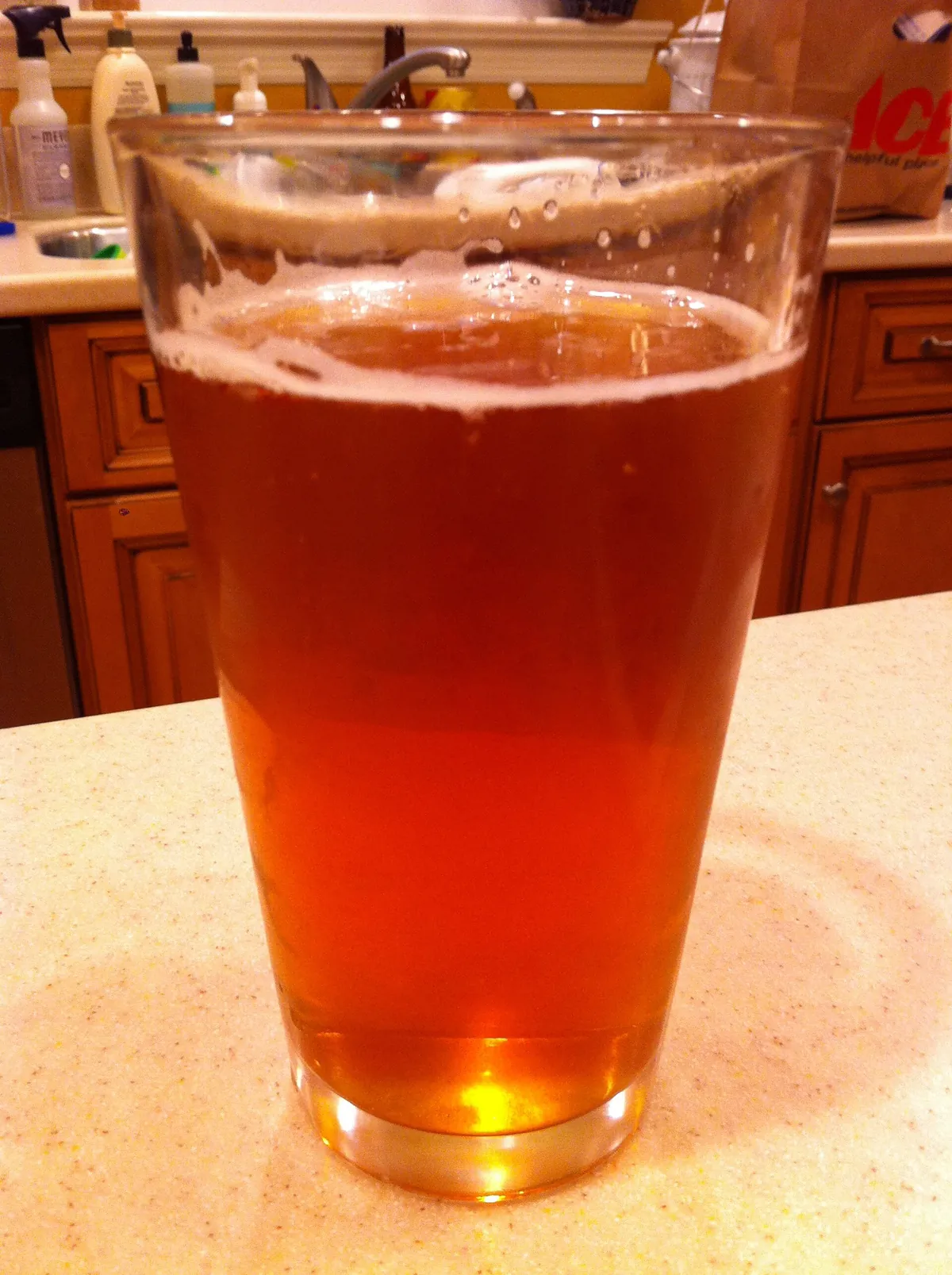
ビール(IPAスタイルの一例)。パイントグラスに注がれた琥珀色のビールで、表面に白い泡の層が立っている。原典キャプションは「Hoppyum IPA」というホップを効かせた自家醸造ビールと記す。ビール全般の標準形ではなく、IPAと呼ばれるスタイルの一例である。
写っているもの: 該当分類群なし(IPAスタイルのビール一杯)部位・状態: パイントグラスに注がれた、白い泡の層をのせた琥珀色のIPA(インディア・ペール・エール)。液体そのものの色・泡立ちが見える状態
写真: misterkong/ CC BY-SA 3.0/ 原画像/ 台帳の原画像
写真の範囲と来歴
被写体の確認: 原典の記載による同定。原典キャプションは「A pint of Hoppyum IPA」とのみ記載。銘柄・醸造所の詳細は不明で、ビール全般の代表例ではなく苦味の強いIPAスタイルの一例として掲載する。
掲載画像: Wikimedia Commons の1920px版。苦味研究所では切り抜き・色調変更なし。 表示用には幅1200px上限のWebPを配信し、台帳の原画像は上のリンクから確認できます。
On this page (8 sections)
Reading the bitterness
When viewed through bitterness, hops in beer are not merely a flavoring agent. In one glass lie multiple compounds derived from different sources with different properties: hop bitter acids including iso-α-acids, humulinones arising from oxidation, and polyphenols. Some bitterness hits sharply the moment it enters the mouth; other bitterness gradually strengthens, rounds off, and fades. Beer bitterness is not merely 「強い・弱い」 (in translation: "strong or weak")—it is a taste with form and time.
Therefore, the IBU on the label alone cannot account for the bitterness in the glass. In more than 120 commercial highly hopped beer brands, the relationship between Bitterness Units (BU) and human-rated bitterness intensity was non-linear. In dry hopping, humulinones and polyphenols increase while iso-α-acids may decrease, as has been reported. IBU is an analytical measurement of bitterness-related components determined by a standard method; it does not convert the quality or perception of bitterness into a single score.
Furthermore, bitterness does not finish in the fermentation tank and remain unchanged. In a trial tracking 9 beers of different alcohol content through before and after swallowing, the high-alcohol group showed bitterness and astringency as more dominant. However, because differences among individual products are also involved, this cannot be attributed to alcohol alone. The influence of hop freshness on bitterness quality was not the same between dry hopping and long-duration boiling. Which hop, when, in what state it is added, and how it rises and falls in the mouth—all of this is beer bitterness.
Sources for this overview
The impact of hop bitter acid and polyphenol profiles on the perceived bitterness of beer
Checked for this overview: Analysis of hop bitter acids in commercial lagers / Analysis of polyphenols in commercial lagers / Sensory study linking bitterness onset and quality to compound composition and hopping method
Evaluation of Nonvolatile Chemistry Affecting Sensory Bitterness Intensity of Highly Hopped Beers
Checked for this overview: Analysis of humulinones in commercial highly hopped beers / Research on more than 120 highly hopped beers showing non-linear relationship between BU and rated bitterness intensity
Checked for this overview: Research identifying humulinones as oxidation products of hop acids
Toward Understanding the Bitterness of Dry-Hopped Beer
Checked for this overview: Research showing that dry hopping can raise humulinones and polyphenols while lowering iso-α-acids
Effects of Dry-Hopping on Beer Chemistry and Sensory Properties - A Review
Checked for this overview: Review synthesizing the distinction between IBU and perceived bitterness
Exploring the flavor life cycle of beers with varying alcohol content
Checked for this overview: TDS research on 9 beers of different alcohol content tracked through swallowing
Impact of Hop Freshness on Dry Hopped Beer Quality
Checked for this overview: Small-scale sensory trial comparing hop freshness index with bitterness quality of dry-hopped beers
The Impact of Hop Freshness on Kettle-Hopped Beers
Checked for this overview: Sister study showing how boiling duration alters the bitterness effect of aged hops
Follow the connections
beer →contains→ hop bitter acids →contributes to→ bitterness
beer →contains→ humulinones →contributes to→ bitterness
beer →contains→ polyphenols →contributes to→ bitterness
Hypotheses and recipe candidates for this entry are on the Japanese page.
Structured claims — open a section to read each claim's confidence, evidence and limits
Composition and content (3)
Scope: Commercial lager beers chemically analyzed in the cited study
Note: Concentration and product profile vary. / 2026-08-31: calibration-downgraded from established to supported because the supporting evidence has no full-text-checked source. May be re-upgraded once full text is checked.
Show data
ingredient-beer —contains→ compound-hop-bitter-acidsScope: Highly hopped commercial beer in the cited study
Note: Humulinones arise through oxidation and are not present in equal amounts in every beer.
Show data
ingredient-beer —contains→ compound-humulinonesScope: Commercial lager beers chemically analyzed in the cited study
Note: Polyphenol composition varies with raw materials and process. / 2026-08-31: calibration-downgraded from established to supported because the supporting evidence has no full-text-checked source. May be re-upgraded once full text is checked.
Show data
ingredient-beer —contains→ compound-polyphenolsSensory (5)
Scope: Commercial lager beers in the cited study
Note: Terms such as sharp, progressive, and rounded are descriptors from that study's own panel, not fixed categories applicable to every beer.
Show data
ingredient-beer —has_bitterness_character_influenced_by→ "Hop bitter acid and polyphenol profile, and hopping strategy"Scope: More than 120 highly hopped commercial beer brands
Note: Model performance outside highly hopped beers has yet to be verified.
Show data
ingredient-beer —has_nonlinear_relationship_between→ "Bitterness Units (BU) and rated bitterness intensity"Scope: A finding specific to dry hopping (when hops with HSI > 0.4 are used). In kettle hopping, a sister study found no bitterness-quality problem at high HSI when boiled for at least 45 minutes
Note: Quality and intensity behave differently: quality declined monotonically, while measured BU peaked at an intermediate HSI in 2 of 3 cultivars. 10 assessors, one brewing trial per cell.
Show data
ingredient-beer —has_bitterness_quality_reduced_by→ "Dry hopping with hops of a storage index (HSI) above 0.4. Bitterness quality scored 4.9-5.0 on a 1-5 scale at HSI 0.3, and declined at higher HSI"Scope: TDS of 9 beers differing in alcohol content
Note: This is not a mechanistic claim that alcohol directly enhances bitterness perception. It includes concurrent differences among the beer groups.
Show data
ingredient-beer —has_perceived_bitterness_affected_by→ "The higher the alcohol content of a sample, the more temporally dominant bitterness and astringency were, particularly before swallowing"Scope: An explanatory article on the official Yaho Brewing website, in the domain of Japanese craft beer (a differentiated-brand category)
Note: Source text: the official website states that the IBU of lager beer generally drunk in Japan is roughly around "20" (in translation: "20"), and that what creates a beer's 「苦味」 (in translation: "bitterness") is ... 「ホップ」 (in translation: "hops"); the component called 「α酸」 (in translation: "alpha acid") contained in hops is the source of the bitterness. Within the portfolio of this same differentiated (craft) brewer, IBU is deliberately varied from 11 to 62, an example in which the strength of bitterness is adjusted by each brand's positioning rather than by an industrial-versus-gourmet distinction.
Show data
ingredient-beer —has_sensory_attribute→ "The official Yaho Brewing website, 「よなよなの里」 (in translation: "Yonayona no Sato"), shows Suiyobi no Neko at 11, Yona Yona Ale at 41, and Indo no Aooni at 62 as the IBU of its own beers, and states, for comparison, that the IBU of lager beer generally drunk in Japan is roughly around "20" (in translation: "20")."