humulinones
compound class / compound-humulinones
フムリノン類
Oxidation products of hop alpha acid.
Photographs (captions in Japanese)
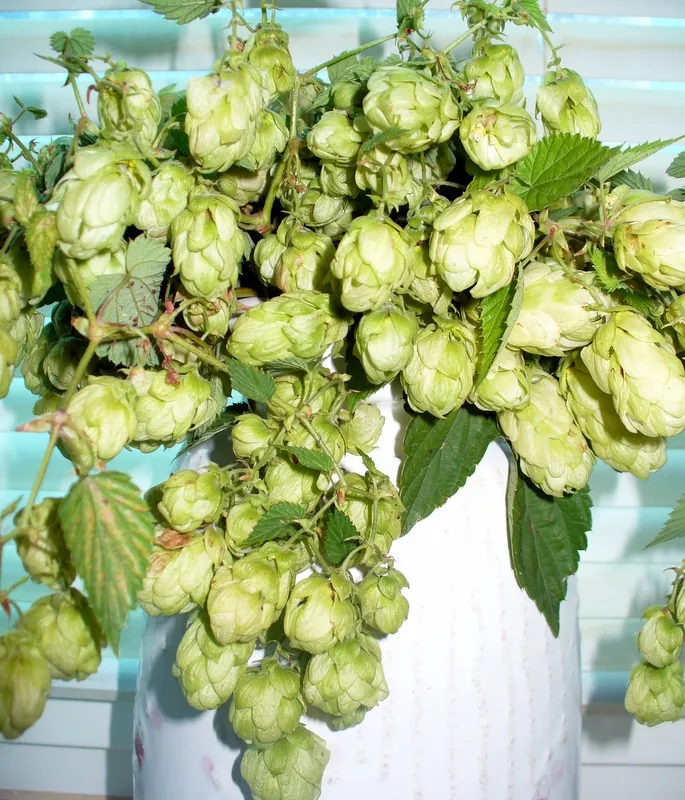
ホップ(Humulus lupulus)の毬花。humulinones はホップα酸の酸化生成物であり、化合物そのものではなく給源となる毬花の写真である。
原料写っているもの: Humulus lupulus(ホップ)部位・状態: 毬花(ホップコーン)
写真: Magdalena Šajinovićová/ CC BY-SA 3.0/ 原画像/ 台帳の原画像
写真の範囲と来歴
被写体の確認: 原典の記載による同定。
掲載画像: Wikimedia Commons の原寸ファイル。苦味研究所では切り抜き・色調変更なし。 表示用には幅1200px上限のWebPを配信し、台帳の原画像は上のリンクから確認できます。
On this page (9 sections)
Reading the bitterness
Humulinones are a group of compounds produced by oxidation of alpha acid contained in hops and are positioned as one of the compounds contributing to beer bitterness. In research analyzing hop resin components, as oxidation products derived from alpha and beta acids, they are positioned as constituents of soft resin together with humolones.
Regarding contribution to beer bitterness, in predictive research on bitterness intensity with multiple non-volatile components incorporated into a model, humulinones emerged as a significant contributing factor. In research on dry hopping, while the main contributor to overall beer bitterness is stated to be iso-α-acids, humulinones and polyphenols are described as potentially having significant contribution to bitterness, particularly in beer heavily dry-hopped. Some reports state the strength of this bitterness to be approximately 66% (standard deviation 13%) of iso-α-acids, and a survey found that humulinones were detected in 117 of 121 commercially available beer brands (average 17 mg/L), which reviews consolidate as factors in the increase in perceived bitterness after dry hopping. In independent analytical chemistry research, concentration changes of humulinones through fermentation and storage processes of Double IPA dry-hopped and Vienna lager non-dry-hopped were tracked by LC-MS/MS. However, these models simultaneously contain iso-α-acids and ethanol, and do not represent isolated verification of humulinone-only effects.
Humulinone content also changes with hop storage. In research comparing 3 varieties from Slovenia across an HSI (hop storage index) range of 0.3 to 0.7, in all varieties humulinone content increased as the index rose—for example, Aurora variety increased from 0.43% to 0.69%. However, in the finished beer, when HSI thresholds that differed by variety were exceeded, humulinone concentration initially rose and then declined, which researchers explained as due to further oxidation.
Sources for this overview
Checked for this overview: Confirmed classification as oxidation products derived from alpha and beta acids
Evaluation of Nonvolatile Chemistry Affecting Sensory Bitterness Intensity of Highly Hopped Beers
Checked for this overview: Confirmed description as significant contributing factor in bitterness prediction model / Confirmed modeling as contributing factor in heavily hopped beer
Effects of Dry-Hopping on Beer Chemistry and Sensory Properties - A Review
Checked for this overview: Confirmed description of post-dry-hopping bitterness increase factor and 66% and 121-brand survey data
Quantification of Hop-Derived Bitter Compounds in Beer Using Liquid Chromatography Mass Spectrometry
Checked for this overview: Confirmed tracking over time of Double IPA and Vienna lager by LC-MS/MS method
Toward Understanding the Bitterness of Dry-Hopped Beer
Checked for this overview: Confirmed caveat regarding iso-α-acids as main contributor and potential humulinone contribution limited to heavily dry-hopped beer
Impact of Hop Freshness on Dry Hopped Beer Quality
Checked for this overview: Confirmed conclusion as primary bitterness source in dry-hopped beer / Confirmed humulinone content increase in 3 varieties with HSI rise
Follow the connections
humulinones →contributes to→ bitterness →can be measured separately …→ astringency
beer →contains→ humulinones
humulinones →is extracted into beer by→ dry hopping
humulinones →differs from→ iso-α-acids (isohumulones) →contributes to→ bitterness
Structured claims — open a section to read each claim's confidence, evidence and limits
Composition and content (1)
Scope: Highly hopped commercial beer in the cited study
Note: Humulinones arise through oxidation and are not present in equal amounts in every beer.
Show data
ingredient-beer —contains→ compound-humulinonesSensory (2)
Scope: Highly hopped commercial beer
Note: The contribution was modeled together with isohumulones and ethanol; it is not a universal explanation by a single compound.
Show data
compound-humulinones —contribute_to→ sensation-bitterScope: A sensory panel evaluation conducted by Algazzali and Shellhammer (9 trained panelists, 0–15 point scale). The original source is a presentation at the 2015 ASBC Annual Meeting, and may not be a peer-reviewed journal article
Note: Secondhand information read in the body of the review by Klimczak et al. (2023). The original source (Algazzali & Shellhammer, 2015 ASBC Annual Meeting proceedings) itself has not been checked. The figures were copied as given in the review.
Show data
compound-humulinones —differs_from→ compound-iso-alpha-acidsMechanism and receptors (1)
Scope: The kettle-hopping experiment in Rutnik 2023 (a comparison at the same HSI with different boiling times)
Show data
compound-humulinones —differs_from→ compound-iso-alpha-acidsHow processing and cooking change it (2)
Scope: Dry-hopped beer in a pilot-scale study, a survey of 15 commercial brands, and a hop-freshness trial across 3 varieties
Show data
compound-humulinones —is_extracted_into_beer_by→ process-dry-hoppingScope: 3 hop varieties from Slovenia, at 5 HSI levels (0.3, 0.4, 0.5, 0.6, 0.7)
Note: The direction is consistent across all 3 varieties. In the resulting beer, humulinone levels rose and then fell once a variety-dependent HSI was exceeded, which the authors attribute to further oxidation.
Show data
compound-humulinones —increases_in_hops_with→ "A rise in the hop storage index (HSI). From HSI 0.3 to 0.7, humulinone content rose from 0.11 to 0.18% (Celeia), 0.43 to 0.69% (Aurora), and 0.42 to 0.72% (Styrian Wolf)"