日本語版

chicory

ingredient / ingredient-chicory

チコリ / Cichorium intybus

Chicory leaves, roots, and chicory-derived food products.

Photographs (captions in Japanese)
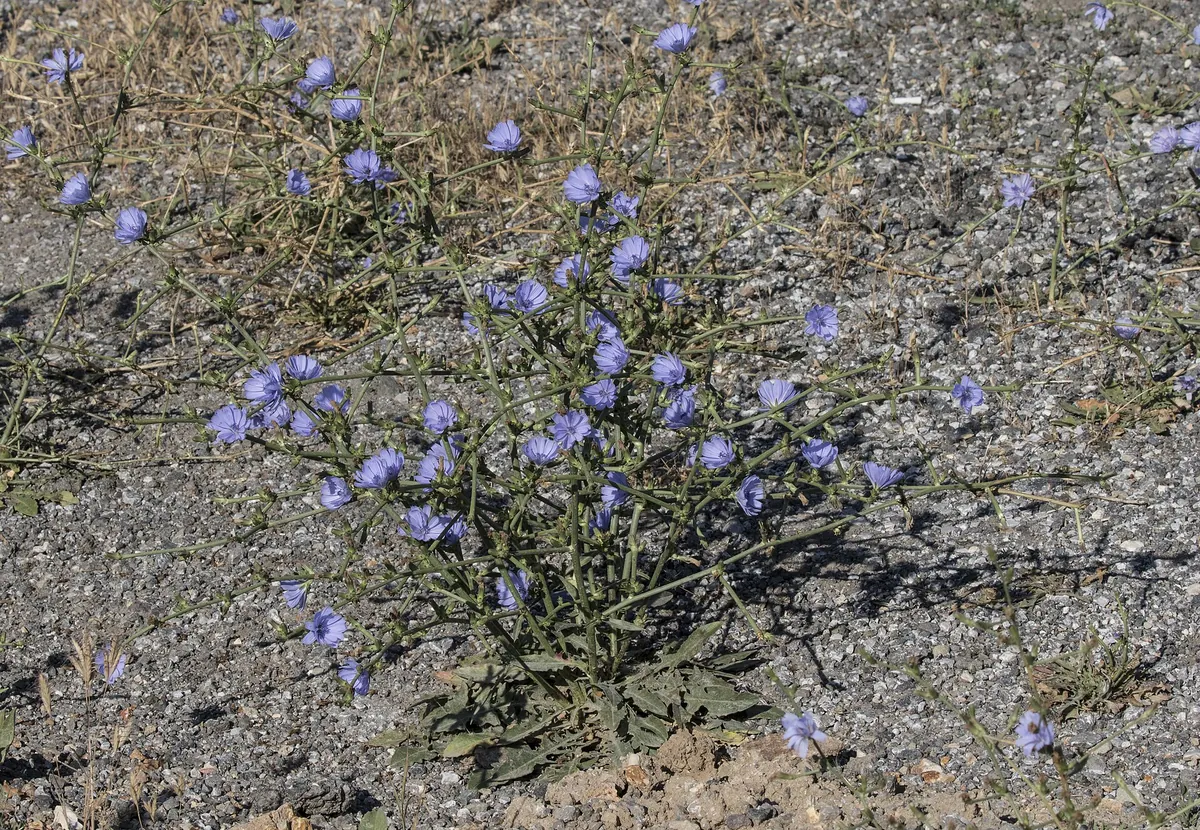
乾いた砂利の地面から伸びる細い緑の茎が四方に広がり、薄い青紫色の花びらを持つ花が多数開いている。株元には根出葉がわずかに見える。

チコリ(Cichorium intybus)の野生株。トルコ・シヴァス県ザラで撮影されたもので、細い茎に薄青紫色の花が多数咲き、根出葉が株元に見える。栽培されるベルギーエンダイブ(ウィットルーフ)など軟白栽培品とは見た目が異なる。

写っているもの: Cichorium intybus部位・状態: 野生状態で開花したチコリの地上部(茎葉と青紫色の花)

写真: Zeynel Cebeci/ CC BY-SA 4.0/ 原画像/ 台帳の原画像

写真の範囲と来歴

被写体の確認: 原典の記載による同定。原典はトルコで撮影された野生チコリの開花株。食用として流通するウィットルーフ・カットチコリー等の加工形態を示す写真ではない。

掲載画像: Wikimedia Commons の1920px版。苦味研究所では切り抜き・色調変更なし。 表示用には幅1200px上限のWebPを配信し、台帳の原画像は上のリンクから確認できます。

On this page (7 sections)
  1. Overview
  2. Sources for this overview (7)
  3. Topic hubs
  4. Follow the connections
  5. Related entries (10)
  6. Composition and content (7)
  7. Sensory (1)
↑

Reading the bitterness

Chicory (Cichorium intybus) is not a vegetable with one fixed way of preparation. Under EU geographical indication registration, forms ranging from red and variegated heading types of radicchio called Treviso, Castelfranco, Chioggia, and Verona, to young flower stems called puntarelle, are all positioned as varieties of chicory. Roasted and ground root has also been used as a coffee substitute. From leafy vegetables to processed root products, the range of forms is broad, but what is common to all is the bitterness characteristic of chicory.

The representative compounds that carry this bitterness are lactucin and lactucopicrin, which are classified as sesquiterpene lactones. In one study, lactucin was detected at 42.13 umol/g and lactucopicrin at 11.93 umol/g in raw chicory roots, and neither was present in roasted coffee. However, this concentration is not a fixed value specific to the material. In another study using fresh-cut chicory, the total amount of sesquiterpene lactones was reduced by 60.9–64.5% depending on the washing method, and the composition ratio of lactucin-class compounds was shown to change during storage.

There are also reports that in roasted chicory-containing coffee substitutes, the perception of bitterness changes depending on the order in which they are consumed. In a human taste-comparison test of chicory, coffee substitute, and roasted coffee, the bitterness of chicory was rated lower immediately after roasted coffee consumption, but conversely, the bitterness of roasted coffee did not change even when chicory was consumed first. The authors consider this asymmetry may be because roasted coffee activates a broader set of receptors, whereas the lactones contained in chicory act on a limited set of receptors that desensitize first; however, this is an interpretation from a single test with a panel of 16 individuals.

Sources for this overview

  1. Single document: Radicchio Rosso di Treviso PGI

    European Commission / 2020 / government document / full text checked

    Checked for this overview: Confirmed that Treviso is defined as Cichorium intybus var. silvestre.

  2. Summary of requirements: Radicchio Variegato di Castelfranco PGI

    European Commission / 2007 / government document / full text checked

    Checked for this overview: Confirmed that Castelfranco is a variegated form of chicory.

  3. Summary of requirements: Radicchio di Chioggia PGI

    European Commission / 2008 / government document / full text checked

    Checked for this overview: Confirmed the classification of 2 Chioggia types: early and late.

  4. Single document: Radicchio di Verona PGI

    European Commission / 2022 / government document / full text checked

    Checked for this overview: Confirmed that the Verona cultivar belongs to Cichorium intybus.

  5. Application for registration: Cicoria puntarelle molfettese PGI

    European Commission / 2026 / government document / full text checked

    Checked for this overview: Confirmed in the application that puntarelle are flower stems of chicory.

  6. Overlapping activation pattern of bitter taste receptors affect sensory adaptation and food perception

    Lang R; Lang T; Dunkel A; Ziegler F; Behrens M / 2022 / journal article / full text checked

    Checked for this overview: Confirmed the use as a coffee substitute from the description of the research material as roasted chicory coffee substitute powder. / Confirmed the value of lactucin content of 42.13 umol/g in raw roots. / Confirmed the value of lactucopicrin content of 11.93 umol/g in raw roots. / Confirmed the asymmetric order effect of decreased chicory bitterness after roasted coffee consumption.

  7. Sesquiterpene lactone content and overall quality of fresh-cut witloof chicory (Cichorium intybus L. var. foliosum Hegi) as affected by different washing procedures

    Wulfkuehler S; Gras C; Carle R / 2013 / journal article / abstract checked

    Checked for this overview: Confirmed the variability of 60.9–64.5% reduction in lactone amount with washing.

Follow the connections

chicory →— perceived bitterness is a…→ consumption sequence

chicory →contains→ lactucin →contributes to→ bitterness

chicory →contains→ lactucopicrin →contributes to→ bitterness

Structured claims — open a section to read each claim's confidence, evidence and limits

Composition and content (7)

chicory contains lactucinsupported

Scope: Chicory and chicory-based coffee substitute in the cited research

Note: Concentration varies with the material and preparation.

Lactucin was quantified at 42.13 +/- 4.10 umol/g in fresh chicory root, 32.48 +/- 5.87 umol/g in roasted chicory coffee-substitute powder, and 1.35 +/- 0.10 uM in the prepared coffee-substitute extract. It was not present in roasted coffee. 11beta,13-dihydrolactucin rose sharply with roasting (from 6.18 +/- 0.19 umol/g in fresh root to 52.69 +/- 5.50 umol/g in the powder).
Limitations: Values from a single study on one set of chicory samples. Independent research shows that sesquiterpene lactone content depends strongly on processing, so these should not be cited as fixed compositional constants.
Source: Overlapping activation pattern of bitter taste receptors affect sensory adaptation and food perception (Lang R; Lang T; Dunkel A; Ziegler F; Behrens M, 2022) · full text checked
Limits: Shows that chicory's sesquiterpene lactone content is not a fixed, material-specific property but depends strongly on processing. Every washing procedure significantly lowered sesquiterpene lactone content and bitterness, and warm-water washing reduced the total amount by 60.9-64.5%. The profile changed during storage, and by the end of storage 11(S),13-dihydrolactucin had become dominant.
Limitations: The abstract does not give lactucin's individual concentration, only the reduction in total sesquiterpene lactones and the dihydro compound's dominance at the end of storage. This does not deny lactucin's presence; it qualifies the single cited concentration.
Show dataingredient-chicory —contains→ compound-lactucin
claim: clm-chicory-contains-lactucin / type: composition / updated: 2026-08-30
chicory contains lactucopicrinsupported

Scope: Chicory and chicory-based coffee substitute in the cited research

Note: Concentration varies with the material and preparation.

Lactucopicrin was quantified at 11.93 +/- 0.46 umol/g in raw chicory root, 10.66 +/- 0.94 umol/g in roasted chicory coffee-substitute powder, and 0.45 +/- 0.04 uM in the prepared coffee-substitute extract; it was not present in roasted coffee.
Limitations: A single set of samples and a single processing route. A separate, independent group reports that lactucopicrin is the major sesquiterpene lactone in freshly-cut witloof chicory right after processing, but that the profile changes during storage, so its ranking relative to lactucin depends on the product and the process.
Source: Overlapping activation pattern of bitter taste receptors affect sensory adaptation and food perception (Lang R; Lang T; Dunkel A; Ziegler F; Behrens M, 2022) · full text checked
An independent group that quantified sesquiterpene lactones in freshly-cut witloof chicory reports lactucopicrin as the major sesquiterpene lactone right after processing, confirming its presence in chicory outside the Lang 2022 dataset.
Limitations: Absolute concentrations are not captured from the abstract; this corroborates presence and relative ranking, not the Lang 2022 figures. It differs from Lang 2022's roasted chicory in plant part and product form (freshly-cut witloof).
Show dataingredient-chicory —contains→ compound-lactucopicrin
claim: clm-chicory-contains-lactucopicrin / type: composition / updated: 2026-08-30
Radicchio Rosso di Treviso is a type of chicorysupported

Scope: Classification under the EU PGI specification

Note: In the legal specification, it is Cichorium intybus L. var. silvestre.

The PGI specification defines it as consisting of the tardivo and precoce types of Cichorium intybus L. var. silvestre.
Limitations: This is the legal product specification, not an up-to-date taxonomic synonymy review.
Source: Single document: Radicchio Rosso di Treviso PGI (European Commission, 2020) · full text checked
Show dataingredient-radicchio-treviso —is_a_type_of→ ingredient-chicory
claim: clm-treviso-chicory / type: taxonomy / updated: 2026-08-31
Radicchio Variegato di Castelfranco is a type of chicorysupported

Scope: Classification under the EU PGI specification

Note: A variegated form of Cichorium intybus var. silvestre.

Defined as a variegated form of the genus Cichorium, species intybus, variety silvestre.
Limitations: This is the legal specification, not a molecular phylogenetic analysis.
Source: Summary of requirements: Radicchio Variegato di Castelfranco PGI (European Commission, 2007) · full text checked
Show dataingredient-radicchio-castelfranco —is_a_type_of→ ingredient-chicory
claim: clm-castelfranco-chicory / type: taxonomy / updated: 2026-08-31
Radicchio di Chioggia is a type of chicorysupported

Scope: Classification under the EU PGI specification

Note: Includes 2 types, early and late.

Defined as belonging to the family Asteraceae, genus Cichorium, species intybus, variety silvestre, with 2 types, early and late.
Limitations: The original text has the spelling "inthybus," which is normalized here to Cichorium intybus.
Source: Summary of requirements: Radicchio di Chioggia PGI (European Commission, 2008) · full text checked
Show dataingredient-radicchio-chioggia —is_a_type_of→ ingredient-chicory
claim: clm-chioggia-chicory / type: taxonomy / updated: 2026-08-31
Radicchio di Verona is a type of chicorysupported

Scope: Classification under the EU PGI specification

Note: Rossa di Verona, of the genus Cichorium, species intybus.

Defined as a Cichorium intybus product covering the tipo precoce and tipo tardivo of the Rossa di Verona cultivar.
Limitations: Compositae appears here exactly as in the original text, as the older family name for Asteraceae.
Source: Single document: Radicchio di Verona PGI (European Commission, 2022) · full text checked
Show dataingredient-radicchio-verona —is_a_type_of→ ingredient-chicory
claim: clm-verona-chicory / type: taxonomy / updated: 2026-08-31
Cicoria puntarelle molfettese is a type of chicorysupported

Scope: A 2026 EU geographical indication registration application

Note: This is treated as still at the application stage, not as a completed registration.

A GI registration application covering the head and young flower shoots (puntarelle) of Cichorium intybus L.
Limitations: As of 2026-08-31, this is at the stage where the application has been published, and does not mean the registration is finalized.
Source: Application for registration: Cicoria puntarelle molfettese PGI (European Commission, 2026) · full text checked
Show dataingredient-puntarelle-molfettese —is_a_type_of→ ingredient-chicory
claim: clm-puntarelle-chicory / type: taxonomy / updated: 2026-08-31

Sensory (1)

chicory — perceived bitterness is affected by: consumption sequencesupported

Scope: Human order-effect test using chicory, coffee substitute, and roasted coffee.

Note: The effect is specific to the tested foods and the order design.

Verbatim: The line-up consisted of 16 individuals (7 women, age 36 +/- 12 years; 9 men, age 37 +/- 10 years). The order effect was asymmetric. verbatim: the bitterness of chicory was rated lower after roasted coffee consumption. Evaluation of this stimulus pair in opposite sequence revealed no change in the bitterness of roasted coffee after chicory consumption. The authors attribute this asymmetry to roasted coffee activating a broader set of receptors (including TAS2R43 and TAS2R46) and chicory lactones selectively acting on receptors that desensitize first.
Limitations: As a crossover order effect, a panel of 16 is a small sample, and the effect size and statistical value of the order comparison are not included in verbatim. The desensitization explanation is the authors' interpretation linking receptor assay findings to sensory results and is not an independently verified mechanism.
Source: Overlapping activation pattern of bitter taste receptors affect sensory adaptation and food perception (Lang R; Lang T; Dunkel A; Ziegler F; Behrens M, 2022) · full text checked
Show dataingredient-chicory —has_perceived_bitterness_affected_by→ process-consumption-sequence
claim: clm-chicory-sequence / type: sensory / updated: 2026-08-30

↑ Top of page · ← Encyclopedia (English entries)