lactucopicrin
compound / compound-lactucopicrin
ラクチュコピクリン
Lactucopicrin is a sesquiterpene lactone found in chicory.
Photographs (captions in Japanese)
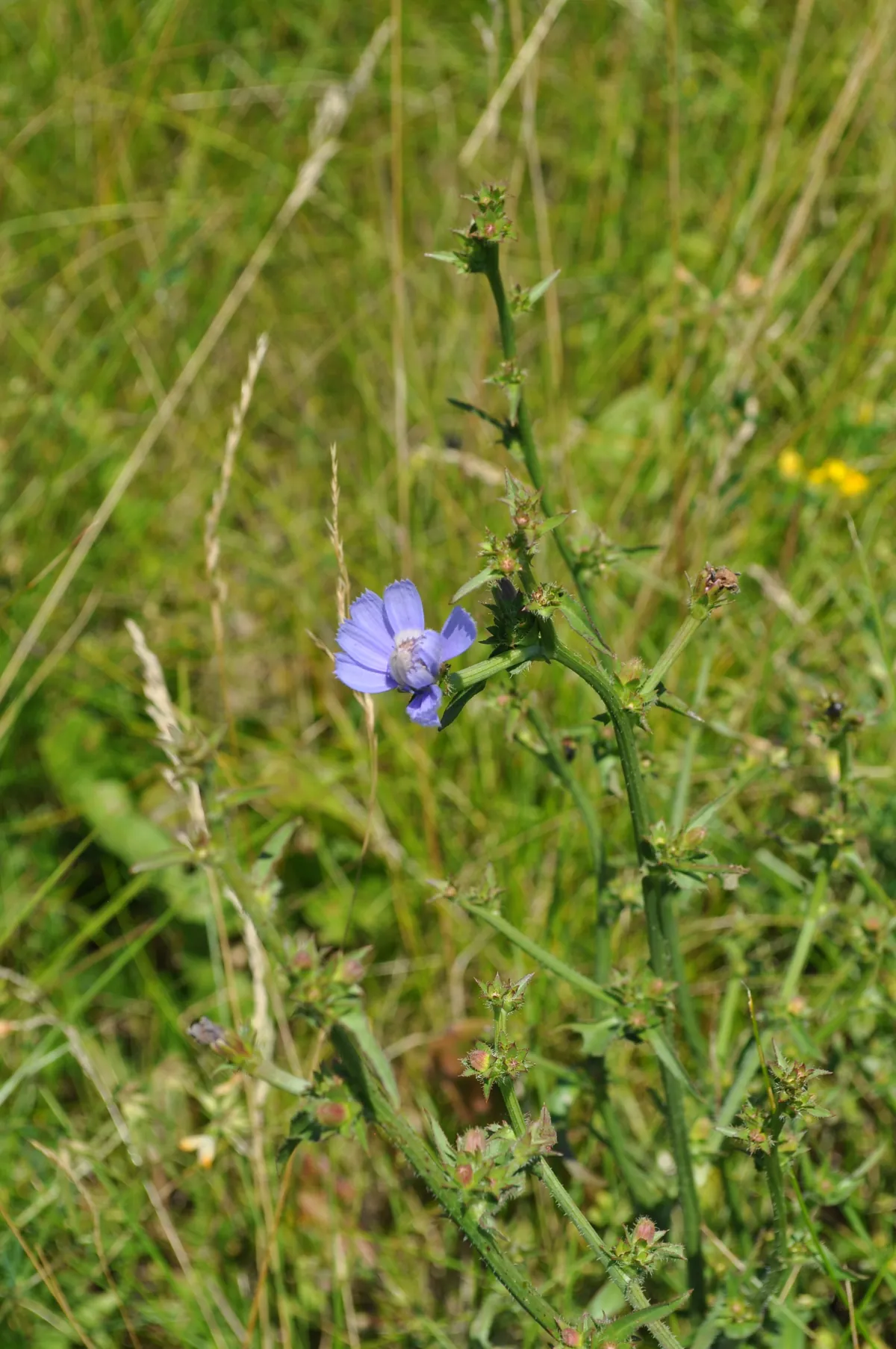
チコリー(Cichorium intybus)の開花株全体。lactucopicrin はこの植物に存在するセスキテルペンラクトンであり、化合物そのものではなく給源植物の写真である。
原料写っているもの: Cichorium intybus(チコリー)部位・状態: 開花株全体
写真: NY State IPM Program at Cornell University from New York, USA/ CC BY 2.0/ 原画像/ 台帳の原画像
写真の範囲と来歴
被写体の確認: 原典の記載による同定。ingredient-chicory・compound-lactucin で使用した写真とは別ファイル(重複回避)。
掲載画像: Wikimedia Commons の原寸ファイル。苦味研究所では切り抜き・色調変更なし。 表示用には幅1200px上限のWebPを配信し、台帳の原画像は上のリンクから確認できます。
On this page (10 sections)
Reading the bitterness
Lactucopicrin is a sesquiterpene lactone contained in the root of chicory (Cichorium intybus). It has been reported to exist at concentrations of 11.93±0.46 micromolar per gram in raw root, 10.66±0.94 micromolar in roasted chicory-substitute coffee powder, and 0.45±0.04 micromolar in its extract. It was not detected in roasted regular coffee.
Among the lactones derived from chicory that were compared in the same study, lactucopicrin elicited the strongest bitter-receptor response. It activated the human bitter receptor TAS2R43 at a threshold of 0.1 micromolar and an EC50 of 0.46±0.08 micromolar, and TAS2R46 at a threshold of 0.03 micromolar and an EC50 of 0.35±0.06 micromolar; the response to TAS2R14 was only minimal, with a threshold of 30 micromolar. However, TAS2R46 is a receptor that has been shown in separate research to respond broadly to sesquiterpene lactones in general, and this high potency does not necessarily indicate selective binding to lactucopicrin. Additionally, despite its lower concentration on a per-gram basis than lactucin, its effect on receptors was far stronger; the authors caution that reordering chicory's bitter compounds by concentration alone is misleading.
The lactucopicrin concentration in chicory extract (0.45 micromolar) exceeds the receptor threshold but remains near the EC50 level, and sensory testing is still needed to directly link it to the intensity of bitterness actually perceived. An independent research group also confirmed lactucopicrin as the major sesquiterpene lactone in fresh-cut witloof chicory immediately after processing, and reported that its composition changes with storage.
Sources for this overview
Checked for this overview: Concentrations in 3 forms—raw root, powder, and extract—and non-detection in roasted coffee. / Thresholds and EC50 values for TAS2R43, TAS2R46, and TAS2R14 activation; caution regarding the mismatch between concentration and potency. / Confirmation that extract concentration exceeds threshold but remains near EC50.
Checked for this overview: Confirmation that TAS2R46 responds broadly to sesquiterpene lactones in general.
Checked for this overview: Independent group's confirmation in fresh-cut witloof, and composition changes with storage.
Follow the connections
lactucopicrin →activates→ TAS2R46
lactucopicrin →contributes to→ bitterness →can be measured separately …→ astringency
chicory →contains→ lactucopicrin
Measured values (1)
| Kind | Compound | Target | Value | Conditions | Source |
|---|---|---|---|---|---|
| receptor EC50 | lactucopicrin | TAS2R46 | 0.35±0.06 µM | HEK293 cell assay | Lang R, 2022 |
Values are the reported values of each source (with units and conditions). Thresholds and EC50 depend on the panel and method; they are not single true values.
Structured claims — open a section to read each claim's confidence, evidence and limits
Composition and content (2)
Scope: Chicory and chicory-based coffee substitute in the cited research
Note: Concentration varies with the material and preparation.
Show data
ingredient-chicory —contains→ compound-lactucopicrinScope: Fresh-cut witloof chicory
Note: Reported as the major sesquiterpene lactone immediately after processing.
Show data
ingredient-witloof-chicory —contains→ compound-lactucopicrinSensory (3)
Scope: Chicory and chicory-based coffee substitute in the cited research
Note: Receptor activation together with the concentration in the food forms perception.
Show data
compound-lactucopicrin —contributes_to→ sensation-bitterScope: Sensory evaluation (bitterness, astringency, herbaceous flavor, overall preference) and chemical analysis correlation study on a germplasm collection of Cichorium endivia var. crispum (curly endive) and var. latifolium (escarole).
Note: According to the abstract, 2 compounds—lactucopicrin and kaempferol malonyl glucoside—were consistently related to perceptions of bitterness, astringency, and herbaceous flavor. Overall preference showed a significant negative correlation primarily with bitterness. Significant differences in bitterness, astringency, and herbaceous flavor were found among varieties, with curly endive scoring on average higher than escarole, particularly notably so for bitterness. The abstract also notes that the general statement 『セスキテルペンラクトンとフェノールが苦味等の決定要因』 (in translation: "sesquiterpene lactones and phenolics are determinants of bitterness and the like") is not fully consistent with the data, and that the balance of compounds has a complex effect (with a dominant negative contribution from phenolics).
Show data
ingredient-endive —has_perceived_bitterness_associated_with→ compound-lactucopicrinScope: Horie 2011, the 「lactucopicrins の苦味強度」 (in translation: "Bitterness intensity of lactucopicrins") section. A sensory comparison of authentic standards (the number of panelists and the scale are not given)
Note: The authors infer that LO's own bitterness is extremely weak compared to L. The 0.5 ppm threshold is cited from reference 3 and is not a measurement from this paper.
Show data
compound-lactucopicrin —has_reported_human_taste_threshold_of→ "0.5 ppm (cited from an earlier report). The precursor lactucopicrin 15-oxalate (LO) was perceived as equally bitter at roughly 10 times the concentration of L, and its threshold was estimated to be higher than 5 ppm (because the authentic standard of LO contains 5% L, its precise threshold could not be measured, and it is also possible that L formed from LO in the mouth)"Mechanism and receptors (2)
Scope: Receptor assay in a cultured-cell system, in the cited study
Note: The same paper also reports overlapping receptor activation by other chicory lactones.
Show data
compound-lactucopicrin —activates→ receptor-tas2r46Scope: Horie 2011, Figure 1. Endive leaves blended and extracted for 3 minutes with 9 times their weight of 0.1 M phosphate buffer, n=3
Note: When the latex of lettuce and endive is analyzed quickly, L is 1% or less of the total (endive 0.9%, lettuce 0.6%), and the authors caution that L can also form from LO during sample preparation for analysis.
Show data
compound-lactucopicrin —is_derived_from→ "Breakdown of lactucopicrin 15-oxalate (LO). When endive leaves were blended and extracted in buffers at pH 5.5, 6.5, and 7.5, the proportion of L in the L+LO total was 1% or less, 4%, and 9%; at pH 7.5, LO decreased and L increased over time after extraction. L forms under neutral to weakly alkaline conditions, and that formation is suppressed under weakly acidic conditions"How processing and cooking change it (1)
Scope: Residual root-stock (FR) tissue following forcing; cv. Sweet Lady; 12 months storage.
Note: Same as above.
Show data
process-witloof-forcing —increases→ compound-lactucopicrin