Goishi tea
ingredient / ingredient-goishi-cha
碁石茶 / Goishi-cha (goishi tea)
Goishi tea is a post-fermented tea transmitted in Otoyo, Nagaoka District, Kochi Prefecture. It is made by mold-inoculating steamed tea leaves (aerobic fermentation), pickling them in a tea cask for lactic acid fermentation (anaerobic fermentation), then sun-drying and cutting them. The name is described as coming from the cut leaves becoming black and rounded and looking like arranged go stones.
Photographs (captions in Japanese)
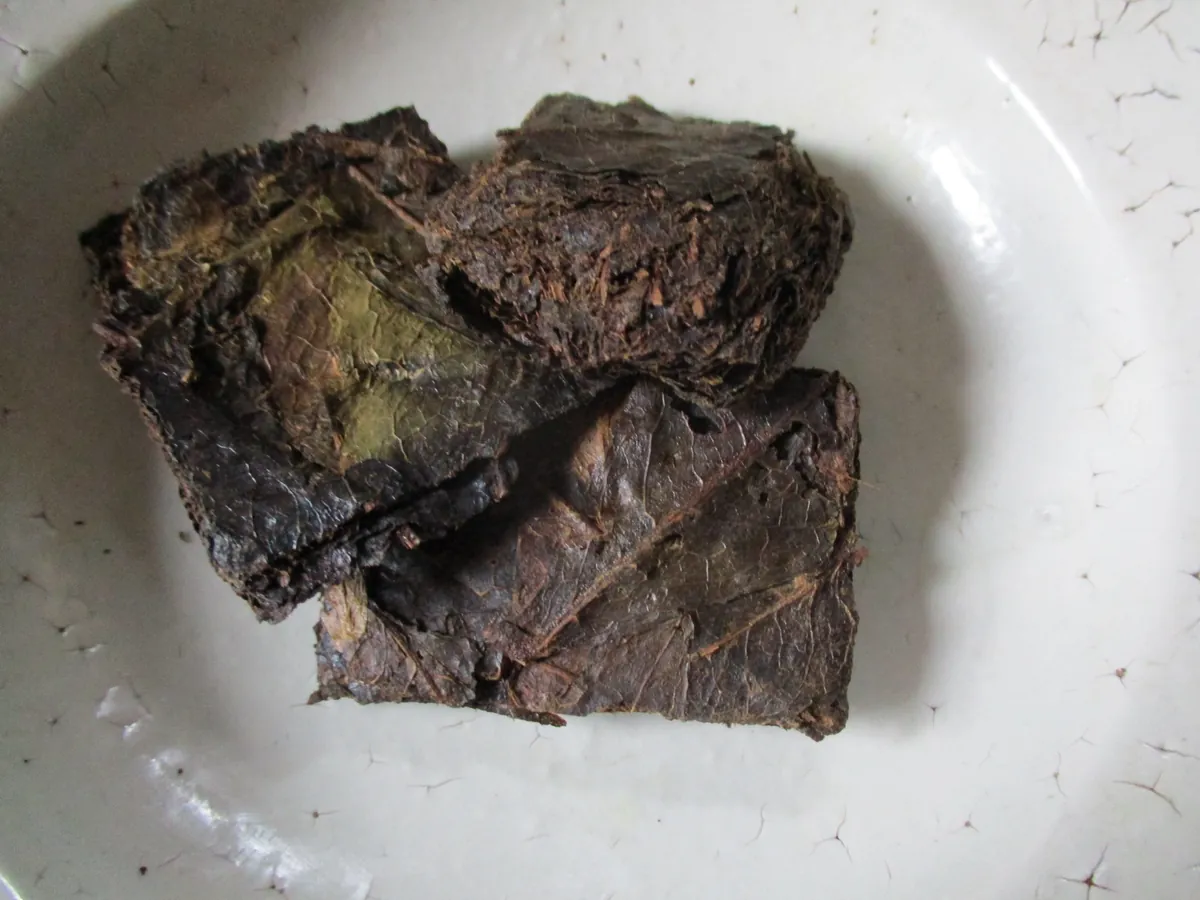
高知県長岡郡大豊町に伝わる後発酵茶、碁石茶。蒸した茶葉をカビ付け(好気発酵)ののち茶樽で乳酸発酵(嫌気発酵)させ、天日で乾燥・裁断した茶葉ブロックの写真。
写っているもの: 該当分類群なし(碁石茶の茶葉ブロック)部位・状態: 裁断・乾燥させた碁石茶の茶葉ブロック
写真: Asset utilitist/ CC0 1.0/ 原画像/ 台帳の原画像
写真の範囲と来歴
被写体の確認: 原典の記載による同定。原典の説明は「碁石茶の茶葉」のみで学名の記載なし。同一アップロード者による関連写真群が2026年5-6月にCC0で複数投稿されている。
掲載画像: Wikimedia Commons の原寸ファイルを取得後、苦味研究所にて sips で長辺2400px程度に縮小。切り抜き・色調変更なし。 表示用には幅1200px上限のWebPを配信し、台帳の原画像は上のリンクから確認できます。
On this page (7 sections)
Reading the bitterness
Goishi-cha is a post-fermented tea transmitted in Otoyo, Nagaoka District, Kochi Prefecture. It is made by mold-inoculating steamed tea leaves (aerobic fermentation), then pickling them in a tea cask for lactic acid fermentation (anaerobic fermentation), and sun-drying and cutting them. Ueda (2015) cites an HPLC analysis of hot-water extracts reporting that the total of major catechins and gallic acid in goishi-cha was approximately 1/7 that in green tea and about half that in oolong and black tea. Catechins are involved in tea astringency, and goishi-cha after two-stage fermentation is described as mild in astringency. The original 2002 paper was not confirmed; this is a secondary citation by Ueda (2015).
The record described as the oldest surviving record of goishi-cha is the 1745 (Enkyō 2) statement 『長岡郡豊永郷 碁石茶 六蔵茶とあわせ茶高30斤入り3154丸』 (in translation: "Nagaoka District, Toyonaga Township, goishi-cha; together with Rokuzo tea, tea total 30 kin, 3154 balls") in a work by Anyoji Kamaro, and the statement 『茶 韭生郷 大抜茶 本川郷 碁石茶』 (in translation: "Tea: Niu Township, Ōnuki tea; Motokawa Township, goishi-cha") in 『南路志』 (in translation: "Nanroshi"), compiled around 1815. From these, Ueda (2015) considers that goishi-cha was already being produced before 1745. The cited Edo-period sources themselves were not confirmed in this investigation; this is a secondary citation by Ueda (2015).
Ueda (2015) measured goishi-cha against green tea, black tea, hojicha, coffee, and red wine using a taste-sensor radar chart comprising astringency, bitterness, umami, sourness, bitter aftertaste, astringent aftertaste, and umami aftertaste. Goishi-cha was reported to have weaker astringency and umami and stronger sourness than the other teas and coffee; this pattern was extremely similar to red wine among the compared drinks. The panel size and number of repetitions are not given, and this was a comparison of a single sample.
A 1987 report analyzing aroma compounds in hot-water extracts of goishi-cha and Awa-bancha by GC identified 12 new compounds (2 esters, 5 alcohols, 4 phenols, and acetoin) and described a shared aroma pattern considered characteristic of 『漬物茶』 (in translation: "pickled tea"). Only the abstract was confirmed; it does not mention bitterness or astringency, and sample numbers and production details were not confirmed.
Sources for this overview
Checked for this overview: The cited HPLC-analysis results by Ueda (2015) were confirmed. / The 1745 historical statement and the quoted passage from 『南路志』 (in translation: "Nanroshi") were confirmed. / The taste-sensor radar-chart measurement results were confirmed.
Checked for this overview: The abstract description of aroma-compound identification by GC was confirmed.
Hypotheses and recipe candidates for this entry are on the Japanese page.
Structured claims — open a section to read each claim's confidence, evidence and limits
Composition and content (2)
Scope: A comparison of hot-water extracts across several teas including goishicha
Note: As described by Ukeda (2015); the original is given as Moriyama, Katayama, Nakabayashi, Ukeda, and Sawamura, Nippon Shokuhin Kagaku Kogaku Kaishi 49, 679 (2002). The primary source (the 2002 paper) itself was not checked this time, so it is included as a secondary citation.
Show data
ingredient-goishi-cha —has_composition→ "HPLC analysis of hot-water extracts found the total amount of the main catechins and gallic acid in goishicha to be extremely low compared with other teas -- about 1/7 that of green tea and about half that of oolong and black tea, the source reports. Because catechins are the components involved in tea astringency, the source describes goishicha, whose catechins decrease during fermentation, as having mild astringency."Sensory (1)
Scope: Taste-sensor comparison of Goishicha (sample of unspecified origin) against 6 reference beverages
Note: A taste-sensor measurement performed by Ukeda (2015) himself. No mention of panel size or number of replicates. This is a comparison of single samples, and is not generalized to tea types in general, pu-erh tea included.
Show data
ingredient-goishi-cha —has_sensory_attribute→ "Comparing Goishicha with green tea, black tea, hojicha, coffee, and red wine using a taste sensor (a radar chart made up of astringency, bitterness, umami, sourness, bitterness aftertaste, astringency aftertaste, and umami aftertaste) brought out the characteristic that Goishicha has weaker astringency and umami and stronger sourness than the other teas and coffee. Among the palatable beverages compared, this pattern was extremely similar to that of red wine."Culture (1)
Scope: Otoyo, Kochi Prefecture
Note: As recorded by Ukeda (2015). The works cited as the source, 『土佐幽考』 (in translation: "Tosa Yuko") (of the Tani Taizan school) and 『南路志』 (in translation: "Nanroshi"), have not themselves been checked this time, and are included here as a secondary citation via Ukeda (2015).
Show data
ingredient-goishi-cha —has_historical_origin→ "The oldest known surviving record is a description found in the 1745 (Enkyo 2) work of Anyoji Kamaro: 『長岡郡豊永郷 碁石茶 六蔵茶とあわせ茶高30斤入り3154丸』 (in translation: "Nagaoka District, Toyonaga area: Goishicha, together with Rokuzo tea, 3,154 balls in cases of 30 kin"), and a description in 『南路志』 (in translation: "Nanroshi") (compiled around 1815): 『茶 韭生郷 大抜茶 本川郷 碁石茶』 (in translation: "Tea: Nirao area, Otsunuki tea; Honkawa area, Goishicha"). From these, Goishicha is inferred to have already been in production before 1745."