Hoshigaki (dried persimmon)
ingredient / ingredient-hoshigaki
干し柿
Hoshigaki (dried persimmon) is a general term for dried fruit made by drying persimmon fruit. When astringent persimmons are used, it exploits the natural deastringency that progresses during drying. Production methods and names vary by region, including Ichida-gaki, anpogaki, and korogaki.
Photographs (captions in Japanese)
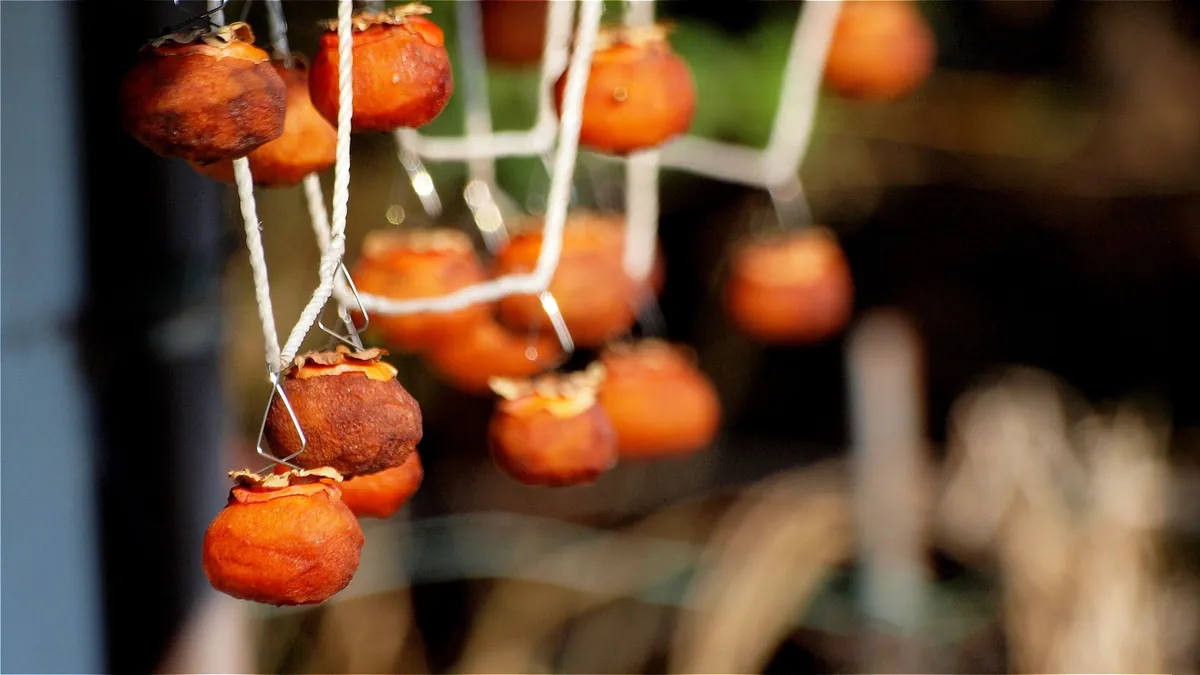
紐で吊るされ乾燥途中の柿。表面の色が橙色から飴色へ変わりつつある
加工後写っているもの: Diospyros kaki (hoshigaki, described by uploader via linked Saveur article on hoshigaki)部位・状態: 皮を剥いた柿の実を紐で吊るし乾燥させている途中段階。表面が飴色に変わり始めた個体と、まだ橙色が強く残る個体が混在
写真: coniferconifer from japan/ CC BY 2.0/ 原画像/ 台帳の原画像
写真の範囲と来歴
被写体の確認: 原典の記載による同定。説明欄はSaveur誌のhoshigaki解説記事へのリンクのみで直接「hoshigaki」という語の記載はないが、被写体は柿の吊るし干し工程そのもの。原寸4032x2268 画像を開いて確認。紐で吊るされた柿の実が複数写り、乾燥の進み具合が個体ごとに異なる。ヘタの部分に金具が付いている
掲載画像: Wikimedia Commons の原本を長辺2400pxへ縮小。切り抜き・色調変更なし。 表示用には幅1200px上限のWebPを配信し、台帳の原画像は上のリンクから確認できます。
On this page (9 sections)
Reading the bitterness
Hoshigaki is a general term for dried fruit made by drying persimmon fruit, with production methods and names varying by region. Geographical Indication (GI) registrations show that Ichida-gaki, Noto Shika Koro-gaki, and Date no Anpogaki are each explicitly described as 「干柿」 (in translation: "dried persimmon") in their specifications, indicating that products with distinct regional names share the broad category hoshigaki.
Hoshigaki made from astringent persimmons is a processed product that uses the natural deastringency that advances while the peeled fruit dries. Manufacturing descriptions show a process in which peeled persimmons are fumigated with sulfur and then sun-dried. However, Yamada et al. (2012) state that although many astringent-persimmon cultivars can be made edible as hoshigaki, some cultivars do not readily lose astringency even after deastringency treatment, indicating that processing astringent persimmons into hoshigaki is not uniformly easy.
In an experiment that peeled the astringent persimmon 「横野」 (Yokono) from Kagawa Prefecture and sun-dried it on a rooftop, bringing the fruit indoors at night and during rain, the soluble tannin content of the flesh fell from about 1.5% at the start to 0.17% on day 7. The measurement used a sample made by shredding and mixing 4 fruits together, and the same values cannot be applied to dried persimmons of different cultivars or weather conditions.
In the same sun-drying, some astringency remained on day 7, but it had almost disappeared and was not perceived by day 10. Between the fumigated lot, using sulfur equal to 0.2% of fruit weight, and the untreated lot, almost no difference was found in the rate of de-astringing. However, the number of panelists and the scale used in the sensory test are not stated, and no significance test is shown. This is an observation of astringency, not bitterness.
Sources for this overview
Checked for this overview: Used as the basis for this paragraph in the Ichida-gaki GI specification.
地理的表示産品情報発信サイト 能登志賀ころ柿(登録番号第20号)
Checked for this overview: Used as the basis for this paragraph in the Noto Shika Koro-gaki GI specification.
地理的表示産品情報発信サイト 伊達のあんぽ柿(登録番号第123号)
Checked for this overview: Used as the basis for this paragraph in the Date no Anpogaki GI specification.
柿の脱渋に関する一考察(第2報) タンニンの不溶化及びそれに関与する酵素活性の変動
Checked for this overview: Used as the basis for this paragraph in the description of sulfur fumigation in hoshigaki production.
Checked for this overview: Used as the basis for this paragraph in the description of how readily astringent-persimmon cultivars lose astringency.
A Study of the Drying of Japanese Persimmons
Checked for this overview: Supports the Yokono persimmon, peeling and rooftop sun-drying with the fruit brought indoors at night and during rain, the soluble tannin decline from about 1.5% to 0.17%, the 4-fruit composite sample, and the limitation to this cultivar and these weather conditions. / Supports the astringency remaining on day 7, its near-disappearance and non-perception by day 10, the fact that the number of panelists and the scale are not stated, and the limitation that this is not bitterness. / Supports the sulfur equal to 0.2% of fruit weight, the near-absence of a difference in de-astringing rate between the fumigated and untreated lots, and the fact that no significance test is stated.
Other names: 干柿 (ja)
Follow the connections
Ichida-gaki →is a type of→ Hoshigaki (dried persimmon)
Noto Shika Koro-gaki →is a type of→ Hoshigaki (dried persimmon)
Date no Anpogaki →is a type of→ Hoshigaki (dried persimmon)
Hoshigaki (dried persimmon) →is prepared by→ drying-based kaki de-astringing →is documented as having→ bitterness
Hypotheses and recipe candidates for this entry are on the Japanese page.
Structured claims — open a section to read each claim's confidence, evidence and limits
Composition and content (4)
Note: The GI specification explicitly states 「干柿」 (in translation: "dried persimmon").
Show data
ingredient-ichida-gaki —is_a_type_of→ ingredient-hoshigakiNote: The GI specification explicitly states 「干柿」 (in translation: "dried persimmon").
Show data
ingredient-noto-shika-korogaki —is_a_type_of→ ingredient-hoshigakiNote: The GI specification explicitly states 「干柿」 (in translation: "dried persimmon").
Show data
ingredient-date-anpogaki —is_a_type_of→ ingredient-hoshigakiScope: Manabe et al. 1978; Yokono persimmons from Kagawa Prefecture; mainly the results of the second of 2 sun-drying experiments conducted in 1975.
Note: Soluble tannin was measured on a sample made by shredding and mixing 4 fruits. The fruit was brought indoors at night and during rain. The decline during drying is not treated as a value for astringency intensity.
Show data
ingredient-hoshigaki —has_composition→ "In an experiment that sun-dried peeled Yokono persimmons on a rooftop, the soluble tannin content of the flesh fell from about 1.5% at the start of drying to 0.17% on day 7."Sensory (2)
Scope: Manabe et al. 1978; a sensory test conducted during sun-drying of peeled Yokono persimmons.
Note: The number of panelists, the scale, the replication, and the presentation method for the sensory test are not stated in the text. This is a result concerning astringency, not bitterness.
Show data
ingredient-hoshigaki —has_sensory_response→ "In the same sun-drying, some astringency remained on day 7, but it had almost disappeared by day 10 and was not perceived."Scope: Manabe et al. 1978; the sulfur amount was 0.2% of fruit weight; comparison of fumigation treatment (30 minutes in the first experiment, 10 minutes in the second) with no treatment.
Note: There is no statement of a significance test, so this is limited to the scope of the original text's 「差が認められなかった」 (in translation: "almost no difference was found"). The fumigation time differed between the 2 experiments.
Show data
ingredient-hoshigaki —has_sensory_response→ "In sun-drying of peeled Yokono persimmons, almost no difference was found in the rate of de-astringing between the sulfur-fumigated lot and the untreated lot."How processing and cooking change it (1)
Note: Dried persimmon (hoshigaki) made from astringent persimmon is a processed product that makes use of the fact that de-astringing proceeds in the process of peeling and drying the fruit. Based on the description of a dried-persimmon (hoshigaki) workshop in Inari & Tomoeda (1992), and on the statement of Yamada et al. (2012), 「多くの渋ガキ品種は、干柿にすれば食用とはできるが、脱渋処理をしても容易に脱渋しない」 (in translation: “many astringent persimmon cultivars can be made edible as dried persimmon (hoshigaki), but do not readily de-astringe even with de-astringing treatment”).
Show data
ingredient-hoshigaki —is_prepared_by→ process-kaki-drying-deastringing