konowata (salted sea cucumber entrails)
ingredient / ingredient-konowata
このわた
Konowata is a salted, briefly matured preparation of the intestines of the Japanese sea cucumber. "ko" is another name for sea cucumber, and "wata" means intestine. The Noto region of Ishikawa Prefecture is known as a production area. Sources describe it as one of the "three great delicacies of Japan" alongside sea urchin and karasumi, but this is a reported designation.
Photographs (captions in Japanese)
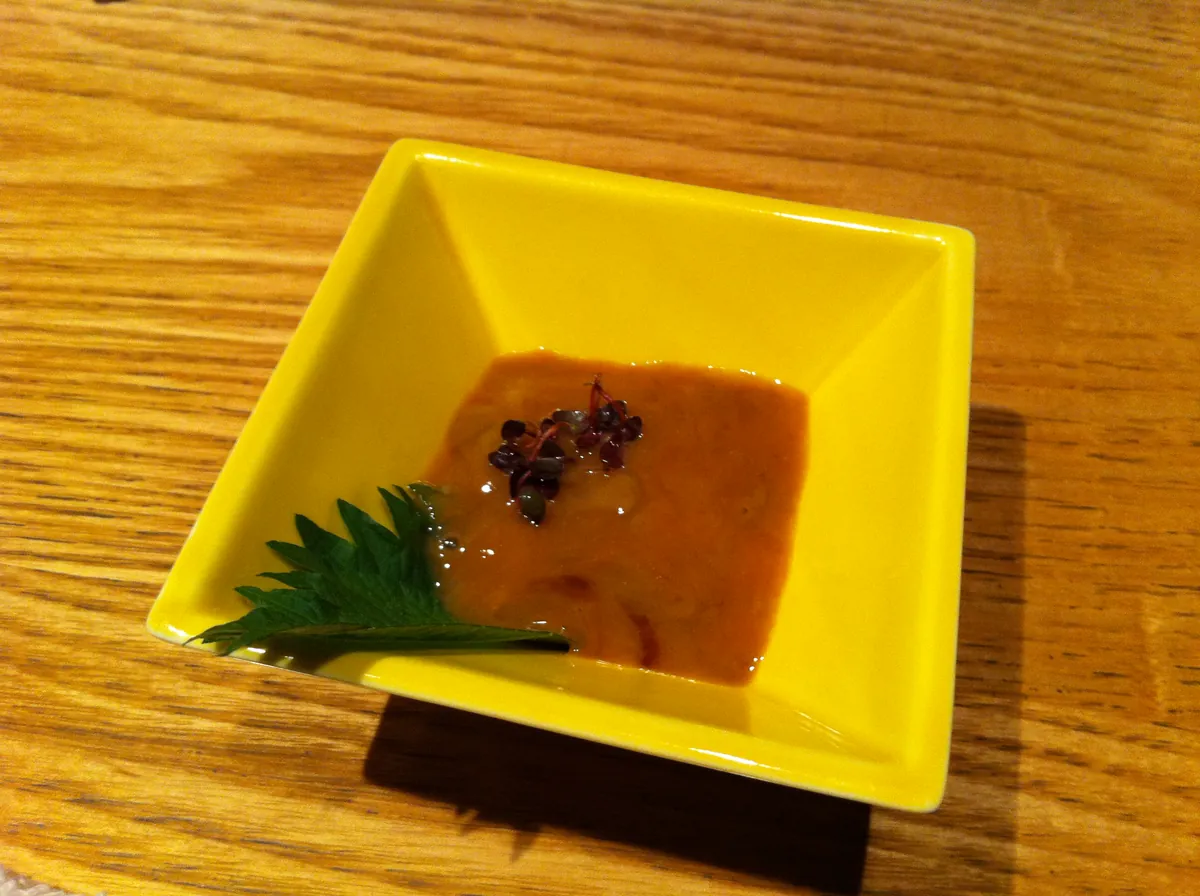
「このわた 春風萬里」ラベル付きの、なまこ腸の塩辛を小鉢に盛った写真。
写っているもの: 該当なし(加工食品)部位・状態: 盛り付け(小鉢)
写真: Koji Horaguchi/ CC BY 2.0/ 原画像/ 台帳の原画像
写真の範囲と来歴
被写体の確認: 原典の記載による同定。裁定に基づき、当初 ingredient-kuchiko(このこ)側の代理候補として検討されていた本写真を、被写体が実際にはこのわたであることから ingredient-konowata の候補として採用した。
掲載画像: リサイズ・トリミング・色調変更なし。Wikimedia Commons のオリジナル画像をそのまま使用。 表示用には幅1200px上限のWebPを配信し、台帳の原画像は上のリンクから確認できます。
On this page (8 sections)
Reading the bitterness
Konowata is made by salting the intestines of Japanese sea cucumber and maturing them briefly. 「こ」 (in translation: "ko") is another name for sea cucumber, and 「わた」 (in translation: "wata") means intestine. According to an Ishikawa Prefecture (Noto region) local-food database, the sand-purged cucumber’s abdomen is cut open by 3–5 cm to remove the intestines. Intestinal fluid and mud are removed, about 5–8% salt is mixed in, and the mixture rests for 3–30 minutes before draining and refrigerating for 1–3 days to mature. Variation in salt amounts and maturation days among households and producers has not been quantified.
The Noto region of Ishikawa Prefecture is known for producing konowata. Its local-food database describes it as an offering to courtiers in the Muromachi period and a food served at celebratory meals for Kaga domain lords in the Edo period; it also states that it appears in the Heian-period 『延喜式』 (in translation: "Engishiki"). These are secondary descriptions, however, without consultation of the primary historical sources themselves.
Sources describe konowata, alongside sea urchin and karasumi, as one of the 「日本三大珍味」 (in translation: "three great delicacies of Japan"). However, they do not identify a source for the ranking or its selection criteria. Even in an official local-food database this remains a descriptive designation, not a verified ranking.
Another delicacy from the same Japanese sea cucumber is 「くちこ」 (in translation: "kuchiko"), also called 「このこ」 (in translation: "konoko"), made from gonads containing both ovaries and testes. Besides using a different body part, gonads rather than intestines, accounts of how kuchiko is prepared conflict. The Ishikawa local-food database calls it salt-preserved, whereas a 1999 academic paper analyzing the general composition of konoko describes it as dried without added salt. The available sources do not resolve which account is correct.
Sources for this overview
Checked for this overview: Confirmed the described method of removing the intestines, salting, and refrigerated maturation. / Confirmed the secondary descriptions of an offering, celebratory meals, and an Engishiki mention. / Confirmed the phrase “three great delicacies of Japan” as a reported designation. / Confirmed the Ishikawa source’s description of kuchiko as salt-preserved.
ナマコ生殖巣の干物(このこ)と類似海産製品の一般組成およびエキス成分
Checked for this overview: Confirmed the 1999 paper’s description of kuchiko as dried without salt.
Follow the connections
konowata (salted sea cucumber entrails) →differs from→ kuchiko (dried sea cucumber ovary)
Structured claims — open a section to read each claim's confidence, evidence and limits
Composition and content (1)
Scope: Ishikawa Prefecture materials on konowata and kuchiko, and an analytical paper on konoko.
Note: The Ishikawa Prefecture material (MAFF) and Ogushi (1999), an academic paper, conflict on the preparation (salting versus drying without salt); which is correct is not decided at this point.
Show data
ingredient-konowata —differs_from→ ingredient-kuchikoHow processing and cooking change it (1)
Scope: Konowata of Ishikawa Prefecture (Noto region), in the Ministry of Agriculture, Forestry and Fisheries’ 「にっぽん伝統食図鑑」 (Nippon Dentōshoku Zukan).
Show data
ingredient-konowata —is_prepared_from→ "The intestines of the Japanese sea cucumber are used. The abdomen of a sand-purged sea cucumber is cut open by 3–5 cm to remove the intestines; intestinal fluid and mud are removed. About 5–8% salt is mixed in for 3–30 minutes, then drained and refrigerated for 1–3 days to mature."Culture (2)
Scope: The Ishikawa entry for konowata and kuchiko in the Ministry of Agriculture, Forestry and Fisheries’ 「にっぽん伝統食図鑑」 (Nippon Dentōshoku Zukan).
Show data
ingredient-konowata —has_historical_origin→ "The Noto region of Ishikawa Prefecture is known as a production area. Konowata is described as an offering to courtiers in the Muromachi period and as served at celebratory meals for Kaga domain lords in the Edo period; it is also described as appearing in the Heian-period 『延喜式』 (in translation: "Engishiki")."Scope: The Ishikawa entry for konowata and kuchiko in the Ministry of Agriculture, Forestry and Fisheries’ 「にっぽん伝統食図鑑」 (Nippon Dentōshoku Zukan).
Note: The source for the ranking and selection criteria is not specified, so it is treated as a reported designation.
Show data
ingredient-konowata —is_documented_as_part_of→ "Sources contain the designation of konowata as one of the 『日本三大珍味』 (in translation: "three great delicacies of Japan") alongside sea urchin and karasumi."