liangcha
ingredient / ingredient-liangcha
涼茶
Liangcha is a collective term for Lingnan cooling teas and herbal drinks made by extracting plant materials, not limited to Camellia sinensis, in water. Cultural use and evidence of medicinal effects are treated separately.
Photographs (captions in Japanese)
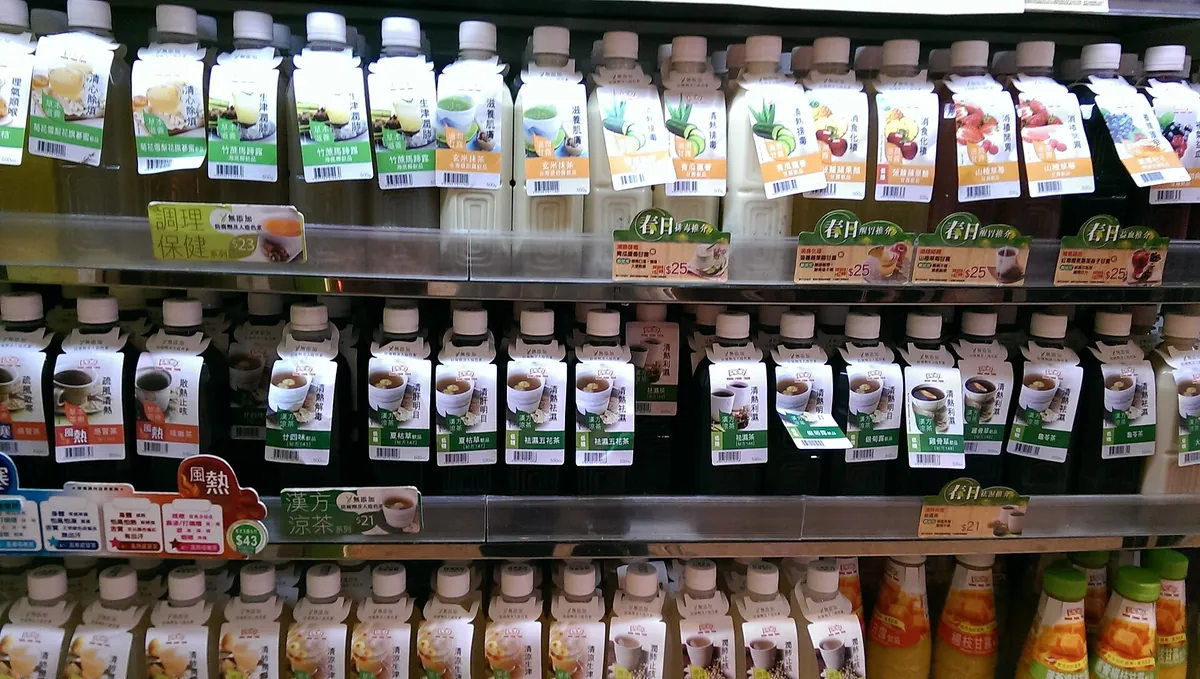
涼茶(中国広東式の薬草茶飲料)の市販ボトル群。「漢方涼茶」の棚札とともに、清熱・去湿などをうたう複数銘柄のボトルが陳列されている状態で、涼茶が瓶入り飲料として流通している様子がわかる。
写っているもの: 該当分類群なし(複数植物素材の涼茶飲料群)部位・状態: 香港のスーパーマーケットの棚に並ぶ、瓶入り・ボトル入りの各種涼茶(漢方涼茶シリーズを含む)
写真: Map cla1401/ CC BY-SA 3.0/ 原画像/ 台帳の原画像
写真の範囲と来歴
被写体の確認: 原典の記載による同定。個々の銘柄・原料植物は瓶ラベルの写り込みからは確定できないため学名は記載しない。写真は瓶詰め商品の陳列であり、椀に注いだ状態の涼茶を示す写真ではない。
掲載画像: Wikimedia Commons の1920px版。苦味研究所では切り抜き・色調変更なし。 表示用には幅1200px上限のWebPを配信し、台帳の原画像は上のリンクから確認できます。
On this page (9 sections)
Reading the bitterness
Liangcha (cooling tea) is a collective term for herbal drinks of the Lingnan region (southern China, including Guangdong and Guangxi) made by decocting or infusing plant materials not limited to the Chinese tea plant (Camellia sinensis) in water. An ethnobotanical survey of 12 sociolinguistic groups and 300 people in Lingnan conducted from 2010 to 2012 recorded it as a drink made by extracting diverse parts, including leaves, fruits, flowers, bark, seeds, and roots, from one or more species in water. Because the subjects covered as many as 238 taxa, the term does not refer to a single recipe. The same survey states that gathering and cultivating liangcha have cultural and economic value and that its consumption has become part of Lingnan regional culture and lifestyle. How bitterness is softened and discussed is also part of the region’s liangcha culture.
The art of preparing liangcha was registered in 2006 as a traditional craft belonging to Guangdong Province in the first group of China’s national-level intangible cultural heritage. However, this registration indicates cultural status and does not guarantee the safety or efficacy of individual products. It has also been recorded that producers and distributors of market products began adding sweeteners to soften bitter flavors, but their types and amounts, and how much bitterness they actually suppressed, have not been measured. A cultural article posted on the Guangzhou municipal government website in 2023 introduces local elders’ account that liangcha bitterness is divided roughly into three grades, with higher grades having heavier flavor and darker color, but this is not a standardized scale and has not been confirmed by a reproducible survey.
Sources for this overview
Ethnobotanical survey of cooling herbal drinks from southern China
Checked for this overview: Confirmed the definition involving water extraction of diverse plant parts. / Confirmed the survey result that it is part of Lingnan regional culture. / Confirmed the record of adding sweeteners to soften bitterness.
Checked for this overview: Confirmed the registration record as national-level intangible cultural heritage.
Checked for this overview: Confirmed the local account dividing bitterness into three levels.
Other names: 凉茶 (zh), liáng chá (zh-Latn)
Follow the connections
liangcha →is documented as part of→ Lingnan
Hypotheses and recipe candidates for this entry are on the Japanese page.
Structured claims — open a section to read each claim's confidence, evidence and limits
How processing and cooking change it (2)
Scope: An ethnobotanical survey of Lingnan
Note: Plant species, parts, and combinations vary widely; this is a description as a general term.
Show data
ingredient-liangcha —is_prepared_from→ "Water extraction of one or more plant parts, not limited to Camellia sinensis"Scope: An observation from an ethnobotanical paper on the liangcha (herbal tea) industry of Lingnan
Note: A practice record from producers and distributors. Not a sensory test that measured the effect size of perceptual suppression.
Show data
ingredient-liangcha —is_prepared_with→ "Sweeteners added to commercial products for the purpose of softening bitter flavor"Safety and regulation (1)
Scope: Registration information submitted by the Guangdong Provincial Department of Culture
Note: The registration indicates cultural status; it does not guarantee safety or efficacy.
Show data
ingredient-liangcha —is_listed_as→ "A traditional craft on China's national-level list of intangible cultural heritage (item 439, VIII-89, first batch, 2006)"Culture (2)
Scope: a 2010–2012 study of 300 people across 12 sociolinguistic groups
Note: A reported traditional-medicine use is a separate matter from clinical efficacy.
Show data
ingredient-liangcha —is_documented_as_part_of→ region-lingnanScope: a 2023 cultural article published on the Guangzhou municipal government's website
Note: Not a standardized scale — a regional narrative recorded in a news article. A replication study is needed.
Show data
ingredient-liangcha —is_classified_by→ "In the accounts of 『老広』 (in translation: "old-time Guangzhou locals"), bitterness is divided into roughly three grades, with the higher grades being heavier in flavor and darker in color"