soyasaponin group A
compound class / compound-class-soyasaponin-group-a
グループAサポニン
Group A soyasaponins with soyasapogenol A as aglycone (Aa, Ab, Ac, Ad, Ae, Af, etc.). Bisdesmosidic saponins localized in soybean seed hypocotyls with partially acetylated carbohydrate chains. Reported as major contributing compounds to soybean's undesirable taste (bitterness and astringency).
Photographs (captions in Japanese)
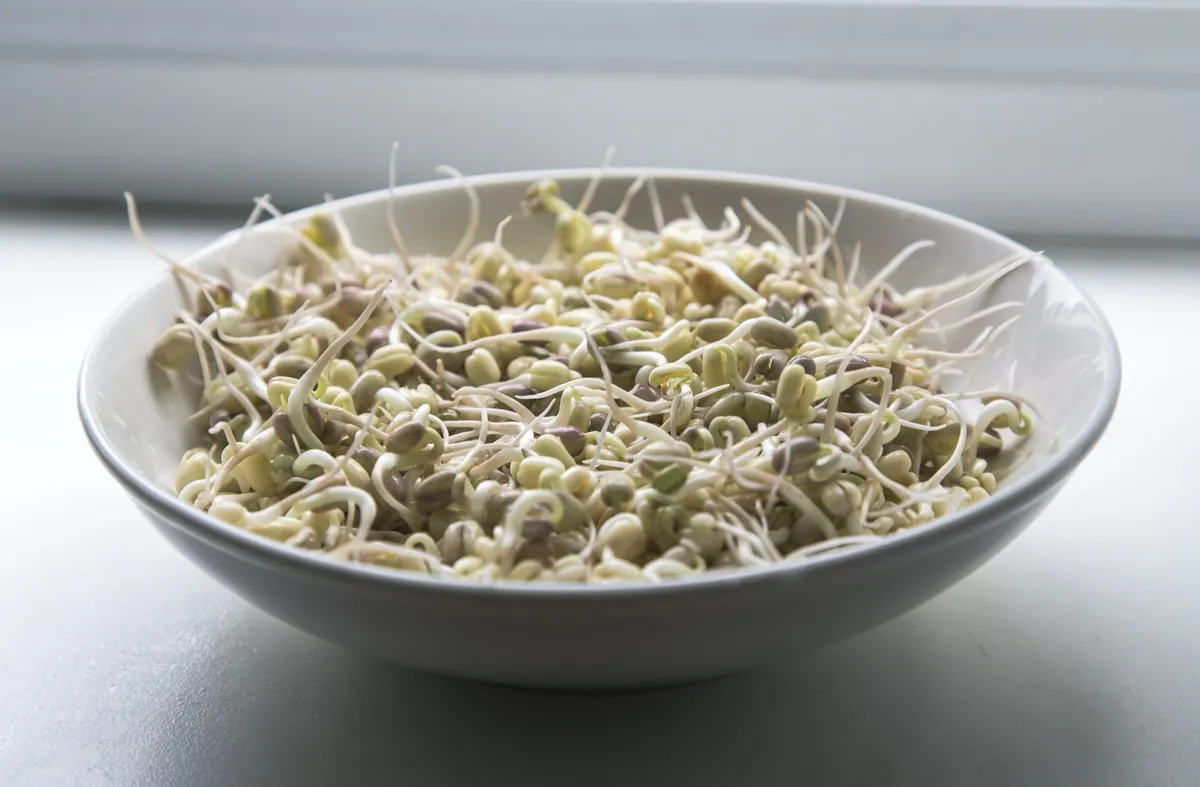
ダイズのもやし(콩나물、コンナムル)。ソヤサポゲノールAを持つグループAソヤサポニン類はダイズ種子の胚軸に局在するとされ、胚軸が視認できる発芽体の写真を給源素材として採用した。
原料写っているもの: Glycine max(ダイズ)の発芽体(콩나물/コンナムル)部位・状態: 胚軸を含む発芽体(もやし)
写真: milivanily/ CC0 1.0/ 原画像/ 台帳の原画像
写真の範囲と来歴
被写体の確認: 原典の記載による同定。化合物そのものの写真ではなく、胚軸が確認できる大豆もやしの写真。
掲載画像: Wikimedia Commons の原寸ファイルを sips で長辺2400pxに縮小。苦味研究所では切り抜き・色調変更なし(リサイズのみ)。 表示用には幅1200px上限のWebPを配信し、台帳の原画像は上のリンクから確認できます。
On this page (6 sections)
Reading the bitterness
Group A saponins are collectively termed soybean (Glycine max) seed-derived triterpenoid saponins that have soyasapogenol A as their aglycone (Aa, Ab, Ac, Ad, Ae, Af, etc.). Okubo (1988) isolated the major components of this group A and the major components of group B with soyasapogenol B as aglycone (Ba, Bb, etc.), and conducted sensory evaluation to compare the taste detection thresholds (minimum concentration that can be detected) and taste qualities of both groups.
As a result, the taste detection threshold of group A saponins was lower than that of group B, and was detected even at lower concentrations. The taste detection threshold of soybean saponins ranged from 10⁻³ to 10⁻⁵ mM. Tsukamoto's (2012) review also states that group A saponins with soyasapogenol A as aglycone are reported as contributing factors to soybean's undesirable taste, consistent with Okubo's sensory evaluation results.
Regarding taste quality, Okubo's (1988) sensory evaluation reported that group A saponins exhibited strong bitterness along with weak astringency (sensation of the tongue tightening, similar to the drying sensation of tannins). Bitterness was evaluated as the predominant quality with astringency relatively weak; the two could not be treated as equal in intensity. However, the author notes that there was considerable individual variability among evaluators in the description of taste.
Sources for this overview
大豆のDMF(Dry Mouth Feel,あく,不快味)成分と豆腐等の食品加工におけるその挙動
Checked for this overview: Confirmed the isolation methods of group A and B major components and the sensory evaluation procedures. / Confirmed that group A has the lowest taste detection threshold and that the threshold range is 10⁻³ to 10⁻⁵ mM. / Confirmed the taste quality evaluation of strong bitterness and weak astringency and the note on individual variability.
Checked for this overview: Confirmed the review's description reporting the compound as a contributing factor to soybean's undesirable taste.
Follow the connections
soyasaponin group A →contributes to→ bitterness →can be measured separately …→ astringency
soyasaponin group A →contributes to→ astringency →is not synonymous with→ bitterness
Structured claims — open a section to read each claim's confidence, evidence and limits
Sensory (2)
Scope: Group A saponin fraction isolated from unprocessed soybean (sensory evaluation)
Note: Okubo (1988) isolated the major components of soybean group A saponins (Aa, Ab, etc.) and their aglycones (soyasapogenol A, B, E) and investigated their taste thresholds and taste qualities by sensory evaluation, showing that group A saponins have the lowest taste threshold and exhibit strong bitterness and astringency. Tsukamoto (2012) also reviews that 「ソヤサポゲノールAをアグリコンとするグループAサポニンは不快味の原因成分であると報告されている」 (in translation: "group A saponins with soyasapogenol A as the aglycone are reported to be causative components of the undesirable taste").
Show data
compound-class-soyasaponin-group-a —contributes_to→ sensation-bitterScope: Group A saponin fraction isolated from unprocessed soybean (sensory evaluation)
Note: Okubo (1988) gives the taste of saponin A in the legend of Figure 1 as 「強い苦味、弱い収斂味」 (in translation: "strong bitterness, weak astringency"). In Table 1 of the same report, group A saponins (from hypocotyls) are described as 「嫌悪感、苦味、収斂味、ざらつき」 (in translation: "aversive, bitter, astringent, gritty"), with no degree word on astringency. Bitterness and astringency are recorded as separate claims. The contribution to astringency is weak.
Show data
compound-class-soyasaponin-group-a —contributes_to→ sensation-astringent