日本語版

hydroxy-alpha-sanshool (sanshool alkylamides)

compound / compound-hydroxy-alpha-sanshool

サンショオール

Hydroxy-alpha-sanshool (sanshool alkylamides) is an alkylamide related to the tingling sensation of Zanthoxylum; in human psychophysics, the stable derivative IBA is often used.

Photographs (captions in Japanese)
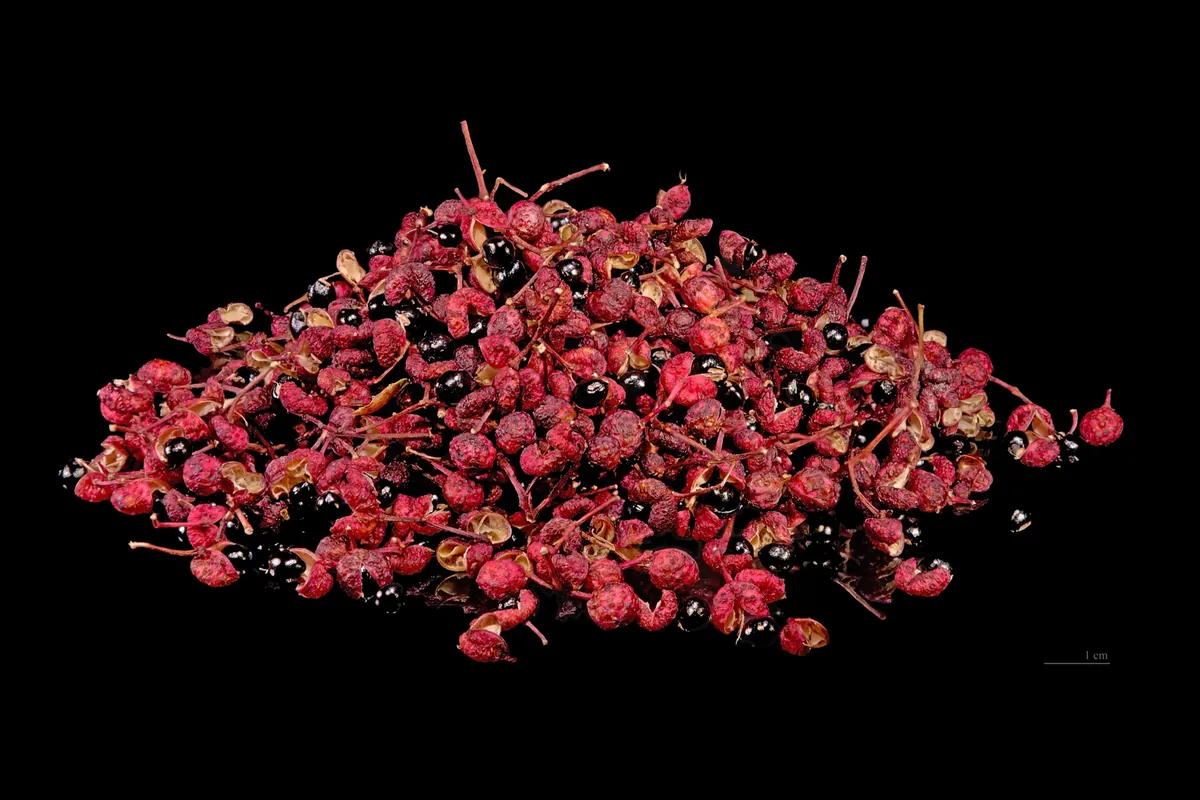
赤く裂開したサンショウの果実と黒い種子が接写されている写真

サンショウ(Zanthoxylum piperitum)の果実と種子。hydroxy-alpha-sanshool を含むサンショオールアルキルアミド類はこの植物のチクチク感に関連するとされ、化合物そのものではなく給源となる果実・種子の写真である。

原料写っているもの: Zanthoxylum piperitum(サンショウ)部位・状態: 果実と種子

写真: Didier Descouens/ CC BY-SA 4.0/ 原画像/ 台帳の原画像

写真の範囲と来歴

被写体の確認: 原典の記載による同定。ingredient-sansho-fruit で使用した写真とは別ファイル(重複回避)。

掲載画像: Wikimedia Commons の原寸ファイルを sips で長辺2400pxに縮小。苦味研究所では切り抜き・色調変更なし(リサイズのみ)。 表示用には幅1200px上限のWebPを配信し、台帳の原画像は上のリンクから確認できます。

On this page (9 sections)
  1. Overview
  2. Sources for this overview (6)
  3. Topic hubs
  4. Follow the connections
  5. Related entries (10)
  6. Measured values (5)
  7. Composition and content (1)
  8. Sensory (2)
  9. Mechanism and receptors (1)
↑

Reading the bitterness

Hydroxy-alpha-sanshool is one of the alkylamides contained in the fruit of the genus Zanthoxylum (Zanthoxylum), a component that produces a distinctive tingling or numbing sensation in the mouth. This is not a 「味」 (in translation: "taste") like sweetness, sourness, or bitterness, but rather a chemical stimulus sensation felt in the mouth, close to pain or temperature sensation. Most psychophysical experiments in human subjects are conducted not with sanshool itself from nature, but with the more stable derivative IBA.

This sensation is not merely a type of pain, but is intertwined with tactile sensation. When IBA is applied to the anterior third of the tongue, the R-index indicating tactile discrimination clarity decreased from 93.8 to 84.3 with one force of von Frey filament and from 86.9 to 75.2 with another filament, and tactile sensation became duller. Capsaicin, used as a control, did not have the same effect. Conversely, there is also an experiment showing that when sustained pressure is applied to the lip, the tingling sensation from sanshool itself is suppressed to approximately 24.7% of baseline; thus, tingling and tactile sensation have a mutually influential relationship.

Which receptor mediates this tingling sensation remains disputed among studies. In one mouse experiment, sanshool excited 52.3% of sensory neurons, with strong effects on the two-pore potassium channels KCNK3 and KCNK18 (IC50 of 30.3 and 50.2 uM respectively), and the response was unchanged in mice lacking both TRPV1 and TRPA1. However, in another study, hydroxy-alpha-sanshool has been reported to activate TRPV1 as an agonist at EC50 1.1 uM and TRPA1 at EC50 69 uM, and in mice lacking TRPV1, avoidance behavior to 1 mM sanshool is treated as nearly abolished. In human experiments, even when pain-sensing channels are adapted with capsaicin or mustard oil, the tingling from sanshool is not weakened, and the numbness on the lip is positioned in a tactile-like neural pathway (RA1). One of the authors pointed out that this discrepancy may be due to differences in test temperature, and the mechanism remains unsettled.

Sanshool as a pungent component of sansho is also a long-studied research subject. The original 1931 paper records that ether extract was obtained from the fruit of Japanese sansho (Xanthoxylum piperitum D.C.), and crude sanshool was isolated by reduction, fractional distillation, and decomposition, the methods of that time. This is not a study identified and quantified as a single compound by modern analysis, but is positioned as a historical first step.

Sources for this overview

  1. Psychophysical Evaluation of a Sanshool Derivative (Alkylamide) and the Elucidation of Mechanisms Subserving Tingle

    Albin KC; Simons CT / 2010 / journal article / full text checked

    Checked for this overview: Confirmed experimental design using IBA derivative in human psychophysics. / Confirmed values showing R-index for tactile threshold decreased from 93.8 to 84.3 etc. with IBA. / Confirmed results showing tingling sensation not weakened by capsaicin pretreatment.

  2. Touch inhibits touch: sanshool-induced paradoxical tingling reveals perceptual interaction between somatosensory submodalities

    Cataldo A; Hagura N; Hyder Y; Haggard P / 2021 / journal article / full text checked

    Checked for this overview: Confirmed results showing tingling sensation suppressed to 24.7% with sustained pressure.

  3. Pungent agents from Szechuan peppers excite sensory neurons by inhibiting two-pore potassium channels

    Bautista DM; Sigal YM; Milstein AD; Garrison JL; Zorn JA; Tsuruda PR; Nicoll RA; Julius D / 2008 / journal article / full text checked

    Checked for this overview: Confirmed IC50 values for KCNK3 and KCNK18 and maintained response in double knockout.

  4. Compounds from Sichuan and Melegueta peppers activate, covalently and non-covalently, TRPA1 and TRPV1 channels

    Riera CE; Menozzi-Smarrito C; Affolter M; Michlig S; Munari C; Robert F; Vogel H; Simon SA; le Coutre J / 2009 / journal article / full text checked

    Checked for this overview: Confirmed EC50 values for TRPV1 and TRPA1 and abolished avoidance in knockout.

  5. Food vibrations: Asian spice sets lips trembling

    Hagura N; Barber H; Haggard P / 2013 / journal article / full text checked

    Checked for this overview: Confirmed frequency experiment positioning numbing sensation in RA1 pathway.

  6. 山椒の成分サンショオールに就て

    淺野三千三; 兼松鐵雄 / 1931 / journal article / full text checked

    Checked for this overview: Confirmed record of crude sanshool isolation from 1931 original paper.

Follow the connections

hydroxy-alpha-sanshool (sanshool alkylamides) →can elicit→ tingling

Xanthoxylum piperitum D.C. →contains→ hydroxy-alpha-sanshool (sanshool alkylamides)

Measured values (5)

KindCompoundTargetValueConditionsSource
receptor EC50hydroxy-alpha-sanshool (sanshool alkylamides)TRPV11.1 µMHeterologous expression system (Mechanism is disputed.)Riera CE, 2009
receptor EC50hydroxy-alpha-sanshool (sanshool alkylamides)TRPA169 µMHeterologous expression system (Mechanism is disputed.)Riera CE, 2009
receptor IC50hydroxy-alpha-sanshool (sanshool alkylamides)KCNK330.3±4.9 µMHeterologous expression system (Mechanism is disputed.)Bautista DM, 2008
receptor IC50hydroxy-alpha-sanshool (sanshool alkylamides)KCNK1850.2±1.9 µMHeterologous expression systemBautista DM, 2008
receptor IC50hydroxy-alpha-sanshool (sanshool alkylamides)KCNK9450±30.1 µMHeterologous expression systemBautista DM, 2008

Values are the reported values of each source (with units and conditions). Thresholds and EC50 depend on the panel and method; they are not single true values.

Structured claims — open a section to read each claim's confidence, evidence and limits

Composition and content (1)

Xanthoxylum piperitum D.C. contains hydroxy-alpha-sanshool (sanshool alkylamides)supported

Scope: Isolation study from 1931 original paper using the fruit of Japanese sansho Xanthoxylum piperitum D.C. as material.

Note: The original paper addresses crude sanshool and is positioned as a historical first step, not as modern chemical identification and quantification.

The original paper states that crude sanshool was obtained from ether extract of sansho fruit and subjected to reduction, fractional distillation, and decomposition.
Limitations: Historical crude preparation research; not a modern analysis-based single-compound content value.
Source: 山椒の成分サンショオールに就て (淺野三千三; 兼松鐵雄, 1931) · full text checked
Show dataingredient-sansho-fruit —contains→ compound-hydroxy-alpha-sanshool
claim: clm-jp-sansho-fruit-sanshool / type: composition / updated: 2026-08-31

Sensory (2)

hydroxy-alpha-sanshool (sanshool alkylamides) reduces Tactile sensitivity (von Frey threshold) during application. Different from capsaicinsupported

Scope: Human psychophysics using IBA applied to skin and lip sites

Note: Suggests that tingling is mediated through mechanosensory channels rather than pure nociception.

On the front third of the tongue, IBA significantly raised the tactile threshold: the R-index fell from 93.8 +/- 1.2 to 84.3 +/- 2.1 with the 0.02 N von Frey filament (p < 0.001), and from 86.9 +/- 1.7 to 75.2 +/- 2.1 with the 0.008 N filament (p < 0.001). Capsaicin, tested as a control stimulus, did not affect tactile sensitivity (p = 0.456; p = 0.687). Experiment 5 had 31 subjects (16 male, 15 female; ages 25-56).
Limitations: The stable derivative IBA was used, not natural hydroxy-alpha-sanshool, and testing was on the front of the tongue. The measure is the R-index of discriminability, not an absolute force threshold. The divergence from capsaicin is a null result for the capsaicin condition, showing that no detectable capsaicin effect occurred at the concentration used — it does not prove that no such effect exists.
Context: Demonstrates the reverse direction of the same tingling-touch interaction. Sustained mechanical pressure suppressed sanshool-induced tingling (to a mean of 24.7% +/- s.d. 34.0 of baseline; t9 = 7.00, p < 0.001, dz = 2.21), and in a graded-load experiment, the probability of reporting a stronger sensation on the loaded side of the lip decreased progressively as the force increased (F1.6,11.2 = 12.09; p = 0.002). The authors attribute this to an inhibitory interaction between mechanoreceptive channels, rather than to nociceptive or C-tactile pathways.
Limitations: Uses natural sanshool (ZANTHALENE), not the IBA derivative from Albin 2010, and measures the suppression of tingling by touch pressure rather than the rise in tactile threshold caused by alkylamides. It therefore supports a bidirectional interaction, but does not itself reproduce the von Frey threshold result.
Show datacompound-hydroxy-alpha-sanshool —reduces→ "Tactile sensitivity (von Frey threshold) during application. Different from capsaicin"
claim: clm-iba-tactile-reduction / type: sensory / updated: 2026-08-30
hydroxy-alpha-sanshool (sanshool alkylamides) can elicit tinglingsupported

Scope: Human sensory. A phenomenon-level observation; for the receptor mechanism, see the related record (contested)

Note: Separated by the phenomenon/mechanism split (a playbook rule).

In humans, the tingling sensation from sanshool was not diminished even after TRP-desensitizing pretreatment with capsaicin/mustard oil.
Limitations: Attribution of the mechanism is contested among knockout (KO) experiments (see the separate claim).
Source: Pungent agents from Szechuan peppers excite sensory neurons by inhibiting two-pore potassium channels (Bautista DM; Sigal YM; Milstein AD; Garrison JL; Zorn JA; Tsuruda PR; Nicoll RA; Julius D, 2008) · full text checked
Show datacompound-hydroxy-alpha-sanshool —can_elicit→ sensation-tingling
claim: clm-sanshool-tingle-trp-independent-phenomenon / type: sensory / updated: 2026-08-30

Mechanism and receptors (1)

hydroxy-alpha-sanshool (sanshool alkylamides) — currently proposed mechanisms: Inhibition of KCNK 2P-domain potassium channels on mechanosensitive neurons. Separate from the TRPV1/TRPA1 pathwaycontested

Scope: Human psychophysics using the stable sanshool derivative IBA, and the neurophysiology that supports it

Note: The mechanism is contested: the KCNK (2P-type K+ channel) inhibition hypothesis (neural response unchanged even in TRPV1/TRPA1 double KO) versus the TRPV1-main-pathway hypothesis (aversion nearly eliminated in KO). Differences in method and temperature dependence are candidate causes of the disagreement. The phenomenon itself (the tingling, the prickling) is not disputed.

In 68 subjects aged 20-59 across 5 experiments (Exp 1 self-desensitization n = 25; Exp 2 cross-desensitization n = 30 capsaicin and n = 30 mustard oil; Exp 3 time-intensity n = 28; Exp 4 temperature-tingling n = 29; Exp 5 tingling-touch n = 31), IBA-induced tingling was not reduced by pretreatment with either the TRPV1 or TRPA1 agonist: the effect of capsaicin pretreatment was non-significant (p = 0.585; tingling rating p = 0.104), and the same was true for mustard oil (p = 0.200; p = 0.845). Time-intensity used a modified procedure in which subjects rated on a 0-10 scale every 60 seconds for 32 minutes while selecting descriptor words. The authors conclude, verbatim: "alkylamides activate mechanosensitve neurons via blockade of KCNK two-pore potassium channels to induce the novel tingling sensation."
Limitations: The conclusion of KCNK involvement is an inference from a pattern of psychophysical dissociation; the channel itself was not measured in this study. The cross-desensitization argument rests on a null result, and its interpretation depends on whether the pretreatment concentration achieved effective desensitization. IBA is a stable derivative, not natural sanshool. An independent rodent study (Riera 2009) reports alpha-sanshool as a TRPV1/TRPA1 agonist and found that aversion was nearly eliminated in TRPV1 knockouts, so the divergence from these channels is contested at the mechanism level.
Context: The paper does not stop at the level of the spice, but names the compound explicitly (hydroxyl-alpha-sanshool, hereafter sanshool); the frequency and adaptation results (matching at 50.0 Hz; a reduction in perceived tingling frequency after 80 Hz lip adaptation, t7 = 3.1, p = 0.017) place this perception within the RA1 flutter pathway, complementing a mechanistic account via mechanoreceptive channels.
Limitations: This study used crushed Sichuan pepper, not isolated sanshool; the attribution to hydroxy-alpha-sanshool is not something verified here but the authors' identification of the active compound. The psychophysical channel assignment does not identify a molecular target; it is consistent with KCNK blockade but does not demonstrate it.
Source: Food vibrations: Asian spice sets lips trembling (Hagura N; Barber H; Haggard P, 2013) · full text checked
Verbatim: "We found that sanshool (100 uM) serves as an excitatory agent for a specific subgroup (52.3%; n = 2,063) of sensory neurons." Verbatim: "The greatest potency was observed with KCNK3 and KCNK18 (IC50 = 30.3 +/- 4.9 and 50.2 +/- 1.9 uM, respectively); KCNK9 was much less sensitive (IC50 = 450 +/- 30.1 uM)." Verbatim: "sanshool-evoked responses were not altered (in prevalence or magnitude) in sensory neurons cultured from mutant mice lacking both TRPV1 and TRPA1 channels."
Limitations: Rodent, not human. It provides a channel-level mechanism that human psychophysics can only infer. The 1 mM drinking-test observation is behavioral, not perceptual.
Source: Pungent agents from Szechuan peppers excite sensory neurons by inhibiting two-pore potassium channels (Bautista DM; Sigal YM; Milstein AD; Garrison JL; Zorn JA; Tsuruda PR; Nicoll RA; Julius D, 2008) · full text checked
Contradicts: Reports hydroxy-alpha-sanshool (alpha-SOH) as an agonist of both TRP channels, giving the EC50 values verbatim as alpha-SOH: EC50 = 1.1 uM (TRPV1), alpha-SOH: EC50 = 69 uM (TRPA1), and states, verbatim: "1 mM alpha-SOH was markedly aversive to WT animals but, in KO animals, the aversion was almost entirely eliminated (P < 0.001)." The authors distance themselves clearly from the two-pore potassium channel hypothesis, stating, verbatim: "However, our results showing that alpha-SOH did not activate DRGs, which did not respond to capsaicin, diverge from those of Bautista et al. (2008), who identified sanshool responses in both capsaicin-sensitive and insensitive neurons," and, verbatim: "This finding deviates from the behavioural results presented by Bautista et al. (2008) where their TRPV1/TRPA1 double KO mice remained sensitive to the aversive effect of 1 mM alpha-SOH."
Limitations: Rodent and heterologous expression systems, not human perception. The authors themselves state, verbatim: "However, to assess taste preference we used a different testing paradigm from that used by Bautista et al. (2008)," and suggest, verbatim: "In this regard, KCNK channels may be less sensitive to sanshool at higher temperatures." Because aversion in a drinking test is not the same measure as human perception of tingling, the disagreement concerns the mechanism, not the existence of the sensation.
Source: Compounds from Sichuan and Melegueta peppers activate, covalently and non-covalently, TRPA1 and TRPV1 channels (Riera CE; Menozzi-Smarrito C; Affolter M; Michlig S; Munari C; Robert F; Vogel H; Simon SA; le Coutre J, 2009) · full text checked
Show datacompound-hydroxy-alpha-sanshool —has_currently_proposed_mechanisms→ "Inhibition of KCNK 2P-domain potassium channels on mechanosensitive neurons. Separate from the TRPV1/TRPA1 pathway"
claim: clm-sanshool-tingling-mechanism / type: mechanism / updated: 2026-08-30

↑ Top of page · ← Encyclopedia (English entries)