tannins
compound class / compound-tannins
タンニン類
Diverse polyphenol compounds that can interact with proteins and other oral components.
Photographs (captions in Japanese)
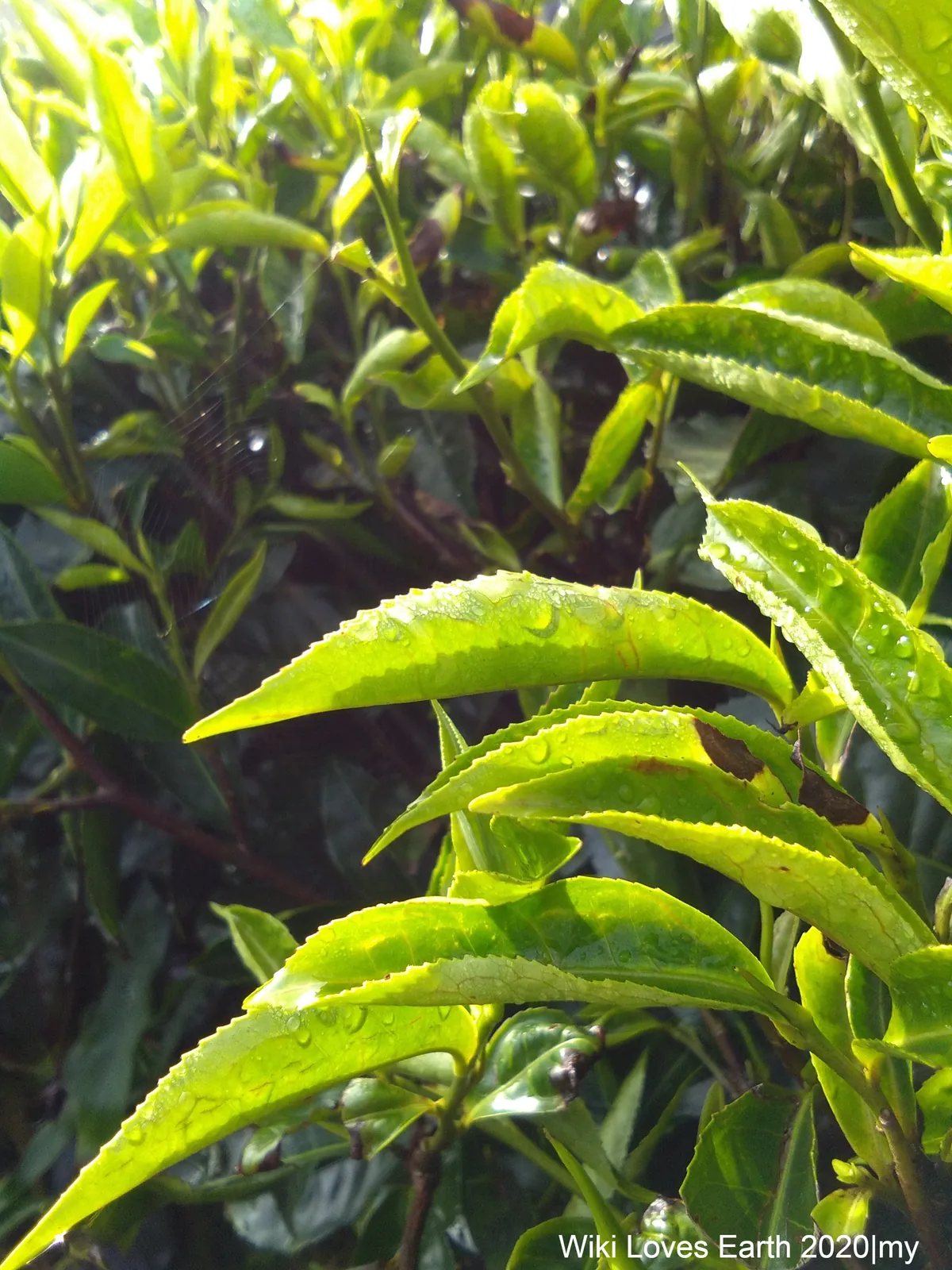
チャノキ(Camellia sinensis)の茶園での葉の接写。タンニン類はタンパク質等と相互作用しうる多様なポリフェノール化合物群で、代表的な給源であるチャノキの写真を採用した。
原料写っているもの: Camellia sinensis(チャノキ)部位・状態: 茶樹の葉
写真: Pro QueeNia/ CC BY-SA 4.0/ 原画像/ 台帳の原画像
写真の範囲と来歴
被写体の確認: 原典の記載による同定。ingredient-goishi-cha・ingredient-awa-bancha で使用した写真とは別ファイル(重複回避)。
掲載画像: Wikimedia Commons の原寸ファイル。苦味研究所では切り抜き・色調変更なし。 表示用には幅1200px上限のWebPを配信し、台帳の原画像は上のリンクから確認できます。
On this page (8 sections)
Reading the bitterness
Tannins are a general term for diverse polyphenol compounds that can bind to proteins and other substances in the mouth, and are a representative component that triggers astringency. Astringency is defined as a dry, tightening, narrowing sensation in the mouth that is felt when something containing astringent components is placed in the mouth. Proposed mechanisms include salivary proteins (particularly those rich in proline) binding to tannins and precipitating, tannins binding to epithelial cells or membranes on the mucous surface in the mouth, and involvement of the trigeminal nerve and mechanoreceptors, but the extent to which each contributes to astringency has not been settled. It is also pointed out that higher polymer-degree tannins tend to produce stronger astringency, while smaller molecules tend to produce stronger bitterness.
In fact, some tannins are also involved in bitterness itself. Pentagalloyl glucose, a type of hydrolyzable tannin, has been shown to activate bitter taste receptors TAS2R5 and TAS2R39 at very low concentrations (EC50 of 2.7 µM), and punicalagin, castalagin, and vescalagin, which are classified as ellagitannins, activate TAS2R7. Some of the procyanidins that form the basis of condensed tannins (dimers B1, B2, B3 and trimer C1) have been reported to be perceived as bitter only at higher concentrations (0.4-0.5 mM) than the concentration at which they are perceived as astringency (0.19-0.3 mM).
Sources for this overview
Tannins in Food: Insights into the Molecular Perception of Astringency and Bitter Taste
Checked for this overview: Definition of astringency, candidate mechanisms, and polymer-degree trend confirmed in body text / TAS2R activation by PGG and ellagitannins, and EC50 values confirmed in body text
Follow the connections
tannins →can elicit→ astringency →is not synonymous with→ bitterness
tannins →can contribute to→ bitterness →can be measured separately …→ astringency
persimmon tannin (kaki-tannin) →is a type of→ tannins
Structured claims — open a section to read each claim's confidence, evidence and limits
Composition and content (1)
Note: Positions kaki-tannin as a condensed tannin (proanthocyanidin) that accumulates in the tannin cells of persimmon fruit.
Show data
compound-kaki-tannin —is_a_type_of→ compound-tanninsSensory (5)
Scope: Food tannins
Note: Intensity and quality depend on structure, concentration, and matrix.
Show data
compound-tannins —can_elicit→ sensation-astringentScope: Some food tannins and polyphenols
Note: Not all tannins have the same receptor and sensory profile.
Show data
compound-tannins —can_contribute_to→ sensation-bitterScope: 4 phenolic substances — catechin, gallic acid, grape-seed tannin, and tannic acid — added to white wine. Scalar rating and time-intensity methods with a trained panel (both increased linearly with concentration).
Note: For the polymers, tannic acid and grape-seed tannin, astringency ratings exceeded bitterness ratings, unlike their respective monomers (gallic acid and catechin). Conversely, for the monomers gallic acid and catechin, bitterness ratings exceeded astringency. Time to reach maximum intensity was slightly longer for bitterness than for astringency.
Show data
compound-tannins —has_perceived_bitterness_affected_by→ "Degree of polymerization (a reversal in which monomers show bitterness > astringency, and polymers show astringency > bitterness)."Scope: Time-intensity method with a panel of 18 trained assessors (continuous recording from ingestion through 10 seconds after expectoration until the sensation disappeared).
Note: As the degree of polymerization rose, the maximum bitterness intensity and total duration fell, while maximum astringency intensity rose. Monomers were significantly more bitter than dimers, and dimers significantly more bitter than trimers. Astringency was weaker for the monomer than for the dimers and trimers (total duration showed no significant difference by degree of polymerization). Even among dimers made of the same catechin units, bitterness and astringency intensity varied by linkage position (4→6 versus 4→8 bonds) and by constituent unit (catechin versus epicatechin).
Show data
compound-tannins —has_perceived_bitterness_affected_by→ "Degree of polymerization (bitterness decreases and astringency increases as it rises). 7 synthetic flavan-3-ol aqueous solutions made of catechin, epicatechin, and 3 dimers and 2 trimers derived from them (a model system, not wine itself)."Scope: 16 assessors. A comparison of conditions in which pH, ethanol concentration (including the wine range of 11–15%), and tartaric acid concentration were each manipulated independently.
Note: As ethanol concentration and pH rose, perceived astringency weakened. pH affected astringency only, whereas ethanol, at wine-range concentrations, contributed to perceived bitterness as well as astringency. Varying tartaric acid concentration at a constant pH affected neither astringency nor bitterness. Recorded as an asymmetric result showing that astringency and bitterness cannot be explained by a single mechanism alone.
Show data
compound-tannins —has_bitter_astringency_affected_by→ "pH (astringency only) and ethanol (both astringency and bitterness). Grape-seed-derived oligomeric tannins in a model wine solution."Safety and regulation (1)
Scope: The same document, Part I, Table 1. Placed as a separate entry for astringency within the same table as the bitterness reference (quinine sulfate).
Note: A record that, within the same training table, the reference substance for bitterness (quinine sulfate) and the reference substance for astringency (tannic acid) are clearly separated as distinct rows.
Show data
compound-tannins —is_used_as_sensory_reference_for→ sensation-astringent