日本語版

theobromine

compound / compound-theobromine

テオブロミン

Theobromine is a methylxanthine abundant in cacao.

Photographs (captions in Japanese)
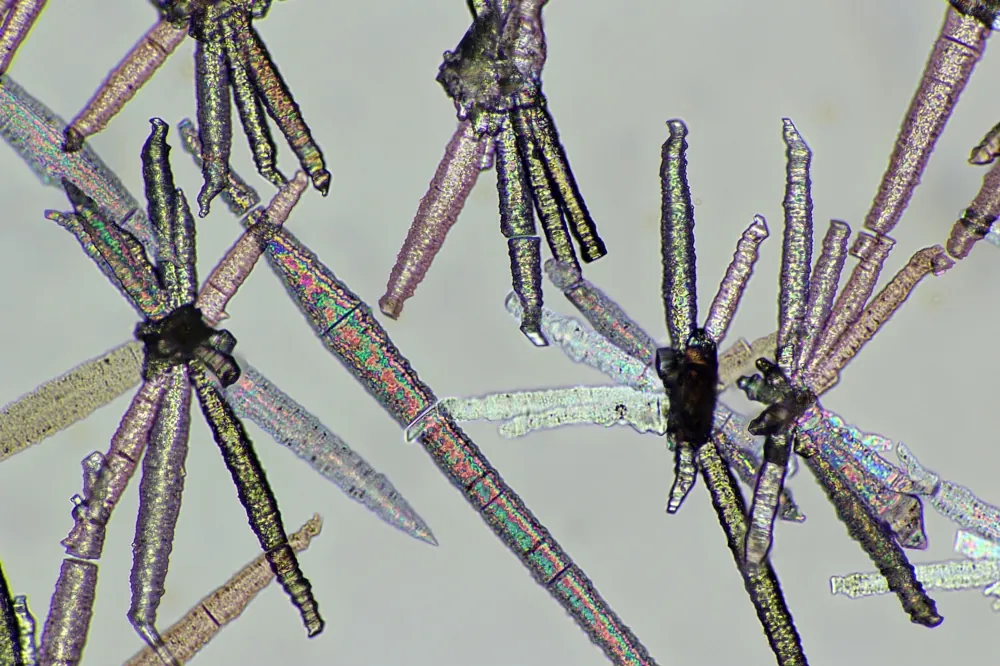
偏光顕微鏡で色とりどりに見えるテオブロミンの針状結晶

昇華法で得たテオブロミン結晶を偏光顕微鏡で撮影した写真。ファイルページのドイツ語記載に基づく。

写っているもの: 該当なし(生物ではなく化合物の結晶)部位・状態: 結晶(偏光顕微鏡像)

写真: Heiko4/ CC BY-SA 4.0/ 原画像/ 台帳の原画像

写真の範囲と来歴

被写体の確認: 原典の記載による同定。カカオ豆そのものではなく、精製・昇華したテオブロミン結晶自体の写真。

掲載画像: リサイズ・トリミング・色調変更なし。Wikimedia Commons のオリジナル画像をそのまま使用。 表示用には幅1200px上限のWebPを配信し、台帳の原画像は上のリンクから確認できます。

On this page (8 sections)
  1. Overview
  2. Sources for this overview (6)
  3. Topic hubs
  4. Follow the connections
  5. Related entries (10)
  6. Composition and content (1)
  7. Sensory (2)
  8. Mechanism and receptors (1)
↑

Reading the bitterness

Theobromine is a component belonging to the methylxanthines (a group of compounds related to caffeine), and it is abundant in cacao beans. Research on roasted cacao nibs has reported that, even after repeated quantitative reconstitution and omission trials—in which the amounts were standardized and reformulated or specific components were removed—theobromine remained a major bitter taste contributor.

However, when cacao liquor samples are compared with each other, the extent to which the amount of theobromine corresponds to the perceived bitterness differs among studies. In one study, a low correlation was observed between bitterness and theobromine and catechin, whereas in another study, theobromine, caffeine, and catechins were reported to correlate strongly with bitterness and astringency in cacao liquor from Mexico's Tabasco State. In research focused on polyphenols, it was polyphenol that showed positive correlation with bitterness; no statement is made regarding correlation or lack thereof with purine alkaloids. This is a discrepancy between studies using different samples and statistical methods, and it cannot be said that one is erroneous.

The link between bitterness and theobromine has also been reported in beverages other than cacao. In research comparing 3 white tea cultivars, integrated analysis of component analysis and taste data identified theobromine, together with a component group of high astringency, as a component showing positive association with bitterness and astringency strength. Additionally, in research comprehensively examining bitter taste receptors in mice, a receptor called Tas2r121 was reported to respond to theobromine at a threshold concentration of 0.03 mmol/L. This is a preliminary value based on a single study and is from a mouse receptor; therefore, the corresponding response in humans or the concentration at which theobromine elicits half of the response is not shown in this study.

Sources for this overview

  1. Molecular definition of the taste of roasted cocoa nibs (Theobroma cacao) by means of quantitative studies and sensory experiments

    Stark T; Bareuther S; Hofmann T / 2006 / journal article / abstract checked

    Checked for this overview: Confirmed the finding that theobromine remained a major contributor in reconstitution and omission trials of roasted cacao nibs.

  2. The impact of controlled fermentation temperature on chemical composition and sensory properties of cacao

    Calvo AM; Montenegro AC; Monroy DM; Rodriguez-Silva LG; Carreno-Olejua AR; Camargo ID / 2025 / journal article / full text checked

    Checked for this overview: Confirmed the report stating that the correlation between bitterness and theobromine in cacao liquor is low.

  3. Linking chemical composition and sensory attributes in cocoa liquors: a multivariate profiling strategy

    Velasquez-Reyes D; Morales-Hernandez N; Alcazar-Valle M; Kirchmayr M; Garcia-Alamilla P; Lugo-Cervantes E; Gschaedler A / 2026 / journal article / abstract checked

    Checked for this overview: Confirmed the report stating that theobromine correlates strongly with bitterness in cacao liquor from Tabasco.

  4. Chemical composition and flavor of Ecuadorian cocoa liquor

    Luna F; Crouzillat D; Cirou L; Bucheli P / 2002 / journal article / abstract checked

    Checked for this overview: Confirmed the scope of research describing only positive correlation between polyphenol and bitterness.

  5. Application of metabolomics profiling in the analysis of metabolites and taste quality in different subtypes of white tea

    Yang C; Hu Z; Lu M; Li P; Tan J; Chen M; Lv H; Zhu Y; Zhang Y; Guo L; Peng Q; Dai W; Lin Z / 2018 / journal article / abstract checked

    Checked for this overview: Confirmed the analysis in which theobromine correlated with bitterness and astringency across 3 white tea cultivars.

  6. Comprehensive analysis of mouse bitter taste receptors reveals different molecular receptive ranges for orthologous receptors in mice and humans

    Lossow K; Hubner S; Roudnitzky N; Slack JP; Pollastro F; Behrens M; Meyerhof W / 2016 / journal article / full text checked

    Checked for this overview: Confirmed the single measurement value of theobromine threshold concentration for mouse Tas2r121.

Follow the connections

theobromine →contributes to→ bitterness →can be measured separately …→ astringency

theobromine →activates→ mouse Tas2r121

kola nut →contains→ theobromine

Structured claims — open a section to read each claim's confidence, evidence and limits

Composition and content (1)

kola nut contains theobrominesupported

Scope: The source lists caffeine and theobromine as 「コーラナッツの2つの重要成分」 (in translation: "2 important constituents of kola nuts").

Note: No content values are stated in the abstract.

"Caffeine and theobromine are two important constituents of kola nuts"
Limitations: No content values are stated in the abstract.
Source: Safety assessment of kola nut extract as a food ingredient (Burdock GA; Carabin IG; Crincoli CM, 2009) · abstract checked
Show dataingredient-kola-nut —contains→ compound-theobromine
claim: clm-kola-theobromine / type: composition / updated: 2026-08-31

Sensory (2)

theobromine contributes to bitternesssupported

Scope: Aqueous reconstitution and removal trials of roasted cacao nibs.

Theobromine remained a major bitter taste contributor even after quantitative reconstitution and omission trials.
Limitations: Limited to specific materials and an aqueous model.
In metabolomics and taste quantification of three white tea subtypes (Silver Needle, White Peony, Shou Mei), PLS analysis identified theobromine, together with a component group of flavan-3-ols, theasinensins, and procyanidin B3, as showing positive correlation with bitterness and astringency. This supports the association between theobromine and bitterness in a different food matrix and a different research lineage from the cacao reconstitution trial (Stark 2006).
Limitations: Only abstract confirmed. Correlation-based rather than isolation and removal trials; the contribution of theobromine alone is unclear. The concentration in white tea should be substantially lower than in cacao, but concentration is not noted in the abstract.
Source: Application of metabolomics profiling in the analysis of metabolites and taste quality in different subtypes of white tea (Yang C; Hu Z; Lu M; Li P; Tan J; Chen M; Lv H; Zhu Y; Zhang Y; Guo L; Peng Q; Dai W; Lin Z, 2018) · abstract checked
Show datacompound-theobromine —contributes_to→ sensation-bitter
claim: clm-theobromine-bitter / type: sensory / updated: 2026-08-30
theobromine is correlated with bitternesscontested

Scope: Cacao liquor. 2 independent trained panel studies with instrumental quantification.

Note: The discrepancy is among studies using different materials and different statistics. Neither report contains coefficients in the text we read.

Contradicts: The source reports significant correlation (p < 0.05) between bitterness and epigallocatechin, caffeine, epicatechin, and total phenol concentration, and states that in contrast, a low correlation was observed between bitterness and theobromine and catechin. Theobromine is reported to correlate moderately with the astringency profile.
Limitations: The r value and p value specific to theobromine are not printed in the text we read. The authors state that the scope of 3 genotypes limits generalizability and that controlled fermentation does not fully replicate natural fermentation.
Source: The impact of controlled fermentation temperature on chemical composition and sensory properties of cacao (Calvo AM; Montenegro AC; Monroy DM; Rodriguez-Silva LG; Carreno-Olejua AR; Camargo ID, 2025) · full text checked
The source states that in cacao liquor from 2 sub-regions of Tabasco State, Mexico, theobromine, caffeine, catechin, and epicatechin were strongly associated with bitterness and astringency.
Limitations: Only abstract; sample size, panel size, and coefficients are not stated. The association is from multivariate ordination rather than reported correlation coefficients, and in this design origin and composition are confounded.
Source: Linking chemical composition and sensory attributes in cocoa liquors: a multivariate profiling strategy (Velasquez-Reyes D; Morales-Hernandez N; Alcazar-Valle M; Kirchmayr M; Garcia-Alamilla P; Lugo-Cervantes E; Gschaedler A, 2026) · abstract checked
Limits: The source reports that polyphenol correlated positively with astringency, bitterness, and green note, and negatively with fruity character, concluding that polyphenol may be essential to the overall perception of cacao liquor characteristics; the abstract quantifies purine alkaloids, but does not state correlation between alkaloids and bitterness in either direction.
Limitations: A population derived from a single clone and a single short-term fermentation condition. The absence of alkaloid-bitterness correlation in the abstract is not evidence that correlation was not found; the full text was not obtained.
Source: Chemical composition and flavor of Ecuadorian cocoa liquor (Luna F; Crouzillat D; Cirou L; Bucheli P, 2002) · abstract checked
Show datacompound-theobromine —is_correlated_with→ sensation-bitter
claim: clm-cocoa-theobromine-bitterness-correlation / type: sensory / updated: 2026-08-30

Mechanism and receptors (1)

theobromine activates mouse Tas2r121preliminary

Scope: A heterologous-expression screen of 34 mouse Tas2r receptors against 128 mostly natural bitter compounds

Note: A non-human receptor. A single study, single value; no EC50 for theobromine has been found.

In Table 1, entitled "Threshold concentrations (mm) for Tas2r activators", the theobromine row has a single value, 0.03, in the Tas2r121 column, and every other column is a dash.
Limitations: A mouse receptor, not human. That the Table 1 columns are mouse Tas2r numbers only has been verified twice on a focused re-read. No EC50 for theobromine is given.
Source: Comprehensive analysis of mouse bitter taste receptors reveals different molecular receptive ranges for orthologous receptors in mice and humans (Lossow K; Hubner S; Roudnitzky N; Slack JP; Pollastro F; Behrens M; Meyerhof W, 2016) · full text checked
Show datacompound-theobromine —activates→ receptor-mouse-tas2r121
claim: clm-theobromine-mouse-tas2r121 / type: mechanism / updated: 2026-08-30

↑ Top of page · ← Encyclopedia (English entries)