日本語版

grapefruit juice

ingredient / ingredient-grapefruit-juice

グレープフルーツジュース / Citrus paradisi

Grapefruit juice is a citrus juice in which slight bitterness accompanies sweetness and acidity. Studies of removing naringin and limonin show that reducing bitterness can also change aroma and liking.

Photographs (captions in Japanese)
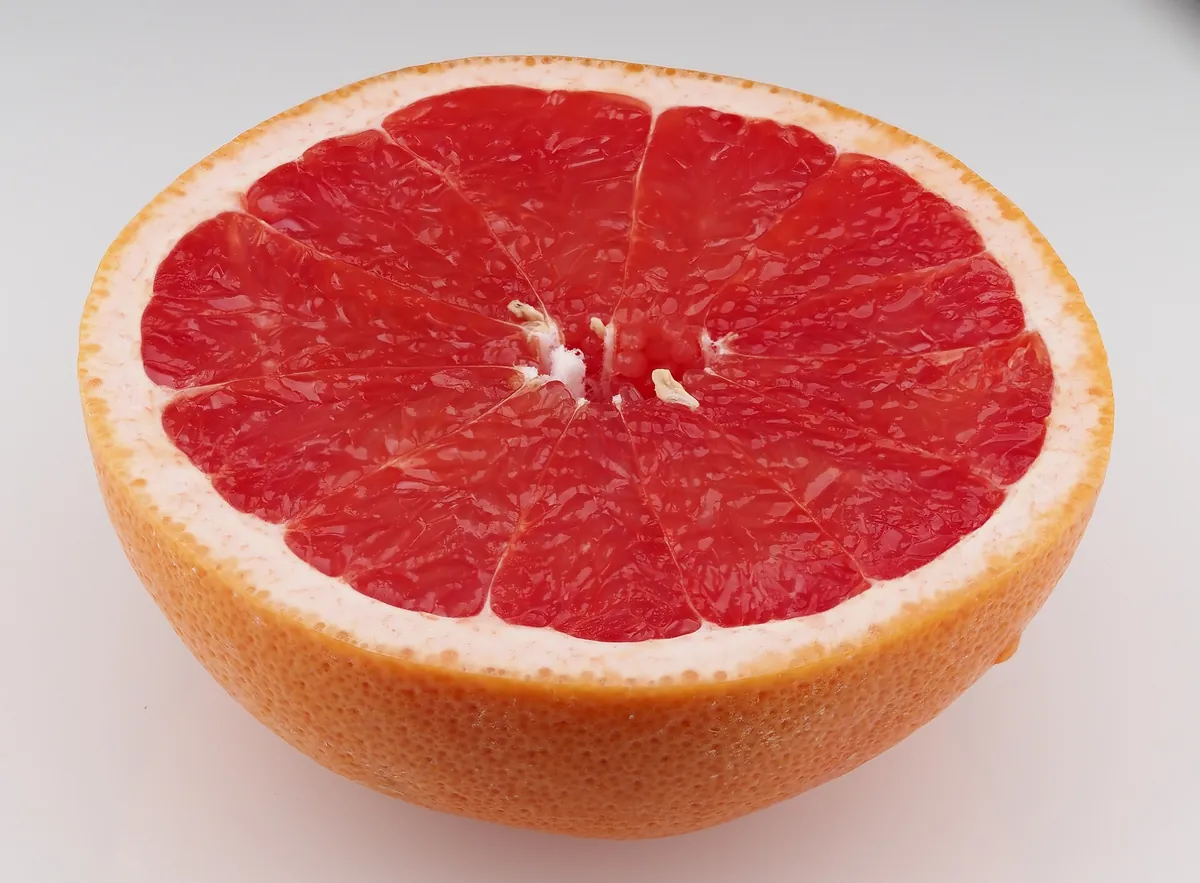
白い背景の上で横半分に切られた赤い果肉のグレープフルーツ

グレープフルーツジュースの原料となる果実の断面。果肉を囲む白いアルベドとじょうのう膜も見える。品種や果汁の製法はこの写真からは分からない。

原料写っているもの: grapefruit(種・品種は原典未記載)部位・状態: 横半分に切った果実

写真: Jedesto/ CC BY-SA 4.0/ 原画像/ 台帳の原画像

写真の範囲と来歴

被写体の確認: 原典の記載による同定。図鑑項目との関係は原料。果汁そのものではない。

掲載画像: Wikimedia Commons の1920px版。原画像は6枚のフォーカススタッキング合成。苦味研究所での追加加工なし。 表示用には幅1200px上限のWebPを配信し、台帳の原画像は上のリンクから確認できます。

On this page (7 sections)
  1. Overview
  2. Sources for this overview (4)
  3. Topic hubs
  4. Follow the connections
  5. Related entries (10)
  6. Sensory (4)
  7. How processing and cooking change it (3)
↑

Reading the bitterness

The photo shows a cross-section of the fruit, but this entry concerns the juice pressed from it. Besides the pulp's sweetness and acidity, components abundant in the membranes enclosing the segments and the white albedo inside the peel can enter the juice during pressing and shape its slight bitterness. Debittering studies have mainly targeted naringin, a flavonoid glycoside, and limonin, a limonoid. These two components do not belong to the same chemical pathway and must be tracked separately during processing.

Reducing bitterness does not remove just one element of flavor. A study combining immobilized enzymes with an adsorbent reduced naringin and limonin, but conducted no sensory panel. In a separate resin study, aroma compounds were also adsorbed, and in a consumer test, partially debittered juice was preferred most over completely debittered juice. The amount of bitterness removed and how good the drink tastes are not the same measure.

Even for the same juice, liking varies among drinkers. A study of 246 adults associated perception of quinine bitterness and recalled liking for unsweetened grapefruit juice with genetic variants near TAS2R31. The participants rated a remembered preference, however, rather than juice tasted at the time, and nearby variants may be linked. The result does not show that preference is determined by one particular gene alone.

Sources for this overview

  1. Grapefruit Debittering by Simultaneous Naringin Hydrolysis and Limonin Adsorption Using Naringinase Immobilized in Agarose Supports

    Munoz M; Holtheuer J; Wilson L; Urrutia P / 2022 / journal article / full text checked

    Checked for this overview: Clarified naringin's transfer from membranes and albedo into juice and its immediate bitterness. / A debittering study that targeted both naringin and limonin. / Component reduction using immobilized enzymes and an adsorbent, with the limitation that no sensory evaluation was conducted.

  2. Sorption of citrus flavour compounds on XAD-7HP resin during the debittering of grapefruit juice

    Kranz P; Adler P; Kunz B / 2011 / journal article / abstract checked

    Checked for this overview: A study in which resin co-adsorbed naringin and some volatile aroma compounds.

  3. Performance of macroporous resins for debittering HLB-affected grapefruit juice and its impacts on furanocoumarin and consumer sensory acceptability

    Gordon RM; Washington TL; Sims CA; Goodrich-Schneider R; Baker SM; Yagiz Y; Gu L / 2021 / journal article / abstract checked

    Checked for this overview: A consumer test that preferred partial debittering most over complete debittering.

  4. Quinine Bitterness and Grapefruit Liking Associate with Allelic Variants in TAS2R31

    Hayes JE; Feeney EL; Nolden AA; McGeary JE / 2015 / journal article / full text checked

    Checked for this overview: A study of the association among quinine bitterness, recalled juice liking, and genetic variation.

Follow the connections

grapefruit juice →has liking associated with→ TAS2R31

grapefruit juice →— perceived bitterness is s…→ naringin →is associated with→ bitterness

Structured claims — open a section to read each claim's confidence, evidence and limits

Sensory (4)

grapefruit juice has liking associated with TAS2R31supported

Scope: 246 adults (mostly of European ancestry). Recalled liking of unsweetened grapefruit juice was rated on a bipolar hedonic scale

Note: A parallel association was seen with quinine bitterness (21.5 versus 30.8 gLMS). The authors discuss the possibility that the earlier TAS2R19 association reflects linkage disequilibrium with TAS2R31. The verified agonist of TAS2R31 is quinine, not naringin or limonin.

Val240 homozygotes rated quinine's bitterness lower (21.5 plus-minus 1.9; Ile240 homozygotes rated it 30.8 plus-minus 3.1), and had higher remembered liking for grapefruit juice (9.3 plus-minus 4.5 versus -16.53 plus-minus 7.1). 3 SNPs at TAS2R19/TAS2R31 form a haplotype block (D' of 0.96 and 0.87), and the earlier TAS2R19 association may be an LD artifact.
Limitations: Grapefruit liking is based on memory, not actual tasting. The SNP is a tag SNP rather than the putative causal variant Arg35Trp, and may be in LD with an unmeasured variant (a limitation the authors themselves note).
Source: Quinine Bitterness and Grapefruit Liking Associate with Allelic Variants in TAS2R31 (Hayes JE; Feeney EL; Nolden AA; McGeary JE, 2015) · full text checked
Context: The presence of high LD spanning functionally distinct TAS2R loci predicts that bitterness responses to many compounds will correlate strongly even when mediated by different genes. Haplotype analysis showed that most single-marker associations in the TAS2R30-46 cluster are an apparent product of LD with TAS2R31.
Limitations: This provides mechanistic background for Hayes 2015's argument that the earlier TAS2R19-grapefruit/quinine association may be an LD artifact of TAS2R31; the study itself does not test grapefruit liking.
Source: Genomic, genetic and functional dissection of bitter taste responses to artificial sweeteners (Roudnitzky N; Bufe B; Thalmann S; Kuhn C; Gunn HC; Xing C; Crider BP; Behrens M; Meyerhof W; Wooding SP, 2011) · abstract checked
Show dataingredient-grapefruit-juice —has_liking_associated_with→ receptor-tas2r31
claim: clm-grapefruit-liking-tas2r31 / type: sensory / updated: 2026-08-30
grapefruit juice — perceived bitterness is suppressed by: naringinsupported

Scope: Layer: Solution. Not actual grapefruit juice, but a model beverage composed with color, aroma, naringin concentration, and sucrose concentration as factors. Descriptive analysis by a trained panel of 16 raters and acceptance evaluation by a consumer panel of 90 raters (female, aged 18-24).

Note: This supports a household method of 「甘みで苦味を和らげる」 (in translation: alleviating bitterness with sweetness) beyond resin adsorption and naringinase, but the results are from a model system and reproducibility in actual beverages requires separate confirmation.

Verbatim: "Sour, bitter, astringent, and bitter aftertaste intensities decreased as the sweet level increased, while sweetness increased." Within each naringin concentration series (158/315/473 mg/kg fixed), sensory attributes related to bitterness consistently decreased with increasing sucrose concentration (8/10/12 Brix).
Limitations: Results from model beverage, not actual grapefruit juice. Consumer panel limited to female, younger age group (18-24 years).
Show dataingredient-grapefruit-juice —has_perceived_bitterness_suppressed_by→ compound-naringin
claim: clm-w68c-grapefruit-sucrose-reduces-bitterness-model / type: sensory / updated: 2026-09-06
grapefruit juice — perceived bitterness is suppressed by: Addition of a high concentration of aroma (a blend of caryophyllene, citral, nootkatone, and C8-C10 aldehydes, 10 mg/kg)supported

Scope: Layer: solution. The same grapefruit-like model beverage as in Gous et al. (2019). An experimental design combining 2 levels of aroma — low (2.5 mg/kg) and high (10 mg/kg) — with multiple levels of naringin concentration (bitterness). Descriptive analysis on a 10-point intensity scale by a trained panel of 16.

Verbatim from the full text: “bitter flavor and bitter aftertaste were notably less intense in the high aroma samples, compared to the low aroma samples, but only significantly so for the medium and high bitter level beverages.” The main effect of aroma in Table 3 (averaged over other factors): the bitterness score was 4.77 for low aroma (2.5 mg/kg) and 4.27 for high aroma (10 mg/kg) (10-point intensity scale, a significant difference).
Limitations: This is a model solution, and extrapolation to real beverages needs verification. The aroma is a blend of multiple compounds, not a single compound. It is a citrus aroma, not a roast aroma. The cell means for the aroma × bitterness-level interaction are in a supplementary table; only the main effect can be read from the main text.
Show dataingredient-grapefruit-juice —has_perceived_bitterness_suppressed_by→ "Addition of a high concentration of aroma (a blend of caryophyllene, citral, nootkatone, and C8-C10 aldehydes, 10 mg/kg)"
claim: clm-w70b-grapefruit-aroma-suppresses-bitterness / type: sensory / updated: 2026-09-07
grapefruit juice — perceived bitterness is affected by: Temperature of the sample. Grapefruit juice (diluted 2-fold) was held at 10, 35 and 60°C for 30 minutes and compared by 14 people in a ranking test; the 60°C juice was rated as more bitter than the 10°C juice (rank sums for bitterness: 34 at 10°C, 30 at 35°C and 20 at 60°C; smaller means stronger; significant at the 5% level). In an evaluation by 11 people of the juice made into a 1% agar gel and held at 10, 35 and 60°C, 60°C was also more bitter than 10°C (rank sums 30 at 10°C, 23 at 35°C and 13 at 60°C; significant at the 1% level). For sourness and sweetness, neither showed a significant difference by temperature. This is the effect of the temperature at which it is eaten (held in the mouth), and is separate from any effect of heating increasing bitter substances.supported

Scope: Commercial grapefruit juice (1 lot, warmed to 60°C, left to cool and frozen; diluted 2-fold) and its agar gel. Ranking tests with 10 to 16 students and staff members. Held for 30 minutes. Sensory evaluation of the holding temperature of juice, not marmalade or heat-cooked dishes

Note: The direction of the ranking is not stated in the text; from the conclusion that "60°C is significantly more bitter", it was read that a smaller rank sum means stronger. The authors themselves state that results on the relationship between the perception of bitterness and temperature are not consistent across reports. This is the effect of sample temperature and is separate from any effect of heating increasing bitter substances (the study froze the juice for sensory use in a uniform way to remove differences in components). This study alone cannot say whether a cooled dish makes bitterness taste weaker.

The bitterness rank sums for juice (n=14) are 34 at 10°C, 30 at 35°C and 20 at 60°C, and the text states that Kendall's concordance was significant at a risk level of 5% for bitterness, that the Kramer test found the 60°C juice significantly more bitter at a risk level of 5%, and that no significant difference was found for sourness and sweetness. For the agar gel (n=11), the bitterness rank sums are 30 at 10°C, 23 at 35°C and 13 at 60°C, and "in the Kramer test a significant difference at a risk level of 1% was obtained between 60°C and 10°C". A paired comparison (n=15) of gel and sol at 35°C found no significant difference in bitterness, and a comparison of agar concentrations of 0.5, 1.0 and 1.5% (n=15) found no significant difference in bitterness or sweetness (only sourness differed, between 0.5% and 1.5%).
Limitations: This is the effect of the sample temperature (the temperature at which it is eaten) and does not include any effect of heating increasing bitter substances. The direction of the ranking is not stated in the text and was read from the conclusion. The authors state that the relationship between bitterness and temperature is not consistent across reports. Juice and gel, not heat-cooked dishes.
Source: グレープフルーツ果汁ゲルの硬さと保温条件の相違が苦味に及ぼす影響 (森下敏子; 和田令子; 藤井治子, 1989) · full text checked
Show dataingredient-grapefruit-juice —has_perceived_bitterness_affected_by→ "Temperature of the sample. Grapefruit juice (diluted 2-fold) was held at 10, 35 and 60°C for 30 minutes and compared by 14 people in a ranking test; the 60°C juice was rated as more bitter than the 10°C juice (rank sums for bitterness: 34 at 10°C, 30 at 35°C and 20 at 60°C; smaller means stronger; significant at the 5% level). In an evaluation by 11 people of the juice made into a 1% agar gel and held at 10, 35 and 60°C, 60°C was also more bitter than 10°C (rank sums 30 at 10°C, 23 at 35°C and 13 at 60°C; significant at the 1% level). For sourness and sweetness, neither showed a significant difference by temperature. This is the effect of the temperature at which it is eaten (held in the mouth), and is separate from any effect of heating increasing bitter substances."
claim: clm-grapefruit-warm-serving-stronger-bitterness-morishita-1989 / type: sensory / updated: 2026-10-15

How processing and cooking change it (3)

grapefruit juice can be debittered by: Simultaneous adsorption of limonin with immobilized naringinase on butyl- or octyl-glyoxyl agarose (a 54-74% reduction in naringin, a 76-100% reduction in limonin)supported

Scope: Grapefruit juice treated at pH 4.0 and 30°C. The biocatalyst was reused across 5 batches of 24 hours each

Note: Whether the final concentration reached the cited detection threshold was carrier-dependent: limonin fell below threshold on both carriers, but naringin only on the octyl carrier.

Naringinase immobilized on butyl-glyoxyl agarose lowered naringin and limonin by 54% and 100%; on octyl-glyoxyl agarose, by 74% and 76%. Limonin fell below the detection threshold on both carriers, but naringin only on the octyl carrier. The biocatalyst was reused across 5 batches of 24 hours each.
Limitations: No sensory panel; the bitterness reduction is inferred from literature thresholds; the initial juice concentration varied between batches.
Show dataingredient-grapefruit-juice —can_be_debittered_by→ "Simultaneous adsorption of limonin with immobilized naringinase on butyl- or octyl-glyoxyl agarose (a 54-74% reduction in naringin, a 76-100% reduction in limonin)"
claim: clm-grapefruit-enzymatic-debittering / type: processing / updated: 2026-08-30
grapefruit juice can be debittered by: Macroporous resin adsorption (PAD550, PAD600). Naringin removed to below the taste threshold, with limonin, nomilin, and bergamottin also reducedsupported

Scope: HLB-affected Florida grapefruit juice in a fixed-bed column. A consumer sensory comparison of untreated, half-debittered, and fully debittered juice

Note: Consumers rated the debittered and half-debittered juices higher than the untreated juice, but the half-debittered juice was preferred most; complete removal of bitterness was not the consumer optimum.

PAD550 and PAD600 macroporous resins adsorbed naringin (pseudo-second-order kinetics). Fixed-bed processing lowered naringin below the taste threshold and also reduced limonin, nomilin, and bergamottin. A consumer panel rated the debittered and half-debittered juices higher than the untreated juice on overall acceptability, and preferred the half-debittered juice most.
Limitations: Abstract only. Panel size, the resin's loading rate, and the thresholds used cannot be read without the full text.
Source: Performance of macroporous resins for debittering HLB-affected grapefruit juice and its impacts on furanocoumarin and consumer sensory acceptability (Gordon RM; Washington TL; Sims CA; Goodrich-Schneider R; Baker SM; Yagiz Y; Gu L, 2021) · abstract checked
Context: Debittered reconstituted grapefruit juice with an XAD-7HP macroporous resin in a lab-scale downflow column, lowering naringin to 51.28% of its initial value, but aroma volatiles were also selectively co-adsorbed: alpha-terpineol fell to 43.05%, while beta-myrcene through beta-caryophyllene retained 76.27-92.76%; adsorption followed a Lagergren model, and column flow rate affected the adsorption of both alpha-terpineol and naringin.
Limitations: A different resin (XAD-7HP versus PAD550/PAD600) and no sensory panel; naringin was only halved, not brought below threshold. It independently reproduces resin debittering while exposing a trade-off in aroma-compound loss. The abstract was reconstructed from OpenAlex (single pathway).
Show dataingredient-grapefruit-juice —can_be_debittered_by→ "Macroporous resin adsorption (PAD550, PAD600). Naringin removed to below the taste threshold, with limonin, nomilin, and bergamottin also reduced"
claim: clm-grapefruit-resin-debittering / type: processing / updated: 2026-08-30
grapefruit juice is presented as: A white grapefruit juice whose distinguishing feature is a refreshing sweet-tartness with a hint of bitternessobservation

Scope: The product description for "Sunkist 100% Luxury Juice, Rich Grapefruit" (Morinaga Milk Industry; from concentrate, sweetened; a mass-market product)

Note: An example of an official press release for a mass-market, from-concentrate product presenting bitterness as a distinguishing feature rather than a flaw. Recorded as a counterexample to the oversimplified picture that "mass-market products remove bitterness."

Describes "Sunkist 100% Luxury Juice, Rich Grapefruit" as "a white grapefruit juice whose distinguishing feature is a refreshing sweet-tartness with a hint of bitterness", and lists "grapefruit juice (from concentrate, sweetened)" in the product overview.
Limitations: The wording of 1 press release; whether the same tendency holds for other mass-market products has not been checked.
Show dataingredient-grapefruit-juice —is_presented_as→ "A white grapefruit juice whose distinguishing feature is a refreshing sweet-tartness with a hint of bitterness"
claim: clm-w51-sunkist-presented / type: culinary / updated: 2026-09-03

↑ Top of page · ← Encyclopedia (English entries)