日本語版

naringin

compound / compound-naringin

ナリンギン

Naringin is a flavanone glycoside associated with bitterness in some citrus fruits.

Photographs (captions in Japanese)
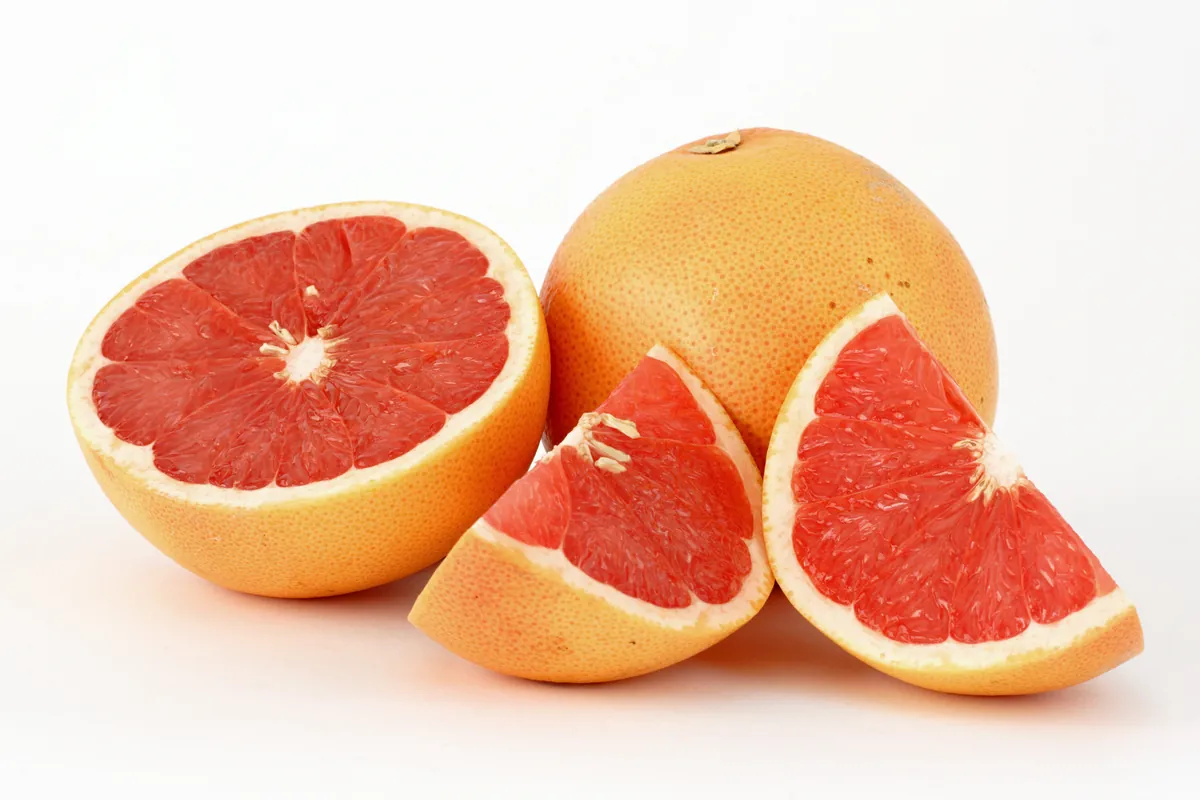
ピンク色を帯びたグレープフルーツの果実が別アングルで写っている写真

グレープフルーツ(Citrus paradisi)の果実。naringin は柑橘果実の苦味に関連するフラバノン配糖体で、name の由来でもあるグレープフルーツを代表的な給源として撮影した写真である。

原料写っているもの: Citrus paradisi(グレープフルーツ)部位・状態: 果実(外観、別アングル)

写真: א (Aleph)/ CC BY-SA 2.5/ 原画像/ 台帳の原画像

写真の範囲と来歴

被写体の確認: 原典の記載による同定。compound-limonin と同一撮影者の別アングル写真(Commons上の別ファイル)。ingredient-grapefruit-juice で使用した写真とも別ファイル。

掲載画像: Wikimedia Commons の原寸ファイル。苦味研究所では切り抜き・色調変更なし。 表示用には幅1200px上限のWebPを配信し、台帳の原画像は上のリンクから確認できます。

On this page (10 sections)
  1. Overview
  2. Sources for this overview (4)
  3. Topic hubs
  4. Follow the connections
  5. Related entries (10)
  6. Measured values (5)
  7. Composition and content (15)
  8. Sensory (4)
  9. Mechanism and receptors (1)
  10. How processing and cooking change it (3)
↑

Reading the bitterness

Naringin is a flavanone glycoside found in citrus fruits, particularly in grapefruit, and is counted as one of the two major bitter compounds of citrus alongside limonin. It is described as leaching from the albedo (white portion) and pith into the juice, and has been regarded as the main carrier of the bitterness felt at the moment of tasting many grapefruit products. However, its presence and importance vary among citrus species and products, and no single value applies uniformly.

The concentration at which bitterness is first perceived (recognition threshold) is reported to be approximately 20 mg/L in distilled water. For juice, another source states that bitterness occurs immediately when concentration exceeds 20 ppm. This value was cited within citrus debittering research and has not been directly confirmed as an independent sensory measurement.

Naringin and grapefruit bitterness have long been closely linked, but tracing genetic research shows that naringin does not activate TAS2R19, a bitter taste receptor subtype, in vitro. For TAS2R31, another receptor suggested by grapefruit preference genetics, what has been tested is the bitterness of quinine, not naringin. There is no doubt that naringin itself is bitter, but the mechanistic basis of the receptor responsible for its bitterness remains unresolved within the scope of this literature.

Sources for this overview

  1. Citrus Taste Modification Potentials by Genetic Engineering

    Li LJ; Tan WS; Li WJ; Zhu YB; Cheng YS; Ni H / 2019 / review / full text checked

    Checked for this overview: Confirmed the positioning as a bitter compound and its transition into juice.

  2. Grapefruit Debittering by Simultaneous Naringin Hydrolysis and Limonin Adsorption Using Naringinase Immobilized in Agarose Supports

    Munoz M; Holtheuer J; Wilson L; Urrutia P / 2022 / journal article / full text checked

    Checked for this overview: Confirmed the transfer pathway from pith and albedo into juice. / Confirmed the description of immediate bitterness at concentrations exceeding 20 ppm in juice.

  3. Effect of some citrus juice constituents on taste thresholds for limonin and naringin bitterness

    Guadagni DG; Maier VP; Turnbaugh JG / 1973 / journal article / abstract checked

    Checked for this overview: Confirmed the recognition threshold value of 20 mg/L in distilled water.

  4. Quinine Bitterness and Grapefruit Liking Associate with Allelic Variants in TAS2R31

    Hayes JE; Feeney EL; Nolden AA; McGeary JE / 2015 / journal article / full text checked

    Checked for this overview: Confirmed the in vitro result of non-activation of TAS2R19 and the description of the unresolved receptor. / Confirmed the contrast that TAS2R31 was verified with quinine, not naringin.

Follow the connections

naringin →is associated with→ bitterness →can be measured separately …→ astringency

grapefruit pith →contains→ naringin

Citrus natsudaidai →contains→ naringin

Measured values (5)

KindCompoundTargetValueConditionsSource
human recognition thresholdnaringin—20 mg/LDistilled waterGuadagni DG, 1973
concentrationnaringinSanh orange peel16.58 mg/100 gUntreated cam sành pericarp (Table 2。)Nguyễn Đức Tùng, 2023
concentrationnaringinSanh orange peel3.70 mg/100 gAfter 2-minute blanching plus 1-hour soaking in 100 ppm NaOH (Not a household-scale processing condition.)Nguyễn Đức Tùng, 2023
concentrationnaringinpomelo pith18.90 mg/g DWUntreated Kao Nampung pomelo albedo (Table 3。)Jaroennon Pattamaporn, 2025
concentrationnaringinpomelo pith5.1395 mg/g DW0.7% β-CD plus ultrasonic treatment (Table 3。)Jaroennon Pattamaporn, 2025

Values are the reported values of each source (with units and conditions). Thresholds and EC50 depend on the panel and method; they are not single true values.

Hypotheses and recipe candidates for this entry are on the Japanese page.

Structured claims — open a section to read each claim's confidence, evidence and limits

Composition and content (15)

grapefruit pith contains naringincontextual

Scope: A literature synthesis on naringin moving from the membranes and albedo into the juice in grapefruit

Note: A secondary account drawn from the introductions of existing studies. Not a fixed content value for the white pith.

Context: Naringin is described as being extracted from the membranes and albedo of grapefruit into the juice, and is associated with the immediate bitterness.
Limitations: A secondary citation rather than a primary distribution measurement. Does not give a fixed concentration for the white pith.
Show dataingredient-grapefruit-pith —contains→ compound-naringin
claim: clm-grapefruit-pith-naringin / type: composition / updated: 2026-08-31
Citrus natsudaidai contains naringinsupported

Scope: Direct measurement of natsumikan first-press juice (Nihon Kankitsu Kogyo K.K., Yawatahama factory, batch produced in mid-March)

Note: A 1962 analysis. Note that the content differs by more than twofold between pressing stages (1st vs. 2nd press).

Measured naringin at 75.2 mg% in the 1st-press juice of natsumikan (glucose 2.6%, sucrose 2.6%, citric acid 2.9%, pH 2.9), and 156 mg% in the 2nd-press juice (sugar 5.1%, pH 2.9).
Limitations: Information on the growing region and cultivar lineage is not specified in the text (it is recorded only as 『夏ミカン』 (in translation: "natsumikan")).
Source: ナリンギン分解酵素による夏ミカン果汁の苦味除去 (中林敏郎, 1962) · full text checked
Show dataingredient-natsumikan —contains→ compound-naringin
claim: clm-w40b-natsumikan-naringin-content / type: composition / updated: 2026-09-02
amanatsu (Citrus natsudaidai) contains naringinsupported

Scope: Kumamoto Prefectural Industrial Technology Center research, 2005-2007 fiscal years, 8-variety comparison

Kawano Natsudaidai, Daibukuro, 「河内晩柑」 (Kawachi Bankan), and Banpeiyu are treated as a 『苦味系』 (in translation: bitter type) containing high levels of naringin and limonin in juice and pericarp, while Unshu mikan, Ponkan, Shiranui, and Sweet Spring are classified as non-bitter type (centered on naringenin and hesperidin). Heat treatment did not change the content of bitter components, but heating odor was strongest in Unshu mikan and weakest in Kawano Natsudaidai.
Limitations: Public information is summary-level only; specific quantitative values (mg% etc.) and analytical method details have not been confirmed from the primary report. Whether the heating odor evaluation was a quantitative sensory assessment or descriptive evaluation could not be confirmed in this survey.
Source: カンキツ類の苦味成分と加熱による臭いの変化 (熊本県産業技術センター, 2008) · full text checked
Show dataingredient-amanatsu —contains→ compound-naringin
claim: clm-w40b-amanatsu-naringin / type: composition / updated: 2026-09-02
Citrus maxima contains naringinsupported

Scope: Kumamoto Prefectural Industrial Technology Center research, 2005-2007 fiscal years, 8-variety comparison

Banpeiyu was treated as being classified with Kawano Natsudaidai, Daibukuro, and 「河内晩柑」 (Kawachi Bankan) as a 『苦味系』 (in translation: bitter type) containing high levels of naringin and limonin in juice and pericarp.
Limitations: Quantitative values have not been confirmed (presence/absence classification only).
Source: カンキツ類の苦味成分と加熱による臭いの変化 (熊本県産業技術センター, 2008) · full text checked
Show dataingredient-banpeiyu —contains→ compound-naringin
claim: clm-w40b-banpeiyu-naringin / type: composition / updated: 2026-09-02
Kawachi bankan contains naringinsupported

Scope: Kumamoto Prefectural Industrial Technology Center research, 2005-2007 fiscal years, 8-variety comparison

Kawachi bankan was classified, together with kawano natsudaidai, otachibana, and banpeiyu, into the 『苦味系』 (in translation: "bitter group") that contains abundant naringin in the juice and peel.
Limitations: Quantitative values have not been confirmed (presence/absence classification only).
Source: カンキツ類の苦味成分と加熱による臭いの変化 (熊本県産業技術センター, 2008) · full text checked
Show dataingredient-kawachi-bankan —contains→ compound-naringin
claim: clm-w40b-kawachibankan-naringin / type: composition / updated: 2026-09-02
Hassaku — bitterness is attributed to: naringincontextual

Scope: Wakayama Prefecture product introduction webpage.

Note: The prefectural material states 『八朔に特徴的な苦味は、ナリンギンというポリフェノールの一種の成分によるもの』 (in translation: Hassaku's characteristic bitterness is due to the component naringin, a type of polyphenol) and that naringin is abundant in the joumou (inner membrane). Sections regarding claimed benefits (antioxidant, obesity prevention, hypertension prevention) are excluded as outside NIGAMI LAB's scope. As an administrative product introduction article without presentation of measured data, it is treated as contextual per the drug plant evaluation report protocols.

「八朔に特徴的な苦味は、『ナリンギン』というポリフェノールの一種の成分によるもの」 (in translation: Hassaku's characteristic bitterness is due to the component 『naringin』, a type of polyphenol) and 「『ナリンギン』はじょうのう(中袋)に多く含まれ」 (in translation: 『naringin』 is abundant in the joumou (inner membrane)).
Limitations: No measured data presented; described as an administrative product introduction article only. Benefit claim section excluded as outside scope.
Source: わかやま食材テロワール「八朔(はっさく)」 (和歌山県 農林水産部 農林水産政策局 食品流通課) · full text checked
Show dataingredient-hassaku —has_bitterness_attributed_to→ compound-naringin
claim: clm-hassaku-bitterness-naringin / type: composition / updated: 2026-09-02
Citrus natsudaidai contains naringinsupported

Scope: Part-by-part analysis of 1 sample of natsumikan (from Yugawara). The fruit was quartered and divided into peel and fruit; of the peel, the outer 1/3 was taken as flavedo and the remaining 2/3 as albedo. Separated by thin-layer chromatography and quantified by fluorescence.

Note: This is the distribution of the amount of naringin, regarded as a bitter substance, not a sensory evaluation of bitterness (the main text treats naringin as one of the bitter substances and states that removing it is important in making marmalade). The part-by-part values are 1 point each, and the number of fruits and replicates are not described in the main text. Another study of the same natsumikan (Bessho et al. 1964) gave about 1300 mg% for albedo and segment membrane and about 360 mg% for the outer skin (flavedo) by a colorimetric method; the order is the same but the numbers differ.

Table 2 gives the naringin amounts of each part of natsumikan as outer peel 436, albedo 1105, segment membrane 833, juice 52 and residue 264 (all mg%). The albedo and segment membrane are high, and the juice is lowest.
Limitations: The numbers of replicates and individual fruits are not given. This is a 1971 method and cannot be compared directly with current values by high-performance liquid chromatography.
Source: マーマレード作製中のナリンギン量の変化について (諸星俊雄; 菅原龍幸, 1971) · full text checked
Show dataingredient-natsumikan —contains→ compound-naringin
claim: clm-hnprep-natsumikan-naringin-parts-morohoshi-1971 / type: composition / updated: 2026-10-13
Hassaku contains naringinsupported

Scope: Fruit of hassaku and Kawano natsudaidai harvested and stored at the New Variety Development Center of the Ehime Prefecture fruit and vegetable federation (from October 1981 to June 1982). 10 fruits were divided into peel (flavedo and albedo), segment membrane, core, seeds and flesh and analyzed.

The main text states that by part, the naringin content was extremely high, 300 to 1200 mg/100 g, in the segment membrane, core and albedo, and low, 100 mg/100 g or less, in the flavedo and flesh, and that it decreased in every part as the fruit matured. For hassaku in Table 2 (HPLC), the values are flesh 24, seeds 26, segment membrane 1152, peel 720 and juice 12 mg/100 g.
Limitations: The part-by-part values for hassaku alone are 1 set in Table 2 (no harvest date given), and the values by season are in figures only. The 300 to 1200 mg/100 g in the main text is a description combined with Kawano natsudaidai. No sensory evaluation of bitterness.
Source: 柑橘果実の苦味物質の含量と時期別変化 (福谷敬三; 宮本等, 1983) · full text checked
Show dataingredient-hassaku —contains→ compound-naringin
claim: clm-hnprep-hassaku-naringin-parts-fukutani-1983 / type: composition / updated: 2026-10-13
Hassaku contains naringinsupported

Scope: Juice of hassaku, natsumikan and Kawano natsudaidai squeezed with a reamer-type test juicer, quantified by high-performance liquid chromatography. Harvested from December 28 to May 8.

For Hassaku in Table 3, the values are 17.5 on Dec. 28, 17.0 on Feb. 5, 12.3 on Mar. 9, 9.6 on Apr. 19 and 8.4 mg/100 g on May 8. The main text states that the naringin content in May showed a decrease of 37 to 52% compared with December, and that by cultivar the order from highest was natsumikan, Kawano natsudaidai, then hassaku.
Limitations: Juice only. No sensory evaluation.
Source: 柑橘果実の苦味物質の含量と時期別変化 (福谷敬三; 宮本等, 1983) · full text checked
Show dataingredient-hassaku —contains→ compound-naringin
claim: clm-hnprep-hassaku-juice-naringin-season-fukutani-1983 / type: composition / updated: 2026-10-13
Citrus natsudaidai contains naringinsupported

Scope: Natsumikan juice squeezed with a reamer-type test juicer, quantified by high-performance liquid chromatography. Harvested from December 28 to May 8. The table labels the cultivar Natsudaidai, while the main text calls it natsumikan.

For Natsudaidai in Table 3, the values are 38.2 on Dec. 28, 34.0 on Feb. 5, 30.0 on Mar. 9, 30.1 on Apr. 19 and 24.0 mg/100 g on May 8. The main text states that the naringin content was, in order from highest, natsumikan, Kawano natsudaidai, hassaku.
Limitations: Juice only. No sensory evaluation.
Source: 柑橘果実の苦味物質の含量と時期別変化 (福谷敬三; 宮本等, 1983) · full text checked
Show dataingredient-natsumikan —contains→ compound-naringin
claim: clm-hnprep-natsumikan-juice-naringin-season-fukutani-1983 / type: composition / updated: 2026-10-13
Citrus natsudaidai contains naringinsupported

Scope: Fruit collected from February to March from 1 natsumikan tree at an orchard in Matsuyama, Ehime Prefecture. Each part was finely cut and ground with 5 times its volume of water, the filtrate after heating for 30 minutes in a boiling bath was quantified by Nakabayashi's modified Davis method (colorimetry at 420 nm).

Note: This is the distribution of the amount of naringin, regarded as a bitter substance, not a sensory evaluation of bitterness (the main text describes the bitterness of natsumikan as due mainly to naringin). Differences between fruits were large, with a range of 1.5 to 1.8 times in the juice. In fruit harvested on April 6, the albedo (869 mg%) and segment membrane (978 mg%) were lower, and the amount fell sharply outward from the albedo and segment membrane (a mean of 5 fruits; the author says it is not certain without increasing the number of samples). Fukutani and Miyamoto (1983) point out that the colorimetric method also picks up other flavonoids and so gives higher values than HPLC.

The mean of 5 fruits in Table 1 is flavedo 364, albedo 1323, segment membrane 1311, flesh 88 and juice 29 (mg%). The main text states that the concentration in the albedo and segment membrane is extremely high compared with other parts, at around 1,300 mg% in both, followed in decreasing order by the flavedo, flesh and juice; the summary gives about 1,300 mg% for the albedo and segment membrane, about 400 mg% for the flavedo, and the lowest, about 100 mg%, for the flesh.
Limitations: Fruit from 1 tree. The colorimetric method has low selectivity. No sensory evaluation.
Source: 夏ミカン利用に関する研究(第1報) (別所康守; 真部孝明; 児玉雅信; 久保進, 1964) · full text checked
Show dataingredient-natsumikan —contains→ compound-naringin
claim: clm-hnprep-natsumikan-naringin-parts-bessho-1964 / type: composition / updated: 2026-10-13
Citrus natsudaidai contains naringinsupported

Scope: Fruit from 1 natsumikan tree at an orchard in Matsuyama, Ehime Prefecture. The juice sacs of the flesh, with the segment membrane removed, were divided into the stalk, central part and tip, and quantified by the modified Davis method. The juice was withdrawn with an injection needle.

Note: This is the distribution of the amount of naringin, not a sensory evaluation of bitterness. The author considers that bitterness could be removed almost completely by removing naringin from the stalks and membrane without moving it into the juice part, and conjectures that for peeled flesh, removal from the dorsal side would be more effective than from the ventral side (a conjecture, not confirmed by experiment). The concentration values are by a colorimetric method.

The main text states that the naringin concentration on a fresh-weight basis was overwhelmingly high in the stalk part, decreasing in order to the central part and then the tip, and that the stalk part is only about 2% of the whole by weight but holds about 40% of the naringin content. The juice withdrawn with an injection needle was 5 to 10 mg%, and the naringin concentration of the whole juice sac is stated as 10 to 14 times that of this juice, but the ratios for the 6 samples in Table 11 are 6.2, 9.6, 10.3, 13.7, 9.7 and 13.8 (mean 10.0). The summary states that within 1 grain, the content is higher in the central part than at both ends and in the dorsal part than in the ventral part (for the former, the summary says 1.2 to 1.3 times but the main text says 1.2 to 1.4 times, and the ratios in Table 7 are 1.21, 1.40, 1.18 and 1.41; for the latter, 1.8 to 2.4 times), and that in the juice sac part the concentration in the stalk is overwhelmingly high, about 30 times that of the other parts.
Limitations: Colorimetric method. No sensory evaluation of bitterness. The proportion occupied by the stalk is from the main text description; the numerical values in the table were not read from the image.
Source: 夏ミカン利用に関する研究(第1報) (別所康守; 真部孝明; 児玉雅信; 久保進, 1964) · full text checked
Show dataingredient-natsumikan —contains→ compound-naringin
claim: clm-hnprep-natsumikan-juice-sac-stalk-naringin-bessho-1964 / type: composition / updated: 2026-10-13
amanatsu (Citrus natsudaidai) — composition: naringinsupported

Scope: Naringin in the flesh (juice sacs), segment membrane and peel of Kawano natsudaidai was compared between the portion extracted with water after complete grinding and the total amount obtained by heating after grinding.

Note: This result differs from the earlier explanation (Nakabayashi's theory, cited by Tsusaka 1965) that 40 to 70% of the naringin in natsumikan is in an insoluble or bound form that becomes soluble on heating. Bessho et al. and Manabe et al. (1964, natsumikan) also reported that more than 90% of the amount found after heating dissolved out by grinding alone, with the insoluble or bound form being only a part.

The Japanese summary says "juice and segment membrane", but the main text (p.547), Table 1 and the English abstract (pulp segment) state that no insoluble naringin was found at all in the flesh (juice sacs) and segment membrane, and that all of it was the soluble form. In the peel, 4.0% of insoluble naringin was present, but it was not clear whether this was a true insoluble form or whether the grinding of the peel was still insufficient; in any case, the author considers that most of the naringin in the fruit appears to be water-soluble.
Limitations: The treatment of the 4.0% in the peel is uncertain. The table values in the main text were not read. "Juice" in the Japanese summary disagrees with "flesh" in the main text, tables and English abstract. This claim follows the main text and tables.
Source: カンキツの苦味に関する研究 (間苧谷徹; 長谷嘉臣; 松本亮司, 1979) · full text checked
Show dataingredient-amanatsu —has_composition→ compound-naringin
claim: clm-hnprep-amanatsu-naringin-mostly-soluble-maotani-1979 / type: composition / updated: 2026-10-13
Citrus natsudaidai — bitterness is attributed to: naringincontextual

Scope: The introduction of a production test of canned natsumikan in syrup (Nomura et al. 1963). No measured values underlying the proportion are shown in the main text.

Note: The "80% and 20%" is the author's rough estimate, and its source or measurement is not described in the main text. It is not a proportion based on sensory evaluation of bitterness. It is an estimate from 1963.

Context: The introduction states that natsumikan contains 2 kinds of bitterness, flavonoid-type and limonoid-type, that the proportions of flavonoids and limonoids in the bitterness are roughly 80% for the former and 20% for the latter, that the former seems to cause the larger problem, and that naringinase, the enzyme that hydrolyzes the former, has come to be manufactured in Japan too.
Limitations: No numerical values are presented as the basis.
Source: 柑きつ果の完全利用に関する研究(第1報) (野村男次; 秋山圭司; 新本三郎; 串山勇哲, 1963) · full text checked
Show dataingredient-natsumikan —has_bitterness_attributed_to→ compound-naringin
claim: clm-hnprep-natsumikan-bitterness-share-nomura-1963 / type: composition / updated: 2026-10-13
Citrus natsudaidai contains naringinsupported

Scope: Flesh (juice sacs) of natsumikan from Hiroshima. It was divided into the outer, central and middle parts of the flesh and the juice-storing and stalk parts of the juice sacs, and the naringin dissolving out in a short soak in water and the total naringin were measured by the modified Davis method.

Note: This is the distribution of naringin amount, not a sensory evaluation of bitterness. In fresh fruit, about 1/3 of the total naringin in the juice-storing part and about 1/4 in the stalk part dissolved out in a short soak in water, and after freezing about 2/3 in the juice-storing part and about 1/3 in the stalk part dissolved out. The point that the stalks of natsumikan juice sacs hold a high concentration of naringin agrees with Bessho et al. (1964, about 1.4% in the stalk). The numbers were confirmed in Tables 7 to 9 and the main text. The amounts dissolved from the segment membrane (290 and 219 mg/100 g) are values from separate tests in Table 7 and Table 9, and are the amounts that dissolve when the membrane and flesh are soaked briefly in water, not content.

Table 7 gives pre-freezing dissolution of 7.8 for the inner, 18.0 for the middle and 45.0 for the outer part of the flesh, and 290 mg/100 g for the segment membrane, and Table 9 gives 13.5 for the flesh and 219 mg/100 g for the segment membrane. The main text states that Table 8 is the result of measuring the juice sacs divided into the juice-storing part and the stalk part, that total naringin was 29 mg/100 g in the former against 419 mg/100 g in the stalk part, that the dissolved amount correspondingly was very large in the stalk part, that the difference in dissolved amount by part of the flesh is very large, that in fresh fruit the amount dissolved from the outer part reaches about 6 times that of the central part, and that the amount dissolved from the segment membrane is very large compared with the flesh.
Limitations: Colorimetric method. The dissolved amount is a value under the specific condition of a short soak in water. The sensory evaluation of bitterness is a separate claim.
Source: ナツミカン果実の凍結による苦味の増大について (岩田隆; 緒方邦安, 1976) · full text checked
Show dataingredient-natsumikan —contains→ compound-naringin
claim: clm-hnprep-natsumikan-juice-sac-stalk-naringin-iwata-1976 / type: composition / updated: 2026-10-13

Sensory (4)

naringin is associated with bitternesssupported

Scope: In many of the citrus products where it occurs, an immediate bitterness contribution

Note: How much is present and how much it matters differ by citrus species and product.

Names naringin as one of citrus's two major bitter compounds, linking this fraction to a very strong bitterness.
Limitations: Species- and product-specific detail requires a primary source.
Source: Citrus Taste Modification Potentials by Genetic Engineering (Li LJ; Tan WS; Li WJ; Zhu YB; Cheng YS; Ni H, 2019) · abstract checked
Limits: Naringin and limonin have been "long known to play a key role in the bitterness of grapefruit," yet naringin does not activate TAS2R19 in vitro, and the receptor implicated by grapefruit-liking genetics (TAS2R31) has been verified with quinine, not naringin; the receptor-level basis of naringin perception remains unresolved in this line of literature.
Limitations: Does not dispute that naringin itself is bitter; it says grapefruit bitterness cannot be assigned at the receptor level to any single characterized TAS2R.
Source: Quinine Bitterness and Grapefruit Liking Associate with Allelic Variants in TAS2R31 (Hayes JE; Feeney EL; Nolden AA; McGeary JE, 2015) · full text checked
Show datacompound-naringin —is_associated_with→ sensation-bitter
claim: clm-citrus-naringin / type: sensory / updated: 2026-08-30
naringin — bitter recognition threshold: 20 mg/L in distilled water. In juice, it is stated that immediate bitterness arises once naringin exceeds about 20 ppmsupported

Scope: The value in water comes from a panel of 20-27 screened judges. The statement about juice derives from debittering literature citing the same lineage

Naringin's threshold in distilled water was 20 mg/l. No clear pH optimum for naringin bitterness suppression was reported (limonin's optimum is pH 3.8).
Limitations: Abstract only. The naringin threshold in a juice matrix is not given in the abstract that could be read.
Source: Effect of some citrus juice constituents on taste thresholds for limonin and naringin bitterness (Guadagni DG; Maier VP; Turnbaugh JG, 1973) · abstract checked
Context: States that naringin is extracted into the juice from the membranes and the albedo, and that once its concentration exceeds 20 ppm it gives an immediate bitterness.
Limitations: A secondhand citation (the source text has the misspelling 'narinigin'). Not an independent sensory measurement.
Show datacompound-naringin —has_bitter_recognition_threshold→ "20 mg/L in distilled water. In juice, it is stated that immediate bitterness arises once naringin exceeds about 20 ppm"
claim: clm-naringin-threshold / type: sensory / updated: 2026-08-30
grapefruit juice — perceived bitterness is suppressed by: naringinsupported

Scope: Layer: Solution. Not actual grapefruit juice, but a model beverage composed with color, aroma, naringin concentration, and sucrose concentration as factors. Descriptive analysis by a trained panel of 16 raters and acceptance evaluation by a consumer panel of 90 raters (female, aged 18-24).

Note: This supports a household method of 「甘みで苦味を和らげる」 (in translation: alleviating bitterness with sweetness) beyond resin adsorption and naringinase, but the results are from a model system and reproducibility in actual beverages requires separate confirmation.

Verbatim: "Sour, bitter, astringent, and bitter aftertaste intensities decreased as the sweet level increased, while sweetness increased." Within each naringin concentration series (158/315/473 mg/kg fixed), sensory attributes related to bitterness consistently decreased with increasing sucrose concentration (8/10/12 Brix).
Limitations: Results from model beverage, not actual grapefruit juice. Consumer panel limited to female, younger age group (18-24 years).
Show dataingredient-grapefruit-juice —has_perceived_bitterness_suppressed_by→ compound-naringin
claim: clm-w68c-grapefruit-sucrose-reduces-bitterness-model / type: sensory / updated: 2026-09-06
naringin — bitter recognition threshold: When naringin was dissolved in a model solution resembling a juice soft drink (sugar content 12°Bx, acid 0.45 g/100 g, vitamin C 30 mg/100 g, pH 3.5), the lowest concentration at which 50% of the panel perceived bitterness was 8 mg/100 g, and the lowest concentration at which 100% perceived it was 20 mg/100 g (in the range of 2 to 20 mg/100 g). The bitterness of naringin faded relatively quickly after it was perceived.supported

Scope: A panel of 10 laboratory researchers, repeated 2 times, ascending series of the method of limits (5 mL taken into the mouth in order from low concentration, and the concentration at which bitterness is perceived reported). Purified commercial naringin was used.

Note: These are values in a model solution. They are higher than the value in distilled water (Guadagni et al. 1973, already recorded on the site: 20 mg/L = 2 mg/100 g), but the main text states that bitterness is affected by sweetness and sourness. The main text notes that individual differences were large, with some people perceiving bitterness easily and others not. In the cumulative proportion table (Table 6), 8 mg/100 g is 50%, 10 is 60%, 12 is 70%, 15 is 80% and 20 is 100%.

The main text states that the lowest concentration at which 50% of the panel perceived bitterness was 8 mg/100 g for naringin, and the lowest at which 100% perceived bitterness was 20 mg/100 g, and that the bitterness of naringin faded relatively quickly after perception. The cumulative proportions in Table 6 are 10% at 4 mg/100 g, 40% at 6, 50% at 8, 60% at 10, 70% at 12, 80% at 15 and 100% at 20.
Limitations: The panel is small, 10 laboratory researchers. These are thresholds in a model solution, not an evaluation of juice or the fruit itself.
Source: 柑橘果実の苦味物質の含量と時期別変化 (福谷敬三; 宮本等, 1983) · full text checked
Show datacompound-naringin —has_bitter_recognition_threshold→ "When naringin was dissolved in a model solution resembling a juice soft drink (sugar content 12°Bx, acid 0.45 g/100 g, vitamin C 30 mg/100 g, pH 3.5), the lowest concentration at which 50% of the panel perceived bitterness was 8 mg/100 g, and the lowest concentration at which 100% perceived it was 20 mg/100 g (in the range of 2 to 20 mg/100 g). The bitterness of naringin faded relatively quickly after it was perceived."
claim: clm-hnprep-naringin-bitter-threshold-fukutani-1983 / type: sensory / updated: 2026-10-13

Mechanism and receptors (1)

naringinin vitro TAS2R19 (Arg299 and Cys299 variants) does not activate supported

Scope: Heterologous in vitro receptor assay cited in genetic research. Limonin similarly did not activate it, according to the report.

Naringin and limonin 'each failed to activate the Arg299 or the Cys299 variants of the TAS2R19 receptor in vitro' and TAS2R19 remains an orphan receptor without known ligands.
Limitations: Secondary description. The primary in vitro assay paper was not read in this survey.
Source: Quinine Bitterness and Grapefruit Liking Associate with Allelic Variants in TAS2R31 (Hayes JE; Feeney EL; Nolden AA; McGeary JE, 2015) · full text checked
Show datacompound-naringin —does_not_activate→ "in vitro TAS2R19 (Arg299 and Cys299 variants)"
claim: clm-naringin-tas2r19-negative / type: mechanism / updated: 2026-08-30

How processing and cooking change it (3)

Scope: Layer: Grapefruit juice, naringinase immobilized on agarose carrier (octyl-glyoxyl agarose).

Note: Treatment with the carrier resulted in a 74% reduction in naringin concentration, according to the report.

Treatment of grapefruit juice with naringinase immobilized on octyl-glyoxyl agarose carrier resulted in a 74% reduction in naringin concentration, according to the report.
Limitations: Laboratory-scale processing; application results in commercial production lines cannot be confirmed from this paper.
Show dataprocess-citrus-enzymatic-naringinase-debittering —reduces→ compound-naringin
claim: clm-w51-naringinase-reduces-naringin / type: processing / updated: 2026-09-03

Scope: Layer: Food. Kao Nampung pomelo mesocarp powder, beta-CD 0.0/0.3/0.5/0.7/0.9% (w/v) compared with and without ultrasonic treatment (n=3, one-way ANOVA, Tukey test).

Verbatim: "At 0.3%, the naringin and limonin concentrations decreased to 14.90 and 0.2231 mg/g, respectively... At 0.5%, the values declined to 10.86 mg/g (naringin) and 0.1537 mg/g (limonin)... The lowest concentrations were found at 0.7CyUAP (5.14 mg/g of naringin, 0.0776 mg/g of limonin) with minimal sensory bitterness (1.31 ± 0.47). No significant differences were observed between the 0.7CyUAP and 0.9CyUAP treatments." Table 3 values by condition: 0.3Cy 14.8977/0.2231 mg/g (bitterness 4.61), 0.3CyUAP 13.4079/0.1897 mg/g (bitterness 3.69), 0.5Cy 10.8564/0.1537 mg/g (bitterness 2.95), 0.5CyUAP 9.5546/0.1337 mg/g (bitterness 2.36), 0.7Cy 8.0219/0.0996 mg/g (bitterness 1.39), 0.9Cy 5.8501/0.0779 mg/g (bitterness 1.41), 0.9CyUAP 5.1358/0.0784 mg/g (bitterness 1.35).
Limitations: The inconsistency between the sensory evaluation scale definition (Methods) and values in the table has been noted. The statement "No significant differences were observed between the 0.7CyUAP and 0.9CyUAP treatments." in the text and the superscript characters in Table 3 (0.7CyUAP=f, 0.9CyUAP=g) differ within the source material.
Source: Postprandial Glucose Reduction by Pomelo Albedo Treated with β-Cyclodextrin and Ultrasound (Jaroennon Pattamaporn; Nuanchankong Jutawan; Parnklang Tewarak; Manakla Sakunta, 2025) · full text checked
Show dataprocess-pomelo-cyclodextrin-ultrasound —reduces→ compound-naringin
claim: clm-w71c2-pomelo-dose-response-plateau / type: processing / updated: 2026-09-07

Scope: Layer: Food. Grapefruit juice, OGA-immobilized naringinase used sequentially for 5 batches by washing and recovering the catalyst every 24 hours of reaction at the same catalyst-to-juice ratio.

Note: The authors note that initial concentrations in each batch varied by season and growth stage. Specific values are not indicated in the text but appear only in Figure 9 as a graph, so verbatim citation remains qualitative in scope.

"As can be observed, among five sequential batches, there was a reduction in the initial concentrations of limonin and naringin, reaching values close to their corresponding threshold." "The catalyst was recovered and used for another batch of reaction, maintaining the initial catalyst: juice ratio."
Limitations: Specific concentration values for each batch are shown in the figure (Figure 9) only, not in the text body, so the values themselves are not quoted verbatim. Prunin concentration increased after reaction in each batch except batch 2 (batch 2 alone was exceptional).
Show dataprocess-citrus-enzymatic-naringinase-debittering —reduces→ compound-naringin
claim: clm-w71c2-naringinase-repeated-batch-stability / type: processing / updated: 2026-09-07

↑ Top of page · ← Encyclopedia (English entries)