Citrus tamurana Hort. ex Tanaka
ingredient / ingredient-hyuganatsu
日向夏
Citrus tamurana Hort. ex Tanaka is a citrus fruit originating in Miyazaki, eaten together with its white inner peel (albedo). Its outer peel is reported to contain relatively few bitter constituents. A separate related cultivar is grown in Kochi under the name Konatsu.
Photographs (captions in Japanese)
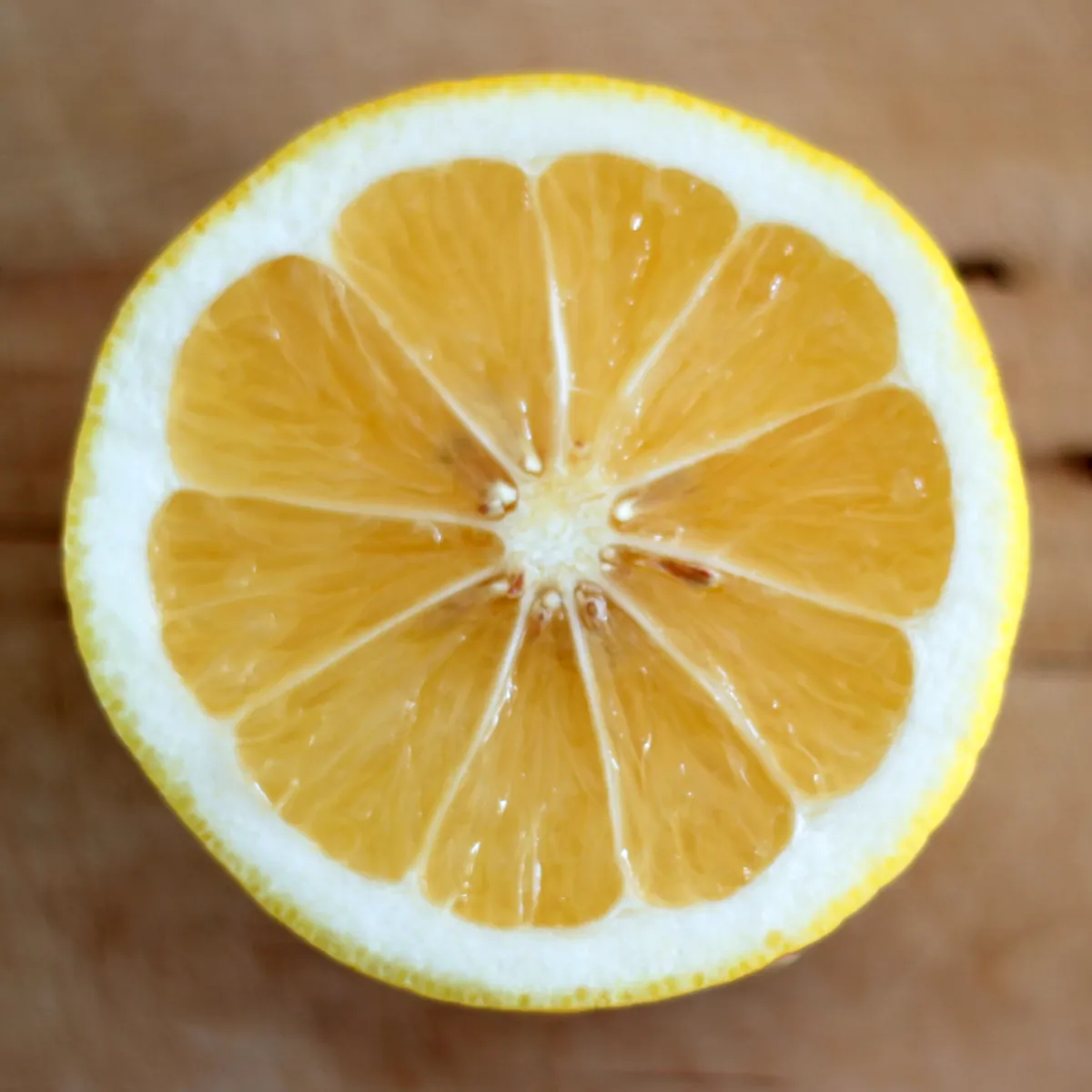
半分に切った日向夏の断面。黄色い果肉の周りに厚い白色の内果皮(アルベド)が付いたままの状態。
写っているもの: Citrus tamurana部位・状態: 果実の横断面(外果皮・内果皮=アルベド・果肉を含む)
写真: Marubatsu/ CC BY-SA 3.0/ 原画像/ 台帳の原画像
写真の範囲と来歴
被写体の確認: 原典の記載による同定。説明文「Hyuganatsu cut in half」。アルベドごと食べる特徴が断面から視覚的に確認できる。 画像を開き、果肉の外側に厚い白色の層(アルベド)が果肉と一体化した状態で残っているのを確認した。
掲載画像: Wikimedia Commons の原本を長辺2400pxへ縮小。切り抜き・色調変更なし。 表示用には幅1200px上限のWebPを配信し、台帳の原画像は上のリンクから確認できます。
On this page (8 sections)
Reading the bitterness
Hyuganatsu is distinctive because the outer peel is pared thinly, like an apple, and the white albedo is eaten with the flesh; this way of eating it is also mentioned in the background section of a peer-reviewed paper. A 2015 review of citrus processing compares Hyuganatsu with pomelo-type citrus such as grapefruit and pummelo, whose outer peel is thick and strongly bitter, and says Hyuganatsu has a softer outer peel with fewer bitter constituents. The review does not give quantitative values for bitter constituents in Hyuganatsu itself.
Heating is generally described as generating bitterness in citrus marmalade production. A study of Hyuganatsu reports that using high-pressure processing instead of heating produced marmalade with less bitterness and good flavor. Here too, numerical values from sensory assessment of bitterness are not stated in the text; this remains the authors’ interpretation.
Sources for this overview
Checked for this overview: Background description of the custom of eating the albedo with the flesh. / Used the qualitative bitterness comparison with pomelo-type citrus as evidence for this paragraph. / Used the reported reduction of bitterness under high-pressure processing as evidence for this paragraph.
Other names: 日向夏蜜柑 (ja), ニューサマーオレンジ (ja, identification medium), 小夏 (ja, identification low)
Structured claims — open a section to read each claim's confidence, evidence and limits
Sensory (1)
Scope: A 2015 paper reviewing the authors’ earlier studies on high-pressure marmalade made from yuzu, Hyuganatsu, and lemon.
Note: This review gives no specific quantitative value for Hyuganatsu bitter constituents; the comparison is qualitative. Pairwise sensory comparisons including a bitterness item are shown for yuzu and lemon, but direct sensory values for Hyuganatsu could not be confirmed.
Show data
ingredient-hyuganatsu —has_sensory_attribute→ "Hyuganatsu is reported to have a softer outer peel and fewer bitter constituents than pomelo-type citrus such as grapefruit and pummelo, which have thick, strongly bitter outer peels. Because heating is generally described as producing bitterness during citrus marmalade preparation, the authors report that a high-pressure method produced a less bitter, better-flavored Hyuganatsu marmalade than a heat-treatment method."How processing and cooking change it (1)
Scope: Background descriptions in a peer-reviewed 2015 review and a peer-reviewed 2025 review.
Note: Both sources chiefly concern processing properties and functional assessment of bone metabolism, respectively, but agree in their background descriptions of how the fruit is eaten.
Show data
ingredient-hyuganatsu —has_food_part→ "The fruit is distinguished by a thinly pared outer peel, like an apple, and by eating the white mesocarp (albedo) with the flesh."Culture (1)
Scope: A description in official materials of Sukumo City, Kochi Prefecture.
Note: Tamura Toshichika was from Kochi Prefecture and is described as having sent scions and seedlings to his family home, initiating cultivation there under the name 『小夏』 (in translation: "Konatsu").
Show data
ingredient-hyuganatsu —has_discovery_history→ "During the Bunsei era (around 1820), a chance seedling was found growing at the home of 「真方安太郎」 (Magata Yasutaro) in 「曽井」 (Soi), Miyazaki (now Miyazaki City). In 1887 (Meiji year 20), 「田村利親」 (Tamura Toshichika), an engineer at the Ministry of Agriculture and Commerce, formally named it 『日向夏蜜柑』 (in translation: "Hyuganatsu mikan")."