Citrus natsudaidai
ingredient / ingredient-natsumikan
夏みかん
Citrus natsudaidai is a mid- to late-season citrus fruit (natsudaidai) that became a local crop in Hagi, Yamaguchi Prefecture, during the Meiji period. It is known as a subject of research into juice bitterness caused by naringin and debittering with naringinase.
Photographs (captions in Japanese)
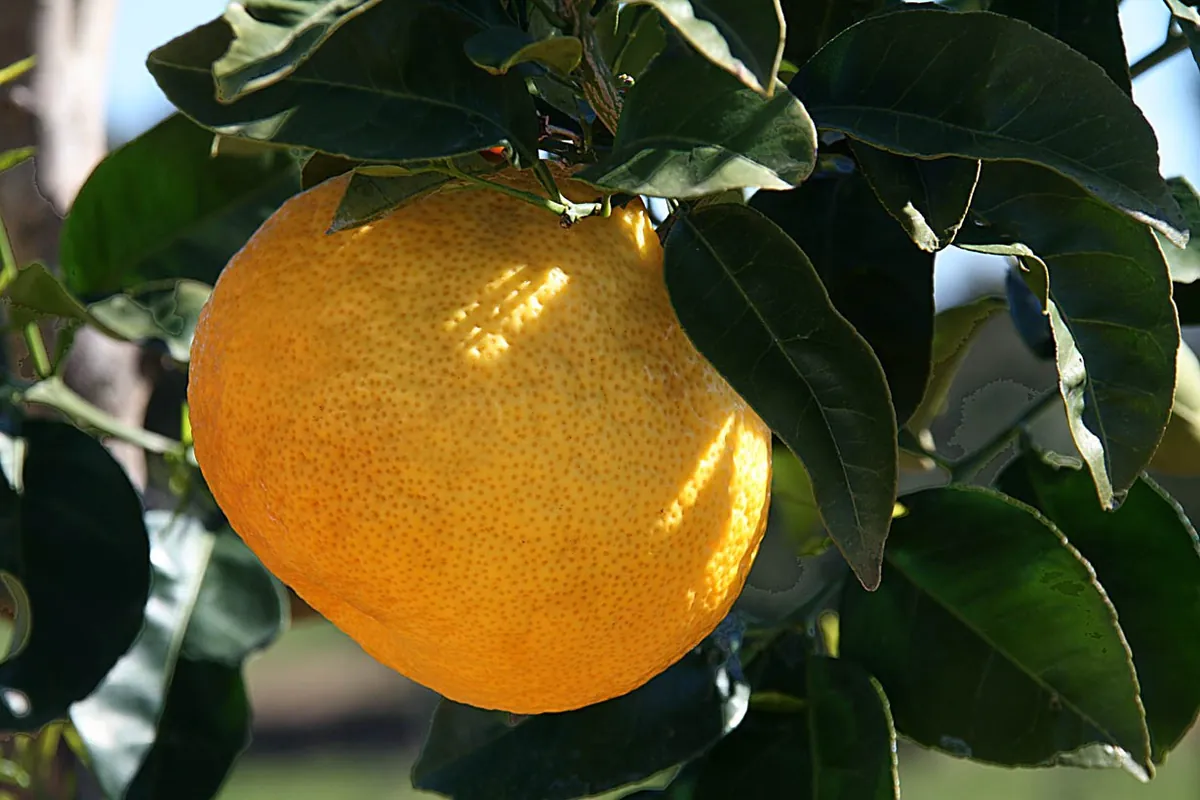
3月の樹上に実る、艶のある黄橙色の夏みかんの果実。
写っているもの: Citrus natsudaidai部位・状態: 樹上の果実(葉付き)
写真: Jpbrigand2/ CC BY-SA 4.0/ 原画像/ 台帳の原画像
写真の範囲と来歴
被写体の確認: 原典の記載による同定。仏語説明「C. natsudaidai en mars fruits sur l'arbre(3月、樹上の果実)」。 画像を開き、樹上の葉に囲まれた大きな黄橙色の果実を確認した。
掲載画像: Wikimedia Commons の原本と同寸。切り抜き・色調変更なし。 表示用には幅1200px上限のWebPを配信し、台帳の原画像は上のリンクから確認できます。
On this page (11 sections)
Reading the bitterness
Natsumikan (also natsudaidai; Citrus natsudaidai) is a mid- to late-season citrus fruit that became a local crop in Hagi, Yamaguchi Prefecture, during the Meiji period. According to official Hagi City material, it was brought to Hagi as a substitute for yuzu in the early Bunka era (early 19th century), and its use as food spread when people around the end of the Edo period noticed that it tasted good even when harvested in summer. The material says that after the Meiji Restoration, Obata Takamasa sowed seeds and distributed seedlings on the sites of former samurai residences that had become nearly abandoned, spreading cultivation throughout Hagi. It also states that by Meiji 22 (1889), revenue from natsumikan exceeded the scale of Hagi's municipal finances.
Naringin is the main component of natsumikan bitterness. A 1962 analysis of natsumikan juice made in mid-March at the Nippon Citrus Industry Yawatahama factory reported measured naringin levels of 75.2 mg% in the first pressing (glucose 2.6%, sucrose 2.6%, citric acid 2.9%, pH 2.9) and 156 mg% in the second pressing (sugars 5.1%, pH 2.9). The more-than-twofold difference between pressing stages of the same fruit indicates that natsumikan juice bitterness can vary substantially with how the juice is extracted.
One investigated way to suppress this bitterness is adding naringinase, an enzyme that breaks down naringin. A 1962 study developed a formula to predict the required enzyme activity from pH, temperature, and glucose concentration and found that adding 500,000–1,000,000 units per ton of juice was an effective amount for which measured and calculated values agreed. In a full-scale factory trial, a taste test (sensory evaluation) confirmed that bitterness actually disappeared. The study also reported that an excessively long reaction caused discoloration, aroma deterioration, and pulp separation, showing the difficulty of both removing bitterness and maintaining quality.
Sources for this overview
Checked for this overview: Used the historical account in official Hagi City material as support for paragraph 1.
Checked for this overview: Used measured naringin values from the 1962 analysis as support for paragraph 2. / Used the taste test confirming the disappearance of bitterness as support for paragraph 3.
Other names: 夏橙 (ja)
Follow the connections
Citrus natsudaidai →contains→ naringin →is associated with→ bitterness
amanatsu (Citrus natsudaidai) →is derived from→ Citrus natsudaidai
Citrus natsudaidai →contains→ limonin →is associated with→ bitterness
Hypotheses and recipe candidates for this entry are on the Japanese page.
Structured claims — open a section to read each claim's confidence, evidence and limits
Composition and content (10)
Scope: Direct measurement of natsumikan first-press juice (Nihon Kankitsu Kogyo K.K., Yawatahama factory, batch produced in mid-March)
Note: A 1962 analysis. Note that the content differs by more than twofold between pressing stages (1st vs. 2nd press).
Show data
ingredient-natsumikan —contains→ compound-naringinScope: An account in official materials from Oita Prefecture
Note: Discovered in the early Showa era as a branch sport (bud mutation) of natsumikan (natsudaidai) at Kawano Yutaka's summer-citrus orchard in Kami-aoe, Tsukumi City, Oita Prefecture. Its citric acid drops faster than ordinary natsudaidai, and it is ready to eat from early in the 3rd month (March). The specific year given in other sources — "discovered in 1935, registered as 'Kawano natsudaidai' in 1950" — could not be confirmed in Oita Prefecture's own official materials.
Show data
ingredient-amanatsu —is_derived_from→ ingredient-natsumikanScope: Part-by-part analysis of 1 sample of natsumikan (from Yugawara). The fruit was quartered and divided into peel and fruit; of the peel, the outer 1/3 was taken as flavedo and the remaining 2/3 as albedo. Separated by thin-layer chromatography and quantified by fluorescence.
Note: This is the distribution of the amount of naringin, regarded as a bitter substance, not a sensory evaluation of bitterness (the main text treats naringin as one of the bitter substances and states that removing it is important in making marmalade). The part-by-part values are 1 point each, and the number of fruits and replicates are not described in the main text. Another study of the same natsumikan (Bessho et al. 1964) gave about 1300 mg% for albedo and segment membrane and about 360 mg% for the outer skin (flavedo) by a colorimetric method; the order is the same but the numbers differ.
Show data
ingredient-natsumikan —contains→ compound-naringinScope: Part-by-part analysis of 1 sample of natsumikan (from Ehime). The division of parts is the same as in Morohoshi and Sugawara (1971). Quantified by a color development method as total limonoids in limonin equivalents.
Note: This is the amount of limonoids (bitter substances mainly limonin), not a sensory evaluation of bitterness. The content is total limonoids, not limonin alone. Unlike the distribution of naringin (higher in the albedo and segment membrane than in the flavedo), limonoids are higher in the flavedo than in the albedo and segment membrane, and highest in the seeds. The color development is unstable, measurement was made within 3 minutes after color development, and the recovery of added amounts is stated as ±10%.
Show data
ingredient-natsumikan —contains→ compound-limoninScope: Natsumikan juice squeezed with a reamer-type test juicer, quantified by high-performance liquid chromatography. Harvested from December 28 to May 8. The table labels the cultivar Natsudaidai, while the main text calls it natsumikan.
Show data
ingredient-natsumikan —contains→ compound-naringinScope: Fruit collected from February to March from 1 natsumikan tree at an orchard in Matsuyama, Ehime Prefecture. Each part was finely cut and ground with 5 times its volume of water, the filtrate after heating for 30 minutes in a boiling bath was quantified by Nakabayashi's modified Davis method (colorimetry at 420 nm).
Note: This is the distribution of the amount of naringin, regarded as a bitter substance, not a sensory evaluation of bitterness (the main text describes the bitterness of natsumikan as due mainly to naringin). Differences between fruits were large, with a range of 1.5 to 1.8 times in the juice. In fruit harvested on April 6, the albedo (869 mg%) and segment membrane (978 mg%) were lower, and the amount fell sharply outward from the albedo and segment membrane (a mean of 5 fruits; the author says it is not certain without increasing the number of samples). Fukutani and Miyamoto (1983) point out that the colorimetric method also picks up other flavonoids and so gives higher values than HPLC.
Show data
ingredient-natsumikan —contains→ compound-naringinScope: Fruit from 1 natsumikan tree at an orchard in Matsuyama, Ehime Prefecture. The juice sacs of the flesh, with the segment membrane removed, were divided into the stalk, central part and tip, and quantified by the modified Davis method. The juice was withdrawn with an injection needle.
Note: This is the distribution of the amount of naringin, not a sensory evaluation of bitterness. The author considers that bitterness could be removed almost completely by removing naringin from the stalks and membrane without moving it into the juice part, and conjectures that for peeled flesh, removal from the dorsal side would be more effective than from the ventral side (a conjecture, not confirmed by experiment). The concentration values are by a colorimetric method.
Show data
ingredient-natsumikan —contains→ compound-naringinScope: Natsumikan grown on the grounds of the Faculty of Agriculture, Yamaguchi University. The peel, segment membrane and seeds were dried and ground, extracted with benzene, and the weight of the precipitate separated with ether was taken as limonoids (from September 1962 to April 1963).
Note: This is a research note; limonoids were measured by the weight of the precipitate, and the composition is unconfirmed (mainly limonin). The result that limonoids in the segment membrane increase with ripening runs opposite to later reports by thin-layer chromatography and HPLC (Hashinaga and Ito 1983, Fukutani and Miyamoto 1983: limonoids in each part decrease as the fruit ripens), and this may be due to the difference in measurement method (precipitate weight method). The author states that values were disturbed from January 1963 onward by frost damage.
Show data
ingredient-natsumikan —contains→ compound-limoninScope: Flesh (juice sacs) of natsumikan from Hiroshima. It was divided into the outer, central and middle parts of the flesh and the juice-storing and stalk parts of the juice sacs, and the naringin dissolving out in a short soak in water and the total naringin were measured by the modified Davis method.
Note: This is the distribution of naringin amount, not a sensory evaluation of bitterness. In fresh fruit, about 1/3 of the total naringin in the juice-storing part and about 1/4 in the stalk part dissolved out in a short soak in water, and after freezing about 2/3 in the juice-storing part and about 1/3 in the stalk part dissolved out. The point that the stalks of natsumikan juice sacs hold a high concentration of naringin agrees with Bessho et al. (1964, about 1.4% in the stalk). The numbers were confirmed in Tables 7 to 9 and the main text. The amounts dissolved from the segment membrane (290 and 219 mg/100 g) are values from separate tests in Table 7 and Table 9, and are the amounts that dissolve when the membrane and flesh are soaked briefly in water, not content.
Show data
ingredient-natsumikan —contains→ compound-naringinSensory (4)
Scope: 7 trial marmalades (A to G) made from natsumikan flavedo and 2 commercial products (H and I). The main text says "10 products" but the table has 9. Boiled down to a sugar content of about 70% with a mix of flavedo 4, juice 5, pectin extract 5 and sugar 10. 20 panelists in their 20s (2 men and 18 women) evaluated bitterness, peel hardness, color, aroma and overall on a 5-point scale. The direction of the bitterness score and statistical testing are not in the original.
Note: The main text does not state the direction of the bitterness score (whether a higher score means more bitter or less bitter). Because the sample with a high overall score also has a high bitterness score (G: bitterness 3.65, overall 3.45), it can be read as higher being the more favorable side, but this cannot be confirmed. There is no statistical test, and the differences are only a comparison of means. The main text says 10 products, but the tables (Tables 3 to 5) have only 9 (A to I). The naringin amount is 60 to 75 mg% in the trial products and 75 and 76 mg% in the commercial products, not a large difference.
Show data
ingredient-natsumikan —has_perceived_bitterness_affected_by→ "7 kinds of natsumikan marmalade (A to G in the table) were made with different combinations of boiling the flavedo for 30 to 60 minutes and soaking in water (13 hours, 1 hour, none), and of soaking the albedo and segment membrane in water (13 hours, 3 hours); together with 2 commercial products (H and I), they were evaluated by 20 panelists on a 5-point scale. There was no large difference in preference in any of the items: bitterness (a preference rating), peel hardness, color, aroma and overall. Slightly, the sample boiled in 2% salt water for 30 minutes and soaked for 1 hour (G) tended to be highest, with an overall 3.45. The author concluded that boiling for 30 minutes in 2% salt water and then soaking for 1 hour, or boiling for 45 to 60 minutes without soaking in water, produced marmalade that was no different in bitterness, peel hardness and overall from conventional products given long bitterness treatment."Scope: 8 samples of canned natsumikan (experiment 3, 3 months after manufacture). Combinations of ordinary peeling and cold-acid peeling, Sankyo naringinase and Kumitanase, and the addition method and the soaking method. 7 panelists ranked the bitterness, the ranks were converted to normal scores, and analysis of variance was performed (14 blocks, 7 replicates).
Note: The significant combinations were confirmed from the main text (B-D and C-D at 1%; A-B, B-E, C-E, D-G and D-H at 5%) and from the adjusted means in Table 8 (the 5% least significant difference is 0.78, and 1% is 1.10). The differences from the no-addition group with the same peeling method and the same enzyme (C versus A, E versus D, F versus D, H versus G) are not significant. The adjusted means (+ is more bitter) were A 0.29, B -0.55, C -0.40, D 0.71, E 0.38, F -0.04, G -0.13 and H -0.28. Regarding E and F being judged more bitter than G and H, the author thinks that because G and H had less acid, the panelists were misled about the bitterness by the sourness. The author's summary generalizes this as "an effect of enzymatic debittering is recognized". In the tasting in experiments 1 and 2, the groups with addition were less bitter than those without, and 2B, 2C, 3B and 3C of experiment 1 are described as tasting almost not bitter, but this is a description of tasting with no number of people or method stated.
Show data
ingredient-natsumikan —has_perceived_bitterness_suppressed_by→ process-citrus-enzymatic-naringinase-debitteringScope: A standard limonoid solution obtained as about 1 g from 400 g of dried natsumikan peel was treated with a 1% aqueous solution of each enzyme preparation at 20°C for 20 hours, and the dilution factors at which bitterness was no longer perceived were compared.
Show data
ingredient-natsumikan —has_perceived_bitterness_suppressed_by→ "An aqueous solution of limonoids extracted from natsumikan peel lost its bitterness only when diluted 6 times without treatment, whereas with a pectinase preparation (strong Sucrase 1%) acting at 20°C for 20 hours it lost its bitterness at a 2-fold dilution; Sucrase 1% was 4 times, naringinase preparation A (1%) 3 times and G (1%) 5 times. The author conjectured that pectinase might break down limonoids, the other cause of the bitterness of natsumikan, and states that further study is continuing."Scope: Natsumikan from Hiroshima. Segments with the peel removed and divided, either whole or with the membrane removed, were stored at -20°C for 10 days, and bitterness was compared by the paired comparison method and also evaluated on a scale from -4 (not bitter) to +4 (extremely bitter). For samples with the membrane, the flesh was tasted after removing the membrane while still frozen.
Note: The results are for frozen flesh, not for raw natsumikan flesh or for eating it with the membrane. The scores come out low because the samples were compared together with strongly bitter ones (in another pair in the same table, almost the same material with the membrane removed was rated 2.6 and described as a strong bitterness unfit for general eating), so they should not be read as absolute values. The number of judgments is shown in the table as 14, and the number of panelists is not in the main text. As for how freezing increases bitterness, the author states that it is because naringin dissolved out on thawing becomes locally concentrated on the flesh surface.
Show data
ingredient-natsumikan —has_perceived_bitterness_affected_by→ "When flesh taken out of natsumikan segments was frozen, flesh frozen with the segment membrane (thin skin) left on was clearly more bitter than flesh frozen with the membrane removed (the version with the membrane was judged more bitter in all 14 paired comparisons, with bitterness scores of +3.4 versus +1.6). However, "considerable bitterness" remained even after removal. There was no significant difference in the bitterness of the flesh between removing the membrane by hand and removing it completely with acid and alkali chemicals."Mechanism and receptors (1)
Scope: 60 g of natsumikan flesh from Ehime (outer skin and segment membrane removed by hand) was put in a plastic bag and immersed in a hot water bath at each temperature for 30 minutes, the juice was squeezed out, and naringin and water-soluble pectin were quantified.
Note: There was no sensory test of bitterness, and "perceived as more bitter" is the author's presumption from the increase in naringin in the juice. The heating was 60°C for 10 minutes (at 70°C or above the juice sac membrane becomes fragile and the juice cannot be withdrawn). This experiment partly disputes the earlier explanation that bitterness increases on heating (that 40 to 70% of the naringin is in an insoluble or bound form that becomes soluble on heating). The same report states that more than 90% of the amount after heating dissolves out just by grinding, and that the portion that becomes soluble on heating is unexpectedly small (a 6 to 8% increase).
Show data
ingredient-natsumikan —was_observed_with→ "When the peeled flesh of natsumikan was heated at 60°C for 10 minutes, the naringin appearing in the juice withdrawn with an injection needle rose about 7 times, from 4.0 mg% (mg% = mg per 100 g) untreated to 29.2 mg% (in hand-squeezed juice too, about 2 times, from 27.5 to 56.6 mg%). The transfer of naringin into the juice rose sharply up to 70°C and hardly changed above 70°C. The author presumed that the main causes of the stronger perceived bitterness on heating are the increased naringin concentration in the juice and the fragility of the juice sac membrane, which makes the naringin inside the cells easier to release (no sensory test of bitterness was conducted)."How processing and cooking change it (8)
Scope: Enzyme treatment experiments and taste tests (including factory field trials) using natsumikan first-press and second-press juice
Note: This is a source that reached sensory evaluation, not just chemical analysis, by directly measuring the time to bitterness disappearance through taste tests (sensory). It also reports that if the reaction time is too long, discoloration, aroma deterioration, and pulp separation occur.
Show data
ingredient-natsumikan —has_perceived_bitterness_suppressed_by→ "Treatment by adding naringinase (an enzyme that breaks down naringin). A formula was developed to predict the activity needed from pH, temperature, and glucose concentration, and an addition of 50–100 ten-thousand units of enzyme (roughly half a million to a million units) per 1 ton of juice was found to be the effective amount at which the measured and calculated values agreed."Scope: Naringin amount by soaking time in water for the flavedo, and the albedo and segment membrane, of natsumikan (from Yugawara). Under 3 conditions (2% salt water, running water, standing water), 2 samples each were measured at 30 minutes and 1, 2, 3, 12 and 24 hours.
Note: This is a measurement of naringin amount, not a result of people evaluating bitterness after soaking in water. The way of cutting (strips for the flavedo, fine chopping for the albedo and segment membrane) affects the speed of dissolution, so it should not be applied as is to thick cuts or whole peel at home. The author describes the difference by type of water as small.
Show data
ingredient-natsumikan —was_observed_with→ "When the flavedo of natsumikan (strips of about 20 × 2 × 2 mm) was soaked in 2% salt water, running water or standing water, most of the naringin dissolved out in 2 to 3 hours and was nearly constant after 3 hours (about 80 to 85% was removed). The albedo and segment membrane (finely chopped) likewise had about 60 to 70% removed in 2 to 3 hours, nearly constant after 3 hours."Scope: 10 g of natsumikan flavedo (from Yugawara) was wrapped in gauze, boiled for 15, 30, 45, 60 and 90 minutes, and naringin was quantified. Compared with and without 1 hour of soaking in water. Hardness was measured with a Kiya-type hardness tester.
Show data
ingredient-natsumikan —was_observed_with→ "When the flavedo of natsumikan was boiled in water, naringin fell sharply in 15 to 30 minutes and was then nearly constant, with no further decrease. The naringin amount before boiling was 450 mg% (mg% = mg per 100 g) for flavedo soaked in water for 1 hour and 855 mg% for unsoaked flavedo. Boiling in 2% salt water tended to make the flavedo softer than boiling in water."Scope: The flavedo, and the albedo and segment membrane, of natsumikan (from Ehime) were soaked in water and boiled by the same methods as in the previous report (Morohoshi and Sugawara 1971), and the remaining limonoid amount (as limonin) was measured.
Show data
ingredient-natsumikan —was_observed_with→ "The limonoids of natsumikan are less soluble in water than naringin; soaking the flavedo in 2% salt water for 3 hours removed about 25%, and the amount was then nearly constant. In water (standing water), almost nothing was removed in 3 hours, and at 12 hours it seemed to reach about the same level as with salt water. Boiling the flavedo for 30 to 40 minutes removed about 30%. For the albedo and segment membrane, soaking in water for 3 hours removed about 12%, and 2% salt water about 25%."Scope: Canned natsumikan (M to L grade) in syrup from Arida District, Wakayama Prefecture. The segment membrane was removed by acid and alkali treatment with 0.6 to 0.7% hydrochloric acid and sodium hydroxide, washed in water, and packed. The enzyme was added to each can by the addition method, and the cans were sterilized at 65°C for 30 minutes or similar and stored. Naringin in the flesh and the liquid of cans 3 months after manufacture (1 month in experiment 2) was quantified by the modified Davis method.
Note: These are results of measuring the amount of naringin (the sensory evaluation of bitterness is treated as a separate claim). The enzyme preparations were commercial products of the time, and their effectiveness differs by type. Preparations with high pectinase activity made the syrup cloudy white, and the flesh sometimes became slightly softer after 6 months of storage. Fukutani and Miyamoto (1983) point out that the colorimetric method (Davis method) gives higher values than HPLC. The naringin amount of the no-enzyme controls (about 30 to 54 mg%) differs with the can conditions.
Show data
ingredient-natsumikan —was_observed_with→ "In canned natsumikan in syrup, when the enzyme solution (naringinase) was added together with the filling syrup and the can sealed so that the enzyme remaining in the can acts during storage (the addition method), the naringin in the flesh 3 months after manufacture was lower than without addition. In experiment 1, 54.0 mg% (mg% = mg per 100 g) without addition became 40.5 mg% by adding 0.1 g to 1 can and 30.5 mg% by adding 0.2 g. In another test with sodium citrate added, 45.0 mg% without addition fell to 18.5 and 15.5 mg% with addition (0.1 g and 0.2 g). In experiment 3, which used 2 other enzymes, 39.2 mg% in the ordinary peeling without addition fell to 15.2 and 15.0 mg%."Scope: Canned natsumikan in syrup. The peeled and washed flesh was soaked overnight in an enzyme solution made with 0.4 to 0.5% enzyme in warm water (50°C) of the same weight as the flesh, then washed in water and packed. Compared with the addition method (experiments 2 and 3).
Note: The bitterness for the soaking method in experiment 2 is a tasting description, and the only numerical sensory evaluation is G versus H in experiment 3. The soaking method had a higher rate of broken flesh than the addition method (in Table 9, whole fruit was 92% for the addition method and 69% for the soaking method, and broken flesh 8% for the addition method and 31% for the soaking method), and the raw-material yield was also better for the addition method. The author states that the addition method has the advantage that the time of enzyme action is not limited, and that the remaining enzyme acts during storage.
Show data
ingredient-natsumikan —has_perceived_bitterness_affected_by→ "In canned natsumikan, the soaking method, in which the flesh is soaked overnight in the enzyme solution, did not reduce naringin as much as the addition method, in which the enzyme is added to the can. In experiment 2, the naringin in the flesh by the soaking method was 36 mg% (mg% = mg per 100 g), the same as the control without addition (36 mg%), and the bitterness was recorded as "strong" (the addition method in the same experiment was 32 and 29 mg% and so on, with bitterness "somewhat less" to "considerably less"). In experiment 3 as well, the Kumitanase group by the soaking method (H) was 29.0 mg%, and the difference in bitterness by ranking test from the soaking-method group without addition (G) at 32.8 mg% was not significant."Scope: Canned natsumikan in syrup (No. 5 can, 250 g of flesh, 120 mL of syrup at 55°Bx). Flesh whose segment membrane had been removed by warm acid and alkali soaking (about 1%, 40°C) was soaked in the enzyme solution, washed in water, packed in cans and sterilized at 85°C for 30 minutes. The naringin in the flesh and syrup 1 month after canning was quantified by the modified Davis method.
Note: This is a measurement of naringin amount, not a sensory evaluation of bitterness. Tsusaka (1965) reported that overnight soaking (in warm water at 50°C, not kept warm) did not reduce naringin (36 to 36 mg%), so the results for the same soaking method differ with temperature, enzyme and pectinase activity. The author states that sugar greatly hinders the action of the enzyme (80% or more at the sugar concentration of canned fruit in syrup) and that the enzyme power actually usable is only about 20% of its potency, noting an economic problem (the table of sugar inhibition values is omitted).
Show data
ingredient-natsumikan —was_observed_with→ "For canned natsumikan in syrup, soaking flesh whose segment membrane had been removed with acid and alkali in an enzyme solution containing naringinase and pectinase reduced the naringin. When soaked in a 1% enzyme solution at 35°C, the naringin in the flesh was 65.0, 50.3, 42.5 and 31.0 mg% (mg% = mg per 100 g) after 0, 2, 4 and 8 hours; with 16 hours of soaking at 20°C, 64.0 mg% with water washing only became 42.0 with a 0.1% enzyme solution, 40.0 with 0.5% and 35.0 mg% with 1.0%, and 40.0 mg% with 0.5% Sucrase (a pectinase preparation) (after canning and 1 month of storage). The author states that combining pectinase with naringinase works well and is convenient because commercial naringinase preparations usually contain pectinase, and adopted soaking at 20°C with 0.5% overnight (about 16 hours)."Scope: Canned natsumikan. Compared: groups with heat- and acid-resistant naringinase (Tanabe Seiyaku) added at 0.5 g per can and pH adjusted with sodium citrate (A) and without adjustment (N), under different sterilization conditions. Cans were opened immediately after sterilization and at 1 day, 1 week, 2 weeks, 1 month and 5 months.
Note: This is a measurement of naringin amount, not a sensory evaluation of bitterness. It is a process study of the relation between the residual enzyme activity after sterilization and the naringin amount, and the conditions are those of can manufacture, not home cooking. The values are read from a figure, and the main text gives about 10 mg%.
Show data
ingredient-natsumikan —was_observed_with→ "When sodium citrate at 0.5 g per can was added to canned natsumikan (flesh pH 2.85, whole segments) together with heat- and acid-resistant naringinase (0.5 g per can) to bring the pH of the syrup at the end of sterilization to 3.4, the enzyme remained active, the naringin in the flesh was lower than in the control from the next day, fell markedly between 2 weeks and 1 month, and became about 10 mg% (mg% = mg per 100 g) after 5 months. In cans without pH adjustment, all sterilization groups were lower than the control only after 1 month, and except for sterilization groups No. 2 and 3 the difference was slight. The difference in sterilization intensity (78°C for 8 to 16 minutes, 76°C for 13 minutes, 80°C for 11 minutes) had little effect, and pH adjustment had a large effect."Culture (1)
Scope: An account in official materials from Hagi City, Yamaguchi Prefecture
Show data
ingredient-natsumikan —has_history→ "Brought to Hagi in the early 19th century (early Bunka era) as a substitute for yuzu, and by the late Edo period its good taste even when harvested in summer had been noticed, spreading its use as food. After the Meiji Restoration, Obata Takamasa sowed seeds and distributed saplings on abandoned former samurai residences, spreading cultivation across Hagi, and by 1889 (Meiji 22) revenue from natsumikan had come to exceed the scale of Hagi's own finances."