potato
ingredient / ingredient-potato
ジャガイモ / Solanum tuberosum
Potato is an edible potato tuber. Tuber steroidal glycoalkaloid (SGA) content varies greatly among cultivars and lines, and high-content lines are described as bitter and acrid.
Photographs (captions in Japanese)
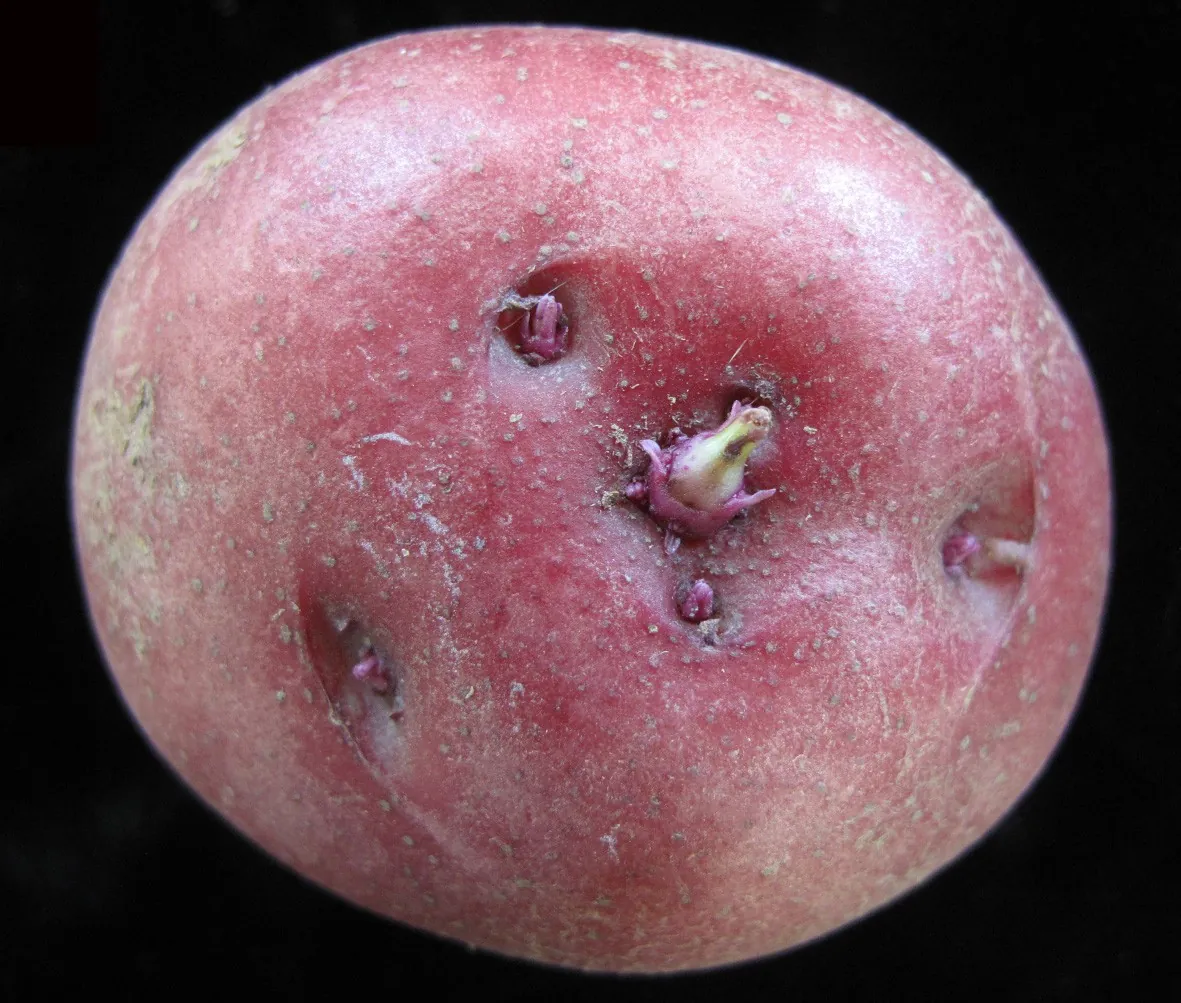
赤紫色の表皮を持つジャガイモ塊茎のクローズアップ。芽(眼)から白い芽が伸び始めている。
写っているもの: Solanum tuberosum部位・状態: 塊茎(表皮、芽・眼を含む)
写真: Ayotte, Gilles, 1948-/ CC BY-SA 4.0/ 原画像/ 台帳の原画像
写真の範囲と来歴
被写体の確認: 原典の記載による同定。仏語説明「Tubercule et bourgeon de pomme de terre(塊茎と芽)」。品種名の記載はなし。 画像を開き、赤紫色の塊茎表面と、中央の芽から発芽した小さな新芽を確認した。
掲載画像: Wikimedia Commons の原本と同寸。切り抜き・色調変更なし。 表示用には幅1200px上限のWebPを配信し、台帳の原画像は上のリンクから確認できます。
On this page (8 sections)
Reading the bitterness
The amount of steroidal glycoalkaloids (SGAs) in potato tubers varies widely by cultivar and line. In a sensory-panel evaluation of 13 clones, the 7 clones with more than 14 mg per 100 g of tuber were rated bitter, and the correlation between content and bitterness rating was reported as highly significant (r=0.93). This finding has only been checked at the abstract level. The same study found no relationship between total phenol content and bitterness or burning sensation, suggesting glycoalkaloids rather than phenols as the principal source of bitterness.
One part of the mechanism affecting these compounds involves the GAME4 gene. A review reports that silencing GAME4 (suppressing its function) can reduce SGA content in leaves and tubers by as much as 74-fold. That review itself, however, does not directly discuss a correlation between SGA content and sensory bitterness. A separate study, discussed in the preceding paragraph, individually confirmed the association between content and bitterness rating. Taken together, these findings suggest one route by which genetic mechanisms relevant to breeding could influence SGA content and, in turn, bitterness.
Some cultivars with high SGA content have in fact disappeared from the market. A review records that 'Lenape', grown in the United States, and 'Magnum Bonum', grown in Sweden, were both withdrawn after having once been widely cultivated because of high tuber SGA content. The review does not give their precise SGA contents or withdrawal years. This is a historical example suggesting how cultivar selection in breeding has greatly affected the amounts of bitterness-related compounds.
Sources for this overview
Effect of Glycoalkaloids and Phenolics on Potato Flavor
Checked for this overview: Used while stating explicitly that this has been checked only at the abstract level.
Potato steroidal glycoalkaloids: properties, biosynthesis, regulation and genetic manipulation
Checked for this overview: Explicitly noted the lack of a direct correlation with sensory bitterness in this source. / Recorded only the reason for withdrawal, without adding numerical values.
Other names: Solanum tuberosum (la)
Structured claims — open a section to read each claim's confidence, evidence and limits
Sensory (1)
Scope: 13 clones of Solanum tuberosum.
Note: Sensory-panel assessment by the flavor-profile method. Total phenol content was reported to have no significant relation to bitterness or burning sensation.
Show data
ingredient-potato —has_bitterness_correlated_with→ "Total tuber glycoalkaloid content. Of 13 clones, the 7 exceeding 14 mg/100 g were rated bitter by a sensory panel; the correlation between content and bitterness rating was highly significant (r=0.93)."Mechanism and receptors (1)
Scope: Solanum tuberosum.
Show data
ingredient-potato —has_debittering_most_likely_due_to→ "Up to a 74-fold reduction in steroidal glycoalkaloid (SGA) content in leaves and tubers through silencing of the GAME4 gene."Culture (1)
Scope: History of Solanum tuberosum cultivars.
Note: The source review records only the withdrawal, without giving precise content values or withdrawal years. A quantitative primary source (Zitnak & Johnston 1970, among others) was located bibliographically on Crossref, but its abstract was not read and it is not included.
Show data
ingredient-potato —has_history→ "'Lenape' in the United States and 'Magnum Bonum' in Sweden were both withdrawn from the market after having been widely cultivated because of high steroidal glycoalkaloid content in their tubers."