tomato
ingredient / ingredient-tomato
トマト / Solanum lycopersicum
Tomato is the edible tomato fruit. Ripe fruit of some wild relatives is bitter because bitter steroidal glycoalkaloids, including α-tomatine, remain.
Photographs (captions in Japanese)
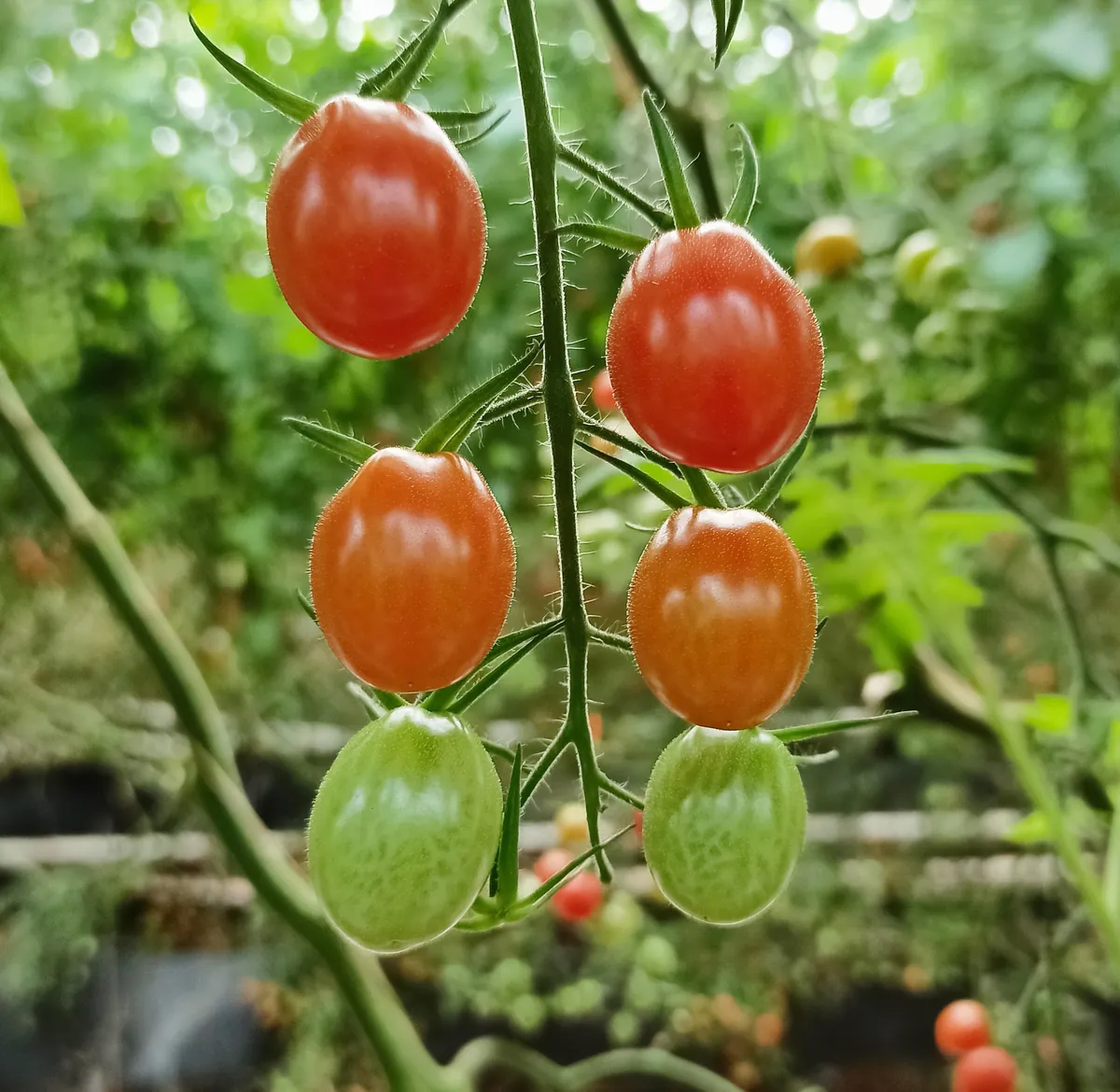
一つの房に、緑・橙・赤と異なる追熟段階の果実が並ぶミニトマト。
写っているもの: Solanum lycopersicum部位・状態: 果実(房状、緑から赤への追熟段階を含む)
写真: Juan Carlos Fonseca Mata/ CC BY-SA 4.0/ 原画像/ 台帳の原画像
写真の範囲と来歴
被写体の確認: 原典の記載による同定。説明文は"Maduración del tomate (Solanum lycopersicum)"(トマトの追熟)。 画像を開き、同一の房に赤・橙・緑の果実が段階的に並んでいるのを確認した。
掲載画像: Wikimedia Commons の原本を長辺2400pxへ縮小。切り抜き・色調変更なし。 表示用には幅1200px上限のWebPを配信し、台帳の原画像は上のリンクから確認できます。
On this page (8 sections)
Reading the bitterness
Fully ripe tomato fruit is generally not bitter, owing in part to a chemical change mediated by a specific enzyme. GAME31, a 2-oxoglutarate-dependent dioxygenase (2-ODD), hydroxylates the bitter steroidal glycoalkaloid α-tomatine to hydroxytomatine. Starting with this reaction, a pathway during ripening converts it into nonbitter compounds such as esculeoside A, removing bitterness from ripe fruit, according to LC-MS metabolite analysis and experiments manipulating gene expression. Because this change occurs during ripening near harvest, it provides a harvest-stage example relevant to how bitterness changes with cultivation and harvest timing.
The pathway’s effect on composition was also tested in reverse. In a line in which GAME31 activity was suppressed by silencing, steroidal glycoalkaloids that normally remain only in trace amounts in ripe fruit increased by as much as 22-fold relative to wild type. No human sensory test was performed: attributing bitterness to these compounds rests on their known bitter properties, not on measured taste in these fruit. Chemical analysis did confirm that altering this one enzyme, GAME31, substantially changes ripe-fruit composition.
A separate enzyme, Sl23DOX, a type of 2-oxoglutarate-dependent dioxygenase, has also been identified as hydroxylating α-tomatine at position 23. Within the scope of the abstract, biochemical analysis of recombinant Sl23DOX protein and confirmation in transgenic tomato plants overexpressing or silencing this enzyme show that it catalyzes 23-hydroxylation; the product spontaneously isomerizes to neorickiioside B, an intermediate of ripening-stage metabolism. How this pathway coordinates with or substitutes for the GAME31 pathway is not clear from the abstract.
According to the abstract, α-tomatine accumulates in all tomato tissues, particularly at high concentrations in leaves and immature green fruit, and is described as a compound that causes bitterness. This is background in a recombinant-protein study, however, without specific concentration values or human sensory evaluation.
Sources for this overview
Checked for this overview: Used the description of the GAME31 hydroxylation pathway. / Used the result while explicitly noting the absence of sensory testing.
Identification of α-Tomatine 23-Hydroxylase Involved in the Detoxification of a Bitter Glycoalkaloid
Checked for this overview: The position-23 hydroxylation pathway through Sl23DOX, distinct from GAME31. / Tissue distribution of α-tomatine, particularly high in leaves and immature green fruit.
Other names: Solanum lycopersicum (la)
Follow the connections
tomato →contains→ α-tomatine →— sensory attribute→ bitterness
α-tomatine →occurs in→ tomato
Structured claims — open a section to read each claim's confidence, evidence and limits
Composition and content (1)
Scope: Layer: food. The background description of α-tomatine tissue distribution and taste in a recombinant-protein study.
Note: Only the abstract was checked; the full text was not reached. The abstract gives no specific concentration values. Earlier claims concern the GAME31 mechanism by which ripe fruit loses bitterness; this claim adds the association of high concentration and bitterness in different tissues, immature fruit and leaves.
Show data
ingredient-tomato —contains→ compound-alpha-tomatineMechanism and receptors (3)
Scope: Tomato, Solanum lycopersicum (cultivated varieties including cv. M82)
Note: In lines where GAME31 was silenced, SGA in ripe fruit increased up to 22-fold relative to the wild type, confirming through reverse genetics that loss of this enzyme can bring bitterness back.
Show data
ingredient-tomato —has_debittering_most_likely_due_to→ "Hydroxylation of the bitter steroidal glycoalkaloid alpha-tomatine to hydroxytomatine by GAME31 (a 2-oxoglutarate-dependent dioxygenase). During ripening, a pathway starting from this reaction converts it into non-bitter esculeoside A and related compounds, which removes the bitterness of the ripe fruit."Scope: Layer: food. Biochemical analysis with recombinant Sl23DOX protein and confirmation in Sl23DOX-overexpressing and silenced transgenic tomato plants.
Show data
ingredient-tomato —is_processed_by→ "Sl23DOX, an α-tomatine 23-hydroxylase and a 2-oxoglutarate-dependent dioxygenase, hydroxylates position 23. Its product spontaneously isomerizes to neorickiioside B, forming an intermediate in α-tomatine metabolism during ripening. This is a parallel metabolic pathway involving an enzyme distinct from GAME31."Scope: Layer: food. Comparison of red-ripe fruit from NOR-KO and RIN-KO tomato mutants with wild type; glycoside quantification by LC-MS and GAME gene-expression analysis by RT-qPCR.
Show data
compound-alpha-tomatine —occurs_in→ ingredient-tomato