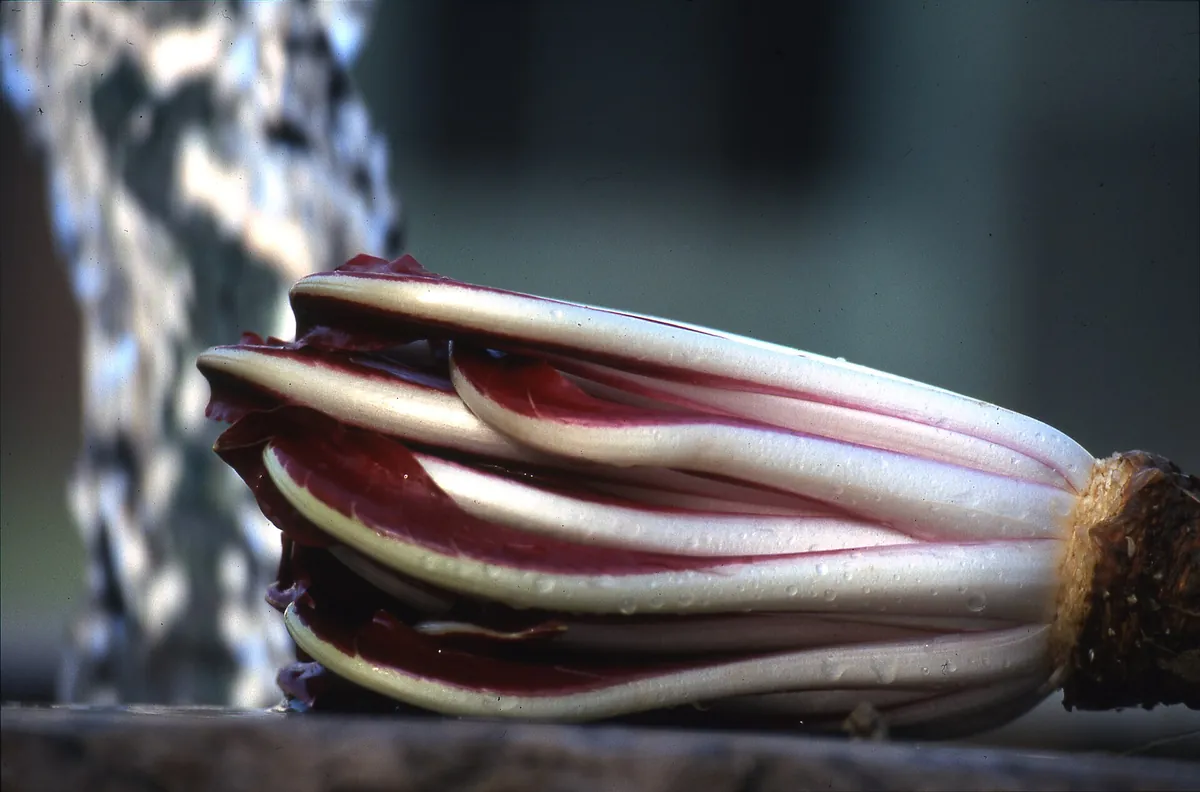
トレヴィーゾ・タルディーヴォ / Cichorium intybus L. var. silvestre
Radicchio Rosso di Treviso tardivo is a late-maturing radicchio with long wine-colored leaf blades and white midribs. The EU geographical-indication specification describes forcing and blanching stages and a pleasant bitterness.
Photographs (captions in Japanese)
トレヴィーゾ・タルディーヴォ。細長い暗赤色の葉身、白く太い中肋、根元を残した形が見える。
写っているもの: Cichorium intybus / Radicchio Rosso di Treviso tardivo部位・状態: 根元を残した葉の束
Radicchio is a leafy chicory, but Treviso Tardivo does not mean just any red-leafed vegetable. The EU geographical-indication specification requires a compact head with leaves closing at the tip, deep wine-colored blades, white midribs, and a trimmed root proportionate to the head. The long red-and-white contrast visible in photographs is a key identifying outline of this late type.
This appearance is not complete when the plant is merely pulled from the field. The EU document lists sowing, cultivation, and harvesting, followed by preliminary forcing, forcing and blanching, tying, washing, and trimming as production stages, all to be carried out in the designated area. Leaf color and head shape result from postharvest human processing as well as the cultivar.
The taste specification focuses on the white midrib, described as having a 「心地よく、いくらか苦い」 (in translation: "pleasant somewhat bitter") taste and a crisp texture. In this description bitterness is not excluded as a defect; it is one of the product's defining properties. This is, however, a legal product description under a geographical indication, not a numerical measurement of bitterness intensity by a trained panel or a guarantee that every head tastes alike.
European Commission / 2020 / government document / full text checked
Checked for this overview: The EU product specification defining leaf arrangement, color, midrib, and root. / The EU production procedure listing preliminary forcing through blanching and trimming. / The EU sensory specification for bitterness and crispness of the midrib.
Entries connected to this one by a claim, by a shared topic hub, or by a short path through the claim data.
Structured claims — open a section to read each claim's confidence, evidence and limits
Composition and content (1)
Radicchio Rosso di Treviso tardivo — composition: Total amount of 8 sesquiterpene lactones: 45.78 ug/g (lowest among the 4 cultivars surveyed), of which lactucopicrin was 13.50 ug/gsupported
Scope: Quantification by Orbitrap-HRMS/MS-MS (part of a comparison among cultivars)
Note: Despite going through forcing (blanching) in the dark, the tardivo type has a lower total SL amount than the precoce type, which undergoes only tying. Recorded as a case that does not support the generalization that dark forcing increases bitter compounds.
Reports that Treviso Tardivo's total sesquiterpene lactone amount is 45.78 ug/g (lowest among 4 cultivars), with lactucopicrin at 13.50 ug/g.
Limitations: The full text was not checked; these are abstract-level figures. Genetic differences among cultivars and process differences are confounded, and the effect of the process alone has not been separated out. This study is a compositional quantification and did not perform sensory evaluation, so the connection to bitterness perception is unconfirmed.
Show dataingredient-radicchio-treviso-tardivo —has_composition→ "Total amount of 8 sesquiterpene lactones: 45.78 ug/g (lowest among the 4 cultivars surveyed), of which lactucopicrin was 13.50 ug/g"
Art. 5: through the forzatura-imbianchimento process, which forms new leaves in the dark, the leaves "perdono la consistenza fibrosa, assumono croccantezza ed un sapore gradevolmente amarognolo" (in translation: "lose their fibrous texture and take on crunchiness and a pleasantly bitter taste"). Art. 6.1.c: "costola dorsale di sapore gradevolmente amarognolo e croccante nella consistenza" (in translation: "the midrib has a pleasantly bitter taste and a crunchy texture").
Limitations: A description in the specification document, not a measurement by a sensory panel. It reinforces, in the original language, the wording of the same disciplinare already recorded in the existing evidence drawn from the English-language EU Official Journal.
"Sapore: costola dorsale di sapore gradevolmente amarognolo e croccante nella consistenza" (verbatim). Defines the taste of the midrib as a pleasant bitterness and a crunchy texture.
Limitations: A quality descriptor with no measurement scale. Confirms, in the original Italian text, the same content as the existing evidence from the English-language EU Official Journal.
Scope: Production steps specified in the EU single document for Radicchio Rosso di Treviso PGI.
Note: Sowing, postharvest pre-forcing, forcing and blanching, tying, washing, and trimming through to harvest must all occur in the designated area.
The EU single document lists sowing, cultivation, and harvest, as well as pre-forcing, forcing and blanching, tying, washing, and trimming, as processes performed in the designated area.
Limitations: This is not an experimental report giving detailed temperatures or numbers of days for each stage.
"La forzatura del Radicchio Rosso di Treviso tardivo avviene mediante utilizzazione di acqua di falda, che nella zona risulta particolarmente idonea all'imbianchimento di queste produzioni. I cespi vengono collocati verticalmente in ampie vasche protette ed immersi fino in prossimità del colletto per il tempo necessario al raggiungimento del giusto grado di maturazione" (verbatim). The tardivo type uses groundwater (acqua di falda), with heads immersed vertically.
Limitations: The existing English-language EU PGI source gives only a general process description and does not specify the water source (groundwater). This detail was confirmed only in the Italian original, in a version of unknown publication year that may not fully match the current 2020 revision. This is the wording of the retrieved version. The current amended version checked during verification changes the water-source wording to 「acqua risorgiva(湧水)約11℃」 (in translation: "spring water at approximately 11°C").
Radicchio Rosso di Treviso tardivo is documented as having Leaves closely packed and closing at their tips, deep wine-colored blades, white midribs, and a trimmed portion of root.supported
Scope: The product specification for tardivo in the EU single document for Radicchio Rosso di Treviso PGI.
Note: A record of the official specification, not a renewed assessment of whether the pictured individual meets PGI requirements.
The EU single document describes tardivo as a regular, compact head with tightly gathered leaves closing at the tip and specifies deep wine-colored leaves, white midribs, and a root trimmed in proportion to the head.
Limitations: This is a legal product specification, not an examination of the individual shown in the published photograph.
Show dataingredient-radicchio-treviso-tardivo —is_documented_as_having→ "Leaves closely packed and closing at their tips, deep wine-colored blades, white midribs, and a trimmed portion of root."
Radicchio Rosso di Treviso tardivo — historical origin: An origin account in tourism and regional-promotion materials says that Belgian-born landscape gardener Francesco Van den Borre (「フランチェスコ・ヴァン・デン・ボッレ」), who moved to Treviso around 1860, spread radicchio forcing and blanching by adapting Belgian chicory-blanching techniques. Local historian Camillo Pavan, however, argues that this account derives from a 1974 article by Giuseppe Maffioli in 『Vin Veneto』 and is a 『歴史的偽造(falso storico)』 (in translation: "historical falsification"): he says Maffioli added 4 paragraphs absent from the 1925 original 『La Coltivazione della Cicoria rossa di Treviso』 by Aldo Van den Borre, Francesco's son, and presented them as Aldo's text.contested
Scope: Origin narratives in the Treviso region: both the account in tourism and regional-promotion materials and the local historian's criticism.
Introduces the account that Belgian-born Francesco Van den Borre, arriving in Veneto in 1860, applied blanching methods common in Belgium to radicchio. It also presents an alternative account in which farmers storing radicchio in livestock sheds in winter noticed the good, crisp cuori di radicchio (hearts). Aldo Van den Borre (1924) called it 『Ecco un erbaggio che è un fiore』 (in translation: "Here is a vegetable that is a flower").
Limitations: An introductory page that does not critically test the origin accounts against historical sources.
Contradicts: Camillo Pavan argues that the Van den Borre origin account comes from Giuseppe Maffioli's 1974 article in 『Vin Veneto』, and that Maffioli added 『4つの段落』 (in translation: "4 paragraphs") on modern forcing and blanching methods that are absent from Aldo Van den Borre's 1925 original 『La Coltivazione della Cicoria rossa di Treviso』, presenting them as Aldo's claims. Pavan criticizes the way this fiction spread 『慣性で』 (in translation: "by inertia") even to Wikipedia.
Limitations: This is a personal blog rather than a peer-reviewed academic publication. It does give bibliographic details for the primary materials (journal title, issue, page, and year of the original), making the argument checkable. This review did not obtain the underlying materials Pavan cites: 『Vin Veneto』 or Aldo Van den Borre's 1925 original.
Show dataingredient-radicchio-treviso-tardivo —has_historical_origin→ "An origin account in tourism and regional-promotion materials says that Belgian-born landscape gardener Francesco Van den Borre (「フランチェスコ・ヴァン・デン・ボッレ」), who moved to Treviso around 1860, spread radicchio forcing and blanching by adapting Belgian chicory-blanching techniques. Local historian Camillo Pavan, however, argues that this account derives from a 1974 article by Giuseppe Maffioli in 『Vin Veneto』 and is a 『歴史的偽造(falso storico)』 (in translation: "historical falsification"): he says Maffioli added 4 paragraphs absent from the 1925 original 『La Coltivazione della Cicoria rossa di Treviso』 by Aldo Van den Borre, Francesco's son, and presented them as Aldo's text."
claim: clm-w25-treviso-tardivo-origin-narrative / type: cultural / updated: 2026-09-01