Radicchio di Chioggia late
ingredient / ingredient-radicchio-chioggia-late
晩生キオッジャ / Cichorium intybus L. var. silvestre
Radicchio di Chioggia late is a late Chioggia-type radicchio with slight bitterness.
Photographs (captions in Japanese)
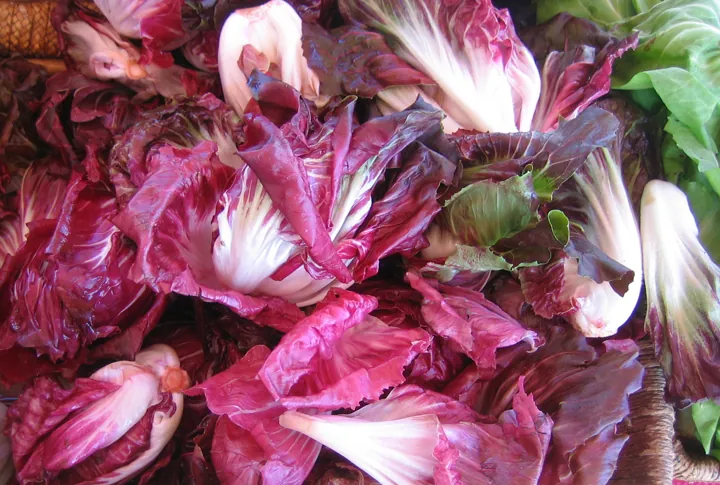
サンフランシスコのファーマーズマーケットで「Chioggia radicchio」として販売されていた株。キオッジャ型の一般的な株であり、早生/晩生の別は写真からは特定できない。
写っているもの: Cichorium intybus L. var. silvestre部位・状態: 結球した株(型一般・市場)
写真: Darya Pino (San Francisco, USA)/ CC BY 2.0/ 原画像/ 台帳の原画像
写真の範囲と来歴
被写体の確認: 原典の記載による同定。裁定に基づき、晩生型の代表として、早生型(ingredient-radicchio-chioggia-early)とは別のCommonsファイルを採用し重複を避けている。
掲載画像: リサイズ・トリミング・色調変更なし。Wikimedia Commons のオリジナル画像をそのまま使用。 表示用には幅1200px上限のWebPを配信し、台帳の原画像は上のリンクから確認できます。
On this page (7 sections)
Reading the bitterness
The EU geographical-indication (PGI) specification (2008) describes the late type of Radicchio di Chioggia as having fairly crisp leaves with a slightly bitter taste (fairly crispy leaves with a slightly bitter taste). It is the category harvested later than the early type.
The original production specification (disciplinare, 2003) describes tardivo leaves as 『sapore amarognolo e di consistenza mediamente croccante(苦味を帯びた味わい、中程度のパリッとした食感)』 (in translation: "a bitterish taste and a moderately crisp texture"). Unlike terms used for late Treviso types, such as gradevolmente (pleasantly) or leggermente (slightly), amarognolo is unmodified here. This is a wording difference between specifications, not a measured comparison of bitterness intensity.
An analysis of 3 lines of the overall Rosso di Chioggia variety, without separating early from late types, compared guaianolides and sugars in heads, outer leaves, and roots at different growth stages. Amounts varied widely across growth stages, plant parts, and the 3 lines studied. The abstract does not give numerical ranges for that variation.
Sources for this overview
Summary of requirements: Radicchio di Chioggia PGI
Checked for this overview: Checked the sensory description of the late type in the English EU PGI specification.
Disciplinare di produzione - Radicchio di Chioggia IGP
Checked for this overview: Checked the unmodified amarognolo description for tardivo in the original Italian disciplinare.
Checked for this overview: Variation in guaianolide content by plant part, growth stage, and line.
Follow the connections
Radicchio di Chioggia late →— sensory attribute→ bitterness →can be measured separately …→ astringency
Structured claims — open a section to read each claim's confidence, evidence and limits
Composition and content (1)
Scope: Layer: food. An HPTLC study comparing guaianolide and sugar content in heads, outer leaves, and roots at growth stages of 3 Rosso di Chioggia lines. It addresses the variety overall without distinguishing early and late types.
Show data
ingredient-radicchio-chioggia-late —has_composition→ "Guaianolide content varies widely among edible heads, outer leaves, and roots, as well as across growth stages and lines."Sensory (1)
Scope: The late type under the EU specification
Note: Recorded as "slightly bitter".
Show data
ingredient-radicchio-chioggia-late —has_sensory_attribute→ sensation-bitter