table olives
ingredient / ingredient-table-olives
テーブルオリーブ / Olea europaea
Olive drupes processed for direct eating.
Photographs (captions in Japanese)
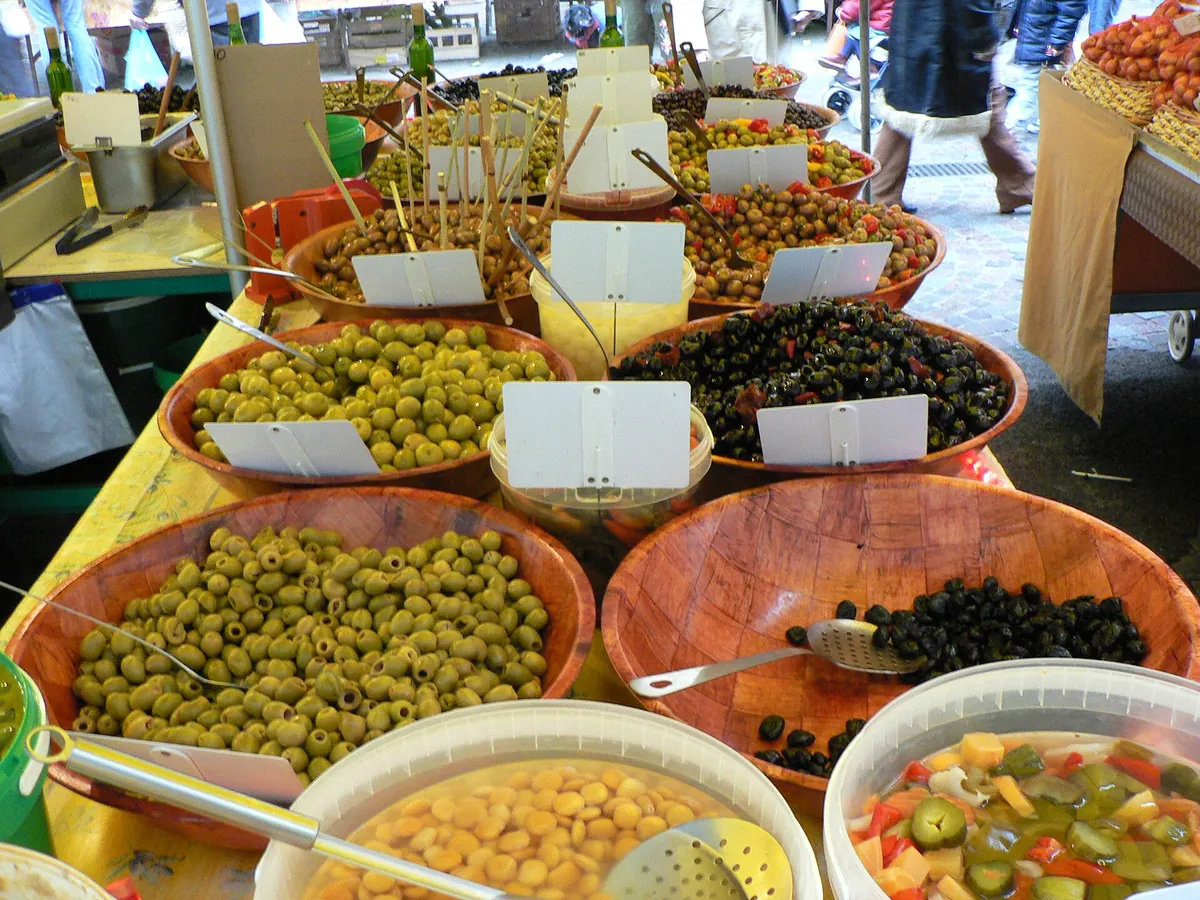
テーブルオリーブ(Olea europaea の果実を塩水や調味液に漬けて加工したもの)が、フランス・トゥーロンの朝市で木製の鉢に品種・仕立てごとに盛られて売られている。緑オリーブ、黒オリーブ、香草や唐辛子を加えたものなど数種が並ぶ、市場での一例。
写っているもの: Olea europaea(加工済みテーブルオリーブ)部位・状態: 調味液に漬け込み加工済みの状態。緑・黒・褐色など複数品種のテーブルオリーブが木製の鉢に盛られ、市場で量り売りされている
写真: David Monniaux/ CC BY-SA 3.0/ 原画像/ 台帳の原画像
写真の範囲と来歴
被写体の確認: 原典の記載による同定。原典ページは『トゥーロンの朝市で売られているオリーブ』と記載するのみで、品種・産地の学術的同定情報はない。この一皿・一台の盛り付けが地域全体のテーブルオリーブの標準形であるとは限らない。専門家による再同定は行っていない。
掲載画像: Wikimedia Commons の1920px版。苦味研究所では切り抜き・色調変更なし。 表示用には幅1200px上限のWebPを配信し、台帳の原画像は上のリンクから確認できます。
On this page (8 sections)
Reading the bitterness
Table olives are olive drupes processed to be eaten as they are. Despite decreasing with fruit ripening, drupes are originally characterized by a strong bitter taste, which reviews summarize as being primarily attributable to oleuropein, a bitter compound. Raw fruit rarely reaches the table unmodified, and only after processing to partially or completely remove bitterness followed by fermentation do drupes become table olives as a pickled product.
The pathway for removing bitterness differs by commercial finishing method. In the Spanish style, prior to lactic fermentation in brine, drupes are immersed in a 1.5–4.5% (w/v) sodium hydroxide solution for chemical hydrolysis of oleuropein. In the Greek style, drupes are fermented directly in brine without using an immersion step. In the Alcaparras style, drupes split in half are immersed over approximately 1 week with water repeatedly changed, and oleuropein is removed by diffusion. Even with the same fruit, the removal pathway differs markedly depending on the finishing method.
Oleuropein that should have been removed sometimes remains measurable in some products. A dry-salted product was reported to have the highest oleuropein content, in contrast to the Spanish style, in which alkali treatment is described as capable of complete removal. In research tracking the processing of naturally green olives, hydrolysis of oleuropein via both enzymatic and chemical reactions has been confirmed during the process; however, these numerical values derive from individual studies compiled by reviews, and must be read with the premise that they vary by processing condition.
Sources for this overview
Table Olives: An Overview on Effects of Processing on Nutritional and Sensory Quality
Checked for this overview: Confirmed in the text that drupes originally possess strong bitterness / Confirmed in the text that oleuropein is treated as the agent of bitterness / Confirmed in the text the debittering methods of Spanish, Greek, and Alcaparras styles / Confirmed in the text the persistence of oleuropein in dry-salted products
Oleuropein hydrolysis in natural green olives: Importance of the endogenous enzymes
Checked for this overview: Confirmed in the text the tracking of enzymatic hydrolysis in naturally green olives
Follow the connections
table olives →is produced through→ olive debittering and fermentation →reduces→ bitterness
table olives →contains, before and during…→ oleuropein →is a major cause of→ bitterness
table olives →can enhance→ bitterness →can be measured separately …→ astringency
Structured claims — open a section to read each claim's confidence, evidence and limits
Composition and content (2)
Scope: Natural green olives, in the cited processing studies
Note: The content changes through enzymatic and chemical hydrolysis.
Show data
ingredient-table-olives —contains_before_and_during_processing→ compound-oleuropeinScope: Layer: food. A comparison of salt and fermentation conditions in the same Gaeta PDO olives, with oleuropein quantified by chemical analysis.
Note: A counterexample showing that increasing salt does not chemically remove the principal bitter compound.
Show data
ingredient-table-olives —does_not_significantly_influence→ compound-oleuropeinSensory (3)
Scope: Layer: food. Italian PDO "Oliva di Gaeta." Quantitative descriptive analysis on an unstructured 0-10 scale by a 10-member panel of students and researchers from the University of Naples Federico II.
Show data
ingredient-table-olives —can_enhance→ sensation-bitterScope: Layer: food. Spanish-style Manzanilla green olives. Evaluation by a consumer panel of 100 with 3-10 years' experience regularly eating green olives. A 14-formulation experimental design.
Show data
ingredient-table-olives —reduces→ sensation-bitterScope: Layer: food. The same test, the same study, the same panel.
Note: An example showing that not every substitute for sodium salt weakens bitterness.
Show data
ingredient-table-olives —can_enhance→ sensation-bitterHow processing and cooking change it (1)
Scope: Principal processing method categories for table olives
Note: The degree and method of debittering vary.
Show data
ingredient-table-olives —is_produced_through→ process-olive-debittering