olive leaf
ingredient / ingredient-olive-leaf
オリーブ葉 / Olea europaea
Olive leaf is the silver-green leaves that support olive fruit can also be used for drinks infused in water and food extracts. Finer grinding may make compounds transfer into water more readily and bring both bitterness and astringency forward.
Photographs (captions in Japanese)
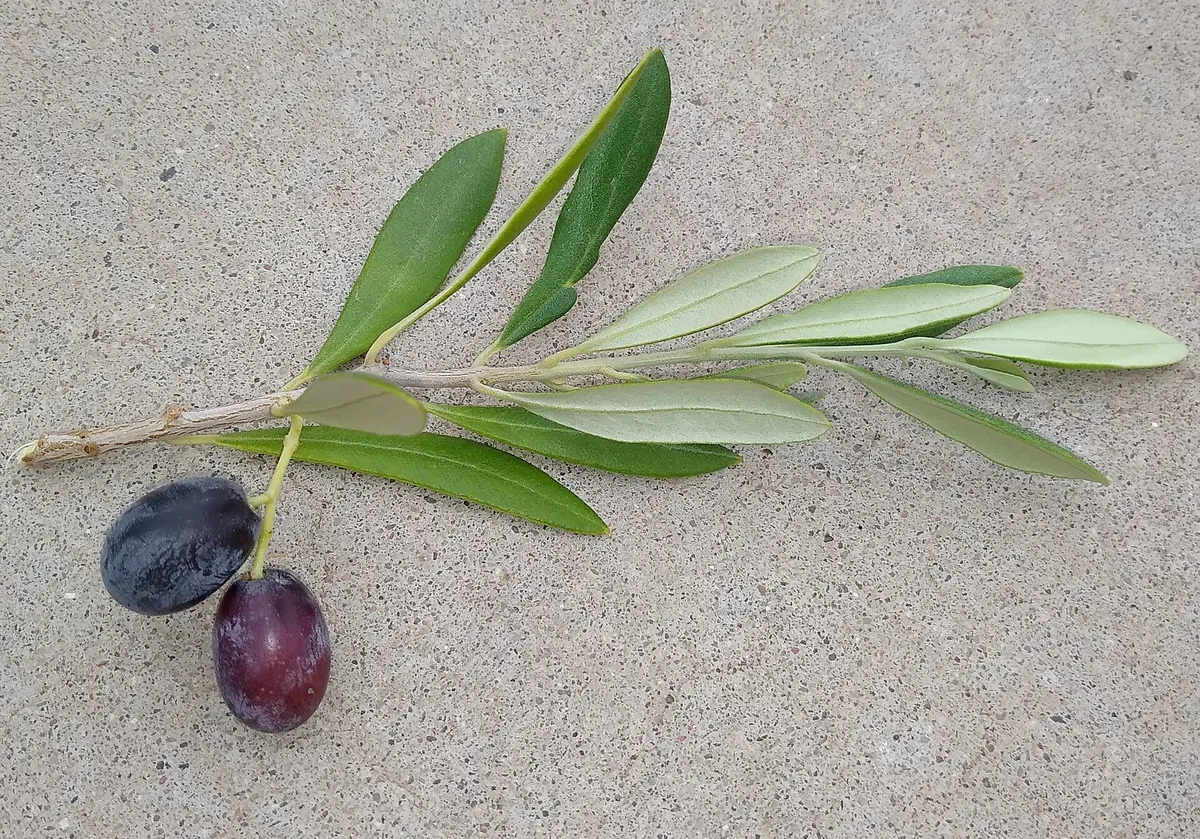
オリーブ Olea europaea の枝、葉、果実。葉の表裏で緑色と銀白色の見え方が異なる。
写っているもの: Olea europaea部位・状態: 枝についた葉と果実
写真: Prahlad balaji/ CC BY-SA 4.0/ 原画像/ 台帳の原画像
写真の範囲と来歴
被写体の確認: 原典の記載による同定。種名は Commons の原典記載による。
掲載画像: Wikimedia Commons の1920px版。苦味研究所では切り抜き・色調変更なし。 表示用には幅1200px上限のWebPを配信し、台帳の原画像は上のリンクから確認できます。
On this page (8 sections)
Reading the bitterness
Olives may bring fruit or oil to mind, but this entry concerns the long, narrow, silver-green leaves covering the branches. Rather than being eaten directly, leaves can be dried, crushed, and steeped in water as a drink ingredient. The study compared infusions made from leaves ground to different degrees, not the taste of an intact fresh leaf. The leaf itself must be distinguished from the flavor transferred to water after processing.
Grinding fineness can substantially alter that flavor. In a study with 13 untrained panelists, finer grinding increased oleuropein in the infusion, and the most finely ground sample was rated very bitter and more astringent. Bitterness is a taste, whereas astringency is a tightening, drying sensation in the mouth; the experiment measured them as separate attributes.
When the extract is added to food, the surrounding flavors also matter. In a fruit-smoothie test by 11 trained panelists, olive-leaf extract produced strong bitterness even at a low addition level. At a higher addition level, sucrose and cyclamate reduced bitterness, while salt showed no comparable effect. These results concern a particular extract and beverage, not a universal mixing rule for home leaf teas.
Drying method also changes the taste of the infusion. Herbal tea brewed from microwave-dried leaves (400 W for 4 minutes) was rated 「より苦く、より渋い」 (in translation: "more bitter and more astringent") than tea from hot-air-dried leaves (50°C for 3 hours) in descriptive sensory analysis. On a consumer acceptability test using a 9-point hedonic scale, taste scores were about 5.8 for the hot-air-dried tea and about 2.5 for the microwave-dried tea; consumers clearly preferred the hot-air-dried herbal tea.
The study's discussion links stronger bitterness to total polyphenols being about 3 times higher after microwave drying than hot-air drying (approximately 3.0 mg/L GAE versus 1.0 mg/L GAE), along with an accompanying increase in oleuropein. The authors describe oleuropein as the most abundant phenolic compound in olive leaves and as a cause of their bitterness.
Sources for this overview
Checked for this overview: The study design comparing infusions from leaves ground to different degrees. / The separately assessed results for oleuropein, bitterness, and astringency.
Checked for this overview: The trained-panel study measuring bitterness of fruit smoothies containing the extract. / The comparison of bitterness-masking effects of sweeteners and salt.
Checked for this overview: The differences in bitterness, astringency, and liking scores by drying method. / The discussion attributing bitterness to total polyphenols and oleuropein.
Follow the connections
olive leaf →contains→ oleuropein →is a major cause of→ bitterness
Structured claims — open a section to read each claim's confidence, evidence and limits
Composition and content (1)
Scope: Layer: food. A discussion passage that links measurement of total polyphenol content in olive-leaf herbal tea (infusion) with sensory analysis.
Note: With microwave drying, total polyphenol content (TPC) increased to about 3 times that of hot-air drying (MWD approx. 3.0 mg/L GAE vs. AD approx. 1.0 mg/L GAE), corresponding to a sensory increase in bitterness. Beyond the existing compound-oleuropein claim (declining content with plant age), this adds oleuropein's positioning as the bitter principle itself.
Show data
ingredient-olive-leaf —contains→ compound-oleuropeinHow processing and cooking change it (1)
Scope: Layer: food. Olive-leaf infusion (herbal tea); a trained descriptive sensory panel and consumer acceptability testing (9-point hedonic scale, 1 = dislike extremely through 9 = like extremely).
Show data
ingredient-olive-leaf —has_perceived_bitterness_affected_by→ "Drying method (hot air versus microwave). Herbal tea from microwave-dried leaves (400 W for 4 minutes) was rated 「より苦く、より渋い」 (in translation: "more bitter and more astringent") than tea from hot-air-dried leaves (50°C for 3 hours) by descriptive sensory analysis. Taste scores in consumer acceptability testing (9-point hedonic scale) were about 5.8 for hot-air drying and about 2.5 for microwave drying."Culture (1)
Scope: A candidate at the level of general knowledge. Regional and naming differences have not been confirmed.
No source connected — this claim has not been verified yet. It is a general-knowledge placeholder, not a confirmed statement.
Show data
ingredient-olive-leaf —is_used_as→ "A vegetable/ingredient carrying bitterness"