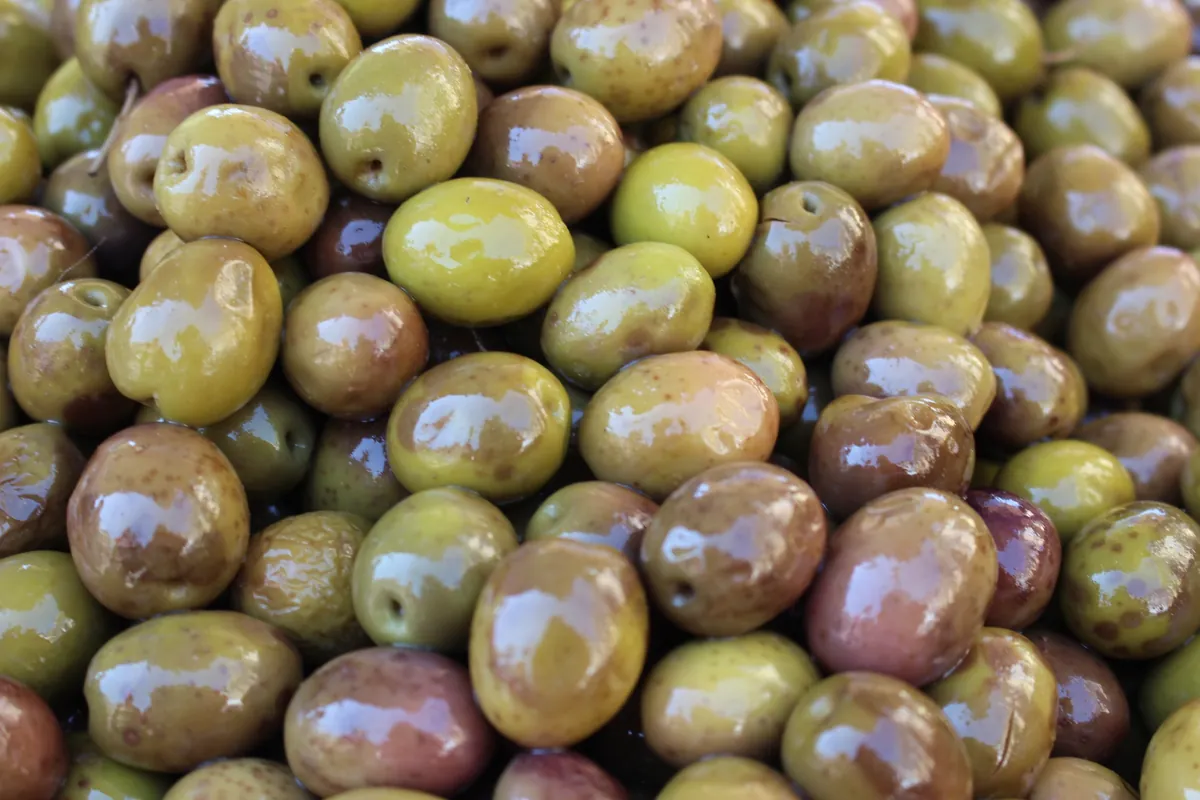
新鮮な核果は verbatim で 'characterized by a strong bitter taste that decreases with fruit ripening' であり、'the bitter oleuropein that diminishes during maturation' を含む。オレウロペインは一部の最終製品でも測定可能なまま残る('The highest oleuropein content was found on dry-salted Throuba Thassos olives')。
対照区と無菌処理区ではオレウロペインが1か月で完全に消失した一方、加熱処理して保存した果実では6か月間安定だった——内在性酵素の失活が脱苦味の進行を止めることを示す。 逐語: 「After one month, the oleuropein completely disappeared in both the control olives (C) and those treated aseptically (S), while this substance remained stable for six months in olives which were heat treated and preserved aseptically (S-P). ... the fruits (S-P)」
文脈: 加熱区では HyEDA の生成が両温度で観察されず、一方でヒドロキシチロソールとチロソールは全区で検出された——β-グルコシダーゼとエステラーゼで熱への強さが異なる。 逐語: 「Two temperatures were tested, 60 and 90 ºC, and the heating time was 10 and 30 min, respectively. ... The formation of HyEDA was not observed in heat-treated fruits at both temperatures. By contrast, hydroxytyrosol and tyrosol were detected in all the olives, 」
逐語: "Three distinct phases are distinguishable in the development and ripening of olive fruit: a growth phase, during which accumulation of oleuropein occurs; a green maturation phase that coincides with a reduction in the levels of chlorophyll and oleuropein; and a black maturation phase that is characterized by the appearance of anthocyanins and flavonoids and during which the oleuropein levels continue to fall." 続けて: "Oleuropein is very abundant in the early stages of fruit development; in young fruit it can reach 14% of dry matter." および "In general, levels of oleuropein decrease in olive pulp during maturation." 一方、成熟果肉の一般的水準は "levels of oleuropein are generally above 3 g/kg (dry weight) and average ∼4.5 g/kg (dry weight)" と記述される。
注記: 組織別(果皮/種子周辺 vs 果肉全体)の定量比較データはこの総説の当該記述には示されていない。定性的な局在記述にとどまる。
逐語: "In olive leaf and fruit the primary bitter phenolics, oleuropein and ligstroside, are accumulated as a defense mechanism against pathogens and herbivores. In general, olive phenolics are localized in the skin and around seed structures."
逐語: "Ortega-Garcia et al. found significantly higher concentrations of oleuropein in olive leaves collected at the early stage of fruit maturation than in 40-day-older leaves. The oleuropein levels remained constant until olive leaves were 120 days old." および "Laguerre et al. found significant changes in the phenolic profile between 1-year-old and 3-year-old Picholine olive leaves. Younger olive leaves contain higher levels of oleuropein, ligstroside, and flavonoid aglycones, whereas mature leaves have higher levels of verbascoside, oleuroside, and the glycosylated form of luteolin."
限界: 一次文献(Ortega-Garcia et al., Laguerre et al.)を直接確認していない。レビューの引用の正確性に依拠する。
注記: マイクロ波乾燥で総ポリフェノール量(TPC)が熱風乾燥の約3倍(MWD 約3.0 mg/L GAE vs AD 約1.0 mg/L GAE)に増え、官能的な苦味増大と対応づけられた。既存の compound-oleuropein 関連主張(生育齢による含量低下)とは別に、苦味本体としての位置づけを追加。
"This difference could be associated with the higher content of total polyphenols, and consequently oleuropein, the most abundant phenolic compound in olive leaves and responsible for their bitter taste." MWD herbal teas showed TPC ~3.0 mg/L GAE than AD ones ~1.0 mg/L GAE(本文逐語および図1の数値)。
このレビューはオレウロペインを逐語的に 'the bitter oleuropein that diminishes during maturation' と呼び、オリーブを 'characterized by a strong bitter taste that decreases with fruit ripening' と記述している。