amaro (bitter liqueur type)
ingredient / ingredient-amaro
アマーロ
Amaro (bitter liqueur type) is a general class of bittersweet liqueurs made by steeping herbs, bark, citrus peel, and other materials; the Italian name means "bitter". Under EU law it may correspond to "bitter-tasting spirit drink or bitter" (Regulation 2019/787, Annex I, category 30) or to a liqueur (category 33). Individual styles with a legal definition or sufficient sources, such as fernet, are treated separately.
Photographs (captions in Japanese)
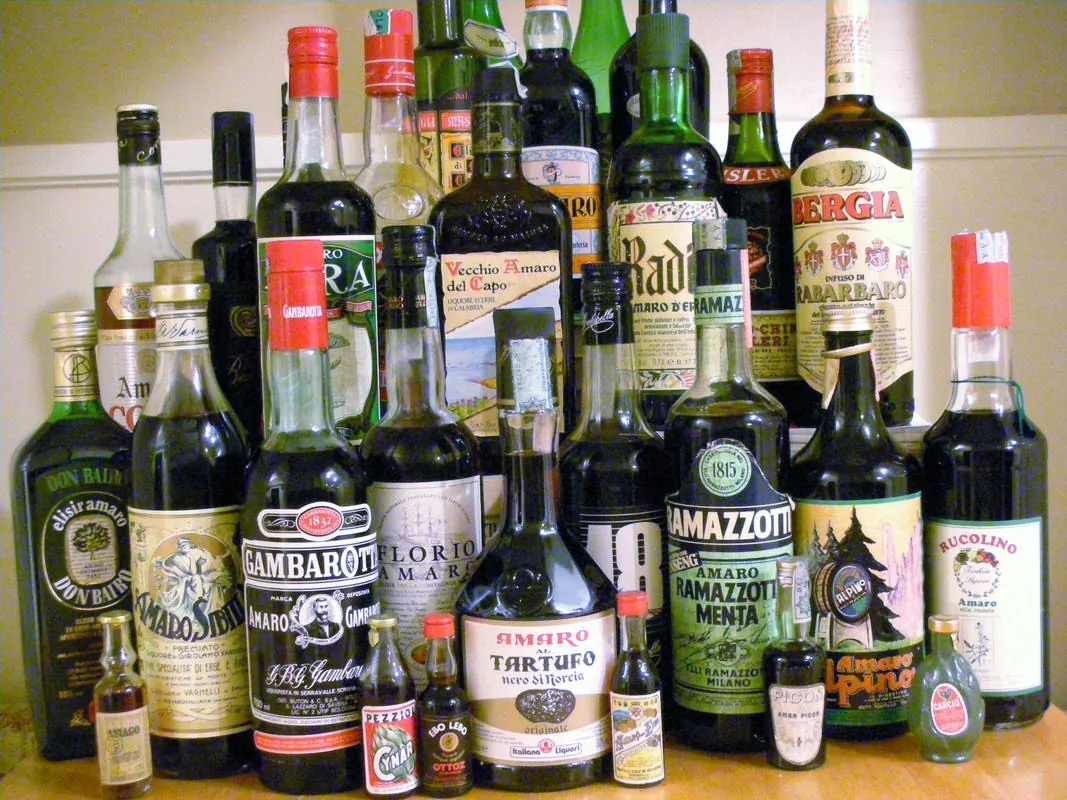
アマーロ(苦味系リキュール)。イタリア各地の銘柄の瓶を集めて並べた一例で、Amaro Gambarotta、Vecchio Amaro del Capo、Amaro Ramazzotti など多様な製法・処方の製品が含まれる。個々の銘柄の配合や産地は写真からは判別できない。
写っているもの: 該当分類群なし(市販アマーロ各銘柄の瓶)部位・状態: Gambarotta、Vecchio Amaro del Capo、Ramazzotti、Florio Amaro など、複数銘柄の瓶入りアマーロ(イタリアの苦味系リキュール)を未開封のまま並べた状態
写真: Steven E. Pav (Shabbychef)/ CC BY-SA 3.0/ 原画像/ 台帳の原画像
写真の範囲と来歴
被写体の確認: 原典の記載による同定。原典キャプションは撮影者の私物コレクションの紹介文のみで、個別銘柄の産地・製法の記載はない。写真は複数銘柄の集合であり、特定の一銘柄をアマーロ全体の標準形とはみなさない。
掲載画像: Wikimedia Commons の原寸版。苦味研究所では切り抜き・色調変更なし。 表示用には幅1200px上限のWebPを配信し、台帳の原画像は上のリンクから確認できます。
On this page (8 sections)
Reading the bitterness
Amaro is a general name for bittersweet liqueurs made by steeping herbs, bark, citrus peel, and similar materials; the word comes from Italian for 「苦い」 (in translation: "bitter"). This category also includes individual brands such as Campari and Aperol and derivative styles such as fernet. Under EU spirits rules, such drinks may correspond to the category 「苦味が支配的な味のスピリッツ飲料」 (in translation: "spirit drink with a predominantly bitter taste"), made by flavoring agricultural ethanol or spirits, with a minimum alcohol content of 15%.
Under EU rules for liqueurs, the general minimum sugar addition is 100 g/L expressed as invert sugar, while the minimum is reduced to 80 g/L for a liqueur flavored exclusively with bitter plants such as gentian root or wormwood. This illustrates that liqueurs foregrounding bitterness are treated separately in regulation.
In meals, amaro is drunk as an aperitivo or, more often, after the meal. The category 「食後酒」 (in translation: "after-dinner drink") is cultural and does not imply a physiological effect such as promoting digestion. A study of Italian food culture likewise groups these drinks among beverages made from edible plants because they are often regarded as part of the close of a meal.
Sources for this overview
Checked for this overview: Checked the EU category for bitter spirits and its 15% minimum alcohol content. / Checked the 80 g/L minimum sugar addition for liqueurs flavored only with gentian or wormwood.
Checked for this overview: Checked general use as an aperitivo or after-dinner drink.
Checked for this overview: Checked the study's description of after-dinner drinks as part of the close of a meal.
Other names: amaro (it)
Follow the connections
Aperol →is a type of→ amaro (bitter liqueur type)
amaro (bitter liqueur type) →has a defining sensory theme→ bitterness →can be measured separately …→ astringency
amaro (bitter liqueur type) →is graded by→ bitter-tasting spirit drink or bitter
Hypotheses and recipe candidates for this entry are on the Japanese page.
Structured claims — open a section to read each claim's confidence, evidence and limits
Safety and regulation (3)
Scope: EU. Regulation (EU) 2019/787, Annex I, category 30, (a)-(d).
Note: The word "amaro" itself does not appear in the English statutory text (confirmed by full-text search). The mapping between the category name "amaro" and this EU category is an editorial arrangement on our part, not a legal synonym.
Show data
ingredient-amaro —corresponds_in_eu_law_to→ ""Bitter-tasting spirit drink or bitter" = a spirits product (minimum 15% ABV) with a "predominantly bitter taste," produced by flavouring ethyl alcohol of agricultural origin or a distillate, or both. The term "bitter" is also permitted on the labelling of bitter-tasting liqueurs. (The word amaro itself does not appear in the statutory text; the correspondence drawn here is an editorial mapping, not one made by the law.)"Scope: EU. Regulation (EU) 2019/787, Annex I, category 33 (a)(i). An example of the law explicitly distinguishing liqueurs made with bitter botanicals (gentian, wormwood).
Note: Recorded as a reference to bitter-botanical liqueurs (including the amaro type). This is a provision for liqueurs in general, not a direct reference to "amaro."
Show data
ingredient-amaro —has_reduced_eu_sugar_minimum_when_flavoured_with_bitter_botanicals→ "The minimum sugar content for liqueurs is normally 100 g/L (expressed as invert sugar), but for liqueurs flavoured exclusively with gentian or a similar plant, or with wormwood, this is lowered to 80 g/L."Scope: The correspondence between the Italian colloquial term "amaro" and the "bitter" category under EU law. The English-language text of the regulation itself does not use the word "amaro".
Note: This makes explicit, in claims.csv and on the basis of checking the regulation's text, an arrangement already present in the description of the existing ingredient-amaro entry.
Show data
ingredient-amaro —is_classified_by→ concept-eu-bitter-spirit-categoryCulture (6)
Scope: general usage in an Italian-language encyclopedia and an ethnobotanical survey
Note: Digestivo is treated as a cultural category and does not imply a digestion-promoting effect.
Show data
ingredient-amaro —is_consumed_in→ "a mealtime position of being taken before the meal, or more often after it"Scope: Treccani vocabulary dictionary, entry "amaro," sense 2.b.
Show data
ingredient-amaro —is_defined_in_dictionary_as→ "The Treccani vocabulary dictionary defines amaro (also called bitter) as a beverage obtained from various bitter botanical materials, used as an aperitivo for its eupeptic properties (which the dictionary describes as aiding digestion), or, when higher in alcohol content, as a digestivo."Scope: The Aperol official FAQ (the company's own description).
Note: The English rendering "little bitter" is the company's own paraphrase, not a literal translation of amaro (which in Italian simply means "bitter"). We do not judge the accuracy of this paraphrase and record it as-is, as the company's own self-description.
Show data
ingredient-aperol —is_a_type_of→ ingredient-amaroScope: A cross-brand comparison of the official company sites and product labels of the 5 brands covered in this section.
Note: A cross-cutting observation across 5 brands and 6 sources, not the claim of a single source. Whether the marketing vocabulary choice is a deliberate strategy is not stated explicitly by any official source; we flag this as our own interpretation with claim_status=observation and do not generalize it into a rule.
Show data
ingredient-amaro —are_not_uniformly→ "Even among official company pages for brands within the same "amaro" category, self-description of bitterness is not uniform. The official pages of Campari, Aperol, and Cynar each contain places that explicitly use the words "bitter" or "amaro" (bitter), whereas the word "bitter" (or its equivalent) never appeared in the official-page text we were able to check for Amaro Montenegro (gruppomontenegro.com / amaromontenegro.us) or Vecchio Amaro del Capo (vecchioamarodelcapo.com)."Scope: An interview article in New York beverage-industry media.
Note: Erica O'Neal (Wine Director, Italienne, New York) is quoted as saying “It's kind of a palate cleanser, and at the end of a meal or at the end of a shift, amaro is probably the most satisfying thing to have”. Attribution records her name, role, and restaurant as stated in the article. This is an individual industry participant's statement, not a claim by NIGAMI LAB.
Show data
ingredient-amaro —has_cultural_role_of→ "A sommelier describes it as a 『パレットクレンザー』 (in translation: "palate cleanser") that resets the palate at the end of a meal or shift, and as the most satisfying drink at that moment."Scope: An interview article in beverage-industry media.
Note: Sother Teague (Beverage Director, Overthrow Hospitality / Amor y Amargo, New York) is quoted as saying “for me the defining characteristic of a digestive is an obvious bitter quality”. Attribution records his name, role, and restaurant as stated in the article. This is an individual industry participant's statement, not a claim by NIGAMI LAB.
Show data
ingredient-amaro —has_defining_sensory_theme→ sensation-bitter