日本語版

cheese

ingredient / ingredient-cheese

チーズ

Cheese is a ripened dairy product in which chymosin and proteinases and peptidases from starter cultures drive both the generation and breakdown of bitter peptides through casein degradation.

Photographs (captions in Japanese)
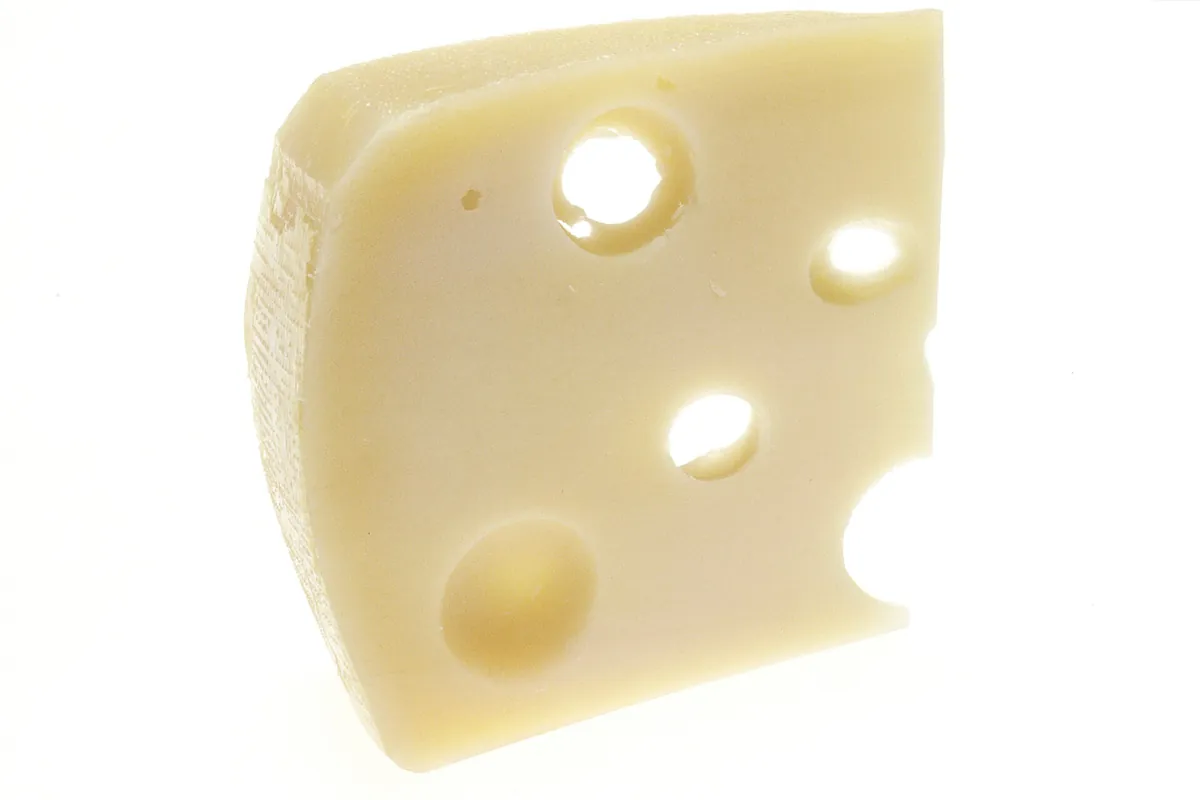
白背景の上に置かれた、いくつもの丸い気孔が空いた黄白色のチーズのくさび。表面は艶があり、側面には格子状のラベル跡が薄く残る。

チーズの一種(スイスタイプ、気孔のある熟成チーズ)をくさび形に切り分けた写真。白い背景の上で断面の気孔と側面が見える。特定の産地・銘柄を代表する写真ではない。

写っているもの: 該当分類群なし(スイスタイプ熟成チーズの断面)部位・状態: スイスタイプ(気孔=ホールのある)チーズのくさび形カット、断面と側面が見える状態

写真: Renee Comet (Photographer)/ Public domain/ 原画像/ 台帳の原画像

写真の範囲と来歴

被写体の確認: 原典の記載による同定。原典は米国国立がん研究所(NCI)提供の一般的な「チーズ」写真で、品種名・産地の記載なし。「cheese」という広い名称全体の標準形として扱わない。

掲載画像: Wikimedia Commons の1920px版。苦味研究所では切り抜き・色調変更なし。 表示用には幅1200px上限のWebPを配信し、台帳の原画像は上のリンクから確認できます。

On this page (7 sections)
  1. Overview
  2. Sources for this overview (7)
  3. Topic hubs
  4. Follow the connections
  5. Related entries (10)
  6. Sensory (8)
  7. How processing and cooking change it (9)
↑

Reading the bitterness

The bitterness of aged cheese is described as arising in part from peptides (fragments of several linked amino acids) formed when casein, a milk protein, breaks down. A study of the water-soluble fraction of aged Gouda identified 16 bitter peptides derived from casein, of which 11 were from β-casein and 6 from αs1-casein. Another study of aged sharp Cheddar identified the 5 peptides with the greatest bitterness intensity; all were derived from β-casein.

However, the concentration of any individual peptide alone does not strongly account for bitterness intensity. In reduced-fat Cheddar, correlations between concentrations of individual peptides and trained-panel bitterness scores were limited to r=0.56–0.58, whereas an index combining two peptides reached r=0.84. The authors also acknowledge that other peptides may contribute to bitterness. Cheese bitterness cannot be attributed to a single peptide.

Consistent with this view, a reconstructed model made by adding 5 peptides at the same concentrations to young mild Cheddar was reported not to differ significantly in bitterness intensity from authentic aged sharp Cheddar. One peptide, GPVRGPFPIIV, increased 28.7-fold during aging and is described as a major contributor to bitterness. Another study reported a correlation of 0.803 at 180 days of aging between the concentration of a related β-casein-derived peptide and trained-panel bitterness ratings. By 270 days, however, the correlation had fallen to 0.554; the authors raised the possibility that other bitter peptides or bitterness-mitigating compounds were involved.

Cheese bitterness also depends on the type of enzyme carried by the lactic starter. In an experiment with reduced-fat Cheddar, cheeses were made with Lactococcus lactis strains differing in the specificity of lactocepin, an extracellular proteinase, and a trained panel of 14 rated bitterness. Cheese made with a strain lacking the proteinase scored 1.8, whereas cheeses made with strains carrying lactocepin scored 3.5–4.7; the difference was statistically significant at 6 months of aging. This was a model experiment using reduced-fat cheese and single-strain starters, however, and may not apply directly to ordinary cheeses.

In an exploratory experiment on bitterness-masking activity targeting cheese, among 71 commercial brands the natural white-mold-type Baraka cheese showed the strongest activity. In a sensory test in which Baraka was eaten immediately before taking a sip of beer, the weakening of bitterness was greater than with any of Gouda, Brie, or Ricotta, and when the free-fatty-acid concentrations of the 4 cheeses were compared, the total concentration was also higher in the order of stronger activity. When Baraka's oil was fractionated, the fraction whose main component was free fatty acids masked quinine's bitterness most strongly, and the same suppressive effect was confirmed with a mixture that mimicked the cheese's fatty-acid composition.

Home-cooking practices that combine cheese with bitter leafy greens are also recorded. A recipe introduction for a salad combining watercress with roasted almonds and Parmigiano mentions the combination of watercress's bitterness and the almonds' toasty aroma, and states that Parmigiano's saltiness and umami are used to finish the dish without adding salt. A recipe introduction for a dish in which shungiku (garland chrysanthemum) is dressed with grated cheese and ground sesame states that the cheese mellows the bitterness of the shungiku. Both are the cooks' own introductions and are not experiments that measured the interaction of bitterness and umami.

Sources for this overview

  1. Sensomics mapping and identification of the key bitter metabolites in Gouda cheese

    Toelstede S; Hofmann T / 2008 / journal article / abstract checked

    Checked for this overview: Checked the identification of 16 bitter peptides in aged Gouda and the breakdown by casein origin.

  2. Identification of bitter peptides in aged cheddar cheese

    Karametsi K; Kokkinidou S; Ronningen I; Peterson DG / 2014 / journal article / abstract checked

    Checked for this overview: Checked that the 5 most intensely bitter peptides identified in aged Cheddar were derived from β-casein. / Checked the reconstruction experiment finding no significant bitterness difference between the 5-peptide model and the authentic cheese.

  3. Contribution of Lactococcus lactis cell envelope proteinase specificity to peptide accumulation and bitterness in reduced-fat Cheddar cheese

    Broadbent JR; Barnes M; Brennand C; Strickland M; Houck K; Johnson ME; Steele JL / 2002 / journal article / full text checked

    Checked for this overview: Checked the difference in correlations for single-peptide and combined-peptide indicators. / Checked the differences in bitterness scores among lactocepin specificity groups.

  4. Relationship between MALDI-TOF analysis of beta-CN f193-209 concentration and sensory evaluation of bitterness intensity of aged cheddar cheese

    Soeryapranata E; Powers JR; Fajarrini F; Weller KM; Hill HH Jr; Siems WF 3rd / 2002 / journal article / abstract checked

    Checked for this overview: Checked how correlations between a single peptide's concentration and bitterness changed with aging time.

  5. Identification of bitterness-masking compounds from cheese

    Homma Ryousuke; Yamashita Haruyuki; Funaki Junko; Ueda Reiko; Sakurai Takanobu; Ishimaru Yoshiro; Abe Keiko; Asakura Tomiko / 2012 / journal article / full text checked

    Checked for this overview: Used for the screening of 71 brands, the sensory comparison of 4 cheeses against beer, and the correspondence with free-fatty-acid concentration / Used for the figures on quinine bitterness suppression by the fatty-acid fraction and the mixed fatty-acid solution

  6. クレソンとアーモンド、チーズのサラダ

    小川聖子 / 2020 / other / full text checked

    Checked for this overview: Used for the quotation from the recipe introduction for watercress, almonds, and Parmigiano

  7. 春菊のごまチーズあえ

    みないきぬこ / 2019 / other / full text checked

    Checked for this overview: Used for the quotation from the introduction to the shungiku dressed with sesame and cheese

Follow the connections

cheese →— bitterness derives in par…→ bitter peptides

bitterness →reduces taste preference for→ cheese

cheese →has a defining sensory theme→ bitterness →can be measured separately …→ astringency

Hypotheses and recipe candidates for this entry are on the Japanese page.

Structured claims — open a section to read each claim's confidence, evidence and limits

Sensory (8)

cheese — bitterness derives in part from: bitter peptidessupported

Scope: Aged Gouda and aged sharp Cheddar (water-soluble extracts).

Note: The explanatory power of any single peptide alone is limited: in Broadbent 2002, the correlation between a single peptide's concentration and the bitterness score stayed at r=0.56-0.58, versus r=0.84 for a combined 2-peptide index (see limits).

A total of 16 bitter peptides were identified from the water-soluble fraction of aged Gouda. All derive from casein proteolysis: 11 are previously unreported β-casein-derived peptides (including 6 derived from β-CN(57-69) and 2 from β-CN(198-206), among others), and 6 are derived from αs1-casein.
Limitations: The abstract does not give sample details such as the cheese's ripening period or origin.
Source: Sensomics mapping and identification of the key bitter metabolites in Gouda cheese (Toelstede S; Hofmann T, 2008) · abstract checked
As the compounds responsible for the bitterness of aged sharp Cheddar, the 5 peptides with the highest bitterness intensity (all derived from β-casein) were identified by de novo sequencing.
Limitations: A corrigendum was issued in 2019 (contents not checked). The abstract gives no absolute values for concentration or threshold.
Source: Identification of bitter peptides in aged cheddar cheese (Karametsi K; Kokkinidou S; Ronningen I; Peterson DG, 2014) · abstract checked
Limits: The correlation between individual peptide concentration and bitterness score was weak (r=0.56-0.58), rising to r=0.84 for a combined index of αs1-CN f1-9 and β-CN f193-209. The authors state "Although other peptides certainly contribute to bitterness," explicitly noting the existence of unmeasured contributors to bitterness.
Limitations: This is a constraint on any claim in general that attributes cheese bitterness to a single peptide. The regression is from a reduced-fat model system.
Source: Contribution of Lactococcus lactis cell envelope proteinase specificity to peptide accumulation and bitterness in reduced-fat Cheddar cheese (Broadbent JR; Barnes M; Brennand C; Strickland M; Houck K; Johnson ME; Steele JL, 2002) · full text checked
Show dataingredient-cheese —derives_bitterness_in_part_from→ compound-class-bitter-peptides
claim: clm-cheese-bitterness-casein-peptides / type: sensory / updated: 2026-08-30
bitter peptides reconstitute the bitterness of cheesesupported

Scope: Aged sharp Cheddar versus young mild Cheddar. A taste-reconstitution experiment.

Note: The sequences are as given in the abstract (residue numbers are not written because they are not given in the abstract).

During ripening, GPVRGPFPIIV, YQEPVLGPVRGPFPI, and MPFPKYPVEP increased 28.7-fold, 3.1-fold, and 1.8-fold respectively; APHGKEMPFPKYPVEPF was detected only in sharp Cheddar; and MAPKHKEMPFPKYPVEPF was unchanged. A mild Cheddar model with the 5 peptides added at matched concentrations showed no significant difference in bitterness intensity from real sharp Cheddar. The main contributor was GPVRGPFPIIV.
Limitations: The abstract does not give absolute concentration values or panel details.
Source: Identification of bitter peptides in aged cheddar cheese (Karametsi K; Kokkinidou S; Ronningen I; Peterson DG, 2014) · abstract checked
In aged Cheddar, the concentration of the β-casein C-terminal bitter peptide β-CN f193-209, quantified by MALDI-TOF, correlated with the bitterness intensity rated by a trained panel: the correlation coefficient was 0.803 at 180 days and 0.554 at 270 days. That is, an independent group has quantitatively linked the β-casein C-terminal peptide to Cheddar bitterness, which is consistent with the results of the reconstitution experiment in which β-casein-derived peptides (including the f193-209 fragment) reconstituted the bitterness of sharp Cheddar.
Limitations: This is only a correlation, and only a single peptide was tracked; the authors attribute the drop in correlation at 270 days to other bitter peptides or masking compounds, which itself constrains attribution to a single peptide. The abstract gives no panel details.
Source: Relationship between MALDI-TOF analysis of beta-CN f193-209 concentration and sensory evaluation of bitterness intensity of aged cheddar cheese (Soeryapranata E; Powers JR; Fajarrini F; Weller KM; Hill HH Jr; Siems WF 3rd, 2002) · abstract checked
Show datacompound-class-bitter-peptides —reconstitute_bitterness_of→ ingredient-cheese
claim: clm-cheddar-bitter-reengineering / type: sensory / updated: 2026-08-30
cheese — bitterness develops depending on: Fresh cheese made from high-protein concentrated milk fermented with extracellular-proteinase (PrtP)-positive Lactococcus lactis strains (LTH 7123, LTH 7122) showed bitterness scores of 3.9 and 4.1 (0 = no bitterness to 5 = extremely bitter; panel n≥12, i=2 replicates), significantly higher (p<0.05) than the 1.7 and 2.8 scores of cheese made with PrtP-negative strains (LTH 7117, LTH 7112). Cheese made with the PrtP-negative strains was also more bitter than a commercial fermented concentrated fresh-cheese reference product (FCo, bitterness 0.5). A control cheese acidified directly without fermentation (CoF) was rated at bitterness 1.0 (very slightly bitter), and there was no significant difference between CoF and FCo.supported

Scope: Experimental fresh cheese (CoF) made using reconstituted casein concentrated-milk media (protein 3.4% and 8.5% w/v). Sensory evaluation by a trained bitterness panel.

Note: This paper's conclusion section summarizes that "the PrtP-negative strains did not produce bitterness," but this is at odds, in the strength of the assessment, with the figures in the results section (see the corresponding evidence's limits line).

CoF fresh cheese fermented with PrtP-positive strains (LTH 7122, 7123) scored bitterness 3.9 and 4.1; PrtP-negative strains (LTH 7117, 7112) scored 1.7 and 2.8 (0-5 scale). Cheese made with PrtP-positive strains was significantly more bitter than that with PrtP-negative strains or the control (p<0.05).
Limitations: There was no significant difference between the non-fermented, directly acidified control (CoF control) and the commercial reference product (FCo).
Source: Effects of Protein, Calcium, and pH on Gene Transcription, Cell-Envelope Peptidase Activity of Lactococcus lactis Strains, and the Formation of Bitter Peptides (Forler B; Horstmann G; Schäfer J; Michel C; Weiss A; Stressler T; Fischer L; Hinrichs J; Schmidt H, 2021) · full text checked
Limits: The conclusion section summarizes that "the prtP-negative strains did not introduce bitterness," but in the results section's figures, cheese made with the PrtP-negative strains (especially LTH 7117) was also more bitter than the commercial fermented reference FCo (0.5) and was rated "slightly bitter" (the non-fermented, directly acidified control CoF was 1.0). There is a mismatch in the strength of the wording between the summary and the results text.
Source: Effects of Protein, Calcium, and pH on Gene Transcription, Cell-Envelope Peptidase Activity of Lactococcus lactis Strains, and the Formation of Bitter Peptides (Forler B; Horstmann G; Schäfer J; Michel C; Weiss A; Stressler T; Fischer L; Hinrichs J; Schmidt H, 2021) · full text checked
Show dataingredient-cheese —develops_bitterness_depending_on→ "Fresh cheese made from high-protein concentrated milk fermented with extracellular-proteinase (PrtP)-positive Lactococcus lactis strains (LTH 7123, LTH 7122) showed bitterness scores of 3.9 and 4.1 (0 = no bitterness to 5 = extremely bitter; panel n≥12, i=2 replicates), significantly higher (p<0.05) than the 1.7 and 2.8 scores of cheese made with PrtP-negative strains (LTH 7117, LTH 7112). Cheese made with the PrtP-negative strains was also more bitter than a commercial fermented concentrated fresh-cheese reference product (FCo, bitterness 0.5). A control cheese acidified directly without fermentation (CoF) was rated at bitterness 1.0 (very slightly bitter), and there was no significant difference between CoF and FCo."
claim: clm-cheese-prtp-strain-bitterness-sensory / type: sensory / updated: 2026-09-01
cheese — bitterness develops depending on: Cheddar cheese made with a nisin Z-producing strain (Lactococcus lactis subsp. lactis biovar diacetylactis UL719) incorporated into the starter showed increased sourness and bitterness in sensory evaluation compared with control cheese. The same strain increased the generation of both hydrophilic and hydrophobic peptides in the cheese's water extract.supported

Scope: Cheddar cheese, aged 6 months. Sensory evaluation was carried out at the 6-month point.

Cheddar cheese made with nisin Z-producing strain UL719 incorporated showed increased sourness and bitterness in sensory evaluation compared with control cheese, and both hydrophilic and hydrophobic peptides in the water extract increased.
Source: Impact of Nisin Producing Culture and Liposome-Encapsulated Nisin on Ripening of Lactobacillus Added-Cheddar Cheese (Benech RO; Kheadr EE; Lacroix C; Fliss I, 2003) · abstract checked
Show dataingredient-cheese —develops_bitterness_depending_on→ "Cheddar cheese made with a nisin Z-producing strain (Lactococcus lactis subsp. lactis biovar diacetylactis UL719) incorporated into the starter showed increased sourness and bitterness in sensory evaluation compared with control cheese. The same strain increased the generation of both hydrophilic and hydrophobic peptides in the cheese's water extract."
claim: clm-cheddar-nisin-starter-bitterness / type: sensory / updated: 2026-09-01
bitterness reduces taste preference for cheesesupported

Scope: Trained-panel sensory evaluation of 25 commercially available U.S. shredded Cheddar brands (2 lots each), followed by consumer preference ratings of 10 representative brands by 151 consumers; analyzed with analysis of variance, principal component analysis, and external preference mapping.

Note: Bitterness was identified as one driver of overall dislike. A powdery appearance also lowered appearance and overall liking ratings.

Bitterness was identified as one driver of overall dislike; a powdery appearance also lowered appearance and overall liking.
Limitations: Consumer clusters showed different preference patterns (a group rating all brands highly, a sharp-cheese preference group, and a mild-cheese preference group), so the size of the bitterness effect may not be uniform across clusters.
Source: Drivers of Liking for Cheddar Cheese Shreds (Meals SE; Schiano AN; Drake MA, 2020) · abstract checked
Show datasensation-bitter —reduces_taste_preference_for→ ingredient-cheese
claim: clm-cheddar-shred-bitterness-dislike-driver / type: sensory / updated: 2026-09-01
cheese has a defining sensory theme: bitternesssupported

Scope: A study relating sensory profiles before and after heating to physicochemical parameters in 4 categories of AOP/PDO blue cheeses from France's Massif Central: Fourme d'Ambert, Fourme de Montbrison, Bleu d'Auvergne, and Bleu des Causses. Along with saltiness and sourness, bitterness was recorded as one of the basic tastes distinguishing these 4 categories after heating, and correlations with physicochemical parameters were also shown.

Note: The paper does not describe bitterness as either a 『欠陥』 (in translation: "defect") or a 『望ましい風味』 (in translation: "desirable flavor"). It treats it neutrally as an attribute distinguishing categories; this entry likewise does not overstate its significance. No peer-reviewed paper addressing bitterness in Gorgonzola itself was found, so the study of French AOP cheeses is included as a related blue-cheese lineage (see the corresponding research lead).

The basic tastes saltiness, bitterness, and sourness were sensory attributes that distinguished 4 categories of French AOP blue cheese after heating; correlations with physicochemical parameters were also shown.
Limitations: The abstract does not call bitterness a 『望ましい』 (in translation: "desirable") attribute. It reports it only as useful for distinguishing categories.
Show dataingredient-cheese —has_defining_sensory_theme→ sensation-bitter
claim: clm-blue-cheese-bitterness-distinguishing-attribute / type: sensory / updated: 2026-09-01
cheese can reduce the perceived bitterness of bitternesssupported

Scope: Layer: food. A human sensory panel (n=7) using 4 commercial cheeses and beer. Baraka was selected through a preliminary screening of 71 cheese brands.

Note: The correspondence between the total free-fatty-acid concentration and masking activity is a descriptive trend across 4 samples, and the fatty-acid composition ratio itself was nearly the same among the 4 cheeses (all shared the feature that oleic acid, palmitic acid, myristic acid, and stearic acid accounted for 60% or more of total free fatty acids). Details of the 71-brand screening results themselves are in the Supporting Information, and the main text gives no figures.

Baraka was selected through a sensory screening of 71 commercial cheese brands. A sensory test (n=7, a 4-point categorical scale: strong 0 - medium 1 - weak 2 - very weak 3) was conducted with Baraka, Gouda, Brie, and Ricotta eaten together with beer, and the Steel-Dwass test gave Baraka vs. Gouda p=0.0159, vs. Brie p=0.0423, vs. Ricotta p=0.0077. The total free-fatty-acid concentrations in Table 3 were Baraka 12.15 mM, Brie 3.86 mM, Gouda 2.25 mM, and Ricotta 1.13 mM, and in each case oleic acid, palmitic acid, myristic acid, and stearic acid together accounted for 60% or more of the total.
Limitations: The figures for the 71-brand screening results themselves are in the Supporting Information and are not given in the main text. Note that the fatty-acid composition ratio of the 4 cheeses was nearly the same, and the main difference was in total concentration.
Source: Identification of bitterness-masking compounds from cheese (Homma Ryousuke; Yamashita Haruyuki; Funaki Junko; Ueda Reiko; Sakurai Takanobu; Ishimaru Yoshiro; Abe Keiko; Asakura Tomiko, 2012) · full text checked
Show dataingredient-cheese —can_reduce_perceived_bitterness_of→ sensation-bitter
claim: clm-cheese-baraka-masks-beer-bitterness / type: sensory / updated: 2026-09-26
cheese can reduce the perceived bitterness of bitternesssupported

Scope: Layer: solution (fractions of the cheese's oily extract; a mixture mimicking the cheese's fatty-acid composition). Human sensory evaluation (a method comparing against a 7-point scale of standard quinine solutions).

Note: The evaluation of the mixed fatty-acid solution had large variance among panelists (ANOVA F-test p=0.001). The authors cite the low solubility of the saturated fatty acids (myristic acid, palmitic acid, and stearic acid) as one cause. With oleic acid alone (0.5 mM), bitterness was suppressed down to the equivalent of 0.0032-0.0038%, and the variance among panelists was also small (F-test p=0.131) (a different part of the same experiment as the claim in the existing concept-taste-mixture-suppression entry).

The oily extract of Baraka cheese was separated by silica-gel column into 4 fractions (A: mainly triacylglycerol; B: 1,2-diacylglycerol; C: 1,3-diacylglycerol + 43.6% free fatty acids; D: monoacylglycerol), and when dissolved in 0.0080% QHCl and evaluated, fraction C showed the strongest bitterness-masking activity (Wilcoxon rank-sum test p<0.025). A 0.5 mM mixed fatty-acid solution mimicking the cheese's fatty-acid composition (OA 0.2 mM, palmitic acid 0.2 mM, myristic acid 0.05 mM, stearic acid 0.05 mM) suppressed the bitterness of 0.0080% QHCl down to the equivalent of 0.0049-0.0060% (ANOVA F-test, difference among panelists p=0.001). With 0.5 mM OA alone, suppression was down to the equivalent of 0.0032-0.0038% (F-test p=0.131).
Limitations: The mixed fatty-acid solution had a non-uniform suspension owing to the low solubility of the saturated fatty acids, so the evaluation variance among panelists was large. This is a result based on the oily extract of a single brand (Baraka).
Source: Identification of bitterness-masking compounds from cheese (Homma Ryousuke; Yamashita Haruyuki; Funaki Junko; Ueda Reiko; Sakurai Takanobu; Ishimaru Yoshiro; Abe Keiko; Asakura Tomiko, 2012) · full text checked
Show dataingredient-cheese —can_reduce_perceived_bitterness_of→ sensation-bitter
claim: clm-cheese-derived-fatty-acid-fraction-masks-quinine-bitterness / type: sensory / updated: 2026-09-26

How processing and cooking change it (9)

cheese — bitterness develops depending on: Specificity groups of Lactococcus lactis lactocepin (an extracellular proteinase). Against proteinase-negative-strain cheese (bitterness 1.8/9), groups a/e/h scored 3.5-4.7 (at 6 months, P<0.0001), with group h the most bitter.supported

Scope: 50% reduced-fat Cheddar, a single isogenic starter, a trained panel (n=14).

Note: A result from a model system (reduced-fat, single-strain starter). Extrapolation to ordinary cheese is limited.

Bitterness scores (0-9 scale) at 6 months: proteinase-negative PH=1.8, PHa=3.5, PHe=4.2, PHh=4.7. Cheese made with lactocepin-carrying strains was significantly more bitter than with the negative strain (P<0.0001), with group h the highest. αs1-CN f1-9 accumulation ran in parallel: 12.1 mg/g for PHh versus 2.9 mg/g for PH (at 6 months).
Limitations: A reduced-fat, single-strain model system. Even the authors limit extrapolation to commercial mixed starters to a suggestion based on the gene-exchange result.
Source: Contribution of Lactococcus lactis cell envelope proteinase specificity to peptide accumulation and bitterness in reduced-fat Cheddar cheese (Broadbent JR; Barnes M; Brennand C; Strickland M; Houck K; Johnson ME; Steele JL, 2002) · full text checked
Context: A follow-up genetic-engineering study: through a 2-step gene replacement, the substrate-binding determinants of prtP, which encodes "group h (bitter) lactocepin," were converted to the "group b (nonbitter) variant" in 2 industrial L. lactis strains. RP-HPLC of lactocepin activity against αs1-casein f1-23 confirmed the change in specificity, and there was no significant change in the milk's acid production or autolysis. The framework treating group h as the bitter type and group b as the nonbitter type puts the link between specificity group and bitterness into a form usable for strain improvement.
Limitations: This is the same research group as the 2002 cheese study, not an independent replication. The abstract reports only the conversion of enzyme specificity; it does not present cheesemaking or sensory bitterness data.
Source: Conversion of Lactococcus lactis cell envelope proteinase specificity by partial allele exchange (Broadbent JR; Rodríguez BT; Joseph P; Smith EA; Steele JL, 2006) · abstract checked
Show dataingredient-cheese —develops_bitterness_depending_on→ "Specificity groups of Lactococcus lactis lactocepin (an extracellular proteinase). Against proteinase-negative-strain cheese (bitterness 1.8/9), groups a/e/h scored 3.5-4.7 (at 6 months, P<0.0001), with group h the most bitter."
claim: clm-starter-lactocepin-bitterness / type: processing / updated: 2026-08-30
cheese can be debittered by: A proposed strategy of deliberately selecting and combining PrtP-positive and PrtP-negative Lactococcus lactis starter strains. The authors only propose this for future investigation; the paper itself did not experimentally test this combination design.preliminary

Scope: A proposal envisaging high-protein fermented dairy products, including concentrated fresh cheese.

Note: Based on the statement 『a sensible selection and combination of prtP-positive and -negative starter strains might be a useful tool...and should be investigated in future studies』. This is not a demonstrated method.

Context: The authors propose for future investigation that 『PrtP陽性株とPrtP陰性株を賢く選択・組み合わせることが高タンパク乳製品の苦味問題を克服する有用な手段となりうる』 (in translation: "judicious selection and combination of PrtP-positive and PrtP-negative strains could be a useful means of overcoming bitterness problems in high-protein dairy products").
Limitations: This combination design was not experimentally tested in this paper; it remains an author proposal.
Source: Effects of Protein, Calcium, and pH on Gene Transcription, Cell-Envelope Peptidase Activity of Lactococcus lactis Strains, and the Formation of Bitter Peptides (Forler B; Horstmann G; Schäfer J; Michel C; Weiss A; Stressler T; Fischer L; Hinrichs J; Schmidt H, 2021) · full text checked
Show dataingredient-cheese —can_be_debittered_by→ "A proposed strategy of deliberately selecting and combining PrtP-positive and PrtP-negative Lactococcus lactis starter strains. The authors only propose this for future investigation; the paper itself did not experimentally test this combination design."
claim: clm-cheese-prtp-strain-combination-proposed / type: processing / updated: 2026-09-01
cheese can be debittered by: An integrated culture system combining 3 starter strains (Lactococcus lactis subsp. cremoris SK11, L. lactis subsp. lactis biovar diacetylactis JVI, and Lactobacillus casei 7A), with SK11 selected as the primary acid-producing strain. Cheese made with SK11 had markedly lower bitterness intensity than cheese made with a commercial Cheddar starter.supported

Scope: Reduced-fat Cheddar cheese, ripened for 150 days. Chemical, microbiological, and sensory analyses were performed at regular intervals.

Note: The abstract does not give the specific score difference for "markedly lower," and the full text was not checked, so it is not written here.

Reduced-fat Cheddar cheese made with an integrated culture system using SK11 as the primary acid-producing strain had markedly lower bitterness intensity than cheese made with a commercial Cheddar starter. Diacetylactis JVI significantly increased diacetyl and acetate concentrations, strengthening the buttery flavor.
Limitations: The abstract does not give a specific figure for the bitterness score difference.
Source: Flavor Enhancement of Reduced Fat Cheddar Cheese Using an Integrated Culturing System (Midje DL; Bastian ED; Morris HA; Martin FB; Bridgeman T; Vickers ZM, 2000) · abstract checked
Show dataingredient-cheese —can_be_debittered_by→ "An integrated culture system combining 3 starter strains (Lactococcus lactis subsp. cremoris SK11, L. lactis subsp. lactis biovar diacetylactis JVI, and Lactobacillus casei 7A), with SK11 selected as the primary acid-producing strain. Cheese made with SK11 had markedly lower bitterness intensity than cheese made with a commercial Cheddar starter."
claim: clm-cheddar-integrated-starter-nonbitter / type: processing / updated: 2026-09-01
cheese — bitterness develops depending on: Aged Cheddar cheese to which either Debaryomyces hansenii or Yarrowia lipolytica was added alone as an adjunct culture showed accelerated development of Cheddar-like flavor, but this was accompanied by the occurrence of bitterness as well.supported

Scope: An experiment conducted in South Africa. Aged Cheddar cheese compared across 4 groups: control, D. hansenii alone, Y. lipolytica alone, and both species combined.

Note: The specific sensory scale and panel size are not stated in the abstract.

Aged Cheddar cheese to which D. hansenii or Y. lipolytica was added alone as an adjunct showed accelerated development of Cheddar flavor, but this was accompanied by the occurrence of bitter flavor as well.
Limitations: The size and scale of the sensory panel cannot be determined from the abstract.
Source: Yeasts as Adjunct Starters in Matured Cheddar Cheese (Ferreira AD; Viljoen BC, 2003) · abstract checked
Show dataingredient-cheese —develops_bitterness_depending_on→ "Aged Cheddar cheese to which either Debaryomyces hansenii or Yarrowia lipolytica was added alone as an adjunct culture showed accelerated development of Cheddar-like flavor, but this was accompanied by the occurrence of bitterness as well."
claim: clm-cheddar-yeast-adjunct-single-bitter / type: processing / updated: 2026-09-01
cheese can be debittered by: A culture design incorporating both Debaryomyces hansenii and Yarrowia lipolytica into the starter at once. In contrast to adding either species alone, it was reported to yield cheese with good, strong Cheddar flavor even with a shortened aging period, and that flavor and aroma persisted for 9 months after production.supported

Scope: As above: the group combining both species in a 4-group comparative experiment in South Africa.

Note: The abstract does not explicitly say 『苦味を避けた』 (in translation: "avoided bitterness"). It only describes this group as having 『good strong flavour』, in contrast to the single-species groups; the absence of a mention of bitterness cannot establish 『苦味が生じなかった』 (in translation: "that no bitterness developed").

Cheese with both D. hansenii and Y. lipolytica incorporated into the starter had good, strong Cheddar flavor despite a shortened aging period; flavor and aroma persisted for 9 months after production.
Limitations: The abstract does not explicitly return to whether bitterness was present or absent (it only says 『良好な風味』 (in translation: "good flavor")).
Source: Yeasts as Adjunct Starters in Matured Cheddar Cheese (Ferreira AD; Viljoen BC, 2003) · abstract checked
Show dataingredient-cheese —can_be_debittered_by→ "A culture design incorporating both Debaryomyces hansenii and Yarrowia lipolytica into the starter at once. In contrast to adding either species alone, it was reported to yield cheese with good, strong Cheddar flavor even with a shortened aging period, and that flavor and aroma persisted for 9 months after production."
claim: clm-cheddar-yeast-adjunct-combined-nonbitter / type: processing / updated: 2026-09-01
cheese can be debittered by: Cheddar cheese to which an adjunct culture of Lactobacillus casei-casei L2A was added in combination with a nisin Z-producing strain is reported to have shown a debittering effect and improved flavor quality. Separately, cheese to which Lb. casei and liposome-encapsulated nisin Z were added was rated highest in flavor intensity in sensory evaluation and ranked first.supported

Scope: Same as above (Cheddar cheese, aged 6 months).

Note: The combination that produced 『脱苦味効果』 (in translation: "a debittering effect") (Lb. casei + nisin-producing strain) and the combination rated as having 『風味強度が最高』 (in translation: "the highest flavor intensity") (Lb. casei + liposome-encapsulated nisin) are distinguished in the abstract, and this note is written so as not to conflate them.

Cheese to which Lb. casei and a nisin-producing strain were added in combination showed a debittering effect and improved flavor quality. Cheese to which Lb. casei and liposome-encapsulated nisin Z were added was rated highest in flavor intensity in sensory evaluation.
Source: Impact of Nisin Producing Culture and Liposome-Encapsulated Nisin on Ripening of Lactobacillus Added-Cheddar Cheese (Benech RO; Kheadr EE; Lacroix C; Fliss I, 2003) · abstract checked
Show dataingredient-cheese —can_be_debittered_by→ "Cheddar cheese to which an adjunct culture of Lactobacillus casei-casei L2A was added in combination with a nisin Z-producing strain is reported to have shown a debittering effect and improved flavor quality. Separately, cheese to which Lb. casei and liposome-encapsulated nisin Z were added was rated highest in flavor intensity in sensory evaluation and ranked first."
claim: clm-cheddar-casei-nisin-debittering / type: processing / updated: 2026-09-01
cheese can be debittered by: A review discusses in particular detail using selected Lactobacillus strains or their enzymes as adjuncts in the manufacture of accelerated-ripened cheese (ARC) or enzyme-modified cheese (EMC) to obtain products without bitterness.supported

Scope: The same 1996 review of cheese bitterness.

Reviews in detail the use of Lactobacillus strains or their enzymes as adjuncts in accelerated-ripened cheese (ARC) and enzyme-modified cheese (EMC) to obtain products without bitterness.
Source: Bitterness in Cheese: A Review (Habibi-Najafi MB; Lee BH, 1996) · abstract checked
Show dataingredient-cheese —can_be_debittered_by→ "A review discusses in particular detail using selected Lactobacillus strains or their enzymes as adjuncts in the manufacture of accelerated-ripened cheese (ARC) or enzyme-modified cheese (EMC) to obtain products without bitterness."
claim: clm-cheese-debittering-arc-emc-review / type: processing / updated: 2026-09-01
cheese is used in: bitternesscontextual

Scope: Layer: recipe (an introduction by a cook). Not a sensory experiment. Posted on the Japan Umami Seasoning Association's recipe site (Seiko Ogawa, 2020-04-02).

Note: What the original text explicitly links is the combination of 「クレソンの苦味」 (in translation: "the bitterness of the watercress") and 「アーモンドの香ばしさ」 (in translation: "the toasty aroma of the almonds"), and there is no direct statement that the cheese weakened the bitterness of the watercress. The role of the cheese is explained in the introduction as a substitute for salt and umami so the dish can be finished without added salt. This is recorded as the cook's practical knowledge, not as sensory data demonstrating the interaction of bitterness and umami.

The ingredients are 100g watercress, 30g sliced almonds, and 20g Parmigiano; the seasoning is 2 teaspoons lemon juice, 1 teaspoon olive oil, a little umami seasoning, and a little coarsely ground pepper (for 2 servings, salt equivalent 0.8g per person). The introduction states 「クレソンの苦味と、ローストしたアーモンドスライスの香ばしさがナイスマッチ」 (in translation: "the bitterness of the watercress and the toasty aroma of the roasted sliced almonds are a nice match") and says the dish is finished without added salt, making use of Parmigiano's saltiness and umami.
Limitations: The assessment in the introduction is the personal description of the creator, not a controlled comparison or a rating by multiple evaluators. There is no statement directly linking the cheese to the bitterness of the watercress; the mention is limited to the combination with toasty aroma and to the cheese as a substitute for salt and umami.
Source: クレソンとアーモンド、チーズのサラダ (小川聖子, 2020) · full text checked
Show dataingredient-cheese —is_used_in→ sensation-bitter
claim: clm-cheese-cress-almond-bitterness-recipe-context / type: culinary / updated: 2026-09-26
cheese can reduce the perceived bitterness of bitternesscontextual

Scope: Layer: recipe (an introduction by an instructor). Not a sensory experiment.

Note: This is a dressed dish involving salt-boiling, rinsing in water, ground sesame, soy sauce, and sugar, and is not a comparison isolating the cheese alone. The assessment 「まろやかにしてくれます」 (in translation: "mellows it") is stated by the instructor as a composite impression that includes the cheese's saltiness, umami, and fat content, and is not an experiment that measured the interaction of bitterness and umami.

The ingredients are 1 bunch of shungiku (200g), 1 tablespoon ground black sesame, 1 tablespoon grated cheese, 2 teaspoons soy sauce, and 1 teaspoon sugar; the preparation is to salt-boil the shungiku in 2L of water with 10g of salt added, then transfer to water and squeeze (for 2 servings, 60kcal and 1.3g salt per person). The introduction states 「チーズが春菊の苦みをまろやかにしてくれます。春菊にしらすを加えたり、ほうれんそうを混ぜたり、アレンジのきく常備菜です」 (in translation: "the cheese mellows the bitterness of the shungiku. It's a make-ahead side dish that's easy to vary — adding whitebait to the shungiku, or mixing in spinach").
Limitations: The assessment in the introduction is the personal description of the instructor, not a controlled comparison or a rating by multiple evaluators. The cooking process also involves salt-boiling, rinsing in water, ground sesame, soy sauce, and sugar, so this is not a description that isolates the effect of the cheese alone.
Source: 春菊のごまチーズあえ (みないきぬこ, 2019) · full text checked
Show dataingredient-cheese —can_reduce_perceived_bitterness_of→ sensation-bitter
claim: clm-cheese-shungiku-goma-bitterness-recipe-context / type: culinary / updated: 2026-09-26

↑ Top of page · ← Encyclopedia (English entries)