Hassaku
ingredient / ingredient-hassaku
八朔 / Citrus hassaku
Hassaku is a mid-to-late-season citrus described as originating in Innoshima, Onomichi, Hiroshima. Its juice and peel contain limonoid glycosides of the limonin and nomilin series. It is introduced as a citrus whose distinctive character includes slight bitterness.
Photographs (captions in Japanese)
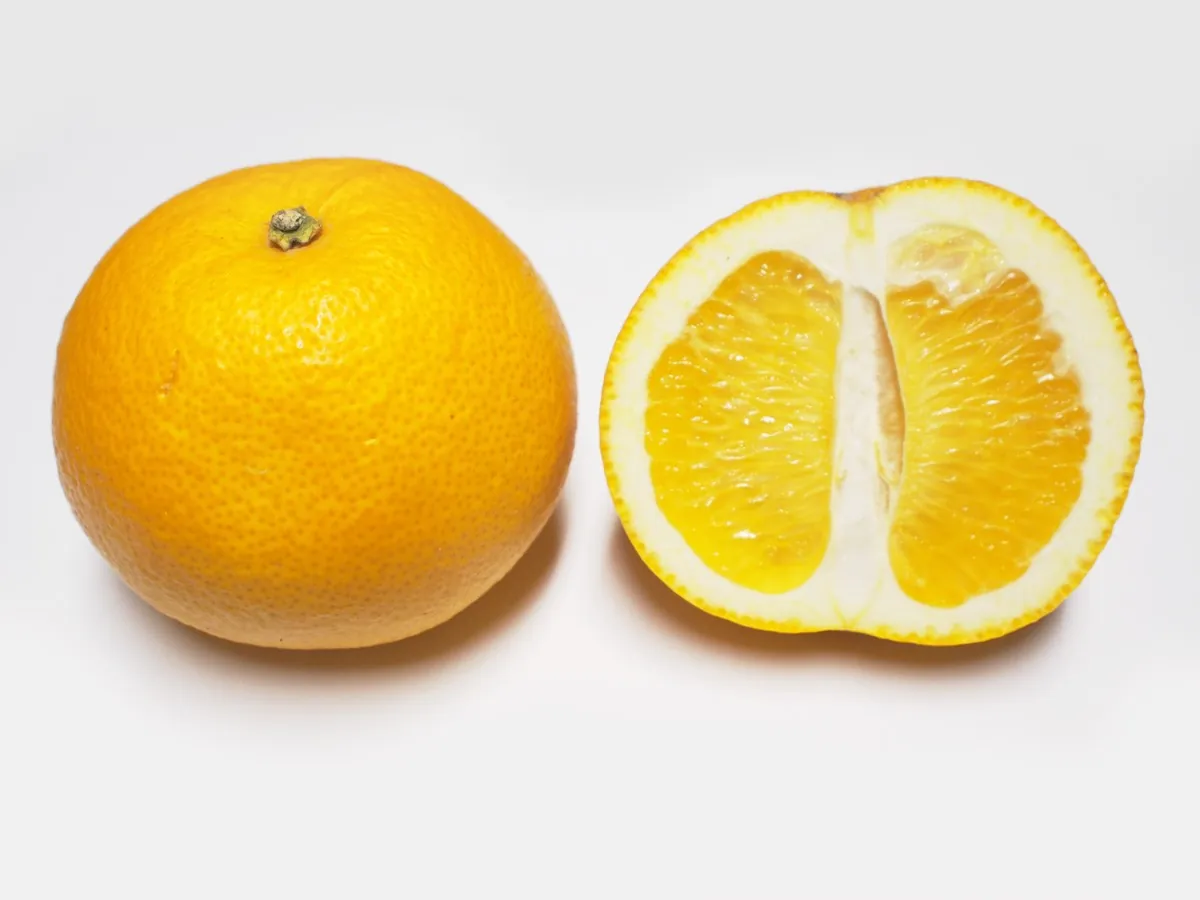
丸ごとの果実と、半分に切って果肉を見せた八朔の断面。
写っているもの: Citrus hassaku部位・状態: 果実全体と横断面(果肉・じょうのう膜を含む)
写真: Froggieboy/ CC BY-SA 3.0/ 原画像/ 台帳の原画像
写真の範囲と来歴
被写体の確認: 原典の記載による同定。ファイル名・説明文ともに Hassaku と明記。 画像を開き、丸ごとの果実と断面の両方で、厚い白皮と黄色い果肉を確認した。
掲載画像: Wikimedia Commons の原本と同寸。切り抜き・色調変更なし。 表示用には幅1200px上限のWebPを配信し、台帳の原画像は上のリンクから確認できます。
On this page (10 sections)
Reading the bitterness
Hassaku is a Japanese citrus introduced as a mid-to-late-season fruit with a popping texture and sweet-and-sour flavor containing slight bitterness. According to the local history 『因島柑橘史』 (in translation: "Innoshima Citrus History") cited by public Hiroshima material, the monk Etoku discovered it in 1860 (Man’en era) on the grounds of Jōdoji Temple in Innoshima, now part of Onomichi, and it was named 「八朔」 (in translation: "Hassaku") in 1886 (Meiji 19), after being eaten around the 1st day of the 8th lunar month. However, this local history itself was not confirmed by the present investigation and is treated only as a secondhand record.
The origin of the name is described as deriving from a priest saying that it could be eaten on the first day of the eighth lunar month, while it is also reported that this differs from the actual season when it becomes ready to eat and that the truth of the origin is uncertain. The discrepancy between the naming tradition and the actual harvest and eating season is itself pointed out by the source and should be recorded.
The juice and peel contain multiple limonoid glycosides, mainly limonin 17-β-D-glucopyranoside. Of the total 314ppm limonoid glycosides in juice, 148ppm (47%) was this limonin 17-β-D-glucopyranoside; it was reported to reach 3100ppm in dried inner peel and 2300ppm in dried outer peel. These are glycosides whose bitterness is weakened by glucose binding and are distinct from limonin (the aglycone), which itself has bitterness. Direct correspondence with sensory bitterness has not been confirmed by this report alone.
In addition to the limonin series, 5 nomilin-series limonoid glycosides — deacetylnomilin acid, deacetylnomilin, nomilin, nomilin acid, and obakunone — were also detected, for a total of 6 types together with the limonin-series glycosides. Direct correspondence with sensory bitterness has not been confirmed for these either.
A Wakayama product-introduction source states that Hassaku’s characteristic bitterness is caused by naringin, a type of polyphenol, and that naringin is abundant in the joumou (inner membrane). However, this is an administrative product-introduction article and provides no measured data.
Sources for this overview
八朔ってどんな柑橘?(広島ならではの商品開発ができる食材「八朔」のご提案)
Checked for this overview: Used as support for the origin tradition of discovery in Innoshima and naming in 1886.
Checked for this overview: Used as support for the description of the gap between the naming origin and the eating season. / Used as support for the prefectural source’s attribution of bitterness to naringin.
Checked for this overview: Used as support for the numerical content and ratio of limonin-series glycosides. / Used as support for detection data for 5 nomilin-series glycosides.
Other names: はっさく (ja)
Follow the connections
Hassaku →contains→ limonin →is associated with→ bitterness
Hassaku →contains→ nomilin
Hassaku →— bitterness is attributed …→ naringin →is associated with→ bitterness
Hypotheses and recipe candidates for this entry are on the Japanese page.
Structured claims — open a section to read each claim's confidence, evidence and limits
Composition and content (8)
Scope: Hassaku fruit (juice, inner peel, outer peel); analysis by TLC and HPLC
Note: Note that these are not the bitter limonin (aglycone) itself, but glycosides whose bitterness has been weakened through glucose conjugation. This connects, as data on debittering through sugar conjugation during ripening, separately from the existing claim (compound-limonin's delayed bitterness).
Show data
ingredient-hassaku —contains→ compound-limoninScope: Hassaku fruit (juice, inner peel, outer peel), analysis by TLC and HPLC methods.
Show data
ingredient-hassaku —contains→ compound-nomilinScope: Wakayama Prefecture product introduction webpage.
Note: The prefectural material states 『八朔に特徴的な苦味は、ナリンギンというポリフェノールの一種の成分によるもの』 (in translation: Hassaku's characteristic bitterness is due to the component naringin, a type of polyphenol) and that naringin is abundant in the joumou (inner membrane). Sections regarding claimed benefits (antioxidant, obesity prevention, hypertension prevention) are excluded as outside NIGAMI LAB's scope. As an administrative product introduction article without presentation of measured data, it is treated as contextual per the drug plant evaluation report protocols.
Show data
ingredient-hassaku —has_bitterness_attributed_to→ compound-naringinScope: The same page.
Show data
ingredient-hassaku —has_historical_origin→ "A citrus native to Japan, described as a mid-to-late-season citrus with a crisp texture and a faint bitterness within its sweet-tartness."Scope: Fruit of hassaku and Kawano natsudaidai harvested and stored at the New Variety Development Center of the Ehime Prefecture fruit and vegetable federation (from October 1981 to June 1982). 10 fruits were divided into peel (flavedo and albedo), segment membrane, core, seeds and flesh and analyzed.
Show data
ingredient-hassaku —contains→ compound-naringinScope: Limonin and nomilin by part (flesh, segment membrane, seeds, peel) of hassaku fruit (Ehime Prefecture), quantified with a dual-wavelength thin-layer chromatography scanner. Harvested on November 16, January 18, March 23 and May 17.
Show data
ingredient-hassaku —contains→ compound-limoninScope: Juice of hassaku, natsumikan and Kawano natsudaidai squeezed with a reamer-type test juicer, quantified by high-performance liquid chromatography. Harvested from December 28 to May 8.
Show data
ingredient-hassaku —contains→ compound-naringinScope: Fruit collected at about 1-month intervals from July 28 to January 17 from 2 hassaku trees aged 12 years at the attached farm of the Faculty of Agriculture, Kagoshima University (10 M-grade fruits, in 2 replicates of 5 fruits each). 40 g of flesh, 10 g of segment membrane and other parts were extracted with methylene chloride and quantified by thin-layer chromatography.
Note: This is the amount of limonoids as bitter substances, not a sensory evaluation. The author states that part of the bitterness of hassaku may depend on limonoids, and that the bitterness of nomilin is stronger than that of limonin (citing earlier studies). The limonoids in the segment membrane of natsumikan follow the same pattern of change as in hassaku, with the content said by the author to be about 2 times higher in hassaku.
Show data
ingredient-hassaku —contains→ compound-limoninSensory (2)
Scope: Product description on the official page of Ito Farm (Wakayama Prefecture), a business-use seller of hassaku juice
Note: The same page also explains a production method in which only the flesh is gently squeezed with a bowl-shaped device, so that components from the outer and inner peel are not included in the juice. The relationship between this peel-excluding method and the source of the described slight bitterness (whether from the flesh itself or from residual peel) is not made explicit on the page.
Show data
ingredient-hassaku —is_presented_as→ ""The juice has a moderate sweetness and acidity, characterized by a distinctive slight bitterness""Scope: A sensory test of hassaku juice from Wakayama Prefecture (10°Bx, reconstituted juice) and of juice in which naringin and limonoids were reduced with a synthetic adsorbent or other means.
Note: The method of the sensory test (number of panelists, procedure, rating scale) is not described in the main text. The statement that "no bitterness was perceived at naringin of 50 mg% or less" is for juice treated with an adsorbent, in which the limonoids were also reduced at the same time. The author states that the limonoid threshold changes with sugar content and acid content.
Show data
ingredient-hassaku —has_sensory_response→ "Hassaku juice had 6.64 ppm of limonin and 10.3 ppm of nomilin, and in the sensory test it tasted especially strongly bitter compared with other citrus juices. The author considered that the strong bitterness of hassaku is due to its high nomilin, from earlier research stating that the bitterness of nomilin is about 2 times that of limonin. For limonoid bitterness, none was perceived up to 2 ppm, it was slightly bitter at 4 ppm, and it became fairly strongly bitter at 6 ppm or more. In juice with reduced naringin, no bitterness was perceived at 50 mg% (mg% = mg per 100 g) or less."How processing and cooking change it (1)
Scope: A test with reconstituted juice, made by diluting to 10°Bx a concentrate that had been made from Wakayama Prefecture hassaku squeezed with an in-line juicer, concentrated to 50°Bx with an APV-type plate concentrator and frozen, and with fresh juice heated at 50 to 90°C for 1 to 3 minutes. Naringin was quantified by the modified Davis method, and limonin and nomilin by high-performance liquid chromatography.
Note: This is a change in the amount of limonoids, not a change in bitterness evaluated by people. The author explains that the tasteless limonin monolactone contained in the juice becomes limonin on heating or acid-and-heat treatment, citing earlier work (Maier et al.), but this point was not confirmed in their own experiment and is to be examined further. Naringin rose from 75.0 mg% (10°Bx equivalent) in juice squeezed from the raw-material fruit to 102.2 mg% in reconstituted juice; the original treats the 40% higher naringin in the juice than in the raw-material fruit as a result similar to earlier reports (Manabe et al., Maotani et al.) that grinding the flesh moves naringin into the juice, not as an effect of heating. This is heating of juice and does not apply to pretreatment by boiling flesh or peel.
Show data
ingredient-hassaku —was_observed_with→ "The limonoids (limonin and nomilin) of hassaku juice increased sharply with heating. The limonoids of reconstituted juice, made by concentrating juice squeezed with an in-line juicer, were 16.64 ppm, about 8 times those of the juice as squeezed from the fruit (2.19 ppm at 10°Bx equivalent), and heating the fresh juice at 70°C and 90°C for 1 minute increased them to 3.7 and 5.7 times those of unheated juice (almost no change at 50°C). Naringin was hardly affected by heating."Culture (2)
Scope: A description from 『因島柑橘史』 (in translation: "Innoshima Citrus History") by Okano Shūzō, cited by public Hiroshima material produced by the JA Hiroshima Fruit Federation.
Show data
ingredient-hassaku —has_discovery_history→ "Its origin is described as the discovery by Etoku in 1860 (Man’en era) at Jōdoji Temple in Innoshima (now Tagumachō, Innoshima, Onomichi, Hiroshima Prefecture), and it was named 「八朔」 (in translation: "Hassaku") in 1886 (Meiji 19) after being eaten around the 1st day of the 8th lunar month (hassaku)."Scope: The origin account on the same page.
Note: A record of a place-linked tradition. Documentary corroboration cannot be confirmed from the same page.
Show data
ingredient-hassaku —has_name_etymology→ "The source records that it was discovered at a temple on Innoshima in Hiroshima City, with the name explained by a monk's remark that it could be eaten around the first day of the eighth month of the lunar calendar (early in the 9th month, i.e. early September); this is at odds with the fruit's actual ripening time, and the source states that the true origin of the name is unclear."