Lampascione (lambascione)
ingredient / ingredient-lampascioni
ランパショーニ / Muscari comosum (L.) Mill.
Lampascione (lambascione) is an edible Muscari bulb growing wild throughout Puglia. It is registered as a Puglian traditional food (PAT) and is fried, pickled (in agro), baked in ashes, and prepared in other ways. In Martina Franca’s 'ncapriata (capriata alla martinese), it is served with fava-bean purée.
Photographs (captions in Japanese)
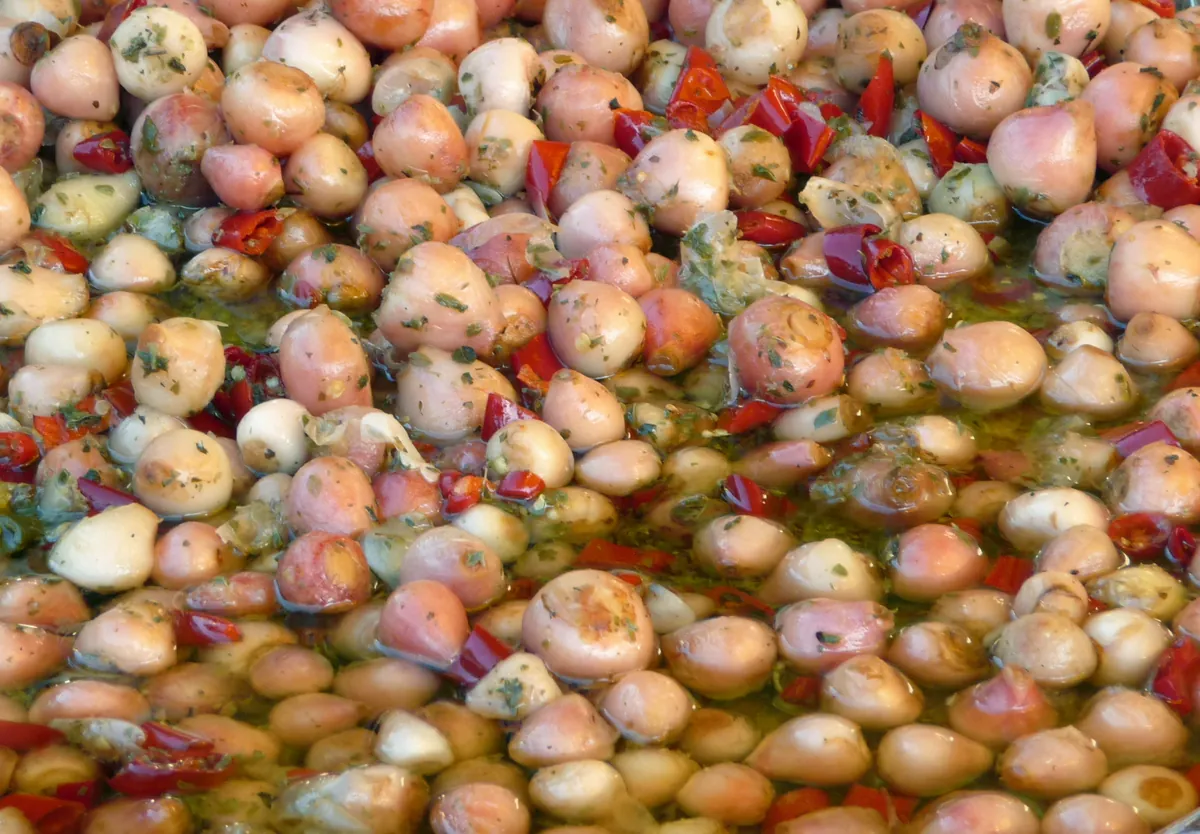
収穫されたランパショーネ(Leopoldia comosa)の生の鱗茎。プーリア州に自生し、揚げ物・酢漬け(in agro)・灰焼きなどに調理される食用ムスカリ属球根。写真は未調理の球根そのものを示す。
写っているもの: Leopoldia comosa(ムスカリ属の食用球根、いわゆる lampascione)部位・状態: 収穫された生の鱗茎
写真: Lucarelli/ CC BY-SA 3.0/ 原画像/ 台帳の原画像
写真の範囲と来歴
被写体の確認: 原典の記載による同定。原典ページの説明は 'lampascioni' とのみ記載。品種・産地はこの写真からは分からない。
掲載画像: Wikimedia Commons の原寸ファイル。苦味研究所では切り抜き・色調変更なし。 表示用には幅1200px上限のWebPを配信し、台帳の原画像は上のリンクから確認できます。
On this page (7 sections)
Reading the bitterness
The Puglian PAT record 『Lampascione (Lambascione) o Cipollaccio』 (in translation: "Lampascione (Lambascione) or Wild Onion") gives the scientific name as Muscàri comosum (L.) Mill. and lists regional names including giacinto col fiocco, cipollaccio col fiocco, and moscaro. It states that the bulbs are dug by hand with a small hoe (zappetta) from December through April and prepared fried (lampascioni fritti), pickled (lampascioni in agro), or baked in ashes (lampascioni sotto la cenere), among other ways.
The same record describes the bulbs as low-energy food and documents a long history of claims about medicinal properties, while also noting that older literature mentioned abdominal bloating. These are accounts recorded in that document; neither a compositional analysis nor a pharmacological test establishes the claimed effects.
In Martina Franca, Taranto Province, 『Capriata alla martinese』 (in translation: "Martina-style capriata"), also called 『'Ncapriata alla martinese』 (in translation: "Martina-style 'ncapriata") or 『Fave e lambascioni』 (in translation: "fava beans and lampascioni"), is made by topping fava-bean purée slowly cooked until soft at low heat with cooked lampascioni bulbs and breadcrumbs fried in oil. It was registered as a Puglian PAT in 2024. Unlike 『Fave bianche e cicorie』 (in translation: "white fava beans and chicory"), this local variation uses lampascioni rather than chicory as its main accompanying vegetable.
An abstract of a 2008 study states that several 3-benzyl-4-chromanones and 1 stilbene derivative were isolated from the notably bitter ether-extracted fraction among bulb fractions extracted using solvents of different polarity. Sensory evaluation of the isolated compounds confirmed their contribution to this food’s characteristic taste. A 2024 review of the same findings identifies 3 of the isolated compounds as muscomin, 8-O-demethyl-7-O-methyl-3,9-dihydropunctatin, and 3,9-dihydroeucomnalin.
The bulbs are sometimes used instead of onions and sometimes eaten raw, but raw consumption is described as uncommon. A 2024 review, citing earlier work by Casoria et al. (1999), states that cooking is needed to neutralize their characteristic bitter taste.
Sources for this overview
Lampascione (Lambascione) o Cipollaccio
Checked for this overview: Confirmed the scientific and regional names, harvest season, and traditional preparations. / Confirmed the scope of the record’s statements on low energy, medicinal traditions, and abdominal bloating.
Checked for this overview: Confirmed the ingredients and preparation of Capriata alla martinese and its 2024 PAT registration.
Taste-Active Compounds in a Traditional Italian Food: 'Lampascioni'
Checked for this overview: Confirmed the strong bitterness of the ether fraction and the sensory assessment of the isolated compounds’ taste contribution.
Checked for this overview: The 3 isolated compounds are named specifically, including muscomin. / Confirmed the description of use as an onion substitute, uncommon raw consumption, and cooking to neutralize bitterness.
Other names: Lampascione (it), Lambascione (it), Cipollaccio col fiocco (it), Muscari comosum (la)
Structured claims — open a section to read each claim's confidence, evidence and limits
Composition and content (1)
Scope: Layer: Food. Preliminary sensory evaluation and structural analysis of Muscari comosum (lampascioni) bulb fractions (Borgonovo et al. 2008, checked in the abstract). A 2024 review by Jaiswal & Lee (full text checked) names 3 compounds from these findings: muscomin, 8-O-demethyl-7-O-methyl-3,9-dihydropunctatin, and 3,9-dihydroeucomnalin.
Note: Only the abstract of the primary paper (Borgonovo et al. 2008) was checked; the full text was inaccessible behind Wiley’s subscription barrier.
Show data
ingredient-lampascioni —contains→ "Among bulb fractions extracted with solvents of different polarity, several 3-benzyl-4-chromanones (including muscomin) and 1 stilbene derivative were isolated from the ether fraction, which showed strong bitterness. Sensory evaluation confirmed that these compounds were responsible for the food’s characteristic taste."How processing and cooking change it (3)
Scope: Martina Franca, Taranto Province. Registered as a Puglian PAT in 2024.
Note: Unlike 『Fave bianche e cicorie』 (in translation: "white fava beans and chicory"), this regional variation uses lampascioni rather than chicory as the main accompanying vegetable.
Show data
ingredient-lampascioni —is_used_in→ "Used in 『Capriata alla martinese』 (in translation: "Martina-style capriata"), also called 『'Ncapriata alla martinese』 (in translation: "Martina-style 'ncapriata") or 『Fave e lambascioni』 (in translation: "fava beans and lampascioni"): cooked lampascioni bulbs are put on fava-bean purée slowly cooked until soft at low heat and topped with breadcrumbs fried in oil."Scope: The Puglian PAT record 『Lampascione (Lambascione) o Cipollaccio』 (in translation: "Lampascione (Lambascione) or Wild Onion").
Note: Statements about low energy, longstanding medicinal traditions, and abdominal bloating in older literature are recorded only as discourse within this source; they do not establish any medicinal effect.
Show data
ingredient-lampascioni —is_prepared_by→ "The scientific name is Muscàri comosum (L.) Mill.; regional names include giacinto col fiocco, cipollaccio col fiocco, and moscaro. Bulbs are dug by hand with a hoe from December through April and prepared fried (lampascioni fritti), pickled (lampascioni in agro), or baked in ashes (lampascioni sotto la cenere)."Scope: Layer: Food. Statement in the 2024 review by Jaiswal & Lee (full text checked, PMC10931824), citing Casoria et al. 1999 (Econ. Bot. 53:113–115; original paper not read).
Note: A secondhand citation in the review; the primary paper by Casoria et al. (1999) has not been checked.
Show data
ingredient-lampascioni —has_perceived_bitterness_affected_by→ "Cooking. Raw bulbs have a characteristic strong bitterness and are sometimes eaten raw, but this is uncommon. A review citing earlier research says cooking is required to neutralize the bitterness."