matcha
ingredient / ingredient-matcha
抹茶
Powdered green tea made by milling tencha into a very fine powder with a tea mill or similar device. Besides serving as the ingredient for koicha and usucha in the tea ceremony, it is also used as a secondary ingredient in foods and beverages.
Photographs (captions in Japanese)
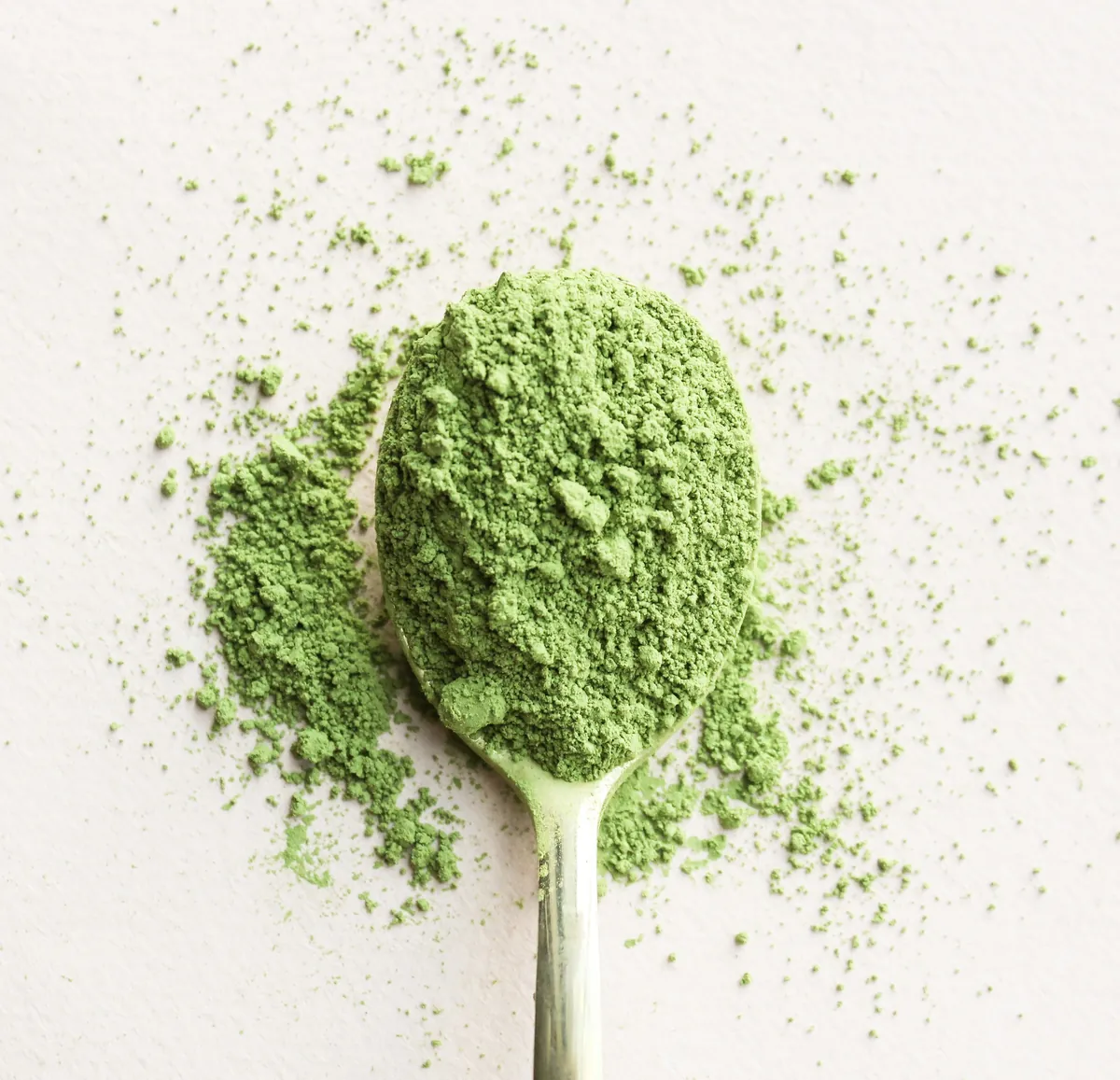
スプーンに山盛りにした、鮮やかな緑色の抹茶粉末。周囲にも粉がこぼれている。
加工後写っているもの: Camellia sinensis(碾茶を微粉末にした抹茶)部位・状態: 微粉末状の粉末茶
写真: Evanhoever/ CC BY-SA 4.0/ 原画像/ 台帳の原画像
写真の範囲と来歴
被写体の確認: 原典の記載による同定。説明文は"A scoop of Matcha"のみ。産地・等級の記載なし。 画像を開き、スプーンに盛られた均一な緑色の微粉末とその飛散の様子を確認した。
掲載画像: Wikimedia Commons の原本を長辺2400pxへ縮小。切り抜き・色調変更なし。 表示用には幅1200px上限のWebPを配信し、台帳の原画像は上のリンクから確認できます。
On this page (8 sections)
Reading the bitterness
The Japan Tea Central Association defines matcha as tencha, tea leaves grown under cover and dried without rolling, milled to a very fine powder with a tea mill or similar device. Explanations by 「裏千家」 (Urasenke) and academic papers also follow this definition. Matcha for processed foods is described as accounting for most production. Research and industrial practice has confirmed that tencha is milled with several types of equipment, including not only traditional stone mills but also ball mills, jet mills, and water-cooled metal mills.
Findings on catechin composition and sensory scores under covered cultivation are separate. A conference abstract cites earlier findings that covering reduces epigallocatechin (EGC), which has relatively weak bitterness and astringency, but produces almost no detectable reduction in epigallocatechin gallate (EGCG), which has stronger bitterness and astringency. In a fiscal 2016 Shizuoka Prefectural Research Institute of Agriculture and Forestry trial with first-flush 「やぶきた」 (Yabukita) tea, stronger and longer covering raised the combined dry-weight content of the 7 principal free amino acids in tencha from 0.844% without covering to a maximum of 2.364%. The sensory score for matcha, a composite of color and luster, foaming, foam color, and taste out of 100 points, rose from 54 without covering to a maximum of 76. This was a composite sensory score, however, not a separate measure of bitterness alone.
The question of why matcha tastes less bitter and astringent than its leaf constituent content would suggest has also been investigated. In a matcha infusion prepared in line with the method used for sensory assessment, extraction rates for theanine, caffeine, and EGC were at least 80%, whereas that for EGCG remained at or below 50%; EGCG concentration in the infusion was reported to be lower than in sensory-assessment infusions of sencha and other teas. The authors propose that vigorous whisking when preparing matcha rapidly lowers the water temperature, impeding dissolution of the highly temperature-dependent EGCG into the water. This is an interpretation based on measured data, however, not an experiment that directly measured the water temperature itself.
A hypothesis that the foam produced during whisking adsorbs EGCG and other bitter-astringent constituents and thus reduces the infusion’s bitter-astringent taste has also been tested. The same authors found no significant difference when they compared tea constituent concentrations before and after foaming, so the foam-adsorption hypothesis was not supported. Foam appears to play a small role in why matcha tastes less bitter than its leaf content would predict.
Sources for this overview
Checked for this overview: Used as evidence for the definition of matcha as milled tencha.
粒度と食感からみた抹茶のおいしさ (The Mouthfeel of Matcha from the Viewpoint of Particle Size and a Texture)
Checked for this overview: Used as the citation basis for the industry association’s official definition. / Used as evidence of milling with multiple kinds of equipment.
Checked for this overview: Used as evidence of milling with a water-cooled metal mill. / Used as evidence for the amino acid and sensory-score data under different covering conditions.
抹茶の点て方に関する化学的考察 (Chemical research on the preparation of matcha)
Checked for this overview: Used as evidence for the different responses of EGC and EGCG to covering. / Used as evidence for the measured low extraction rate of EGCG. / Used as evidence for the proposed decline in water temperature from whisking. / Used as evidence for the negative result on the foam-adsorption hypothesis.
Hypotheses and recipe candidates for this entry are on the Japanese page.
Structured claims — open a section to read each claim's confidence, evidence and limits
Composition and content (2)
Scope: Matcha made from tencha (shading cultivation)
Note: This is background text in the "Purpose" paragraph of a NARO (National Agriculture and Food Research Organization) conference abstract, stated as a summary of prior knowledge rather than new measurement data from the abstract itself (citation numbers are not given in the abstract). Figures such as the rate of change in EGC and EGCG content are not given in this abstract.
Show data
ingredient-matcha —has_composition→ "The source states that the catechin whose content falls with shading cultivation is epigallocatechin (EGC), which has weak bitter-astringency, while epigallocatechin gallate (EGCG), which has strong bitter-astringency, shows almost no drop in content."Scope: Matcha (prepared according to the method used for sensory panels)
Note: A measured value obtained by directly analyzing the centrifuged supernatant with capillary electrophoresis and high-performance liquid chromatography.
Show data
ingredient-matcha —has_composition→ "In matcha infusion prepared according to the whisking method used for sensory panels, the extraction rate into the infusion was 80% or higher for theanine, caffeine, and EGC, whereas it was 50% or lower for EGCG, and the EGCG concentration in the infusion was lower than in sencha and other sensory-panel infusions."Mechanism and receptors (2)
Scope: Matcha (whisked according to the method used for sensory panels)
Note: The authors' own interpretation; the abstract does not present an experiment that directly measured the water temperature itself, nor a causal experiment involving sensory evaluation of the bitter-astringent taste. An interpretation derived from measured extraction-rate data (in which only EGCG is low).
Show data
ingredient-matcha —has_perceived_bitterness_suppressed_by→ "The sharp drop in water temperature brought on by vigorously whisking the tea whisk when preparing matcha. Because this hinders the dissolution into the water of the strongly temperature-dependent EGCG, the authors reason that the whisked matcha infusion does not show as much bitter-astringent taste as would be expected from the content of the tea leaf components."Scope: Matcha prepared by a method corresponding to that used for sensory assessment.
Note: The authors tested and rejected the hypothesis 『泡がEGCG等の苦渋味成分を吸着するため抹茶は苦渋くない』 (in translation: "Matcha is not bitter and astringent because foam adsorbs EGCG and other bitter-astringent constituents"); this negative finding is based on direct measurement.
Show data
ingredient-matcha —has_perceived_bitterness_unchanged_by→ "Foam formed when matcha is whisked: comparing tea constituent concentrations before and after foaming found no significant difference. The hypothesis that foam adsorbs EGCG and other bitter-astringent constituents and lowers the infusion’s bitter-astringent taste was therefore not supported."How processing and cooking change it (5)
Note: Confirmed from both the Japan Tea Central Association's definition (tencha ground finely with a tea mill or similar device) and the Urasenke site's explanation of the process.
Show data
ingredient-matcha —is_prepared_from→ ingredient-tenchaNote: Matcha results from finely milling finished tencha with a stone mill or similar device. In research and food processing, however, metal mills, ball mills, and jet mills are also used.
Show data
ingredient-matcha —is_processed_by→ process-matcha-millingScope: Tea Research Center, Shizuoka Prefectural Research Institute of Agriculture and Forestry; first-flush 「やぶきた」 (Yabukita) tea; fiscal 2016 trial.
Note: This primary source links both constituent (free amino acid) and sensory-score data within the same trial design. The sensory score, however, combines categories including 『滋味』 (in translation: "taste") and is not a separate measure of bitterness alone.
Show data
ingredient-matcha —has_composition→ "The Shizuoka Prefectural Research Institute of Agriculture and Forestry trial compared 4 conditions using first-flush 「やぶきた」 (Yabukita) tea, with direct-cover shading beginning at the 2-leaf stage and lasting 20 days: uncovered; 85% shade for 20 days; 85% for 15 days followed by 98% for 5 days; and 85% for 10 days followed by 98% for 10 days. The combined dry-weight content of the 7 major free amino acids in tencha rose with stronger and longer shade from 0.844% uncovered to 1.784%, 2.096%, and 2.364% under those respective covered conditions. Matcha milled with a water-cooled metal mill was also scored for color and luster, foaming, foam color, and taste, each out of 20 points with a total out of 100: scores increased with stronger and longer shade from 54 uncovered to 70, 72, and 76 under 85% (20 days), 85% (15 days) then 98% (5 days), and 85% (10 days) then 98% (10 days), respectively."Scope: Matcha made by milling tencha of a level used for tea-ceremony practice with different devices. For sensory evaluation, 2 g of matcha was mixed with 80 mL of hot water using an electric whisk; 3–5 people evaluated the samples multiple times.
Note: The paper’s main point is that texture depends not only on median diameter but also on the shape of the particle-size distribution, including the ratio of bimodal peaks and the 90% maximum diameter. It also cites earlier general findings from chocolate and other research that the boundary for perceiving graininess is a median diameter of 20–30 μm.
Show data
ingredient-matcha —has_composition→ "Tencha of the same grade was milled with a tea mill, ball mill, or jet mill; volume-based median particle diameter was measured by laser diffraction. Median size and sensory texture were paired as follows: tea-mill matcha, 18 μm (substantial yet smooth); ball-mill matcha, 18 μm (slightly grainy but smooth); coarse matcha obtained by air classification of ball-mill matcha, 19 μm (grainy); similarly classified fine matcha, 5 μm (light and smooth but watery); and jet-mill matcha, 3 μm (watery). Although the tea-mill and ball-mill samples had almost the same median diameter, their particle-size distributions, including the ratio of the bimodal peaks, differed, as did the textures in sensory evaluation."Scope: The official general-audience explanation by 「裏千家」 (Urasenke), a school of the tea ceremony.
Note: This is a school’s explanation, not a measurement or standard. Its units differ from those in the 「上田宗箇流」 (Ueda Sōko school) explanation (3 heaped scoops) and a 「表千家」 (Omotesenke) instructor’s website (approximately 2 times as much for usucha), so the figures cannot be compared directly.
Show data
ingredient-matcha —has_reported_preparation_style_of→ "According to the official 「裏千家」 (Urasenke) explanation, koicha uses approximately one momme (about 3.75 g) of matcha per person, kneaded with a tea whisk and an appropriate amount of water at an appropriate temperature. For usucha, approximately five bu (about 1.8 g) of matcha and water are placed in a tea bowl and whisked so that no large bubbles remain."